
Tony Rogers on the set of How to Talk Australians.
Australians have always had a unique way of speaking.
From our slang and laid-back attitude to the unspoken rules that make up everyday life, it can be a difficult culture to understand from the outside looking in.
That’s the idea at the heart of How to Talk Australians, the new feature comedy from filmmaker Tony Rogers, which expands upon the wildly successful web series that became a viral sensation and attracted audiences around the world.
The film follows a group of students and teachers from the Delhi College of Linguistics who travel to Australia hoping to experience the country’s authentic language and culture.
However, when storms derail their plans and their tour leader is detained by customs, the group find themselves stranded in regional Australia. Instead of visiting Sydney, Melbourne or Brisbane, they are forced to navigate the “real” Australia, uncovering a world that few tourists ever get to see.
For Rogers, the feature marks the latest chapter in a career built on finding comedy in everyday situations. Best known as the co-creator and director of the beloved Wilfred short film and television series, Rogers has long championed a style of comedic realism grounded in authentic performances and relatable characters.
While Wilfred went on to become an international success and even inspired a popular American remake, Rogers has continued to pursue fresh ideas and stories.
In this interview, Rogers discusses bringing How to Talk Australians to the big screen, the challenges of adapting a web series into a feature film, working with a large ensemble cast, and why he believes the best comedy often comes from keeping things real.

Tony Rogers on the set of How to Talk Australians.
“You’ve just got to write what you think is funny, and it’s on you to recognise when you’ve gone too far. There are a couple of jokes in this film that we thought were a little too much, and they didn’t make the final cut. You know when you’ve gone too far.”
Interview by Matthew Eeles
You’ve worked across both film and television throughout your career. I know this is a broad question, but how do you find working in this landscape at the moment compared to when you first started? Have you witnessed much of a shift in how things work?
It does feel like it’s become a little more conservative, but I don’t know. It’s hard to say. Tastes have shifted, and I think we’re still in a period of flux because of all the new streamers. It’s a new environment, and people are trying to learn how to deal with it. I’m just interested in fresh, new things, and it’s always hard to get them up. When I did Wilfred, we were lucky. We went to SBS with a pilot, and there were some great people there, and I’m sure there still are. But since Wilfred, it’s been a battle to get something else up. It’s just the screen culture here, and the fact that I probably haven’t pushed myself in a way. Although I reckon I do have some great shows, and I think they should be made because once you’ve made a few things, you learn new processes. I’ve made quite a few ads too that have been successful, so I know how to talk to Australian audiences. I think there are a lot of people working in the industry who don’t necessarily know how to talk to their audience as well.
You mentioned Wilfred, which was a massive hit. How frequently does Wilfred come up for you, both publicly and privately, and how do you reflect on that series now?
It was such a great experience. I feel good about it. It was fun to do. That series began as a short film, which started it all. It went to Tropfest and Sundance, luckily, so that confirmed to us that people liked it. There’s a bunch of other things that we’d like to do, but you’ve just got to get money for them, and it’s hard to get. I mean, we struggled to get money for How to Talk Australians, but we had a bunch of private investors come on board, which got it made.
Do you think Wilfred would work as well as a series if it was released today?
In the early days, I had envisioned Wilfred as being more like The Brady Bunch. It could work today as a family getting a new dog. But the initial idea was about a boyfriend who visits his new girlfriend and she’s got a dog who doesn’t like him, and that was really cool. There are lots of ways we could make Wilfred different today. There’s a lot of room for comedy at the moment.
What did you make of the American interpretation of Wilfred?
It was pretty successful. I mean, the great thing about the Australian Wilfred is that it also ran on American television. That’s how we got an agent. They suggested that maybe we could sell it as a format, which we ended up doing. They sold it to FX. We even got an email from Sacha Baron Cohen’s agent, who told us that he loved the show because he saw the Australian version in New York.

How to Talk Australians.
How to Talk Australians started life as a wildly successful web series. Take us back to the early origins of that series and how it all came about.
Well, my good friend Rob Hibbert, who’s a writer, actually went into a new pie shop in South Melbourne called The Australian Pie Company. The only person behind the counter was a genuine Indian Sikh. We always saw that incident as inspiring the format of the series in a way. Rob came up with the idea, and we talked about it and worked out how to produce it. We released it online, and that’s been incredibly successful for us so far. Then the ABC approached us, and we were going to work with them. We spent about a year writing, but it didn’t quite work out. We also wrote an American version called How to Talk Americans, and we took it to America under the advice of an agent who said we should try and sell it. But I think when they read the script, they thought it was a bit crazy. Sometimes you’ve got to interpret the script in relation to how it’s going to be viewed by an unfamiliar audience, and that’s sometimes hard to do. Eventually, we decided to make it into a film, and here we are today.
The web series format has always been an interesting one for me. It seems to come in and out of fashion. How have you found working in the web series space?
We made a couple of web series early on. I did How to Talk Australians, and I did group the series together, which we thought we were going to get up on the ABC, but it’s tricky because they’re oddball comedies. A web series is a format people have probably become more comfortable with. They’re quite popular in Europe.
What made this the right time to turn the series into a feature film?
We started writing a classic 30 x 8-minute comedy series, which we didn’t manage to get on air. So we used that material to write a feature film. We wrote that over a year or two, and eventually we had enough money to make it. It’s not perfect, but I think it’s funny. I think it is genuinely funny.
How has the Indian community responded to How to Talk Australians?
Oh, they’re great about it. They’re all close friends of ours now. They’re gorgeous people. Most of the people involved in How to Talk Australians are not actors. They’re first-time actors, but they’re great. There are a couple of actors who love the craft. Some of them are living in Delhi. I’ve visited them a couple of times. But most of the people in it are first-time actors.
How careful were you not to rehash jokes from the series, and how difficult was it to freshen this feature film version up?
That’s one of the harder parts. It takes a while to come up with fresh material. I went through it with Wilfred too because a lot of people told us we wouldn’t be able to make it into a long-form piece without rehashing what had already been done. But I think you can make anything into a long-form piece if you work hard enough and the idea is good enough. Rob and I sat down and spent about a month together coming up with funny ideas. Sometimes it’s hard to come up with ideas that completely fit the structure of your film.
Tell me about your professional relationship with Rob, because you two seem to have a lot of fun working together.
I was working at an advertising agency when I first met him, and that’s where I realised I preferred directing. While I was working at that agency, I made the Wilfred short film. I personally think Rob is probably one of the best comedy writers in the country, and I’m not bad. [Laughs]. I rely on Rob a lot.
We live in a time where comedy is scrutinised from all angles, and it’s not as easy to get away with certain jokes anymore. Does that concern you as a writer?
It doesn’t worry me at all. You’ve just got to write what you think is funny, and it’s on you to recognise when you’ve gone too far. There are a couple of jokes in this film that we thought were a little too much, and they didn’t make the final cut. You know when you’ve gone too far. I think we’re good and reasonable people. We don’t have issues with anyone or anything. We just have to be honest with ourselves and our jokes. The film obviously deals with the clash of several groups of people. It’s an interesting thing to see white Anglo-Australian culture through the eyes of another group of people from another country. In this case, India.
What are some of your favourite comedies?
Oh man, I always go back to The Young Ones and Life of Brian from the early days, but there’s a whole bunch of stuff. I think Sacha Baron Cohen’s Borat is great. Sacha has made some great stuff.

How to Talk Australians.
As a director, is there a specific comedic tone that you set out to emulate or aspire to?
I think it’s natural for me to try and make things as real as possible. It’s important to me that comedy comes from realism. Throughout my work, I’ve quite often told people to pull it back, pull it back again, and pull it back further. I can’t allow people trying to act to interfere with realism. You’ve got to make it real. The more real it is, the funnier it is. That’s why I believe something like Funniest Home Videos worked so well, because most of it was real.
How keen were your cast members from the web series to return for this feature film version?
Everybody was great. Pretty much everybody in this film I had worked with before. I’ve known a lot of the Indian cast for around 10 or 15 years. I’ve also known the Anglo cast for quite a while. That’s why so many people were happy to jump on board. Apparently, I gave Shane Jacobson his first gig, so we have a history. I’ve also been friends with Dave Lawson and Richard Davies for years. They also made the Bruce web series with me. This film has such a big cast. Madeleine Dyer is also in it, who’s now directing.
I’m such a big fan of Madeleine’s work. I noticed that you were also an executive producer on her debut feature film, A Savage Christmas.
That’s right, yes. We actually decided to put some money into it. I’ve known Madeleine for years, and I think she’s a great person. She’s a genuine, clever person, and she’s genuinely funny too. When you work with her as a co-writer, she’s great because she’s got a great temperament and she’s a gorgeous person.
You mentioned Shane Jacobson’s first gig. Do you remember what that was? How far back was that?
It was an advert. It was for a brand of food that you put in a microwave. He was playing a truckie. It was outside a petrol station in the middle of nowhere. He gets out of his truck and he’s talking about these vegetables that you can put in the microwave, and it’s just like having a meal at home. He sits down with this family who don’t know him and eats with them. It’s pretty funny. But I realised then what a great guy he is, and he still is to this day.
Another actor you work with here is the great Eddie Baroo, who is a personal friend of mine. Eddie always has such a great screen presence, and he gives it his all every time. What is Eddie like to work with?
I must admit, Eddie did ring me about the fact that he was a friend of yours and that you were going to interview me. [Laughs]. I’ll tell you what, I met Eddie around 20 years ago. I remember meeting him at the beginning of his acting career. We did this wacky ad together for Reflex paper. He ended up in a shower with an African-American guy and a photocopier. That’s probably the first thing I did with him. Then we made Bruce together, and now How to Talk Australians, and I reckon he might be in the next thing I do too. He’s a great guy. I love him.
How quick were the actors to land their jokes?
From my own experience, I find that you have to find the right actor for the right joke. You can’t just choose any actor and think they’re going to land it. I find people who can actually play it the way I want without a lot of trouble. I’m not even a big rehearsal fan. I find the right person who I just know is going to do it well.
What were some of the more technical challenges of making How to Talk Australians that aren’t in your wheelhouse?
I try to make films that are not too hard for me. I’m not a big special-effects person. It’s just not me. I work with casts, which isn’t that tricky. I guess the biggest challenge is not having a hell of a lot of money, but in some ways that can be a good thing too. We were going to go up to Gympie and Dubbo and so forth, but we couldn’t get there because of money. The comedy was more important than the look of the film in a way, although we did shoot with a really good cinematographer, Joey Knox, who made the film look really good. I think just trying to get How to Talk Australians made was the trickiest bit. I could also say that stretching comedy into a feature film is a tricky business. Trying to keep people interested for an hour and a half is not an easy thing to do.

How to Talk Australians.
You mentioned that you aren’t a special-effects guy, but there are some special effects in this film, including the plane and the spider. Are you happy with how they turned out?
John Francis created the plane and made the spider. He has worked on a lot of Australian films over the years, including Ride Like a Girl. The spider was really cool. It just enhances the feel of that moment, as well as the comedy.
Are you a fan of special effects in film in general?
I’m not a fan if the film doesn’t necessarily need them, but I think sometimes they’re really handy. There’s potential that we might make a werewolf film later down the track, so that’s going to be interesting.
Tell me more about that.
Well, I’ve been working with people from Sydney, and in particular Muriel Spirams, who is a great actor, writer and director, along with writer Anthony Vercoe and producer Karen Radzyner. It’s a bunch of people from Sydney who’ve got this film that we’ve been working on for years. It’s a supernatural piece with a comic edge, but it’s about werewolves that have crossed with dingoes. So they’re kind of unusual werewolves. They do a few things you don’t expect, but yeah, it’s a werewolf genre film.
That sounds very interesting.
It starts off as a common murder mystery, but with a twist. I think it’s pretty cool. So that may happen.
You sound like the kind of guy who’s got a lot of ideas bubbling away in his brain.
Heaps. Heaps of ideas. We might even get to make How to Talk Indians, which is the reverse of this film. It’s about a whole bunch of young Aussies at a college who go to India. Rob and I have talked about it. It’s a bit different, but there’s heaps of funny stuff. I could see Eddie Barroo in that one too. [Laughs].
This film lands in cinemas this week. Are you hoping your web series audience will be open to heading to the cinema to support this film?
I don’t know. We’ve had three or four preview screenings, including one at the Melbourne International Comedy Festival, where we had about 530 people in the cinema. It was really good. We’ve had some great screenings. We had a great screening up on the Gold Coast at the Gold Coast Film Festival. So I don’t know. It seems to me that people really like it.
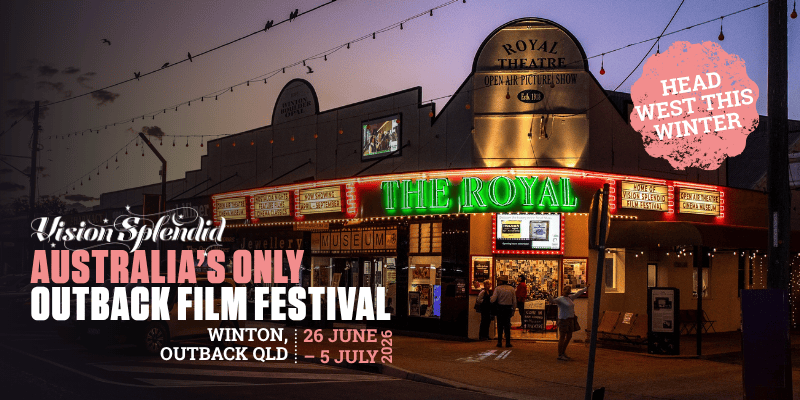
How to Talk Australians is in cinemas from June 10. You can also catch it at the Vision Splendid Outback Film Festival on Thursday, 2 July. Details here.
ADVERTISEMENT Click for details

ADVERTISEMENT Click for details


