-
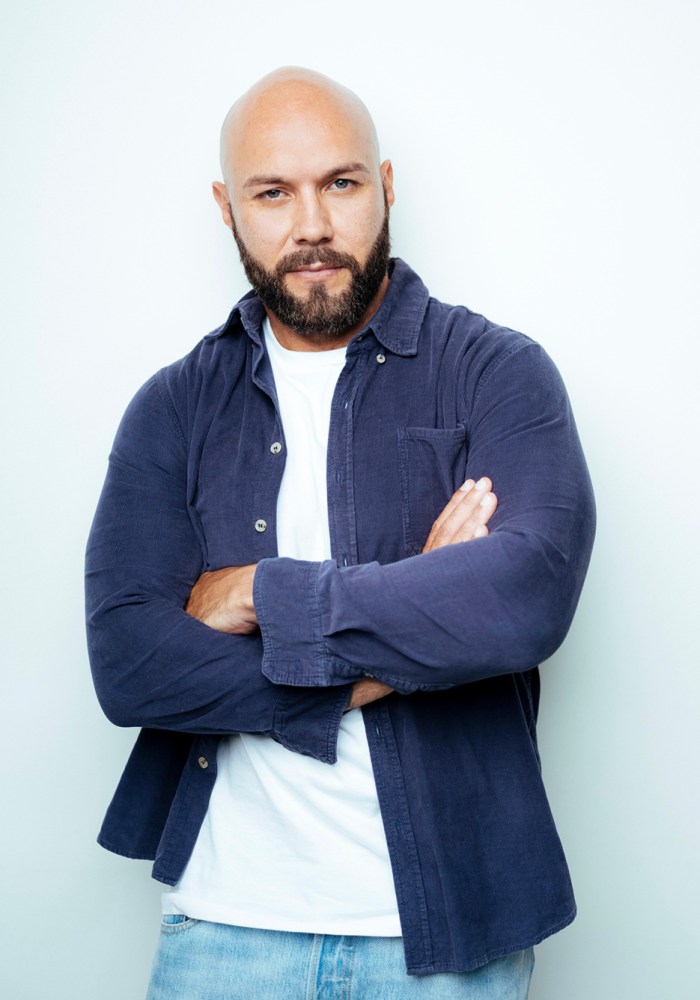
David Cook. Photo by Tyler Alberti.


David Cook, a proud Butchulla man from Queensland, is a filmmaker who wears his heart on his sleeve.
Best known for his acting work in horror film House of Inequity, and the sci-fi comedy Strangeville, Cook has now embarked on a new creative journey as the writer, director, and co-producer of his debut feature film, the poignant coming-of-age drama, Heart of the Man.
The film follows aspiring boxer Chris Wundurra (Parker Little) who lives in the shadow of his father, Sammy Wundurra (played by Cook), a towering one-time champ in the ring known by his moniker of Wonder-Man. Haunted by a family tragedy, Sammy pushes Chris to take a tilt at a national boxing championship, and while the young man is desperate to impress his fearsome father, he is destined to walk another road…one which doesn’t involve pain and violence.
In this interview, Cook tells Cinema Australia why Heart of the Man was such a personal journey for him, and shares with us the aspects of the film that reflect his own life.
Heart of the Man will screen at the Gold Coast Film Festival from Friday, 19 April 2024. Details here.

David Cook as Sammy Wundurra in Heart of the Man.
“Sammy is like an old friend who comes around from time-to-time. Sammy has gone now, but I think I needed to do that role to heal as a man. It was part of my journey.”
Interview by Matthew EelesWhere does your passion for storytelling come from?
When I was young, I was always fascinated with poetry. Then I got into music and the arts. As an adult, I knew a lot of people in the arts, so they encouraged me to try acting. I tried it and fell in love with it. And then I thought, ‘You know what? I’ve got stories inside. I think I need to learn how to write.’ So, a year after I started acting, I began to pursue writing via YouTube, learning how to form plays and develop that need to tell stories. It was something that was out of my control, and I was thinking about it so much that I just had to start writing. So I think there’s something within me that needs to tell stories, and I just realised that I needed to pursue this. And thankfully, I now have the first feature film done.
Does storytelling run in your family?
I’m the first one to do storytelling. So no one’s done any of the creative arts work before, but I feel like being First Nations, I think there’s something there within me that’s meant to tell stories. So maybe my ancestors were telling stories and it’s jumped to me, I think.
You’ve now worked in the screen industry as an actor, director, writer, and co-producer throughout your career. Of all those roles, which one brings you the most joy?
That’s a good question. The funny thing is that directing feels really great because as an actor, when you give a great performance, it’s nice, it’s a good feeling. But when you can give someone a note and say, ‘Hey, have a think about this,’ and they go away for thirty seconds and you plant a thought in their head, and they come back with a completely new performance, it makes you feel like you’ve hit a home run. I’m like, ‘Wow, I can really connect with people.’ I think talent comes down to connection. So you can connect to a film as an audience member, as an actor, you can connect with the script, but as a director, you are connecting with your talent, you’re connecting with your crew.
Of all the movies and TV shows you’ve worked on as an actor, which one has taught you the most about directing?
I think that would be Strangeville with Stephen Osborne as director. I’m friends with Stephen as well. That was the first movie as an actor where I asked him if I could help in pre-production. So then I was there with him during pre-production, going wardrobe shopping, and we were building props, and he taught me about the process of filmmaking. Two or three months prior to filming, I learned more about filmmaking than I had previously. So that experience gave me the courage to one day make a feature. I owe a lot to Stephen.
Had you had any formal training in directing or filmmaking at that stage?
No, this was the first jump that I made. Some friends and I were just producing short content as you do, and we were just making sure to make content first and foremost because we love it. We were trying to sharpen our blade. We were trying to get better and learn about editing and colour grading and production design. I’d never had any formal directing training. I was just asking everyone a lot of questions on set and working with some great directors who were willing to share their knowledge.
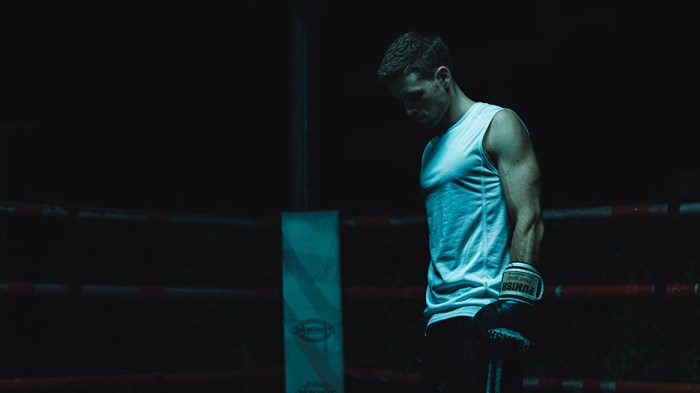
Parker Little as Chris Wundurra in Heart of the Man.
People either love boxing or they loathe it. Does boxing mean anything to you personally, or did you only see it as a great theme for Heart of the Man?
A lot of aspects of my own life story bleed through the Heart of the Man script. I boxed for a number of years. I never boxed professionally, but I was a representative of Australia in athletics, so I did a lot of sports growing up. And I think when you grow up on films like Rocky, there’s always the story of overcoming adversity. That’s always a theme with my writing. So I think the boxing was just a natural choice. There’s so much male-driven boxing films, whether this is a tender coming-of-age boxing story, so the actual film is a little different than what people see in the trailer.
You just spoke about certain aspects of your life bleeding into the script. Are you happy to talk about some of those aspects other than boxing?
Absolutely. So I guess most of the characters derived from different eras in my life as a young man. There were a lot of positive, amazing things that happened to me, and also some traumatic experiences which affected my identity, affected my cultural identity, and where I stood in my community. My sexual identity was questioned during a period of my life. So there are parts of Chris in me, and then with the character I play, Sammy, a washed-up athlete who suffers from alcoholism, those are things that were rampant in my community. Then there’s Marcus, a mentor figure, and you’ve got grandma in there as well. There are some themes in her like stubbornness and being the matriarch figure that were all parts of my life. So when I wrote this story, I’m not ashamed to say it, there were moments I had to put the laptop down because I was almost trying to heal parts of myself or have conversations that I should have had with people that I didn’t have the courage to when I was young.
You obviously knew your character, Sammy Wundurra, well going into this film. Was it easy to find this character within yourself once you called action, or did it take some digging?
Sammy has a lot of anger inside. And again, I’m not ashamed to say it; I was very angry in my twenties and I blamed a lot of people for that anger. But as I got older, I let go of that anger and I forgave, and I rebuilt. So calling upon Sammy was a little difficult at first, but when I accessed it, it was harder to let him go again. We finished filming, and then I was like, ‘Thank God, I can let him go.’ And then we had pickups, and I went, ‘Oh my God, I’ve got to bring him back.’ So he is kind of like an old friend that comes around from time-to-time. Sammy has gone now, but again, I think I needed to do that role to heal as a man. It was part of my journey.
How much of making Heart of the Man was a healing process for you?
One hundred percent of it. It’s been over two years since we shot it. And even just as a film major and a storyteller, I’m very proud of the film, but I just can’t wait to show people my skill set now. I grew a lot, healed a lot, and not just from the process of filming, but I learned a lot as well about how I could have done things differently, or different choices I could have made. I’m very proud of this film, and I’m excited for people to see it.
From a technical perspective, was it a challenge for you to direct and act at the same time?
It definitely was. I didn’t go in wanting to wear all these hats. It’s just the nature of independent projects. There were days where I was trying to put out fires, and it was my job not to let my fellow actors, who I’m acting with on that day, know that I’m dealing with something from a production standpoint. But thankfully when you cast great talent, they pulled me in. So there were days I was telling them that I was there when really I wasn’t. And they very quickly look you in your eyes and they pull you in, and they can tell you’re not there. So they connect, and once they connect, they pull you in. So I think the challenge was there, but thankfully experienced talent, including Parker Little who’s so young yet so experienced, they really pulled me into gear and made sure I was present for my scenes.
Tell us about your creative partnership with Vito Leo. You’ve acted in a few films together now.
I met Vito at the New York Film Academy where I was acting, and he was working as an editor. We were the same age, so instantly we hit it off. We’re both 1984 babies, and I walked into his editing room, and he had Jurassic Park figurines, and I went, ‘We’re going to be friends.’ We formed a friendship right then and we began shooting things on weekends. So he had a lot of experience in filmmaking, and like Stephen Osborne and Josh Hale, he passed that knowledge onto me. I was a sponge. Vito and I, we’ve got so much stuff that we’ve made. We were sitting in his little pool house, and we’d just write ideas and film it. He’d say, ‘Do you want to go shoot something in the shed?’ And of course, I’d say yes. Vito is in almost everything I’ve done, but we’ve said we’ve got to make a film or two without each other for a while, and work together at a later stage.
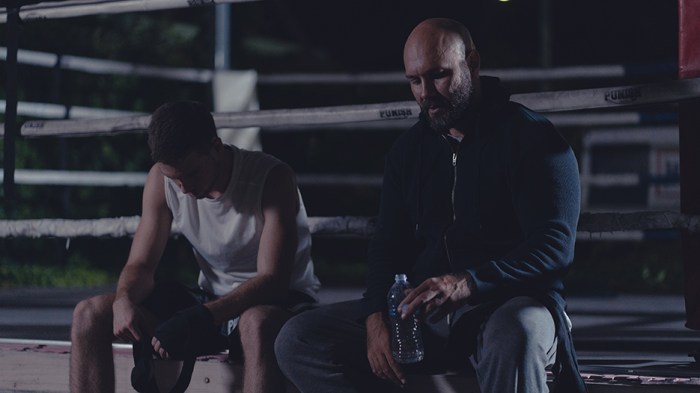
Parker Little and David Cook in Heart of the Man.
Speaking of actors, Parker Little is great as this film’s lead. His character really does go on a rollercoaster of emotions throughout the film. Tell us about working with Parker to get the most out of him as an actor.
Parker is one of those actors where even though he’s young, he teaches you a lot about acting. I think he said he started acting when he was twelve or thirteen. He trained under Tom McSweeney, one of Queensland’s premier acting coaches and casting directors. So he’s got that hands-on knowledge. I worked with him on an indie feature called House of Inequity, and I knew then that I wanted to work with him. He was sixteen at the time. I wasn’t even making films back then, but I knew that I had to work with him one day. So we remained friends, and then years later I said, ‘Hey Parker, I’ve got a bit of a script here. Can I send you something I’d love to attach you to?’ And he read it, and thankfully he said yes. And again, on set there were days where he’d say, ‘You’re thinking about something else.’ And he was right. Through that experience he just drew me in, and I’m captivated every time I watch him. I could watch him for hours. I always tell him that I’m one of his biggest fans, and he knows it.
Roxanne McDonald is also captivating; she really anchors Heart of the Man. Did Roxanne’s maternal instincts transcend her character and onto the set?
Yes. In the community, everyone calls her auntie, and she’s one of our elders. I worked with her in an acting capacity, and she reminded me of my mother. So I found it hard to look at her at first trying to act with this woman who looks like my mother. And then when I started to write scenes in Heart of the Man between Sammy and his mother, I knew that Auntie Roxie was the right person to play that role. An aboriginal female actor of that age in Brisbane is hard to come by. There’s no one else that looks like her and is an actress. She was just incredible. Everyone has the most respect for her, and I just love her to bits.
You co-produced Heart of the Man with Blake Northfield who’s one of Australia’s busiest producers. What did you learn from working with someone like Blake who has so much experience?
Remember how I mentioned that I learned a lot in pre-production on another film? Well, I learned so much about post-production from Blake. The filmmaking process is always something that feels organic and creative, and then you get to the other end of it and you learn so much more about your writing when you’re editing. Blake was really big on recreating the edit, adding offscreen dialogue through ADR to strengthen narratives. He taught me not to be scared to change things around in the edit. He taught me to think about distribution paths, to think about runtime, all the business side of things that I now know is really crucial. We indie filmmakers, we love making movies, but we need to learn more about the business side of it, the business structure, the pathway, and outcomes for a film. So I think that the main takeaway for me working with Blake was to have a clear vision past the filmmaking process. Think about two years ahead, and that’s why I’m here now desperately wanting to go make another film. My writing is better, my directing is better. I’m a better editor even though I wasn’t the editor. I think that working with Blake was just invaluable for me. I owe so much to Bronte Pictures, and The Post Lounge, as well for supporting the project. I’m so keen to get it out there for more people to see.
What lessons did you learn while making Heart of the Man that you will take into your next film?
To be kind to myself. I had a script and I had the expectations of the script, but any production, whether you’ve got ten thousand dollars or ten million dollars, there will be unexpected things thrown at you. You have to constantly reimagine your vision, but don’t be too hard on yourself because well done is better than well said. And that goes into the mental health side of things, which I love to talk about because it’s important. I’d have days where I didn’t quite get it, I didn’t feel like I was in there as an actor or we didn’t get the shot the way I imagined, but just keep breathing and knowing you are making a film and you’re doing amazing things. And yeah, just to be kind to myself. I think that’s a big one.
Heart of the Man will screen at the Gold Coast Film Festival from Friday, 19 April 2024. Details here.
Help get this Australian film made. Click to find out how…
Related posts

Review: A turning for Aussie cinema

Interview: Robert Connolly

Vale Joyce Jacobs

Mystery Road Q&A Preview Screening

AACTAs get shorty

And then there were three

Did you de Heer?

Australian Features at CIFF

8 Aussie films we can’t wait to see

Review: A slow drive down Mystery Road
One thought on “Interview: David Cook”
Leave a comment
 Cinema Australia
Pingback: Interview: Josh Hale | Cinema Australia