
Myles Pollard.


When Cinema Australia caught up with Myles Pollard this week, the busy WA-based actor was rehearsing for Theatre 180’s Sydney II: Lost and Found, a live theatre performance supported by footage projected onto a cinema screen. The performance explores the sinking of HMAS Sydney II.
“It is quite a unique little concept to have a big screen projecting film footage that supports the theatrical performance,” Pollard tells Cinema Australia.
“The history of this true story is actually quite amazing, but it’s very challenging work with the three of us on stage for two hours.”
The theatre performance is worlds away from Pollard’s new film, Frank and Frank (or The Valley and the Walrus: Ruminations on the Mystery from Soup to Nuts), which will celebrate its world premiere at the Revelation Perth International Film Festival this weekend.
In Frank and Frank, Pollard plays Frank 1, a middle-aged man who finds himself at a crossroads when his wife asks for a divorce. Filled with self-doubt and melancholy, Frank 1 meets Frank 2, played by Trevor Jamieson, who sets him on a new path filled with encouragement and optimism.
Both Pollard and Jamieson are at the top of their game in Frank and Frank, both delivering award-worthy performances.
Written and directed by independent filmmaker Adam Morris, Frank and Frank is a micro-budget feature film shot in and around Albany, Western Australia, with many locals contributing to the film to make it possible.
In this interview, Pollard discusses working with those locals, how he prepared for such a challenging character, working with both Adam Morris and Trevor Jamieson, and what he learned about himself as an actor while making the film.

Myles Pollard and Trevor Jamieson in Frank and Frank.
“The older you get, the more you realise and understand that life is fragile. I’ve been around the block a few times to know what some of those emotional challenges can be in life.”
Interview by Matthew Eeles
You live in Dunsborough. It’s such a magical place. I know it’s a popular spot with Western Australians, but I don’t feel like the town gets the full kudos it deserves as a tourist destination nationally and globally, and is overshadowed by other southern towns like Margaret River and Albany, for example. Would you agree?
You’re right. People come down here and they mostly recognise the big masthead towns like Margaret River. The Southwest has that brand attached to it with the wineries and things like that. With Dunsborough, you have to turn off the highway and head towards Yallingup. It’s off the beaten track. Locals know all about it, and it’s definitely a backyard haven for locals. It has been forever. It’s a busy town now. Since Covid, most weekends are like Christmas time, or Easter, or Australia Day, and those sorts of dates that usually invite the most traffic. But every weekend is like that now. It’s a very busy place.
What does an average day look like for you in Dunsborough when you’re not working?
Well, my son is in school, so I’d be doing lunches first up, getting food and packing lunches. Once that’s sorted, I tend to be on the computer doing lots of meetings or getting my teaching schedules organised. I might do a few self-tests or prepare for auditions. I like to play golf, surf, and walk along the beach with my dog. In my spare time, I like to fish just off the beach. It’s a mixed bag, really. I’m also developing a few different film scripts and trying to get different projects off the ground. I just made a short film down here, as you know, called Inheritance. It was a little Dunsborough project which was great. We were really supported by all the local businesses that chipped in and helped us make a little movie about a convict ancestor of mine. That was great. Dunsborough is a lovely little town. I’ve been here for twelve years now, so I feel a little more part of the furniture. It’s quite a tight-knit community.
You’ve been lucky enough to shoot two major feature films in the South West, Drift and Jasper Jones. Does it make you a better actor when you’re filming in familiar locations and working close to home?
I don’t know if it makes me a better actor, but it certainly makes for a more conventional work day. It’s nice finishing work and coming home to be with your family, having dinner, and doing all those conventional things that most normal people do. I love the adventure of travel and going away and working and all that, but I do get homesick. I do miss my family. I suppose that’s the double-edged sword, you know? I have a lot of time off between gigs to be home. The flip side of that is that you don’t have earning security, but you do get to spend big chunks of time at home. But I wouldn’t change it. I love doing what I do.
How did you become involved in Frank and Frank?
It was through Ian Hale, actually, who produced a feature film I’m in called Before Dawn. Ian and I have a great friendship. He’s a great bloke. I have a lot of respect for Ian as a businessman, a filmmaker, and as a person. I was in Sydney doing a play called City of Gold, and I got a call from Ian. He said, “Do you want to do this small film we’re making?” He sent me a link to Adam Morris’ previous film, Edward and Isabella. I hadn’t met Adam. I didn’t know him at all. I watched Edward and Isabella, and I thought it was so interesting. It was a very unique film. I loved it. I loved the writing. The film had really strong, precise dialogue. The film plays like a theater production. I then spoke with Adam, and we clicked immediately. He’s a very clever bloke. Adam sent me the script for Frank and Frank, and I loved it. I just responded to the writing. Again, it was very precise. The dialogue was beautiful. It had really strong themes. It was deeply evocative and emotive at the same time. It was really philosophical. It was completely unique. And I loved my character, Frank 1. I thought that the character was a real challenge. The rest is history. I signed on straight away.

Trevor Jamieson and Myles Pollard in Frank and Frank.
What did you make of Adam as a filmmaker once you started working with him?
Adam has great instincts for filmmaking. I’ve been on film sets before with inexperienced directors who don’t have the same complexity that Adam has in his writing. When you’re on a project that is so well-written, it definitely makes it much easier. Adam made me feel very confident because he’s super smart and he has a great vision. On set, he comes across as being very calm. He has this real sort of carefree sensibility. Adam wouldn’t tell you that, though. [Laughs]. He’d describe himself as a bit of a duck underwater, calm on the outside, but frantically swimming on the inside. Adam told me that he felt out of his comfort zone during the whole process. But what I learned from Adam was that things don’t necessarily turn out the way you plan, but often they turn out better if you just let go and release yourself to it. A big part of his strength as a filmmaker is his ability to allow things to just happen. He was really clear about the story, which is great. He was very confident in that capacity. He was very open to collaboration too, which I love, but still had a really strong sense of what he wanted. There were no egos in the room at all throughout the whole process, which I loved.
While I was watching Frank and Frank, I couldn’t help but sense a personal connection emanating from your portrayal of this character. Was that the case?
There were certainly some strong themes that I related to within this character, especially the mental health themes. Also, I’m a middle-aged male, so I get that bit pretty well. [Laughs]. The older you get, the more you realise and understand that life is fragile. I’ve been around the block a few times to know what some of those emotional challenges can be in life. I’ve got people very close to me who have suffered through mental health issues, relationship crises, and existential moments in their life where they’re trying to work out how to live a happier and more fulfilling life. I think we all go through those processes the older you get. I think I connected a lot with those themes. It was quite a challenge to really go there and to really commit to some of the gravity and the true stakes of the scenarios that Frank 1 finds himself in. It was the first movie I’ve ever done where I didn’t look at a mirror throughout the whole process. I didn’t want to be self-conscious of myself. I think that was more of a response to knowing that this film was going to be shot real quick and in wide shots. I didn’t want to be micromanaging my performance technically. I didn’t want to be too self-aware. So I found that really quite liberating. I think I took some emotional risks. That’s why the film appealed to me. I was quite happy with where my performance landed emotionally and intellectually. It was like learning Shakespeare, to be honest with you. There were so many really intricate ideas, lots of discoveries, lots of big themes, and a profound philosophical debate within this character. I was pushing myself to really connect with some of the suffering in the writing as well. I’m hoping that I did that suffering justice. [Laughs].
What did you learn about yourself as an actor while making this film?
I was reminded that I have a strong work ethic. I’m a strong worker. I really commit. Throughout this process, I surrendered myself to the idea of just allowing things to happen organically. I think that was a really nice lesson. As an actor, you’re doing something where you’re so exposed that you just have to let go and allow things to happen. I really explored that space, and I learned a lot about the process of just being free and letting things happen. Adam and I talk a lot. He’s right into Daoism and that sort of intellectual psychology of your biggest mistakes in life becoming the biggest gifts. When you’re shooting a movie and a car goes past in the background, you think it’s destroyed the shot. But during the edit, you realise that it actually makes for a great moment. Or you drop a plate in a scene and suddenly it becomes an opportunity for a real reaction from the actors. So allowing yourself to be free is a really great asset to have as a filmmaker and an actor.
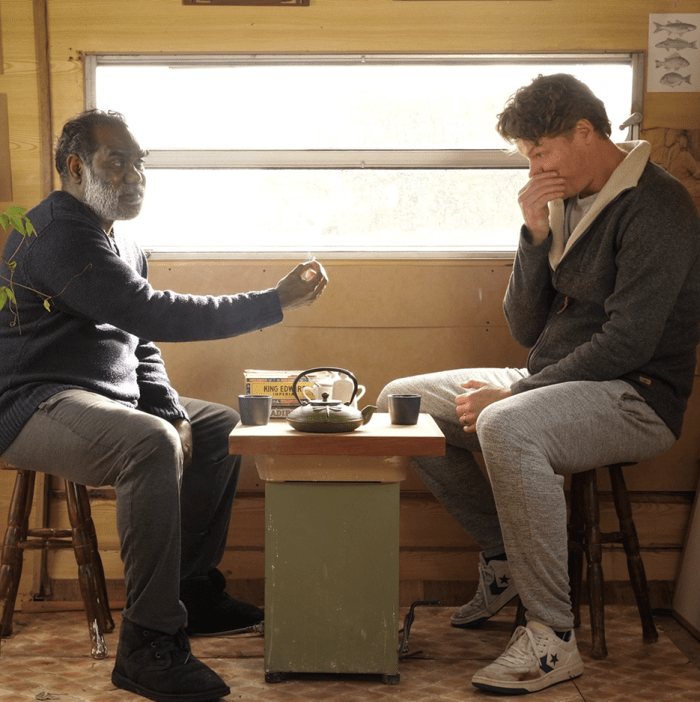
Trevor Jamieson and Myles Pollard in Frank and Frank.
It sounds like you and Adam worked very well together. Tell us about working opposite Trevor Jamieson, whom you share almost every scene with. You two bounce off each other so well.
Trevor was awesome. He’s a lovely man, and he’s a real gentleman. The first night we arrived in Albany, we had dinner at Adam’s, and we cracked a few bottles of red wine and a few beers. We just talked and talked and laughed and laughed. Trev is really irreverent too. He is a really open person. That first night was great. What I liked most about Trev, in terms of his work, is that he’s really present. He is a really good listener. He’s very perceptive. I really rate that as an acting skill. There were moments where we just sat and observed and listened and thought. Making a film like this is so antithetical to doing telly where everything is really quick and really fast because you want to get to your ad break and you want to cram in as much exposition as possible. But for this movie, there was a lot of exposition, but there was a lot of space. And that space was just Trevor and I just sitting and observing. So I love that aspect about Trevor who was just really present.
There’s a very funny, complex scene towards the beginning of the film where your Frank 1 and Trevor’s Frank 2 meet for the first time. I’m curious to know how many takes that scene required. The dialogue is quite rapid-fire, and the one-liners land brilliantly.
I remember reading it on the page for the first time, and I thought it was a really funny scene. But it was such a technical scene as well. The characters are thinking two different things at the same time, and then they eventually come together and understand what each other is trying to say. So the actual grammar, the punctuation of that scene is really clear. The ideas are really clear, but we had to sit and really think about that scene and rehearse it for quite a while to get that timing right. It was such a gift to have it written so clearly on the page. It was actually really quite beautiful writing. But we certainly had a few laughs trying to pull it off.
I think it’s important to acknowledge the local Albany community who made this film possible, with a lot of locals taking part in the production in some capacity. Tell us about working with the local community to get this film made.
Being from WA yourself, you’ll know that Albany has its own personality. It’s a beautiful town with beautiful geography. It’s also quite an artistic community, and people get really excited about being in a movie. They get a bit nervous too. Case in point, there’s a scene set at the rifle range with the owner standing behind the bar while Trevor and I were having a beer. He was really nervous. Adam just rolled the camera without telling him, and I just started talking to him without him knowing that he was being filmed. [Laughs]. I just started talking to him and asking him questions about gun history, and he just started talking and didn’t realise that the scene was happening.
I had a feeling that was the case. It certainly felt organic.
It really was. I looked at Adam and I said, “Did you get all of that?” and he said, “Yeah.” [Laughs]. Another thing that I love about Adam too is that he’s not afraid to bend the rules a little bit in terms of the filmmaking convention. I think that moment was such a beautiful, unpredictable, dynamic moment that happened. How could you not put it in? There were also moments in the art gallery where we had real community artists who come together to paint once a week, and we were in their studio making a movie. And there was the lady that had to do the nude drawing. Just the bravery and the commitment by local people to play a part in this movie and to push themselves out of their own comfort zones was really quite amazing actually.
I believe you’re set to work with Adam again on his next film, Frederickstown. What can you tell us about that film and your role in that film?
Well, it’s a black comedy. The title is a play on Albany’s original name, Frederick Town. Adam and I really connect with our sense of humor. He has a deep intellectual humor that really comes out in his writing. In the film, I play one of three brothers. My character is the complete opposite of Frank 1. I’ve been training for the last few months to really get myself fit and in shape because I completely let myself go as Frank. This character is very fit, and he’s very focused. The relationship dynamic between the three brothers is incredible. There’s the younger, vulnerable brother, myself, and the older brother who’s an ex-con. The writing is both dark and very funny. I can’t say too much yet, but I think people are really going to love it. It really pushes the envelope a bit, which I love. I’m really excited about it.
Frank and Frank will screen at the Revelation Film Festival on Saturday, 15 June and Sunday, 16 June. Details here. A wider release date is expected to be announced soon.
ADVERTISEMENT Road to Perth is available to watch now.
ADVERTISEMENT Donate to the Old Mate crowdfunding campaign today!

ADVERTISEMENT


 Cinema Australia
It is disappointing that “Frank and Frank” does not appear to be available in the USA.