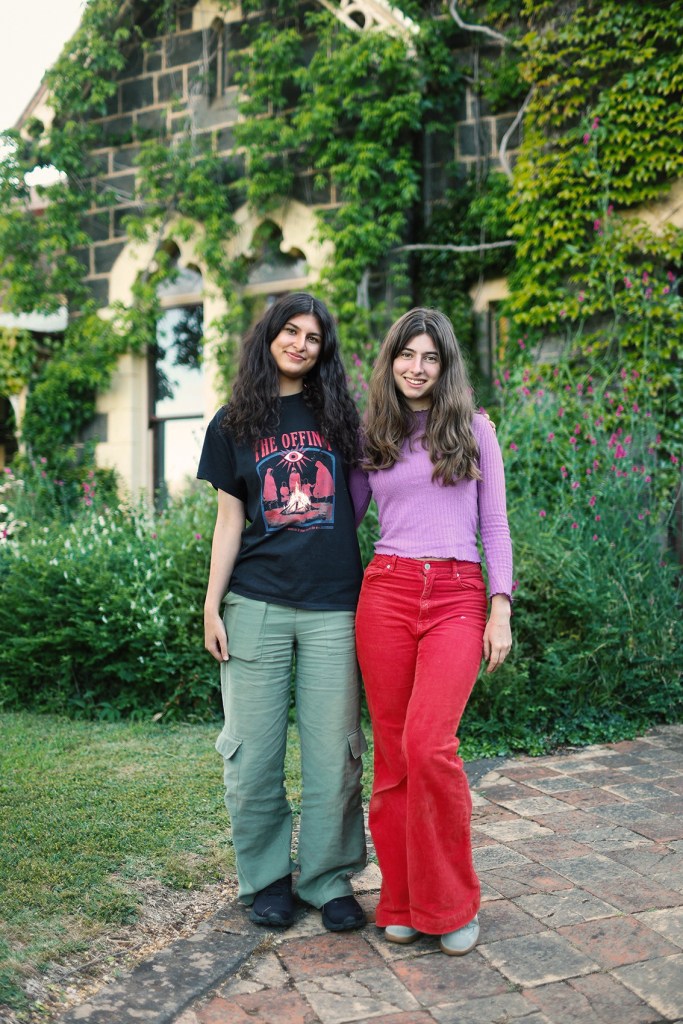
Lily Lunder and Koko Crozier.
An unexpected friendship, sparked by a vintage ’90s leopard print shirt, has led to the emergence of one of Australia’s most exciting new filmmaking duos.
“It was my mum’s shirt,” Lily Lunder tells Cinema Australia.
“Koko [Crozier] and I were both studying Film and Television at the Victorian College of the Arts, and I vividly remember our first day. Everyone was a bit awkward and unsure what to say, but Koko turned to me and told me she liked my shirt.”
From that moment, Lily and Koko quickly became close friends and creative collaborators.
Their first challenge as co-directors came with a short film titled The Backwater, a mystery thriller about a girl who wakes up with no memory of the previous night. It was made by just themselves and a friend on crew, with Koko starring in the lead role.
“I remember during our first university break, Lily messaged me suggesting we make something for the Very Short Film Festival,” says Koko.
“The deadline was only five or six days away. We knew we wanted to create something together, so we came up with an idea very quickly and headed to a swamp location. Our unit base was an abandoned bird-watching hut, covered in all sorts of rubbish.
“It was incredibly unglamorous. It was pouring with rain, we were knee-deep in mud, and dealing with all sorts of challenges. The conditions couldn’t have been worse, but we came out the other side feeling really positive about the experience, and we still had a lot of fun despite it all.”
That experience proved to be a defining moment for the pair, reinforcing their creative partnership.
“It was very empowering,” says Lily. “We met the deadline and even travelled to Tasmania together. It felt like our collaboration was off to a strong start.”
Building on that momentum, the duo went on to develop their debut feature film, The Offing – an unsettling psychological drama that follows Neviah (Jaimie Wood), a tormented recluse, and Freya (Isabella Mangano), an enigmatic stranger.
The two embark on a scenic road trip that gradually spirals into chaos. As they attempt to outrun their pasts, their friendship is pushed to its limits, culminating in a shocking revelation.
The Offing will screen at the Melbourne Women in Film Festival on Saturday, 21 March 2026. While the session is currently sold out, audiences can join the waitlist, and further screening updates will be shared via Cinema Australia.
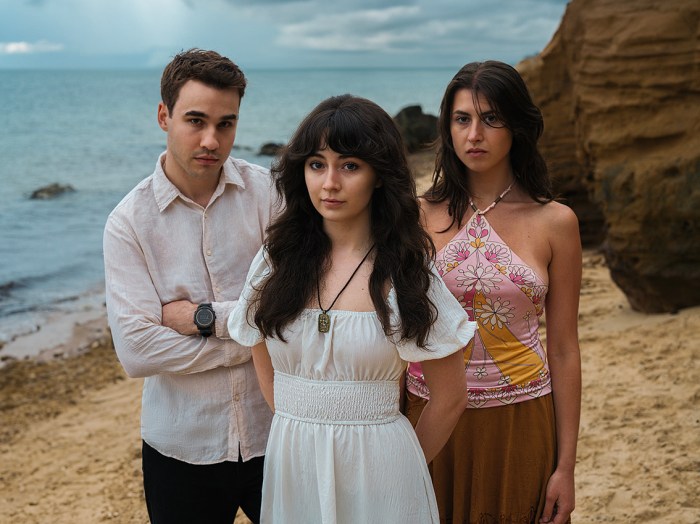
Jacob Pontil-Scala as Tyler, Jaimie Wood as Neviah, and Isabella Mangano as Freya in The Offing.
“It feels like male voices are being platformed to a much greater audience than female voices. It feels like we’ve become complacent, and Australia perhaps thinks we’ve done what we can and we’ve done our dues to support women in film.”
Interview by Matthew Eeles
You’ve both said that you both have an affinity for the dark and atypical. Where does this stem from?
LL That’s a good question. I think, for me, my affinity for the dark and atypical comes from a fascination with the unexplained and our attempts to explain the unexplained, if that makes sense. I find things that don’t make sense really interesting, and that kind of feeds into The Offing and our other films. I feel like there’s a theme of mythology and horror and different folklore that comes into all of our films.
KC For me, it’s very similar to Lily. My family is very much into horror movies in general, so when I was growing up, I was always tagging along to horror screenings with Mum and Dad. From an early age, I was a big fan of James Wan and The Conjuring franchise, and I was fascinated by the supernatural as well. I think that continues to feed into some of our work, but also those psychological themes that are explored in different horror films. I’m very much inspired by death, which I think is the biggest unknown, and it’s what unites us all as humans. I think we interrogate death a lot through art too.
How quickly did you recognise this in each other?
LL I think, in our very early conversations, we realised we had very similar tastes in film and the things that we wanted to explore.
KC I agree. Unfortunately, at uni we had to direct separately as part of the course, but instantly we saw the overlap between our respective works and those psychological themes that united us. So we were excited to finally have the chance to collaborate and bring something together that explores similar ideas.
Going back to The Backwater, how would you describe your dynamics on set at that time? Were you both aware of your roles and how you would navigate working as co-directors?
LL I think it flowed so naturally for us. A lot of people ask us, “Do you have arguments on set? Who’s the one who’s actually working the camera? Who’s the one who’s actually directing?” But we describe it as though we’re one brain but two people, because we do have two brains – at least we have double the brainpower – but I feel like we really click on so many levels, and we get to bounce off each other, and our ideas just get better by collaborating. We really like the dynamics of co-directing. I think solo directing may have its benefits, but for us, I like the dynamic that co-directing creates because it feels so democratic and collaborative, and we’re so open to hearing from our collaborators and what they want to do. It just becomes something that’s so much bigger than yourself when you are in that dynamic.
KC I completely agree with Lily. It feels so free-flowing, and it’s hard to intellectualise and explain sometimes. We’ve evolved a lot as well in terms of when we first started, just by virtue of the fact that we were keeping it small. I was acting in The Backwater, as well as our following project, and now we’ve fully stepped into directing and sometimes co-DOPing as well. It’s worked really well for us, and I think it just comes down to that communication and collaboration that we have, as well as very similar instincts.
Have you maintained those dynamics steadily through your work, or have they developed from project to project?
LL We now have a better sense of each other, and we built a really quick shorthand on set, like knowing exactly when we want to move on from a take or when we feel like we’ve got it in the can. It’s more in our eye contact now, and we don’t need to discuss things as much anymore. [Laughs]. Our skills as filmmakers, both individually and together, have obviously grown so much since then. We were 17 when we were making The Backwater, so we’re growing as people as well. It has been really fun seeing how our dynamic has evolved and being able to trace our filmography and how that reflects us both as people and as filmmakers.
KC Obviously, it’s been interesting seeing the kind of thematic through-line of our work, but we continue to explore different themes together, and we’re still finding what it is that unites it all, and trialling different workflows and different scales of filmmaking too. Ultimately, we have grown a lot together, and those key developmental years we spent together in uni, learning and finding our footing as creatives, were vital. So we’ve very much come out the other end more united and stronger.
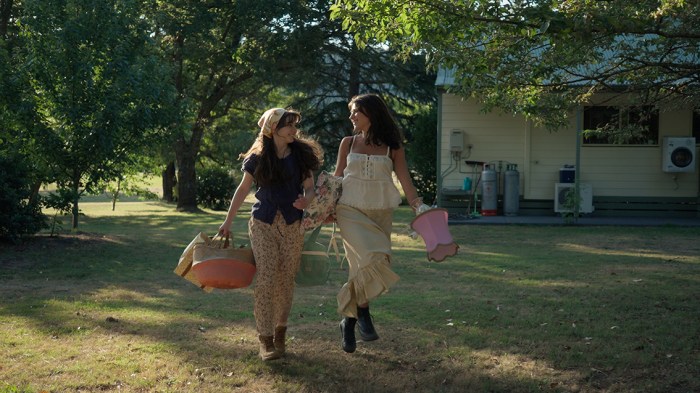
Jaimie Wood as Neviah, and Isabella Mangano as Freya in The Offing.
I noticed that both The Backwater and The Offing have a lead character named Freya. Is there any significance to that name for either of you?
LL [Laughs]. That’s a funny question because we actually forgot that we did that. One of the actors from The Offing asked us the same thing, and we couldn’t remember doing that. Freya does have significance in the context of The Offing as far as the name’s Norse origins go, and it relates to Frigg, but I don’t know why we picked that as the name in The Backwater. I have no idea. Do you have any recollection, Koko?
KC [Laughs]. I actually have no idea. I think we just thought it sounded pretty and cinematic. We’ve found a lot with our work that we rarely use typical or common names. They’re always unique or come from different cultures. So we just can’t bring ourselves to use a more typical Western name. So that just happens to be one that pops up a lot for us.
Tell us about some of those reasons and decisions behind some of the character names you’ve used.
LL With The Offing, we have Freya’s name, which obviously comes from Frigg and has Norse origins. And then Neviah was also a very deliberately chosen name that means “prophet” in Hebrew. And then Tyler is actually a very basic name, and one of the more basic names that have been in our films. But for some reason, ever since I was a child, I would always name my male characters Tyler. So that ended up being a nostalgic nod to that.
KC I think we had a very fun naming convention for all of the girls who played a part in the Norse commune that features in the film. They were all drawn from Norse culture.
Why is Norse culture so important to you two?
LL Obviously, time is super important in The Offing, and we found that within Norse mythology, there’s a lot of thematic exploration of time and different goddesses that represent time. Particularly when we came across Frigg, who’s this symbol of fertility and motherhood and this feminine power, but also she can see into the future and she’s a seer. We were really interested in her in particular and how we could draw from those ideas and what she represented. Also, with Norse mythology, there are such strong female figures that you don’t necessarily see in other mythologies, and we really found it quite refreshing that some of the women in these stories are among the strongest and the most nuanced. We wanted to bring that to the characters in The Offing as well.
Before we dive into The Offing, I want to ask you about your short film Snap. From what I can tell, this is the first film you’ve directed that wasn’t from your own script. How did you find directing someone else’s story? Was it a liberating or a challenging experience?
LL That was a really interesting experience for us. We were approached by a screenwriter who knew us from the VCA, and his friend had written the script. Immediately, we clicked with the themes and thought the script was very similar tonally to a lot of our work. I’d say it was quite liberating working with someone else’s script. It was a very different experience, coming across a different story and then figuring out how to translate that as directors, because I think a lot of our process normally comes from writing scripts, knowing that we’re going to make them, and writing them while thinking about the resources that would be needed and knowing that we would be able to bring them to life. So having to go through that mental process of not knowing that immediately was very interesting. But we are currently working on another film that we haven’t written.
KC When we write our own scripts, we see the screenplay as a blueprint to then explore on set, and we’re very open to new ideas that come up on the day. I think it was really great getting to collaborate with Simon Digby, the writer of Snap, because he shared that kind of openness. He was there on set as well and very involved. But when it came to making it on the day, we were super receptive to what our actor Anna Fujihara, who plays Toni in the film, had to contribute, and still maintained that flexibility. Because it was flexible, but still doing justice to those themes and ideas that were explored in the script, it was an incredibly enjoyable and liberating process for us.
I assume they were happy with the final film?
LL The producer, Finn Hartnett, and Simon were very happy with it. We were all really happy to see it come to life. It had quite a good festival reception as well. We went to St Kilda Film Festival and South by Southwest Sydney with it. So it’s been really fun actually getting to see the audience’s live reaction to it, because it’s got a bit of horror and some cool moments that are fun to see the audience react to.
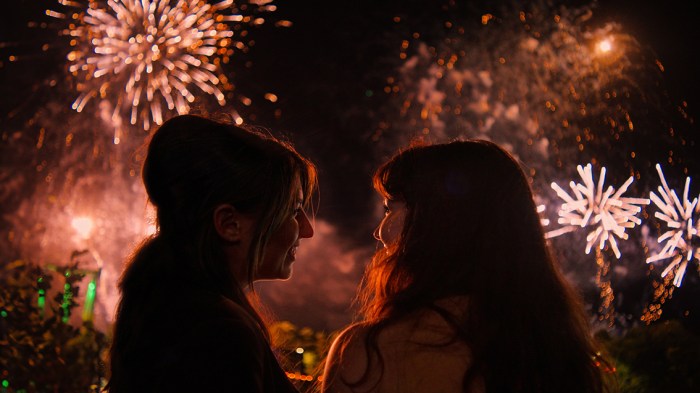
Isabella Mangano as Freya and Jaimie Wood as Neviah in The Offing.
The Offing is intense in its narrative, and it deals with some heavy themes. I really appreciate that you two don’t shy away from telling stories on the edgier side. The Offing is described as being inspired by a true event. What were those events specifically?
KC While we were writing it, specifically with Freya’s storyline, it was very much drawing from true events that we were seeing play out in the world politically and socially in Australia, but also very much in America, drawing from some of those power dynamics that we saw going on and how women were being subjugated. But also, some of her storyline was drawing from an experience of a close friend of ours who trusted us with her story. It’s very much a universal storyline of women being oppressed and subjected to harassment in the workforce, and how do you show up for one another, and what is the best pathway forward to overcome that? So we’re very inspired by those real-world events and how many women can relate to those ideas.
LL I would echo that. I think that’s the clearest way that it is inspired by true events, but obviously it’s also just inspired quite generally by our own experiences and the experiences of other young women around us. The whole caravan road-tripping storyline is very much inspired by my childhood. We even used my family’s caravan in the film. [Laughs]. Neviah’s storyline is also inspired just by the concept of female intuition and sometimes feeling like we can see the future in a strange way. Sometimes I feel like I’ve got a strange sixth sense that’s definitely nowhere near as good as Neviah’s, but I find the concept of intuition really interesting to play with on screen.
At what point did you know that your script was the official finished shooting script?
KC So the turnaround between when we conceived the idea and began shooting was maybe one or two months.
Hang on, hang on. One or two months?
KC [Laughs]. Yeah. We thought of the idea and then wrote it as quickly as possible and continued to develop it. It kept evolving on set and through re-shoots. So we definitely never had that moment of, “Yep, we’ve locked in the shooting script.” It just kept changing. We were very nervous about the idea of sharing it at first, but we had some really lovely close collaborators and lecturers at uni who gave us some really wonderful feedback. But we never thought we’d finished. We had our first rough cut and were getting feedback and deciding where scenes would fit. So it was a very amorphous way of working. There was so much improv on set as well, and new options presented themselves in the moment and evolved into bigger plot lines that we didn’t script from the get-go. So if you looked at the first draft of the screenplay, it’s a totally different entity.
Will you work that way again?
LL I think so. I think it’s really fun being able to improvise, but I think in the future we hope to be slightly more organised with our screenplays and maybe not as brash as we were back when we were 18. We were very fortunate that our actors were so patient with us and so collaborative on The Offing. I think it’s good to be able to work in that way when you have such patient actors. I remember shooting certain scenes and all of us feeling, “Oh, maybe it’s not quite right,” and the actors asking us for another shot. It was a mutual decision between all of us that we were aiming for something better. So yeah, we were very, very lucky with our actors.
Was there a particular reason that you had to start shooting so quickly? I’m just trying to get my head around this quick turnaround time between conception and shooting.
KC We were aiming to get it finished in the uni break. So we had from December until February. A lot of the filming took place at the end of January into February. So we set that harsh deadline for ourselves because once we were back at uni, we wouldn’t have the time to give our all to finishing this film. So that was why we were working with such a quick turnaround.
Did it feel like you were being thrown in the deep end?
LL A little bit. I don’t think we felt too much pressure, simply because our team was quite small and we were all starting out, and we were fortunate enough to also be working with a lot of people from uni and other emerging creatives as crew. We were all definitely treating it as a learning experience and, I think, very intentionally throwing ourselves in the deep end, knowing that we would learn a lot from it.
Look, I was already impressed with what you’ve accomplished with this film, so hearing what you’ve just told has left me even more impressed.
LL Thank you. We really appreciate that.
When we first spoke about this film mid-last year, you told me that the film has drawn acclaim from Garth Davis, who of course directed Lion, and Joel Anderson, who made Lake Mungo. In what capacity did it draw acclaim from these two?
KC We’re fortunate with the VCA network that our lecturers have connected us with those incredibly inspiring figures that we’ve always looked up to. We had the incredible privilege of sharing the film with Garth and Joel, and they both had some really supportive things to say. We continue to learn from both of them and feel really honoured that we have that mentorship from them. Even while we were navigating the rehearsals for The Offing, we were getting some lectures from Garth, some training sessions on how to run rehearsals at uni, and we were feeding that into our practice and learning what it meant to be directors as we went along. It was really gratifying getting to show him the film and speak to that, and what we learned from him and how we incorporated those techniques into the rehearsals.
Was there much constructive criticism or negative feedback?
LL Both of them saw the film in its final state, so not in a direct way. But I think just from the timing of when we were learning from Garth how to run rehearsals, or what his process for that is, I feel like we had a lot of critical feedback for ourselves on how we’d been doing things before that. It entirely revolutionised our approach to rehearsal and performance, and I could really feel the difference after we’d worked with him and learned from him. So not directly, but I think self-imposed and between the lines, definitely.
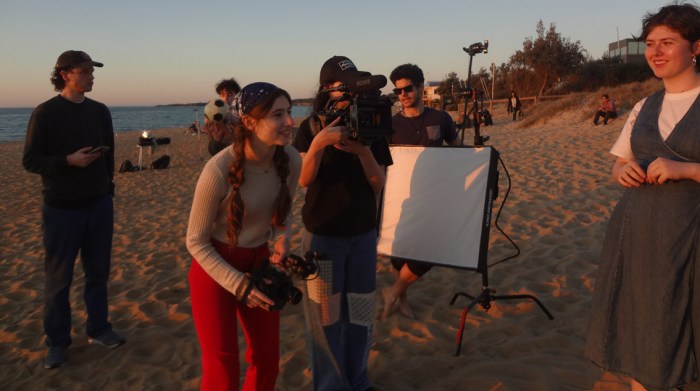
Koko Crozier and Lily Lunder (with camera) on the set of The Offing.
There’s so much to love about this film, but one thing that really impressed me the most about The Offing on my first viewing was the film’s cinematography, which you two are both credited for. The visuals are stunning. Did you shoot this out of necessity? Would you have preferred someone else shot it?
LL I think it came from reflecting on our experiences on our early short films that we were shooting, where we developed that free-flowing collaboration and shorthand. Things went incredibly smoothly, and we really enjoyed what that meant for us. And the fact that there are two of us, it felt like a manageable workload to take on. So we didn’t necessarily feel there was anyone that jumped out to involve in the process. We both had our cameras. It really aligned well because a lot of the film is following those two main characters, and we each took a camera and were filming and focusing on one actor each. I think it made a lot of sense for this film that we shot it.
KC And we’re very visual filmmakers, so it wasn’t out of necessity. It was a collaborative decision that we made, that we really wanted to take on the visual language of the film as well.
Some of the forest shots in the film are incredible. They’re reminiscent of Australian landscape paintings from the early 1900s. Would you consider yourselves cinematographers?
LL That’s such a good question. I feel like I haven’t really thought about whether we consider ourselves cinematographers. We have done a little bit of work since The Offing just as co-DOPs, but that’s been more recently. So I think yes, even though our primary love is directing and producing and writing, we love visuals, and we were very much inspired by the landscape itself and wanting to represent Australian landscapes on screen, just because we don’t see enough of that. I think the natural environment itself was such a big inspiration for us and is definitely a through-line for a lot of our work. We’re drawn to shooting regionally and shooting outside because we feel like it makes our jobs so easy, and we don’t have to do too much as cinematographers because it’s already so beautiful. We just have to place our cameras in the best possible way for the lighting to do all of the work. [Laughs].
KC At the time, we’d just watched Bones and All, and I remember being particularly struck by their use of natural light and then learning about their minimalistic setups. So we carried that into our methodology while filming. It was very much about using natural light. Obviously, the interiors are a bit more hands-on and more lighting-heavy, but because so much was blocked to the exterior, it was just about picking the right locations and incorporating them and leveraging them however we could.
So you wrote the film, you directed it, you shot it, and you co-produced it. What other roles were you taking on throughout the making of the movie?
LL We had some help with production design at certain points, but most of the time we were also the production designers and the costume designers, which we had a lot of fun with. We were pulling a lot of pieces out of our wardrobes and our actors’ wardrobes and trying to create a really fun, colourful costume design and tell more about the characters’ journeys through their costumes. I feel like we did almost everything at some point. [Laughs]. But we were lucky to have a lot of help in different areas throughout. The crew was changing a lot throughout each day of filming and throughout every block. So sometimes there were more people and sometimes there were fewer.
Considering your previous acting work, Koko, had you ever planned to act in the film? Or was that never an option considering your heavy workload already?
KC I think I learned pretty quickly through our early short-form work, and working with the most incredible actors, that my place was definitely behind the camera and not in front of it. I preferred telling those stories rather than being the one to embody them in front of the camera. There was definitely not a moment where I thought that I would want to play a character in The Offing. And if there was, it would just be out of convenience because someone didn’t rock up on the day. I very much prefer directing and being behind the camera.
What I love the most about the two central performances in The Offing is that both actors bring the perfect balance of intensity and playfulness. Is that what impressed you the most about Jaimie Wood and Isabella Mangano throughout their auditions?
LL I think it was really fun being able to bring the two of them together and see their friendship blossom and turn into exactly what those two characters’ dynamic is, because obviously they didn’t know each other prior to making this film. And Jaimie was only 16 while we were filming. They developed that older sibling, younger sibling, best friend dynamic. They were so playful and were learning a lot from each other throughout the process as well. We were very impressed by their authenticity and the range of both of their performances and what they could bring to it.
KC I completely agree. From the moment Jaimie walked into the audition room, she was the antithesis of Neviah—so playful and upbeat. Originally, we saw Neviah as this withheld individual, which you do see a lot of in the film, but the second we called cut, Jaimie was her playful and comedic self again. We thought it’d be very interesting to incorporate that more into Neviah’s character and have a more nuanced take on it. And that’s exactly what she did on set. She brought so much comedy to it. She and Isabella had a lot of synergy that just made it all the better, and they really transcended what we had envisaged for the character. It was incredibly exciting seeing it come to life and be even better than what we had hoped.
LL They are both absolute troopers. We were very open to improvisation and changing the lines on the day because we had the fortune of doing a two-camera setup. So a lot of the film actually is improvised. Obviously, they knew the gist of the scene and what we were trying to get across, but we were very open to them changing the wording or anything else about their scenes. Certain scenes were added in and changed based on things that they said they really wanted to try or do on set. We were all treating it as a learning opportunity and trying to honour their vision for the film as well.
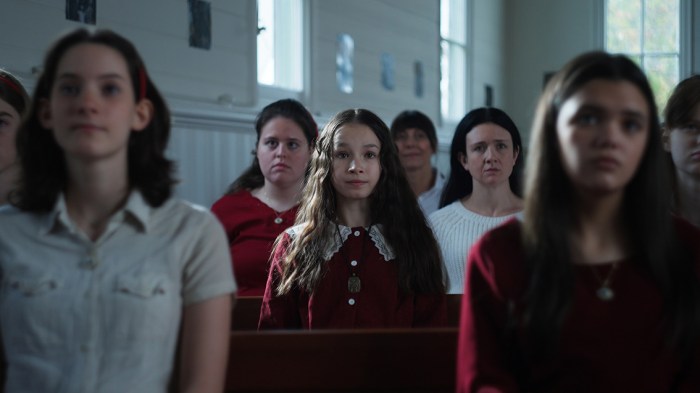
Isobel Lauber as Young Neviah in The Offing.
Isobel Lauber, who plays Young Neviah, is quite the revelation. How different was it working with her compared to the older actors?
KC Working with Isobel Lauber was an absolute dream come true. Honestly, there was very little distinction between her and any of the older actors. She absolutely held her own, and we didn’t have to change our methodology or simplify things to help her. She just snapped into the character the second we called action and brought it to life in such an incredible way. It was a real treasure getting to work with her, and we can’t really take any credit for that. She’s just an absolute powerhouse of a performer. She’s a competitive dancer and a singer, and she’s doing it all. She’s still at school and balancing everything so well. She’s so intelligent. She brought that intelligence and sensitivity to the role and a maturity that we really needed for such an intense role. So it was a real honour to get to work with her.
Was this her first acting gig?
LL This was her first acting gig on screen. She’d done a lot of stage acting and played young Elsa in Frozen and is quite prolific in the musical theatre world.
Considering her age, how much of the film’s narrative was explained to her, or was it a matter of only knowing what’s on the page? She has some fairly confronting scenes opposite Andy Steuart’s character, The Preacher.
LL Everything was very much explained and outlined to Izzy’s mum. We approached it with her about how much should be explained to Izzy. But I think she knew most of what was happening. Speaking to her now, I think she understands more of the film as she’s gotten a little bit older and has now watched it. She was so, so mature beyond her years that she knew what was going on.
KC She’s so mature beyond her years. It’s crazy. I remember on set, our older members of the crew almost being intimidated by how smart Izzy is, and that’s myself included. You would just talk to her and think, “Oh my God, she’s way smarter than me.” [Laughs]. We were changing lenses at one point, from a Zeiss lens to a Helios. We didn’t even know she was paying attention to what we were doing, and she said, “So what’s the difference between the Zeiss and the Helios?” We were so impressed by her will to learn.
Lastly on the casting, I can’t not ask about Milijana Cancar, who plays Agnes in the film. She’s been acting for years, and I was really impressed by her performance in Of an Age recently. What did Milijana bring to this role that you may not have expected?
KC Working with Milijana again was incredible. When she applied, we were surprised that someone of her calibre would want to work with us. We were familiar with her work in Of an Age, so we were very surprised and grateful that she was interested in the production. I think she was particularly resonating with the idea of it being a female-driven production from emerging creatives. But we envisaged the character Agnes to be quite a stern character, and in her audition she brought this warmth and vulnerability to the role that we hadn’t anticipated, and it really elevated her character and brought a much more interesting edge. She herself is just an incredible person to have on set. She brings so much warmth and energy, and I think the other actors really enjoyed getting the opportunity to work with and learn from her, and us as well. It’s just super exciting that we got to work with her, and we’re working with her again for the first time since then very soon. So yeah, we’re very, very much looking forward to that and collaborating with her.
LL I feel like we probably had a very naively one-toned picture of what Agnes was, but actually getting Milijana on board and being able to build the character more with her and around her just made her so much more three-dimensional than our naive young selves had originally written the character to be. So that was a real honour.
One thing that has really surprised me over the years is how few Australian filmmakers actually watch Australian films. You mentioned that you had seen Of an Age, which makes me very happy. Do you actively watch Australian films and keep up with what’s happening locally?
LL We try to stay very active in the Melbourne film industry and the Australian film industry in general and support other filmmakers. I love seeing Australia on screen. I honestly prefer to watch Australian films over international films, just because it’s such a privilege to actually be able to see ourselves and our surroundings reflected on screen. I attend MIFF and other festivals. Some standouts from recent years for me are Pure Scum, which was amazing. The director, Gideon Aroni, is a really good friend of ours, and that was a Melbourne independent film. Sunflower and Godless: The Eastfield Exorcism are other standouts. It’s such a pleasure to be able to know the directors behind these films as well and chat to them about their own trials and tribulations and what their process is. I think we have a really strong community in Melbourne independent film and Australia in general.
I’m so glad that you mentioned Pure Scum because that’s a film that hasn’t been given the attention that it deserves yet. How about you, Koko?
KC I completely agree with Lily. It’s always really exciting when you get the chance to see what fellow creatives are making outside the system, and they always offer something unique that you don’t necessarily get from those commercial films that have been stripped of the directorial vision just to pander to commercial tropes and audiences. So we went to South by Southwest Sydney last year and got the chance to watch some incredible independent films, including Pure Scum. That was definitely a big standout. I very much love keeping up with what other people are making and getting to see how the landscape feeds into their narratives, and also just seeing something that you don’t otherwise get to see and appreciate.
I went a little off script there because I get very excited about Australian movies, so we should get back to The Offing. This film could be considered a road movie, and the film appears to cover a large distance geographically. Was it as broad as it appears, or were the scenes shot in close proximity to each other?
LL It was pretty broad. I guess they don’t really do a crazy amount of travelling. There’s the main movement in the film that is actually the same as in real life, which is between forest areas and the beach. It’s funny because the very start and the very end of the film are shot in the same area, even though they play as different. They’re in the Buxton, Yarra Ranges area in Victoria. And then the beach is on the Mornington Peninsula. So they’re pretty far apart from each other, but we tried to be strategic about not having to drive around heaps. We did enjoy having our own little road trip with the cast and crew. We loved going to local cafes and supporting small towns as well by being there and shooting there.
KC We were trying to be strategic with what we showcased, getting a range of different landscapes and showing the versatility of the area, but keeping it close by. Filming around my grandparents’ place was super exciting. We had an idea of the different locations that were nearby. You’d drive 10 minutes down the road and it’s a very dry field, but then you drive 10 minutes in the opposite direction and it’s beautiful with big trees and very lush and green. And then, of course, we juxtapose that with the beach block, which offers something entirely different. What we love about Victoria is the versatility of landscapes that are still in such close proximity to each other. But we also very much treated it as a bit of a getaway, so when we did have to travel further and stay on location regionally, it was quite a treat to just be amongst those locations, enjoy the serenity, and get to bond with our cast and crew.
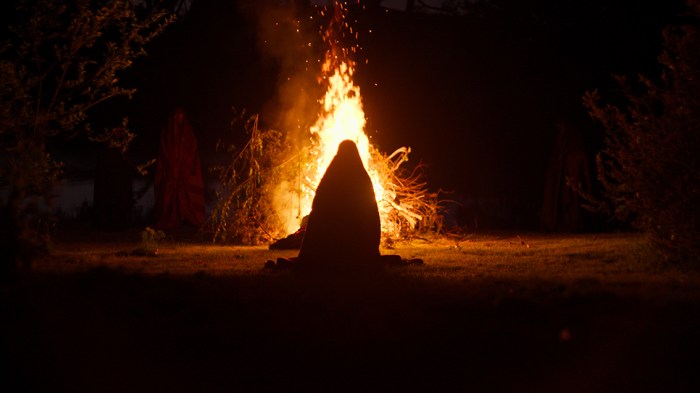
The Offing.
Koko, you mentioned your grandparents there, and earlier Lily mentioned that the caravan was owned by her family. How important is family to independent filmmakers when you’re making films on such low budgets and on this scale?
LL Family was literally everything to us when shooting The Offing. There’s no way we could have done it without our family’s support, and we’re endlessly grateful for that. From my end, we were shooting in my family’s caravan, which my dad was very graciously driving around for us. All the caravan interiors were shot in the caravan parked in my backyard at home. Cast and crew were staying at my house and annoying my entire family. We also had our mums helping us out with catering, which was an enormous help.
Was that Isabella reversing the caravan in the film, or was that your dad?
LL [Laughs]. That was Dad. Isabella did a little bit of driving of the car itself. On Koko’s grandpa’s property, there is one shot where she’s driving the caravan off, which was instructed to be very slowly, but I remember filming it and being like, “Whoa, she is driving very fast right now,” which was still probably only 20 kilometres an hour, but it felt very fast and very scary. [Laughs]. But I’m glad she had the confidence to do that because I would’ve been terrified. [Laughs].
KC It was absolutely a family endeavour. We stayed at my grandpa’s place in Buxton for one of the blocks and shipped him off on a camping trip. So he was very graciously allowing us to film inside his house and then use it as a base for some of the other locations. I also roped in Mum for so many different things. She actually provides the voice that begins the film with the Norse whispers. That was Mum who recorded that. We thought, because she speaks Dutch, that Dutch is kind of comparable to the language, and we quickly discovered it absolutely wasn’t. So it was a bit of a learning curve to work with her on that and craft those whispers that begin the film. We roped everyone into all sorts of miscellaneous missions. We feel really grateful that we had that support and definitely couldn’t have done it without them. Even Grandpa was the pyro-technician on this and helped us with the bonfire that we see in one of the flashbacks, which was one of our favourite moments. It was something that just totally blew all expectations because we shot that with just Lily and me, no other crew around. Grandpa has had a lot of experience dealing with bushfires and is very much on top of fire safety. Lily’s cameo is the silhouette in front of the bonfire. I remember we came and Grandpa had set up this incredible teepee for us, and we were like, “Wow, this is going to be really exciting.” And then the second it’s lit, it’s suddenly five times higher than the teepee. It was this incredible, grand display.
It took me a long time to decide whether or not to include this next question, mostly from my fear of it coming across as being a massive cliché. But the more I think about it, the more relevant I do think it is. When I first launched Cinema Australia in 2013, the biggest conversation at that time was the disproportionate number between male and female directors working in Australia, and the louder people got about it, the better balanced it appeared to become. I could be wrong, but from what I’m observing currently, that balance seems to be dropping off again, and I think Australian cinema really lacks because of that. Is this something that you’re feeling or noticing, and that you’d even agree with? Do you think we need to start making more noise about it again?
LL One hundred percent. I feel like you’ve really hit the nail on the head there, and that’s something that we’ve noticed and sometimes talk about among ourselves. I’m like, “Is anyone else noticing this right now, or are we going crazy?” I think we absolutely need to be championing more female voices in film and making more noise about it, because it seems like the pendulum is swinging the other way at the moment.
KC I completely agree. Some of our biggest inspirations have been local female filmmakers like Jennifer Kent and Natalie Erika James, who’ve made such groundbreaking work, especially in the genre space. But it feels like now we’re shying away from that, and male voices are being platformed to a much greater audience than female voices. It feels like we’ve become complacent, and Australia perhaps thinks we’ve done what we can and we’ve done our dues to support women in film, and now those initiatives have stopped. So I think we really need to keep at it, because we’ve definitely felt it just in the few years that we’ve been working in the film industry—that the pendulum is swinging back. We really need to do everything we can as a community to support women in film and champion those voices.
Does it make you angry, or does it make you more determined?
LL I think a mix of both. I think the anger and spite is a great motivator sometimes. It makes us very determined to create our own spaces and our own sets that do platform those voices, and to have lots of other women on set, and to try to support younger people who are starting out now. Whenever people come to us or ask us for advice, we want to do everything we can to support other young women.
A few times throughout this interview you’ve hinted that you’re currently working on a new film. Is there anything you can share about that?
LL What can we share, Koko? [Laughs].
Well, we know that Milijana’s in it.
KC [Laughs]. It’s a very exciting short film project that we’re working on that is a proof of concept for a greater body of work, but it’s centred on a girl gang in a retirement village. We’re continuing to explore those themes of female friendship, but now in a completely different demographic. It’s got comedic through-lines, and we’re very much looking forward to working with an older cast.
The Offing will screen at the Melbourne Women in Film Festival on Saturday, 21 March 2026. The screening is currently sold out, but you can join the waitlist here. Keep an eye on Cinema Australia for more screening updates.
ADVERTISEMENT
If you enjoy Cinema Australia as much as I love publishing it, please consider supporting Cinema Australia’s commitment to the Australian screen industry via a donation below.
I strive to shine a light on Australian movies, giving voice to emerging talent and established artists.
This important work is made possible through the support of Cinema Australia readers.
Without corporate interests or paywalls, Cinema Australia is committed to remaining free to read, watch and listen to, always.
If you can, please consider making a contribution. It takes less than a minute, and your support will make a significant impact in sustaining Cinema Australia as the much-loved publication that it is.
Thank you.
Matthew Eeles
Founder and Editor.Make a donation here.


 Cinema Australia