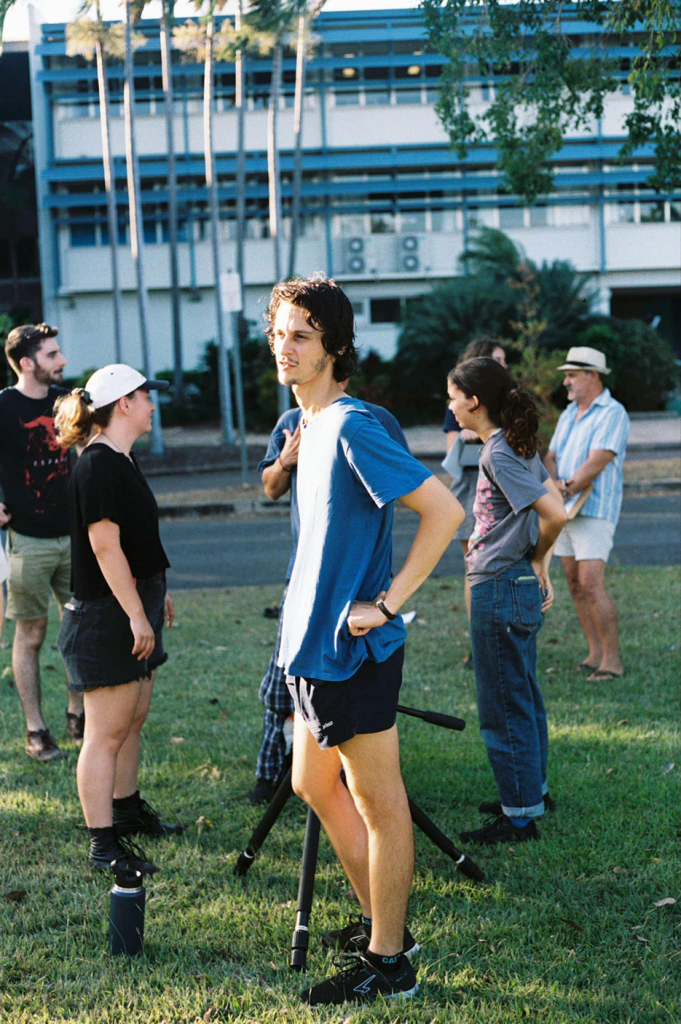
Kostadinos Hatzivalsamis
It’s hard to believe that Kostadinos Hatzivalsamis’ new film Tracy is the first narrative feature made about Cyclone Tracy — the tragic and devastating natural disaster that struck Darwin on Christmas Day in 1974.
Considering Australia’s adoration for films based on true events (Chopper, Red Dog and Rabbit-Proof Fence come to mind), and considering the story’s epic cinematic potential, it’s somewhat surprising that anything other than a handful of documentaries and an extremely dated 1986 television mini-series hadn’t been made until now.
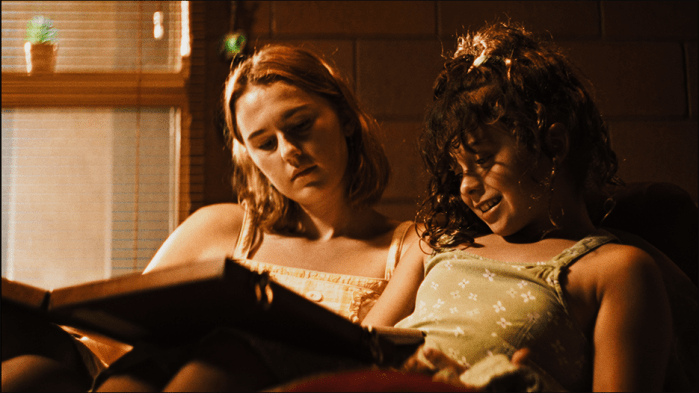
Tracy follows Morris (Arthur Murfitt), Greg (Jack Macmillan), Lisa (Alisha O’Brien), Laurie (Tomas Cummins) and Chloe (Maili Clarke), whose steady-paced lifestyles are quite literally turned upside down when Cyclone Tracy devastates the city of Darwin on Christmas Day.
Based on his own family’s first-hand experiences, Hatzivalsamis’ Tracy focuses on the human side of the destructive event rather than lingering on the moment the eye of the storm struck. Hatzivalsamis’ direction, and the film itself, is at its best when showcasing true Australian mateship and community togetherness in the face of tragedy.
A Greek-Australian emerging artist born and raised in Darwin, Hatzivalsamis’ career began in theatre when he co-founded the local creative collective Big Dog Salad, before moving into filmmaking. With a handful of short films already under his belt, Tracy is Hatzivalsamis’ debut feature film.
Tracy will screen at the Regal Theatre in Adelaide on Saturday, December 6 and The Backlot in Perth on Saturday, December 13. Keep on eye on cinemaaustralia.com.au for more screenings as they’re announced.
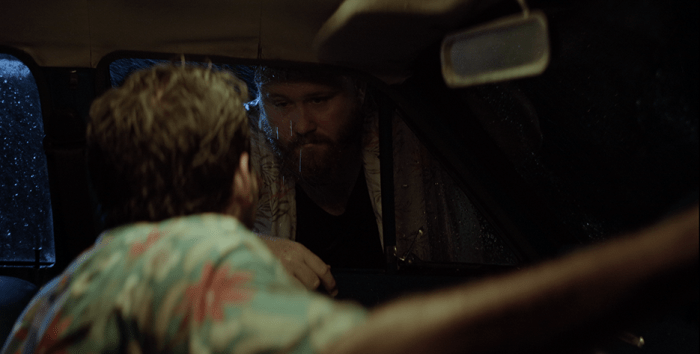
Tracy.
Interview by Matthew Eeles
You began your career in theatre as an actor and director. What inspired that creative path?
I originally wanted to be an actor. When you’re raised by TV like I was, you learn to love movies and television shows, and actors are what you see immediately, that’s what you relate to. So I gave that a real crack. I applied for VCA [Victorian College of the Arts] coming out of high school. I’d been in some local theatre productions and some short films. The more I found myself in those environments, the more I realised that I had so much more appreciation for what happens behind the scenes. And more than that, I really enjoy having a say. So I’ve now found myself being more involved in that capacity. The day it all clicked for me was actually when I watched Close Encounters of the Third Kind. It hit me really hard. I felt such a sense of awe and wonder, and I knew I needed to make my own Close Encounters. So my first short film, which is now the name of my production company, Night Lights, was made shortly after that. It was basically a fan-fic of Close Encounters. I’ve had the bug since then, and I’ve wanted to write and make my own stuff. And screen, compared to theatre, has so many more technical aspects that really fascinate me.
Growing up in Darwin, was it common for younger people to be brought up on TV, especially considering the isolation?
It was much more common for kids to be out and about on their bikes, going swimming and fishing, and doing outdoorsy things. I tried soccer, I tried boxing and other sports, but there was something about watching television that did things for me that running around on a field couldn’t. I was that kid at school who would be quoting movie lines or reenacting scenes, just trying to get a laugh out of people who knew me as the movie guy. I wore a bunch of dorky Back to the Future and Jaws t-shirts.
So far you’ve mentioned Close Encounters of the Third Kind, Jaws and Back to the Future. I’m sensing some Spielberg adoration here.
[Laughs]. That’s fair to say. I hold Mr Spielberg in high regard. [Laughs]. I really enjoy his films, as well as the films he’s produced like Back to the Future, and everything else through Amblin. For a kid, he’s able to capture a real sense of awe and wonder and movement in a story, like kinetic movement that you fall into. I think it’s pretty vanilla to say you’re a Spielberg fan, but I’m proud of it. I stand by it. He’s a legend.
No one should ever feel ashamed to like Spielberg. Filmmakers often tell me they feel the same way when saying they’re a Christopher Nolan fan. These guys are titans.
I mean, who hasn’t seen a Nolan or Spielberg film?

Cast and crew on the set of Tracy.
Does Darwin provide enough opportunities for emerging filmmakers?
Heaps. From my perspective, there was more going on in the theatre space than there was in the filmmaker space, though. There are many theatres in Darwin aching for fresh blood. Coming out of high school, I auditioned for a role in a Brown’s Mart Theatre production of The Crucible, and I got a speaking role in it. Our first rehearsal was on my birthday, and I thought to myself, This is it. This is where my life really starts. And then, through meeting other actors, I realised there is a film scene happening here as well, but it’s much more on the down-low, or taken less seriously than theatre, in my opinion. I think also because there’s definitely a technical obstacle when it comes to equipment. I’m not saying theatre is easy, but it’s relatively easier to grab a script and move about a theatre space than it is to wrangle friends, get them on a specific time schedule in a specific place, get some lights and other equipment, and record it.
So how were you able to get around those technical obstacles to acquire that required equipment?
Ignorance. [Laughs]. Ignorance is great. Well, I mean, with my first short film Night Lights, I just shot that on my camera. It was a point-and-shoot type thing. There were no lighting setups, no external sound recording. It was all done through the camera microphone just to get it done. And then, when I was cutting the film together, I thought to myself, Why isn’t this working? It was only after we finished it that I realised what I needed to do to make it narratively and technically better. It was my way of learning via trial and error. Making films with friends, then watching them back and analysing them, being critical of myself, and then jumping on YouTube was an incredible way to learn. And then, of course, putting that into practice for the next one.
So your film education has primarily come from trial and error rather than a more institutional education?
Yeah. I didn’t go to film school, you see. So learning has been very DIY for me, and mostly the night before. [Laughs]. If it doesn’t work, fix it with gaffer tape. That was my attitude, and it has worked well so far.
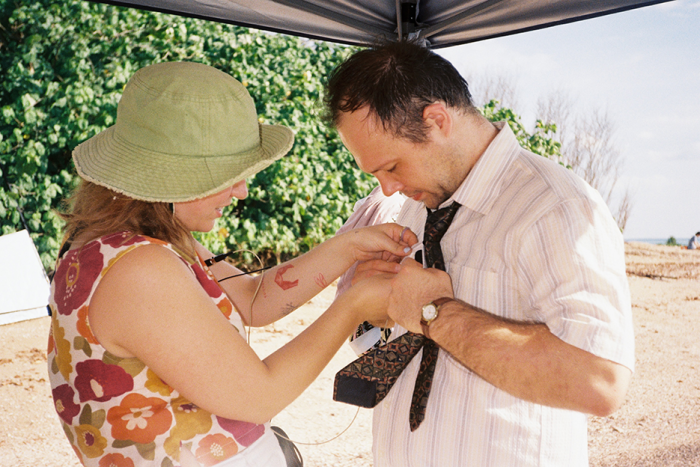
On the set of Tracy.
From what age were you hearing stories about Cyclone Tracy from your family members who experienced it first-hand?
I’d say there was never a time in my life where I didn’t know about Tracy. Every kid knows about it, whether they just know the name or have heard stories from family members. It’s very common to hear people say things like, “This building was here before Tracy.” Buildings are often described as being before Tracy or after Tracy. That’s how people determine lengths of time. Within my family, every wet season and every time the wind kicks up, Dad would start telling us about his own experiences with Tracy. And he was very open about it. He wasn’t ever shy about it. He always talked about it. He would tell us about the time leading up to the night of Tracy, and he would tell us a lot about the time after Tracy, which, as a kid, I was much more interested in.
Is there a particular story that stood out to you?
It actually features in the end credits of Tracy, in which my father tells the story of his mother — my grandmother — putting a turkey in the oven on Christmas Eve, and in the morning the place is flattened, but they see that the oven’s still intact and the turkey’s cooked inside. And in an effort to get something to drink, Dad goes to the local bottle shop and manages to find a cold bottle of champagne and brings that back to the house. So they enjoyed some turkey and some champagne in the devastation, and that was their Christmas lunch. Even as a kid, I just thought that was so tragic yet hilarious. A lot of Dad’s stories had that nice mix of acknowledging tragedy but having a flair for irreverence as well, which I really appreciated.
Cyclone Fina hit Darwin recently. Of course it was much less devastating than Tracy, but what’s the mood like in Darwin when there is a cyclone brewing?
It’s actually quite funny because a lot of people up here see it as an opportunity to get on the piss. The attitude is that it’s never going to be as bad as Tracy again. But Fina got knocked up to a category 3. It passed through the stretch of water between Darwin and the Tiwi Islands, so that was where a lot of the destructive winds were. We just copped the edges of it. There were a few fallen trees and a bit of damage. Most of the damage around where I’m living has already been cleaned up, but there are still some big trees down in the city. If the eye had passed directly overhead, then it would be a very different story, I reckon. I think people probably would’ve been evacuated.

Tracy.
Tracy is an ambitious film that makes the most of its budget restrictions. Did you originally set out to make a much more grand film, or did you recognise your restrictions from the get-go?
In no way did I recognise any restrictions. [Laughs]. I was so ambitious. I had HBO-level ambitions in my head. But then I stood back and looked at our wardrobe and my one tripod and thought, Maybe I need to pull things back a bit. [Laughs]. I was so ambitious with this one. But there were times during the shoot where I was sitting on my balcony rubbing my forehead, thinking to myself, Whose idea was it to make a period drama about a natural disaster with a child actor? It was not very smart to think that $30,000 would cover everything.
What ideas did you have to pull back on specifically?
Well, I never wanted to show the destruction on a Twister level with buildings being ripped apart. But you’ll notice in the film that we stick to interiors and the framing is quite tight. So I guess the main elements that were in the original script that we didn’t end up filming were many more exterior scenes on the streets before and after Tracy. Had we had the budget to do so, I would’ve loved to have recreated a stretch of road of 1974 Darwin, and then also have another stretch of road of a devastated Darwin post-Tracy. I originally wanted many more exteriors outside shops that eventually had to be reworked or cheated so we could have a bit more control over the environment.
Obviously it was early on in the project, but at what exact point did you realise you couldn’t be as ambitious as you intended?
It was early. I’d written Tracy, and as we were preparing to put the team together, I sat down with my producer, who was also my first assistant director, and she said, “We can’t actually do all of this.” I guess it was right before we kicked off pre-production. Right up until then, I was quietly holding onto hope that some miracle would happen and I would be able to film it the way I originally intended, but it didn’t. This entire shoot was one massive compromise. But as I’m sure you’re fully aware, the nature of shooting anything is just the battle of constant compromise.

Tracy.
The cyclone itself is shot really well. Talk us through the filming of those scenes from a technical perspective.
Well, funnily enough, shooting the cyclone sequence was the easiest because my director of photography and I went into it with the presumption that it would be the hardest. So when he first landed in Darwin, we began storyboarding and talking through our movements. It was storyboarded to the nth degree, so from a camera perspective, we had it locked down well before we even set foot on set. I guess the most difficult aspect of filming that scene was that we had leaf blowers and other things going off, so most of the audio had to be re-dubbed later, but that really didn’t matter so much because you could also hear me yelling commands and cues for the actors. But to answer your question properly, I suppose a lot of it was fun movie magic. All of the rain was from garden hoses. [Laughs]. So the whole thing was leaf blowers and garden hoses.
So if that was the easiest, what was the hardest?
The intimate dialogue scenes were tough. I also had quite a strict palette when it came to the film’s aesthetics for scenes pre- and post-Tracy. Lighting was also very difficult because during the time of year that we shot the film, the sun sets much earlier and the sunlight is quite harsh, and we only had the one dedicated gaffer. So it was very often that I would speak to the director of photography about what we needed to do. Then I’d run over to our gaffer, help him out, run back, take a look, run back. And so that was hard because you want these scenes to look good and look true to what the scene required. That, coupled with capturing audio, was difficult. And I think one of the biggest learning curves was little tricks like bugging set pieces with mics to get great audio. But that was also a bit challenging because the birds up here are so loud. [Laughs].
Following the recreation of the cyclone, you use real footage to emphasise the damage to Darwin. What permissions were required to use this footage, if any?
There was a mixture of footage and still photographs that we used. The still photographs were all acquired from public archives, which needed to be credited. The footage was the property of an individual who reached out to me after he heard I was making this film. I had a look at it straight away and it was good. I wrote up a waiver, threw it over to him, and he was very happy to sign. The man who provided the footage wasn’t a survivor himself. He acquired it from a survivor who had since passed.
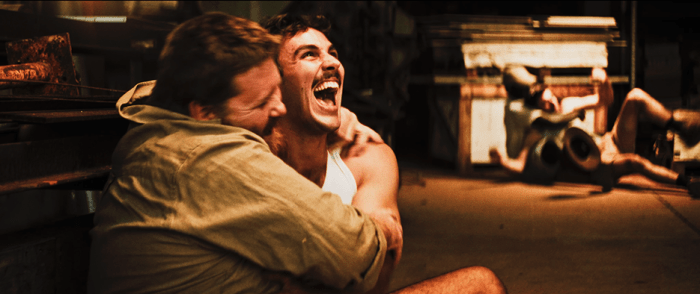
Tracy.
While the film succeeds in maintaining its human spirit by not getting too bogged down in the scientific aspect of the cyclone, there are scenes set in the Bureau of Meteorology, along with one of the film’s main characters, Jack, who works there. How deep did you go with your research into the more scientific aspects of Tracy?
Very. I knew I had to get my facts straight from very early on. Before I attempted to get any kind of themes or characters out on paper, I watched When Will The Birds Return, which is a great documentary on YouTube. I read Gary McKay’s Tracy, Keith Cole’s Winds of Fury, I visited the meteorology website itself, everything. I acquired a complete timeline of events, a number of stories, interviewed local survivors, some of whom feature at the end of the film. And from then, I was able to fictionalise and dramatise. But there was a point where I became more of a historian than a filmmaker for this thing. But it wouldn’t sit right with me if I didn’t have my facts straight about something as important as this.
The casting here is interesting because a lot of these people are non-actors, or actors who had moved on from the craft in Arthur Murfitt’s case. Are these people you had known throughout your career that you called upon, or was there a traditional audition process?
There was a traditional audition process. I wanted to see who would come out of the woodwork. I initially wanted Jack Macmillan, who plays Greg in the film, to play the lead role of Morris because he’s a mate of mine. I’ve known him for years, and I know he is good on camera. He’s believable. But then when I heard him read for Morris, I knew instantly that the character wasn’t right for him. And then we had auditions. It was incredible. Some great people came through, and we used pretty much everyone who auditioned in either speaking roles or as extras. But with Alisha, who plays Lisa, I’d been in one play with her before she moved to Brisbane. When we put the notice out, she was the first person to hit me up. The way that she delivered her lines was how I had heard them in my head. With Arthur, who plays Morris, he came in as this little larrikin. I asked him to read the script and he told me that he couldn’t because he’s severely dyslexic. I was a bit surprised by that, to be honest. We had a chat, and in that 15 minutes he struck me with his can-do attitude. I knew I wanted to give this guy a chance. If it took us a few extra takes just to get it right, I didn’t care, man. He was great. He was Maurice. So I’m so glad we held open auditions; otherwise, we would never have had the kind of talent that we had in the film.
I’ve spoken with other filmmakers who have dyslexia and they’re always so positive about it. How did you find the experience?
Well, Arthur wasn’t the only one. My producer and first assistant director suffers from dyslexia. It wasn’t actually that hard to deal with. One of his co-leads, Tomas Cummins, who plays his friend Laurie in the film, was a legend. He went over the script with Arthur to help him out. Alisha also helped him so much, along with Iona Francis, the producer. We had a lot of patience because not only do people with dyslexia have trouble reading and writing, they have trouble with speaking as well. They can get jumbled up in their head. No matter how tired you are, or how big of a rush you’re in, it’s important that you let them finish what they’re saying how they want to say it.
That’s so great to hear that that community spirit transcended the script and into the cast themselves.
It was such a good mob to work with.
Tracy.
I’m not saying that it’s a negative, but why such a strong emphasis on smoking in the film? In a time where filmmakers are moving away from cigarette placement in historical films, you could have just as easily had no one smoking in Tracy.
It was a very conscious decision. It was written in the script. In fact, they spark up way more in the film than they do in the script. I just want to clarify that there was certainly no sponsorship involved. [Laughs]. It was one of the questions I would ask my interviewees: how much did people smoke? And everyone told me that everyone smoked, and they smoked a lot. It was constant, and it was everywhere. It was an accurate way for us to represent the time period.
Has making Tracy fed your desire to continue making movies?
It has. Even if it’s against my better judgment. [Laughs]. I remember being a teenager and thinking to myself, If I can just make one feature in my life, I’ll be satisfied. Now that I’ve achieved that, I’m nowhere near satisfied. I just want to take every lesson that I learned on Tracy and put it into the next one.
Considering that, and I know this is a super cliché question, what was the biggest lesson you learned?
I would double down on the rule of “show, don’t tell.” I found in the initial cut of the film that I was showing and telling, and I think that was from a lack of confidence, not so much in the audience’s interpretation, but rather in my own ability to convey a message or a meaning. At a certain point, you just need to interpret the script, set it aside, and try to show way more than you tell. And if you are erring on the side of caution, err on the side of showing rather than telling.

ADVERTISEMENT
If you enjoy Cinema Australia as much as I loved publishing it, please consider supporting Cinema Australia’s commitment to the Australian screen industry via a donation below.
I strive to shine a light on Australian movies, giving voice to emerging talent and established artists.
This important work is made possible through the support of Cinema Australia readers.
Without corporate interests or paywalls, Cinema Australia is committed to remaining free to read, watch and listen to, always.
If you can, please consider making a contribution. It takes less than a minute, and your support will make a significant impact in sustaining Cinema Australia as the much-loved publication that it is.
Thank you.
Matthew Eeles
Founder and Editor.Make a donation here.


 Cinema Australia