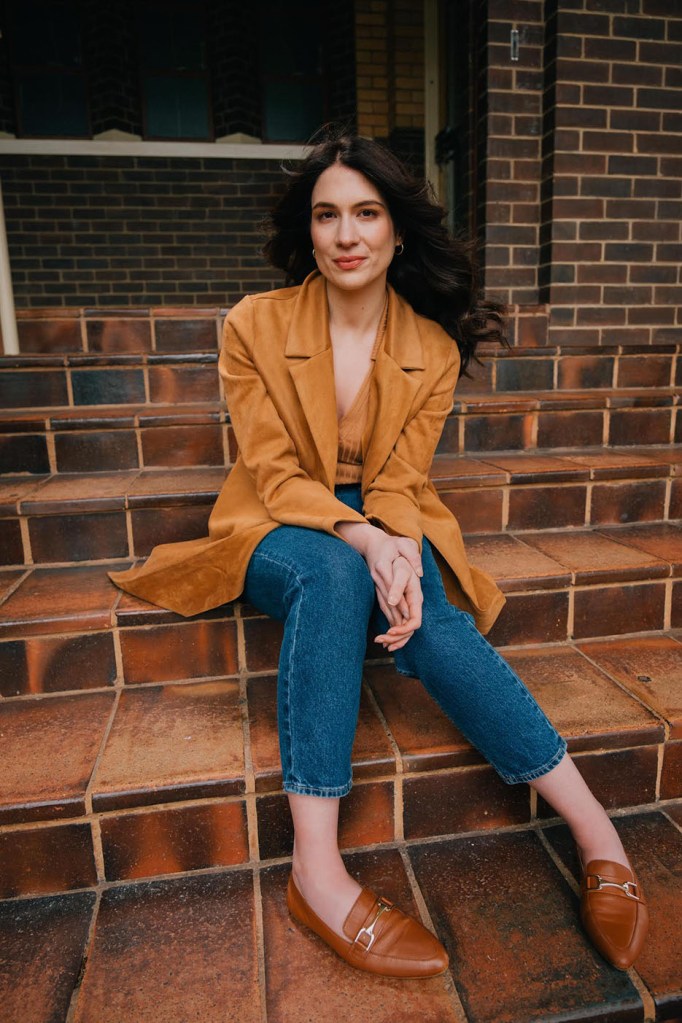
Sarah Nicolazzo. Photo by Yvette Scott.
Melbourne-based actor and filmmaker Sarah Nicolazzo makes a powerful feature lead debut in Adrian Ortega’s family drama Westgate.
Set in 1999, the film follows Netta, a mother whose world is crumbling as she struggles to keep her promises and confront her past. It’s a raw and emotional story about love, loss, and resilience in which Sarah delivers one of the standout performances of the year.
A VCA graduate and award-winning Italian Australian creative, Sarah has spent more than a decade refining her craft, training in acting, movement, and comedy both in Australia and overseas. She’s also the co-founder of Wailing Room Productions, whose work has screened internationally on platforms like Amazon Prime and YouTube.
During our chat, I couldn’t help but notice some striking and admirable similarities between Sarah and her character Netta. Both are fearless, determined women who refuse to settle for anything less than what’s best for themselves on their paths forward.
Westgate will screen at the Sun Theatre Yarraville on Wednesday, 12 November. Details here.

Sarah Nicolazzo as Netta in Westgate.
“I think she’s deeply misunderstood. If a man behaved like her, people would accept that and understand that he’s fed up. A man acting that way is more acceptable to most viewers. I really love and admire her as a character because she’s not beating around the bush.”
Interview by Matthew Eeles
You’ve studied acting extensively both at home and abroad. What part of your training has had the greatest impact on you?
I started my acting journey very much in the theatre world. I learned about Shakespeare and the history behind different styles of acting. That was the launch pad for my training. All of that made me really well-versed in acting, from Shakespearean to realism, which is most commonly used in film. I also did Japanese theatre, which I absolutely adore and always look back on. I was very much a Suzuki theatre actor. It’s a really beautiful discipline because you have to be very present in your body. That really helped me as an actor. It gave me a grounding to connect emotionally with myself. It requires quite a lot of physical stamina and strength, Suzuki theatre and physical theatre in general. So my physical theatre background is probably what has given me a foundation and a backbone. I studied Strasberg, I studied all the techniques, and I’ve done animal work, which I incorporate into my process. I also studied at Groundlings in LA, which is huge. It informs Saturday Night Live and other sketch work. I’m quite accessible emotionally, so character comedy was something I just fell into in America. It helped me so much with improvisation. I’d say improvisation is one of my biggest tools. Groundlings is about character-based improv and it’s all about behaviour. I fell in love with that, and it has layered all of my experiences, from realist theatre to being on the boards, to then doing improv comedy. I’ve been fortunate enough to get funding to write pilot scripts for those comedy characters. I do it because I have a character called Whaling Sarah—that’s what I was known as in my comedy world. I’ve kind of let that go a little bit, but it’s still part of my process and how I work. I’m definitely very improvisational on set and in rehearsal. It’s probably the thing I love the most. It has that playful element and a sense of discovery in every moment.
Explain animal work.
[Laughs]. It’s very physical. It derives from Strasberg, which is an acting school of thought. So if you have a character, you choose an animal that you think shares their mechanisms or behaviours. You get on the floor, be that animal, and make the noises. Then you stand them up and find beautiful little physical behaviours that the animal might have. The easiest one to relate to is a cat. Cats love to lick and touch themselves. So if you were playing a character who’s perhaps quite neurotic, uptight, or a perfectionist, then you’d start picking at threads or brushing dust off your jumper, those kinds of things.
After watching you give such a dramatic and emotional performance in Westgate, I was surprised to learn about your comedy work, particularly in sketch and improv. How much of that have you been able to carry over into your film work?
Well, comedy and drama go hand in hand. Especially if you’re playing a dramatic character because they still have moments of levity. I don’t think I’ll ever be able to escape comedy. Comedy is in everything. Tragedy times one hundred is comedy. Netta is such a tragedy. She has generational trauma and grief bubbling below the surface. But because it’s so tragic, it can be comedic in the way that she’s so defensive. You can use that as an archetype or persona of a joker, or any of those. I think it layers into any character when you’re doing the breakdown or creating them, especially if you cry so hard that sometimes you laugh.
How often are filmmakers you’ve worked with open to improv?
Most of them are open to improv, but you have to recognise the time and place. With Westgate, we were quite fortunate to have a rehearsal period, which is a great time to use improv. We could improvise as much as we wanted to create relationships or past experiences. You just have to read the room to understand if improv is welcome or not. I would never improv the first time doing a scene the way the director envisioned it. It would be something you might be lucky enough to try after a few more takes, or if it’s something that worked well in rehearsal. It’s really about being conscious and mindful of who you’re working with. But it is my natural tendency to improvise a character’s behaviour rather than dialogue. You can improvise behaviour by throwing a plate down or scrunching up your nose. It’s just about picking and choosing the right moments, because obviously the writer has written a beautiful script and you want to honour that to an extent. From my experience, not everyone is open to improv, and that’s okay. But I think they’re probably open to it in the sense that if it’s silent improvisation of behaviour, then it’s mostly always okay.
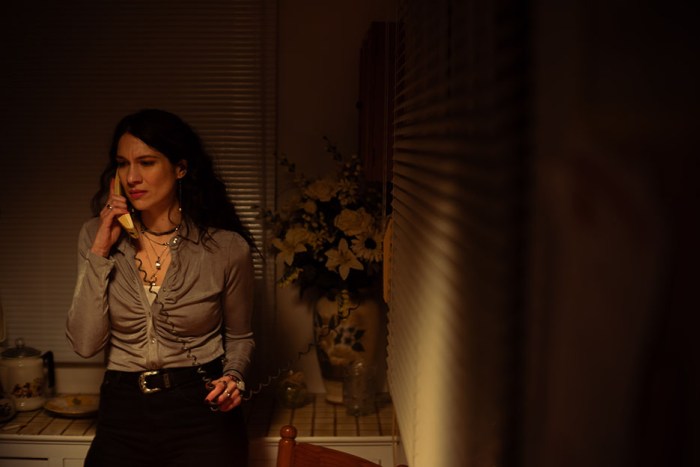
Sarah Nicolazzo as Netta in Westgate.
You’ve described your own family as being extremely expressive. How so?
I don’t know if it’s every migrant or Mediterranean family, but we can’t talk without using our hands. [Laughs]. It’s just the way we are. A dear friend of mine is deaf, and she always looks to me because I’m able to be an interpreter. The expressiveness through my hands is actually a way of communicating. And human beings lie when they speak, words aren’t always correct, so I feel like using our hands and being physically expressive is another way of reading someone accurately. Italians aren’t the most trusting people, so I think we’re all very expressive with our hands as a way of being honest and authentic. At a family dinner or on a family holiday, everyone is talking over one another, and often my husband will be very silent, just sitting there watching and absorbing. [Laughs]. He loves it. He thinks it’s the most entertaining thing. When Adrian and I were talking throughout the Westgate shoot, I’m sure people were wondering if we were okay. He’d often have to explain that we’re just really passionate about what we’re talking about regarding a scene. We’re very direct. I think it can be misinterpreted because Netta is very direct as well, but it’s part of our DNA.
When did you first meet Adrian Ortega? Had you known him prior to Westgate?
I hadn’t known him personally, but the world of social media is a funny thing. We began following one another because I had written and directed a short film called Run, Baby, which he actually supported. So I had known of him. And then, out of the blue, he messaged me via Instagram and we started talking. I read the Westgate script, and then we met up and things went from there.
It amazes me how often I’m hearing that a simple DM on Instagram is how most people initiate their collaborations nowadays.
It’s so interesting. It’s such a different era of acting and promotion because it’s not an easy industry to get into. There are opportunities, obviously, but we have a small industry in Australia. So if you’re not a well-known actor who already has some credibility, it is harder to get roles. It’s really reassuring that there’s a possibility to connect with filmmakers, especially independent ones who don’t have access to our wonderful Australian casting directors or a big production company or budget behind them. It’s not that they’re trying to do it the wrong way or the right way—they’re just trying to make something. I think it’s really beautiful to know there are filmmakers with this thirst to tell stories. So it’s a credit to people like Adrian who are making these films happen. As an actor, independent films are the best way to learn as well. I don’t necessarily love putting myself out there on social media, but it’s something every actor has to do. My view is that as long as I’m authentic, and what I’m putting out there aligns with who I am as a person, then I’m quite comfortable doing it.
It’s almost like creating a digital character of yourself, isn’t it? It may not reflect the real you one hundred percent of the time, but it is the version of yourself that you’re happy to present publicly.
That’s correct. And as an actor, you have to have some mystery to yourself. I still like to keep things about myself private and maintain some mystery, and that’s a beautiful thing. Especially if you’re someone like me who loves being a character actor and wants to completely transform into your characters whenever you get the opportunity.

Sarah Nicolazzo and Max Nappo on the set of Westgate. Photo by Yvette Scott.
Westgate is an extremely personal story for Adrian. How much of yourself, or your family, did you recognise in your character, Netta?
When I read the script, I was like, “Oh my God, I know these women.” These are my aunties, or my mum’s best friends. There are some elements of my own mother, and some elements of my father’s behaviours are in Netta, especially the scene with the Nonna. When I performed that whole scene, I was just like, “Oh my God, this is just like my family.” I was watching my mother and her mother. And I know Adrian, in this sense, was watching his mother and his Nonna. They’re definitely women I’d seen growing up, including my hairdressers. [Laughs]. The cultural side was very apparent, including the shame that Netta has around being Italian and this idea of having to assimilate. That was very present for my mother, and for my generation, hating my own last name or how I spoke. The way I speak now is quite eloquent, to the point where people sometimes ask if I’m British. So this character really resonated with me. And because Netta isn’t first generation—she wasn’t born in Italy and migrated to Australia—it was really important for me to represent these women who reflect my mother, my aunties, and Adrian’s beautiful mother, Nina, as well. I really wanted to honour them because I find them to be beautiful human beings. They just wanted to survive and be independent, which was so important.
I remember my Nonna telling me her story, how her mother put her on a boat and told her, “Never come back, just go.” I think she gave her sheets or tablecloths and that was it. They came to Australia not knowing the language, and that generational trauma gets passed down. I could really relate to that because it’s something I know firsthand. So to answer your question directly, yes, there’s a lot of my family reflected in Netta.
And because of that generational trauma, Netta has this physical and mental rage. How challenging was it for you to express that side of the character?
She absolutely does. As a female actor in this industry, it’s rare that you get to play such a wonderfully emotional character. I describe Netta as a cyclone or a whirlwind of emotions. That was one of the main reasons I wanted to play her. When Adrian sent me the script, I recognised that she’s not someone who’s repressed, even though she’s holding certain things back. I love that she’s so expressive. And I know for myself, in the industry, I’ve been told I’ve got too many emotions, so it was exciting for me to play this woman who’s not only being who she is but isn’t afraid of it either. I think Netta is doing the healthy thing by releasing that mental rage. Obviously, it’s so pent up inside her that it bursts at the end, but I think we all, to some extent, have that rage inside of us. I don’t know if “enjoyment” is the right word, but it was beautiful to play a woman like Netta because if Westgate had been made 20 years ago, this character would have been a man. It would’ve been an Antonio, not a Netta. I have so much to thank Adrian for. I love seeing more complex and nuanced characters like Netta coming through in Australian cinema. I will say this, though—not everyone is going to like Netta.
It’s interesting you say that, because when I interviewed Adrian, I initially described Netta as being unlikable, and he explained that she’s misunderstood, which I also agree with. How would you best describe her?
I think she’s deeply misunderstood, especially because it’s set in the 90s, and the framework people put on women of that era, and the expectations of how they should act. If a man behaved like her, people would accept that and understand that he’s fed up. A man acting that way is more acceptable to most viewers. So yes, I’d say she’s misunderstood, and she’s not going to take anyone’s bullshit. I really love and admire her as a character because she’s not beating around the bush. She’s not a façade upon a façade, even though, to her mother, she says she doesn’t need money, we can see why she’s trying to be so fiercely independent. And remember, this is 1999. It wasn’t easy. Women at the stage of life Netta’s in were supposed to be married, have children, buy a house, they had to have stability because, as immigrants, they didn’t have it. My parents were more rebellious and moved around a lot, and I loved that. I feel like Netta is rebelling against what was expected of a second-generation Italian woman at that time. I think she’s brave. I think she’s courageous. But yes, people have described her as unlikable when she’s simply misunderstood. She can be her own worst enemy at times, and maybe that makes people uncomfortable because we can see what she’s doing to herself, but she can’t. We’ve all got a hero complex, and we all want to save Netta, but that’s not reality. Netta is afraid to be that vulnerable and to admit that she needs help.
Going back to your animal work, what animal did you play Netta as?
She was a cat. A cross between a cheetah and a jaguar. She has those elements about her.

Sarah Nicolazzo and Max Nappo in Westgate. Photo by Yvette Scott.
Almost all of your screen time is spent with your co-star Max Nappo, who plays your son, Julian, in the film. How was that experience for you, working with someone at the beginning of their craft?
It was something I didn’t come into lightly. I remember flagging with Adrian early on that we’d need rehearsals, because Max was 14 at the time, which can be the most awkward male adolescent age. When I first met him, I went to hug him and kiss his cheek, and there was almost a headbutt. [Laughs]. We really needed to develop a relationship, so it was lovely that Adrian was willing to facilitate and cultivate a rehearsal period. Outside of that, I’d write Max letters, and I took him to Timezone. We played games, which he was much better at than me. [Laughs]. I got him a Batman figure and sent it to him in the mail. I sent him lots of little things just to cultivate that kind of relationship. It was a really beautiful bonding experience. I also found myself getting very protective of him. He took a lot away from having someone looking out for him.
His character is based on Adrian. You yell at Julian a lot in the film. Were you able to expel any frustrations you had with Adrian out on Max through your performance?
That’s so funny. [Laughs]. But no. Do you know what though? There was one day where we were all sitting outside and there were some frustrating things happening beyond our control. I was really in character at the time, even though the cameras weren’t rolling, and I think Adrian thought I was angry at him, but I wasn’t. [Laughs]. Thankfully, with Adrian and me, we could always say what we needed to say to one another. That might be because we’re Italian, but we’d rather be completely transparent with each other. It was a really beautiful creative relationship where we’d bounce off one another. It was very energised, and there was never any fear of speaking up, which I absolutely love.
Westgate will screen at the Sun Theatre Yarraville on Wednesday, 12 November. Details here.
If you enjoy Cinema Australia as much as I loved publishing it, please consider supporting Cinema Australia’s commitment to the Australian screen industry via a donation below.
I strive to shine a light on Australian movies, giving voice to emerging talent and established artists.
This important work is made possible through the support of Cinema Australia readers.
Without corporate interests or paywalls, Cinema Australia is committed to remaining free to read, watch and listen to, always.
If you can, please consider making a contribution. It takes less than a minute, and your support will make a significant impact in sustaining Cinema Australia as the much-loved publication that it is.
Thank you.
Matthew Eeles
Founder and Editor.Make a donation here.

ADVERTISEMENT
ADVERTISEMENT: Mothers, Lovers & Others is available via VOD here.


 Cinema Australia