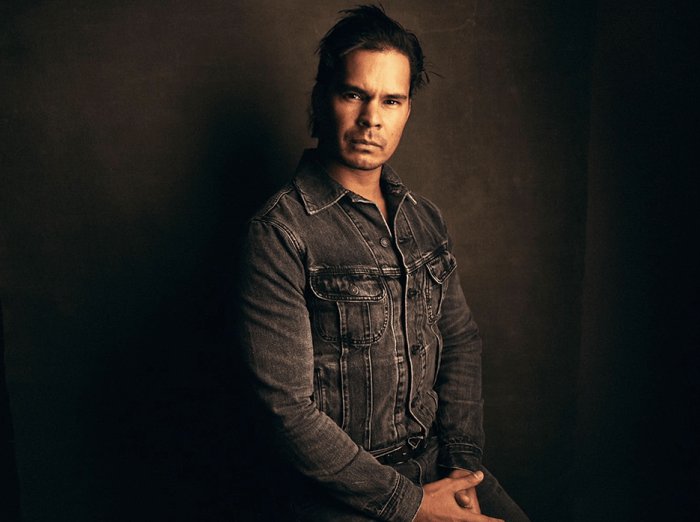
Mark Coles Smith. Photo by Robby Klein/Getty Images for IMDb – © 2025 Robby Klein – Image courtesy gettyimages.com
With four major film and television projects under his belt this year, 2025 is officially shaping up to be the year of Mark Coles Smith.
On the small screen, Mark has impressed audiences as journalist Justin Guthrie in the Netflix megahit Apple Cider Vinegar, and once again stepped into the famous customised Akubra of Detective Jay Swan for Mystery Road: Origin Season Two.
On the big screen, he’s shown a darker side to his craft in the festival favourite We Bury the Dead, taking on the chilling role of Riley in the body retrieval thriller.
Now, in his latest film Beast of War, Mark stars as Leo, a World War II soldier desperate to join the fight and escape the guilt of failing to save his brother from a brutal shark attack years earlier.
The film follows a group of young soldiers, fresh out of boot camp, who find themselves stranded on a raft in the middle of the ocean after their ship is sunk by the enemy, forced to battle for survival against a monstrous great white shark.
In this interview, Mark talks about Beast of War and Mystery Road: Origin Season Two, his connection to the ocean, working alongside a massive robotic shark, and much more.
Beast of War is in cinemas October 9. Mystery Road: Origin Season 2 is now streaming on ABC iView.

Mark Coles Smith in Beast of War.
“They’ve built this tank, and you’ve got your fingers crossed that whoever built this fucking thing knew what they were doing.”
Interview by Matthew Eeles
I’m labelling 2025 the year of Mark Coles Smith. Two of your feature films, Beast of War and We Bury the Dead, are having great success on the festival circuit, and Mystery Road: Origin Season 2 is out now. How are you handling the workload at the moment?
I think I’ve got a pretty good attitude towards it, honestly. I feel like, in the last few years, my spirit animal has been a blue heeler, or an Aussie cattle dog. I love being in a paddock, and I love getting put to work. I really do well when there’s momentum from one thing into the next. I find that really stimulating and inspiring. There was a period early on, in my first decade of being a part of the industry, where I never knew what my trajectory looked like. I never knew what my journey would look like as an artist and as a practitioner inside the Australian film and television landscape. Now, I feel really proud of the work I’ve put in, and I feel really grateful for all the experiences that have built up my toolkit so that I can take on these really big projects opposite incredible international talent as a leading man — as somebody who’s number one on the call sheet. It’s a new chapter, and I’m really taking it in my stride. I’m taking nothing for granted.
Is this what you anticipated when you first had aspirations of becoming an actor? Would you say you’re living the dream?
It’s funny, because I came across some old, grainy home video footage — I must be about four years old — and I’m literally in front of the home video camera with a plastic katana sword, being a ninja for five minutes straight. So, I was a little actor from day dot. It’s been so cool to carve out a career doing something that I love. It has been a dream to be a part of this industry and to get to the place I’m at now in my career. My focus is on being part of really good work and also keeping myself guessing as much as anybody else. I really love pivoting in all kinds of different directions and doing things that I’ve never done before. Beast of War is a very good example of something that I’ve never done before. It’s this kind of midnight horror creature-feature flick that has all these layers that somehow manage to work — at least from my point of view. I think a lot of people are going to be surprised by this film and the fact that it has quite a few layers to it. I’ve had so much fun being a part of it, and it’s going to be really interesting to see how it’s received.

Mark Coles Smith in Beast of War.
You grew up in Broome, an area famous for its beaches. Tell me about your personal connection to the ocean?
I come from one of the old families of Broome, which started as a pearling town. My grandfather was one of the last hard-hat divers in Broome. He spent much of his life walking along the sea floor of the Kimberley collecting pearl shells. In his later years, he had so much nitrogen in his bones that getting on a plane and flying up into the air would have killed him instantly. So, I come from a family with a deep connection to the ocean, and I spend a lot of time on and in the ocean. I’m a passionate spearfisher and free diver. I average around 10 to 15 meters underwater spearfishing along the peninsula and the Kimberley coastline. I’m very familiar with sharks underwater — I’ve had some run-ins with hammerheads and five-metre bronze whalers, all that sort of stuff. The world underneath the surface of the sea is a space that I’m really passionate about and deeply connected to, and that connection flows all the way back into my family. My grandfather was originally from Kupang, a village in West Timor. The totem emblem for that clan is the hammerhead shark. What’s really funny is that, as a little boy, I went through this huge shark phase when I was six or seven — I was obsessed with sharks — and my first nickname from my family was “Marky Sharkey.” [Laughs]. So, with Beast of War, I’ve gone full circle. I have a massive appreciation for the sea and all the incredible sea life and marine creatures that exist on this coastline. It was so much fun to suddenly be in this surreal, heightened shark film.
You just mentioned run-ins with sharks. What’s the closest encounter you’ve experienced?
My first experience was when I was about 13. I was at Cable Beach body-surfing with my mates during a high tide, and I decided to go a little further out because one out of every ten sets was a larger wave. But it was only every now and then, and you had to be further out to catch it. So, I went out up to my collarbone. I was waiting for one of these big waves when suddenly all the fish to my left, about 15 metres away, started jumping. I thought it was a predatory fish coming in. Then I realised it was a hammerhead shark coming straight towards the beach — it took a hard left, straight towards me. I’m standing there, and suddenly this shark is going full speed towards me. I know I can’t turn around and physically get away, so I locked my feet and clenched my fists, knowing that I’d have to do everything to defend myself. In my head, I’m thinking, “I’ll go for its eyes. I’ll push my thumbs into its eyes. That’s what I’ll do.” [Laughs]. It just keeps coming and coming, and I’m completely frozen. It would’ve felt my heartbeat and the electrical impulses vibrating out of my chest through the water into its face. It came up to me, then body-rolled and tilted its head — its single eye at the end of its skull looked straight into my face. It was probably about 20 or 30 centimetres away from my chest, and it just swam straight past. I could have reached out and rubbed its guts and belly as it went by — and that was it for my body-surfing that day. I went up and sat on the beach and just thought, “Wow, what an incredible experience.” It was just me and the shark in that moment, and time stopped still. The closer it got to me, there were a few seconds where we were both looking at each other thinking, “What are you?” And he was probably thinking, “I wonder what you taste like.” And I was thinking, “Please don’t eat me.” Then it took off back into the deep blue. I’m very glad it didn’t try to have a little taste. [Laughs]. I’m more comfortable with sharks than I ever thought I would be. The biggest fear I have now is exclusively for saltwater crocs.
Well, on Cable Beach, if it’s not the sharks, it’s the crocs, right?
Yes. [Laughs]. I’m fine with sharks, but if I get any sense that there’s a croc nearby, I’m out of the water so quick it’ll be like the second coming of Jesus with me running across the top of the water. [Laughs].

Mark Coles Smith with the cast of Beast of War.
As an actor, you’re going from strength to strength with every performance. We see a darker side to your acting skills in We Bury the Dead, but it’s my opinion that you give your best performance yet in Beast of War. What was it about Leo that drew you to this role?
I really liked the idea of playing a character who has quite a complex relationship with the ocean. [Beast of War writer and director] Kiah and I spoke very early on, and we started calibrating on this idea of Leo having a cultural and spiritual identity tied to the ocean, as well as this devastating personal loss and guilt — so that the ocean itself isn’t this neutral thing he’s trying to escape. He’s trying to outrun his guilt, and he’s racing into war as a way to do that. Ironically, it just places him straight back into chomping distance. There was an opportunity there to explore a really interesting psychological component to that character — his relationship with himself, within the sense of mateship, and also his connection to nature, the ocean, and these tectonic spiritual elements. So, yes, this is a shark movie, but there’s a mythic quality to Beast of War that really drew me to it. I think it’s a story that could just as easily be set in ancient Greece as it could be in the Timor Sea.
Kiah told me recently that Leo’s backstory was filmed but didn’t make the final cut. What can you tell us about those scenes?
Yes, that’s correct. I brought a lot into this film because the further I dove into it, the more excited I got, and it became really personal for me. This backstory was loosely inspired by my grandfather’s heritage. Suddenly, this character wasn’t just an Indigenous man — he was an Aboriginal pearl diver from the region I grew up in, connected to my own family history. So I was drawing from a lot of those elements. My grandfather was on the coastline the day Japanese fighters came in and bombed the hell out of Broome, which takes place in the same year as this film, 1942. There were these surreal parallels between that and the prime of my grandfather’s youth. It felt like this strange, almost dreamlike, genetic memory. I even went so far as to write and speak in language. There were a bunch of flashback scenes between Leo and his brother that didn’t make the cut, including a ceremony that takes place on the open water, which really clarifies their cultural relationship and their obligation to the sea. That leads to a moment midway through the film where Leo feels like the shark is actually there for him — that it’s unfinished business. But the fact that those scenes didn’t make the final cut makes total sense to me. I had a feeling they might not make it because there was a very experimental quality to this film — which is one of the things I really love about indie cinema, particularly in the genre space. There was real encouragement and freedom to bring these elements in, anchoring Leo’s identity inside all the craziness. It was great that we did it, because it all bleeds into the rest of my performance and helped me cement that character. All of that other stuff is still in the atmosphere of Leo. It’s still there.
There’s an illusionary aspect to this film in that it’s shot in a massive water tank. When you first saw the set, how convinced were you that the team could pull this off?
Technically, it was a really unusual working environment and creative experience. You come in on day one of a five-week shoot inside this space, and you’re locked inside the soundstage. They’ve built this tank, and you’ve got your fingers crossed that whoever built this fucking thing knew what they were doing. [Laughs]. After the first week and a half, we were still figuring out how the camera worked inside a setup like that. Our voices were ricocheting off the ceiling. It was kind of crazy. It was such a weird space to be in; it felt like a floating theatre stage. For me, I had a tricky time really trusting my decision to maintain an emotionally nuanced sincerity to Leo inside that apparatus. I knew what Kiah’s previous films had been like. There’s a certain “Red Bull gives you wings” quality to them. [Laughs]. There’s this caffeinated sense of absurdity to it all. I just thought, if I could maintain a spirit of authenticity to Leo inside all of this, it could be really interesting. So, we had the blood-spattered spectacle, but we also had me trying to really anchor the heart of Leo within it all.
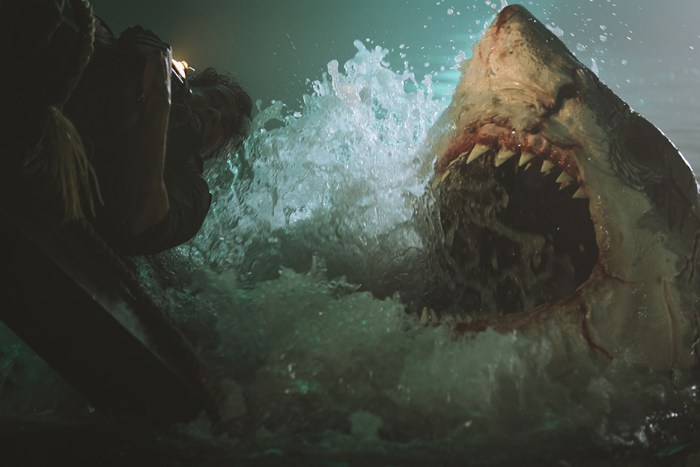
Mark Coles Smith and Shazza the Shark in Beast of War.
Do you remember seeing Shazza the shark for the first time?
Yeah, they’d loaded it up underwater. I think they’d done a couple of tests, and then they finally asked us to come in and jump up on the raft. When we finally saw it come racing up out of the water, chomping at us, we all burst out laughing — but we also thought it looked so great. It was like, “Oh God, here we go. We’re on now. Shaz is here. Shaz is on set.” [Laughs].
How much fun was it to perform opposite this thing?
Oh, it was fantastic. In the history of my career, I have found myself in some really interesting situations, but there’s nothing else I can compare Beast of War to. It’s the most diabolical plot line to live through where suddenly you’re having to try and search for the authentic reactions to exploding on a grenade, or to somebody getting their legs ripped off and all this sort of stuff. And we get to a point where we’re just covered in engine grease and covered in syrupy fake blood and the fog is surrounding us. And we can hear Kiah calling out on the megaphone from a distance, but we can’t see him inside the fog. It was a ball. We had a great time.
You’re working here opposite some of the most exciting acting talent in Australia right now. How was the camaraderie between the cast? Everyone really does give it their all here.
All of us knew there was a sense of the importance in this film of mateship, which was a big theme in the film. And of mateship in a distinctly Australian way, in a way that we wanted to remind everyone out there that mateship is very important. Let’s remind everyone about mateship through the vehicle of this film and how important that is to, in this case, survival. And it was really great to share this experience with these other actors. And as we were losing people to the shark, it was like, “Oh no, Sam’s gone! Hello darkness my old friend.” [Laughs]. But we made sure at the end of each weekend we got the boys on Pina Coladas down at one of the Thai restaurants there in Brissie, in between shoots. We all stayed really connected and really close with each other. It was a massive physical and mental undertaking. There was a certain degree of endurance and stamina required. It was really very cool. It was a very technical space, and we were also put under large creative constraints. It was a shoot that had an unspeakable amount of momentum. We were diving, we were punching. Man, we were really doing everything that’s on camera. Some of that stuff is like one or two takes, then boom, we’re moving onto the next scene. The nicest time of the day was the beginning of the day because that’s when we were dry. [Laughs].

Mark Coles Smith as Detective Jay Swan in Mystery Road: Origin Season 2
I spoke with your cousin recently Jub Clerc, who you worked with on the latest season of Mystery Road: Origin Season 2. What was it like to work with a family member, or someone you have that special connection with, on something like Mystery Road?
Well, it’s great for two reasons. I’ve grown up with Jub in my life and we’ve already got a shared language and we don’t have to tiptoe around each other in any way. And it’s also great because she’s just so bloody talented and she’s got such a lovely heart and she brings such lovely energy into the working space that is just infectious, really. There’s no vaccine for Jub. [Laughs]. I really revelled in having the opportunity to work with her across season two of Mystery Road: Origin. It was lovely. Both her and [co-director] Wayne Blair complement each other so well.
I don’t think I’ve ever seen Jub without a smile from ear to ear.
Yes, and often you hear Jub before you see her. [Laughs].
Detective Jay Swan holds a very special place in my heart. The original Mystery Road film released at the same time that I launched Cinema Australia, and I’ve met so many people involved in Jay’s legacy, including [creator] Ivan Sen who I admire. You share this character with the great Aaron Pedersen, but I’m wondering if you’ve claimed ownership of Jay now.
You have to claim ownership in a certain way in order to get the work done. My headspace filming season one was certainly different compared to season two, in how much I felt like I owned this character. Going into season one, I knew I had some ideas for a young Jay that I wanted to try and contribute to that character’s legacy, and I knew what those ideas were. I didn’t know if they’d be successful. I didn’t know how they’d be received and I didn’t know how I would be received as Jay. And seeing the success of season one was really special to see. Not only because the previous fan base got behind it, but to see that fan base grow even bigger because of Origin was really special. I went into the second season of Origin with a lot more confidence, a lot more focus on really doing everything I could to continue that character’s journey and that character’s story. I was very invested in the first season, even from a writing point of view and from a dialogue point of view. And it was the same case for season two. It’s not something I ever seek out to be credited for, but I really zero in on those scenes and I go over this character line-by-line and word-by-word of what is being said and how sequences and scenes are structured, particularly ones that are very Jay-centric and pivotal to Jay’s arc, which I think is a really interesting arc for season two. I think Jay’s vulnerabilities in his failings and his humanity really comes through in season two in a way that’s really important for him to reconcile.
Beast of War is in cinemas October 9. Mystery Road: Origin Season 2 is now streaming on ABC iView.
If you enjoy Cinema Australia as much as I love publishing it, please consider supporting Cinema Australia’s commitment to the Australian screen industry via a donation below.
I strive to shine a light on Australian movies, giving voice to emerging talent and established artists.
This important work is made possible through the support of Cinema Australia readers.
Without corporate interests or paywalls, Cinema Australia is committed to remaining free to read, watch and listen to, always.
If you can, please consider making a contribution. It takes less than a minute, and your support will make a significant impact in sustaining Cinema Australia as the much-loved publication that it is.
Thank you.
Matthew Eeles
Founder and Editor.Make a donation here.


 Cinema Australia