
Beast of War writer and director Kiah Roache-Turner.
Three bloody and brutal shark horror films have been released in Australia this year, all putting their own spin on the well-explored sub-genre.
First, we were treated to Matthew Holmes’ excellent period piece Fear Below, which sees a ragtag team of 1940s pearl divers go head-to-head with an aggressive bull shark while trying to retrieve a sunken car.
Next up was Sean Byrne’s Dangerous Animals, in which Hassie Harrison’s Zephyr is abducted by a shark-obsessed serial killer, played by Jai Courtney, and held captive on his boat while she watches helplessly as he feeds his victims to hungry great whites lurking below the surface.
Now, as we near the end of the year, Kiah Roache-Turner’s Beast of War is set to be unleashed. Arguably the strongest of the bunch—visually, technically, and narratively—Roache-Turner’s latest rampage follows a group of young soldiers, fresh out of boot camp, who find themselves stranded on a raft in the middle of the ocean after their ship is sunk by the enemy. They must battle for their lives against a giant, hungry great white shark.
This visually splendid horror (think Jaws meets Full Metal Jacket meets Bram Stoker’s Dracula) delivers everything you could ask for in a shark horror—from bucket loads of blood, to awesome jump scares, to one of the best-looking screen sharks we’ve seen in years. It’s ferocious, bloody, and razor sharp.
I won’t go too deep into the making of Beast of War in this intro, because I did that recently in a behind-the-scenes feature article, which you can read here. But it was only fitting that I caught up with Roache-Turner after watching Beast of War to ask some follow-up questions.
Beast of War is in cinemas October 9.
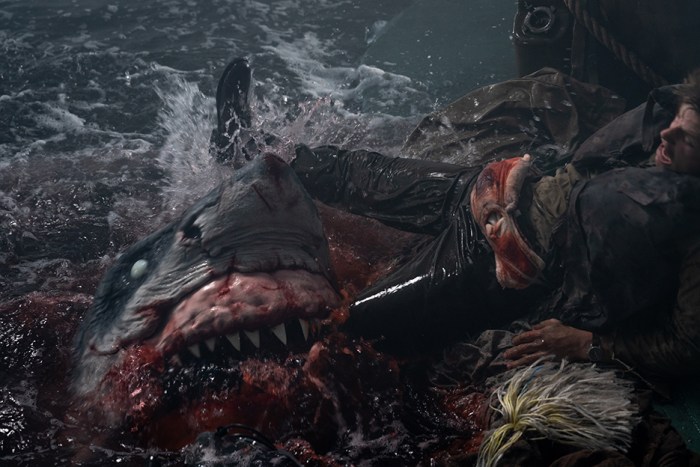
Beast of War.
“Digital can be good sometimes, but it’s not always the right move for horror because horror is a tactile medium, and you need to believe that the thing is there.”
Interview by Matthew Eeles
The critical response to Beast of War has been excellent so far. Do you take notice of reviews and reactions?
Oh, one hundred percent. You want your film to be successful. You want your film to make money. But critical reviews, especially from people like yourself, are very important. I’m not talking about the standard TikTok or YouTube reviewers who are all about clicks. If someone says or writes the word “meh,” I have no time for their opinion. That’s like a three-letter review. They didn’t even try. But when you’re reading a review from a critic who expresses their intelligence and has a very sensitive and layered understanding of what good cinema is, and they tell you that you’ve done a good job, it feels real. It’s like somebody who knows what they’re actually talking about approves. And that means so much.
Over the years, you and I have spoken a lot about your films, and I don’t need to tell you how much I’ve loved watching you grow as a filmmaker, but I feel like Beast of War is your most accomplished film yet from a technical and visual perspective. Do you feel that way?
I do agree. Beast of War is visually splendid, and I have to credit a lot of that to my DoP, Mark Wareham, who I think is one of the best DoPs in the country. His prior film and television work speaks for itself. He did The Drover’s Wife and Boy Swallows Universe. He’s very good. And so is Esther Rosenberg, my production designer. She’s such a brilliant designer. Esther and I were planning the look of the film way before we started shooting. We do a thing called pre-pre-production, which is where we spent months and months planning this. We originally thought we were going to shoot Beast of War in this giant outdoor tank in Malta, which would’ve resulted in a very different film visually. It would’ve been more realistic, but also, in a weird way, more flat, because you’ve got the ocean, which is greeny-blue. You’ve got the sky, which is blue. It’s not a very expansive palette because there’s not much you can do unless you’re shooting at night to colour things up. We were told we couldn’t shoot in that tank because Spielberg was using it—which I thought was wonderfully ironic, because every shark film ever made has stolen its premise from Spielberg originally. [Laughs]. So the only option left was to build this gigantic tank at Screen Queensland Studios. That gave us the option to create this hyperrealistic, deeply saturated colour palette that was very much inspired by Bram Stoker’s Dracula. I was like, “What if we did Nosferatu with a fin?” Both Esther and Mark got very excited by that, and we worked hard to make this palette insanely beautiful. We also worked on the idea that the less you see, the better. By trapping these characters in this giant fog bank, we didn’t have to worry about seeing the edges of the tank or the edges of the indoor studio we were shooting in.
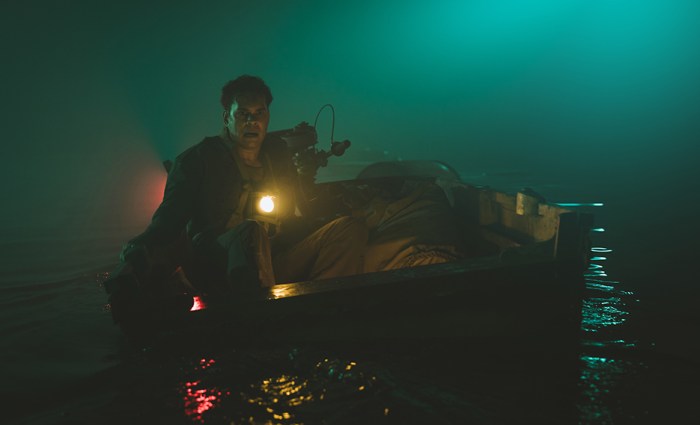
Mark Coles Smith as Leo in Beast of War.
You just mentioned Nosferatu, which is interesting because throughout your filmography you’ve explored zombies, spiders, demons, and now sharks. Are there any other horror subgenres you’re keen to explore?
All of them. [Laughs]. Actually, one of the first screenplays I wrote was called Blood Brothers, and it’s about bogan vampires. I’d be very keen to do that. I’m working on an alien body horror at the moment. Hopefully we might shoot that next year sometime. I keep telling people I’m working my way through all the monsters. I want to try them all. [Laughs]?
Beast of War is the third Australian shark film this year, behind Dangerous Animals and Fear Below. Have you seen either of those films? And I ask this knowing that you were also involved in the making of Fear Below.
Fear Below is one hundred percent a Bronte Pictures picture, and I was involved in some reshoots. Blake [Bronte of Bronte Pictures] asked me to do some reshoots on that film and to do some extra shark work. I didn’t really end up doing much, though. That was mostly [creative director] Steve Boyle, who handled those reshoots. But it was really fun to head up there and see the tank they were using. That was invaluable to me because I could see first-hand all the difficulties of shooting in a tank. Dangerous Animals was shooting while we were shooting, and so some of our crew and stunt people crossed over a little. We heard some pretty crazy stories about their shoot because they were shooting on the actual water out in the ocean. I was so glad we were shooting in a tank. [Laughs]. Shooting on the actual ocean sounds really difficult. I haven’t seen Dangerous Animals yet, but it sounds like that was a really good decision for them. Beast of War and Dangerous Animals, especially, are very different stories, and they both have very different aesthetics and stylistic approaches. So it’s nice to have two very different shark films coming out in the same year.
Australian filmmakers are great at putting their own spin on the shark genre. They’re all so unique and different.
You’re right. I feel like we’re close to it because all Australians have grown up with the threat of sharks. Obviously, we all grew up thinking about it because there are a lot of sharks in Australian waters, and we’ve all seen Jaws. My dad’s a surfer, so I spent a lot of time on beaches and in oceans with Jaws music running through my head as I was treading water. [Laughs]. We’ve all cleverly positioned ourselves between some children and old people so they get eaten first. [Laughs]. Spiders are the same for me. That’s how I made Sting, because I’ve been confronted by huntsman and funnel-web spiders my whole life. Being an Australian, we’re surrounded by monsters, aren’t we?

Beast of War.
Has making Beast of War heightened that anxiety now when you go for a dip?
It’s probably made it worse, yeah. It’s the same with Sting. I have horrible arachnophobia, and I was hoping making a film about a giant spider would help, but I think it just made it worse. They get more hideous. Same with sharks—now that I’ve spent so much time looking at wounds and footage of people being eaten by these giant things, it’s not made it any better. The guilt that comes with it is also knowing how beautiful great white sharks actually are. I’ve seen them in the ocean a couple of times. I had to do a commercial years ago in Port Lincoln and we had to film great white sharks. At first you look at them and you’re horrified—you step away from the edge of the boat and they’re monstrous and horrifying. And then, after about 10 or 20 minutes, you become hypnotised, watching these things move gracefully and beautifully through the water. They are an endangered species. So part of me is a little bit guilty about making a film like Beast of War. But, I mean, Jesus—they’re just so scary. It’s just fodder for a horror filmmaker. Whether they’re endangered or not, they’re still scary as fuck. [Laughs].
Beast of War is dedicated to Jim Roach-Turner, who died in 1945. What was your relationship to Jim, and what did you know about his time in the war?
He was my grandfather. I think about him a lot because my mother lost her father when she was three, and it kind of coloured her entire life. She was raised by a single mum, and she and her brother had to grow up without a dad. It was really full-on. There were always pictures and stories of him circulating through the family. I got to read his letters and correspondence to see what kind of man he was. Over the years, I’ve spoken to some of the people who knew him and learned that he was just a good bloke and a really funny guy, a hard worker, and all of his mates said he was the best bloke to go to war with. He was brave, he was fun. He was all of the things you want a bloke to be. And he died. He got shot by one of his own men. He was coming back from a night mission, and there was a young bloke who was trigger-happy and scared who shot him through the stomach, and he died. That kind of tragedy is so full-on. So I was thinking about this amazing man a lot when I was writing this film. A lot of him went into the character Leo, played by Mark Cole Smith. That’s why Leo comes across as a bit of a hero. That way, my grandfather, who I’ve never met, becomes mythologised. And it was really important to me that we cast Leo right. There’s just no bigger hero than Mark Cole Smith. That guy is so impressive. The younger bloke in the film, Will, was kind of me. I’m a pretty scared, anxious person, and I would hope that I’d go okay in war, but who knows? [Laughs]. It was very important to me that this young guy, played by Joel Nankervis, goes into war terrified, really scared, very anxious—and over time, he starts to come into his own. In a weird way, they almost swap personas. I always love that—when two characters are introduced into a film with very definite personalities, and then they kind of swap roles throughout the film. In the end, Joel’s character is kind of helping Mark’s character, who starts off as this mythical, unbeatable hero but becomes more vulnerable as the narrative goes on.

Mark Coles Smith as Leo in Beast of War.
Mark Coles Smith is incredible in everything he does, but I don’t think he’s ever been better than he is in Beast of War.
It’s so nice to hear you say that. I had never seen him in a role like this. He’s an out-and-out hero—but a flawed hero with a bit of a dark past—and God, he pulled it off. Yeah, he’s very good in this film.
We spoke extensively about this cast in our previous interview, so I won’t ask you too much about everyone here, but now that I’ve seen the film I can see how much of themselves each of these blokes have given to their performances. Do you have any war stories about your time working with these guys that really impressed you?
It was a pretty amazing experience. I grew up on war films like Gallipoli, Platoon, Full Metal Jacket, and Apocalypse Now, and they all make you think, “How do they do it? How do they get this group of guys together to bond as well as they do?” And from day one, all of these guys bonded instantly. It was amazing. Blake had the idea of really putting them through their paces. He brought in a bloke named John, who has been to war, is in the army, and has worked as an advisor on a lot of films. He came in, and they all had to put on their uniforms, and he’s yelling at them, making them swim up and down in a pool in their boots, saying, “Yes, sir, no, sir,” and saluting. And they just clicked into it. Even the extras. We got all these local boys from Byron Bay, and it was so bizarre because I came onto set and already had a pre-prepared unit ready to go. They all felt like they were in a war, and I was very happy with that. To me, I’d always played war games when I was a kid—you pretend to be a soldier—and to see them all believe that they’re in this war and turn up to set so prepared was such a great feeling. At the end of the day, they were just playing together, and they became an absolute unit, really supporting each other. Once they were in uniform, something psychological happened. They started supporting each other and became this team. It was great. It was pretty inspiring.

The cast of Beast of War.
What risks are involved when shooting on so much water?
Water’s incredibly dangerous, especially when you’ve got people in boots with equipment going underwater. We had safety divers on set at all times, and we only cast people who were good swimmers—that was really important. But working in water can be quite horrendous if your foot gets stuck on a rope, or you get dragged under. So it was pretty scary at times, especially with some of the night scenes where there are a bunch of dead guys in the water, floating around with all this debris. The debris is quite dangerous. But again, our stunt guys were really careful. It’s a little bit easier when you’re dealing with a tank because there are these things called “Jesus walks,” which are underwater walkways. So you can always get to somebody if they’re struggling. Shooting indoors is a little bit easier, but I would not want to shoot in the ocean at night-time. I would not want to do that.
Did you spend much time in the water yourself?
No. And I sort of regret that too. We got right to the end of the last day of shooting, and a very young crew member—a very respectful bloke—asked [First Assistant Director] Jamie Crooks if they could throw me in the water as a joke. Jamie came up to me and said, “The little buggers want to throw you in the water.” I was tired, and I said, “Man, I’m not doing that. No, we’re not doing that.” And I regret it to this day, because that’s actually a massive sign of respect. It means they liked me and were comfortable with me, and that would’ve been a beautiful photo opportunity. And also, I never got in the water for the entire shoot. Not once did I get in. I was just Mr Director with my dry clothes, yelling at people from a monitor, sitting in a chair. [Laughs]. And I regret that. But I’m 46 years old, and every year I get lazier, so I didn’t want to jump in the pool. [Laughs]. That’s a young person’s game.
It was the wrong decade for you.
Yeah, 36-year-old me would’ve done it, for sure. [Laughs].

Shazza.
This shark is one of the best-looking sharks I’ve ever seen on film. Talk us through your passion for practical effects.
Digital can be good sometimes, but it’s not always the right move for horror because horror is a tactile medium, and you need to believe that the thing is there. If you get any kind of Uncanny Valley, it ruins the scares. With this one in particular, it had to be a puppet mainly because of water displacement. No matter how far we get digitally, when you’ve got something interacting with water, it’s so difficult to make it look good unless you’ve got $400 million and James Cameron directing. And we did not have either of those things. [Laughs]. So I just knew that if we went with digital, we wouldn’t be able to afford to make it look amazing. And if you’ve got a puppet shark or an animatronic shark popping up out of the water, then the water displacement looks so much more realistic. We talked about digital fins, and I looked at a few digital fins from other shark films which I won’t name, but they just didn’t look real. They looked good, but not real. And of course, all the late seventies and eighties horror movies like The Thing, The Exorcist and Jaws are phenomenal because it’s a real thing. That reality is important. Steve Boyle and his team at Formation FX did the sharks, and they were just amazing. We didn’t have a big budget, but Steve came in and said, “I’ll sort it out. It’s going to look good, trust me.” And he went above and beyond. He was able to give us a half-ton attack shark on a giant metal track that pops up out of the water with these huge jaws snapping away, big explosions of water everywhere, then it pops back down. It just looks amazing. Then he built the fin section, which was like a giant submarine pulled on a huge cable machine that often didn’t work—but when it did, God, it looked good. [Laughs]. The mistake most shark films make is that they just have a fin. They build a fin and put it through the water. But what you’ve actually got to do is build a fin on a submarine, because it’s not about the fin, it’s about what’s under the fin. You get this water displacement that makes everything look so real. Steve also built this giant puppet head that’s basically a stunt crew guy, Chris Bridgewater—who’s actually a UFC fighter—getting inside the shark head and manipulating it to chomp people’s arms and legs and explode up out of the water. The trick with that is it doesn’t work unless you have huge explosions of CO2 underneath. When this lightweight puppet head came at people, there would be no water displacement—just a head. But with all these CO2 canisters rushing water around it, it gives the impression of a huge body underneath. So Steve and his crew gave us so many different options with the shark. I think it’s one of the best puppet sharks in any movie. I was really, really pleased with the results.
This question may be a bit odd, but did you ever come up with a backstory for the shark, considering it is scarred and beaten up? It’s an angry, almost zombie-like shark.
Not really. It’s the look and feel of the thing. My approach to monsters generally is that they’re mythical. I like the idea that we don’t know much about this shark. One of my favourite things about Alien is that you just don’t know. There’s not a lot of backstory in the first film. So this shark is scarred up, and she’s clearly had a lot of fights. She’s a barroom brawler. She’s tough as guts, and she’s going to eat ’em all. [Laughs]. We toyed with the idea of her being the same shark that killed Leo’s brother. That was always going to be a backstory, but a lot of people told me it wasn’t a great idea. So I scrapped it. I thought it was pretty cool, but hey, what do I know? I’m just the writer and director, right? [Laughs].
Well, that’s very interesting, because I wondered if it was the same shark that killed Leo’s brother.
The film originally started with a much longer sequence where Mark and his brother speak to each other in language, and you get to know the brother a lot more. It was a beautiful scene, but it never worked. It slowed the movie down. It was two guys talking in a boat, shot in a very old-school kind of way. It looked like a Vincent Minnelli musical. Beautifully done, but too dreamlike. I just couldn’t start the movie like that. I tried moving it elsewhere, but that was even worse—it slowed things down more. So I ended up cutting the scene into fragmented dream sequences. In the end, that was just a much stronger approach. Less is more.
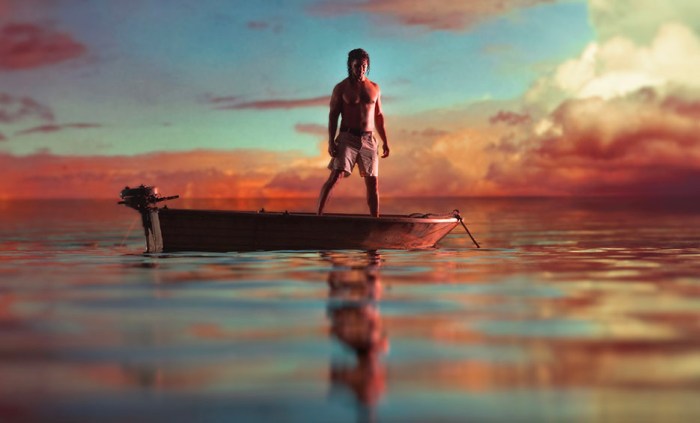
Mark Coles Smith as Leo in Beast of War.
A lot of support is being given to genre cinema in Australia at the moment. Is there anything that could be done better to get more genre films like Beast of War off the ground?
It’s a tricky question, Matthew, to be honest. My career has definitely sailed on various waves of government funding. My projects have always been backed very well in different capacities. So I’m probably not the person to ask because I really have nothing to complain about. I’m sorry, I feel like I deflected your question a bit.
Not at all. It’s the perfect answer.
Well, I’d like to highlight a story for you. When I made my first film Wyrmwood, I started making it as a seven-minute proof-of-concept. We spent about $7,000 on it, and it went viral—hundreds of thousands of views within weeks. Everybody got excited. We took it to Screen Australia and they rejected our financing attempts. They continued rejecting us throughout the entire production. But I kept meeting with people at Screen Australia every couple of months. They said, “Look, we can’t finance it. You’re not a filmmaker, you’re just some bloke with a camera. You’re doing good stuff, but there’s not really anything we can do. But please finish it, and we’ll see what we can do because you guys are doing so well.” Every few months they’d meet with us, always incredibly positive and supportive. Sometimes we’d get frustrated—why weren’t we getting financed? But we didn’t dwell on it. We just kept going. We finished the movie, gave Screen Australia the director’s cut, and said, “Look, we’ve finished it. Can you help with post-production?” They gave us $250,000 to finish the film and pay everybody who worked on it. Now, if I’d been grumpy and said, “Well stuff them, they’re not helping me,” I wouldn’t have had the relationship that got us that post-production funding. If I could offer advice, it’s that funding bodies react really well to people who go out and do it themselves. The people who complain the loudest are often the ones who don’t want to do the work. You can’t just say, “Well, I’m here. I’m ready. I’m talented. Fund me!” That’s not enough to get you a million dollars. But if you say, “Look, I’ve done this amazing thing, I’ve proven I can do it,” then that’s a different conversation. You’ve got to prove you’ve got what it takes, and usually they come to the table. So I’ve been pretty lucky like that.
Do you plan to make another Wyrmwood film?
It’s a tricky question, because me and my brother Tristan made Wyrmwood together. That’s our world. He’s gone back to working as an electrician now, doing very well. So he’s kind of done with the industry. We had a conversation a couple of years ago where he said, “I love making movies with you, but I don’t really love the industry.” And the industry can be difficult, toxic, and pretty insane. A lot of it doesn’t make sense. If you’re not absolutely obsessed with cinema like I am, it’s hard to justify staying in an industry that often doesn’t seem to work very well. Tristan and I liked making films together, but he just got sick of it and moved on. We made Wyrmwood: Apocalypse, and we were so happy with that. It worked out so well that we went out on a high. I probably wouldn’t want to do a Wyrmwood movie without Tristan. So that’s on hold at the moment.
Beast of War is in cinemas October 9.
If you enjoy Cinema Australia as much as I love publishing it, please consider supporting Cinema Australia’s commitment to the Australian screen industry via a donation below.
I strive to shine a light on Australian movies, giving voice to emerging talent and established artists.
This important work is made possible through the support of Cinema Australia readers.
Without corporate interests or paywalls, Cinema Australia is committed to remaining free to read, watch and listen to, always.
If you can, please consider making a contribution. It takes less than a minute, and your support will make a significant impact in sustaining Cinema Australia as the much-loved publication that it is.
Thank you.
Matthew Eeles
Founder and Editor.Make a donation here.


 Cinema Australia