
Kate Woods.
It’s been more than two decades since Kate Woods made her feature debut with the beloved Australian classic Looking for Alibrandi.
Since then, Woods has been busy in the United States, directing episodes of acclaimed series including The Lincoln Lawyer, Law & Order: Organised Crime, The Umbrella Academy, Bosch: Legacy and The Lost Symbol. In 2020 alone, she worked across The Good Lord Bird, for which she earned an ADG Award nomination, Messiah, and Home Before Dark.
Now, Woods has returned to Australian cinema with Kangaroo, her first local feature since Alibrandi. So what was it about this project that pulled her back home?
“It was so quintessentially Australian. You couldn’t get a more Aussie story,” Woods told Cinema Australia during a recent press junket.
Beyond its iconic title, Woods was drawn to the opportunity to explore both the cultural and environmental connections tied to one of Australia’s most recognisable national symbols.
“We’ve seen images of the outback so many times in different ways, but this was a more personal connection with the animals and with the communities in central Australia. It was too good an opportunity to pass up.”
Kangaroo is a heart-warming family comedy about former TV personality Chris Masterman (Ryan Corr), who finds himself stranded in a town outside Alice Springs (Mparntwe). There he meets 12-year-old Indigenous girl Charlie (Lily Whiteley), and together they form an unlikely friendship while working to rescue and rehabilitate orphaned joeys. Against the backdrop of the breathtaking Outback, their journey proves life-changing for them both.
Though intended as a children’s film, Woods insists Kangaroo offers plenty for all ages.
“I’m always hopeful that the parents who go along with the kids will enjoy it too. I think it’s got a little bit of everything for everyone.”
Kangaroo is in cinemas now.

Kangaroo.
“I am so proud of Lily and what she achieved and the courage she had to dive into a leading role like this was extraordinary.”
Interview by Matthew Eeles
Kangaroo is inspired by the true story of Chris Barnes. Were you aware of Chris prior to Kangaroo?
No, not at all. I was introduced to him as part of the film, and I must say that when I visited his sanctuary, when I was first offered the film, that was what sealed the deal for me. Chris is such a charismatic person, so passionate and enthusiastic about what he does. And those little joeys, you can’t help but fall in love with them. They’re so delightful and affectionate because they’ve lost their mums. They’re looking for a replacement, so to speak. They were really fun to be around.
How involved was Chris on an advisory level?
He was there every day. He provided the joeys in the film and taught us how to look after them. They’re wild, traumatised animals because they’ve lost their mums, so they needed very special handling. He was there every moment.
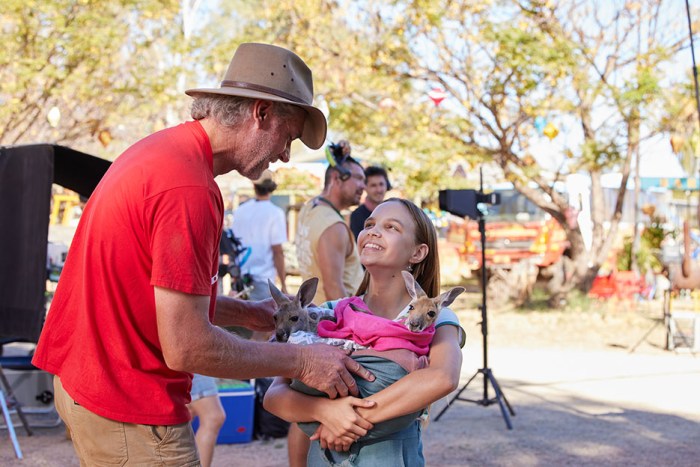
Chris Brolga and Lily Whiteley on the set of Kangaroo.
How did you go with the kangaroos physically?
They’re so cute and delightful, and affectionate. You can’t help but want to hold them. They always seemed to get passed from hand to hand. There was always someone who wanted to give them a cuddle.
I love the little rolly pollies they do into the pouches.
[Laughs]. They’ll jump into anything that looks like a pouch. They hop in, bounce around, then turn themselves the right way up. When they do it outside a pouch, it’s just them trying to find something to get into. It’s really sweet.
You’ve said that not many films have shown kangaroos in a realistic and natural way. Can you talk us through the challenges of presenting them that way?
Number one, they can’t be trained, so you can’t get them to do anything. Even the smallest act wasn’t possible. They will follow you once they know you. They trotted behind Chris all the time, and they did with Ryan Corr, who plays Chris in the film. But we made sure, both in the script and on set, that they were never expected to do anything other than what they would naturally do. Occasionally, there was a milk bottle just outside frame to catch their attention, and of course, there’s some very clever editing to make it all look seamless. But it was filmed all over the place. It was just about being mindful of what we could get.
What percentage of the kangaroos are CGI versus practical? The CGI is exceptional here. I think this is the most realistic kangaroo CGI I’ve ever seen.
They are fantastic. The visual effects team was amazing. It took a long time to get Roger, the big kangaroo that befriends Chris, just right. Every vein and every hair was meticulously worked on. I think they did an incredible job.

Lily Whiteley as Charlie on the set of Kangaroo.
I love being introduced to emerging talent through film, and with Kangaroo it was a joy to watch Lily Whiteley hold her own opposite established talent like Corr and Mailman. How was your time working with Lily, considering this is her first acting gig?
She was incredible. She had never stood in front of a camera before this film. We arranged for her to work with an acting coach before filming. She lived in Queensland, and we wanted to get her working with someone as soon as possible. I also had rehearsal time with her. I am so proud of Lily and what she achieved and the courage she had to dive into a leading role like this was extraordinary. Her appeal on screen is just beautiful. Her face lights up the whole screen. We were thrilled to have found her, and I’m delighted with what she did.
As someone who’s been working in the industry for as long as you have, what do you take away from working with someone as young and fresh as Lily?
I’m always learning from younger people, especially Lily. I learn about different approaches—what makes it easier for them, what challenges them. It’s always a learning experience. My job as a director is to create the best environment for people to do their best work, and you learn how to do that for different people. Working with someone young like Lily was a really great experience.
Tell us about Ryan Corr’s paternal chemistry with both Lily and the kangaroos.
Well, you can’t direct chemistry—it has to happen organically. With a 35-year-old man and a 12-year-old girl, we were very careful about how we put them together, but the chemistry between them was so natural. It flowed beautifully. They got on just as well off set as on, and I think the heart of the film is their relationship. They genuinely loved those kangaroos too. They spent a lot of time with Chris at his sanctuary, learning how to care for them. It was a magical combination.
What can you tell us about the community involvement in this film? Alice Springs is no stranger to film crews. How did they embrace this project?
They were fantastic. All the townspeople came from Alice Springs, of course, and the gang of kids around Charlie were all from there too. None of them had acted before, but they were fabulous. They were fun to work with, focused, and did their very best. I can’t wait for them to see it. It’ll be such fun for those kids to watch themselves on the big screen for the first time. And the elders of the community opened incredible places for us to film. We couldn’t have made it without them.
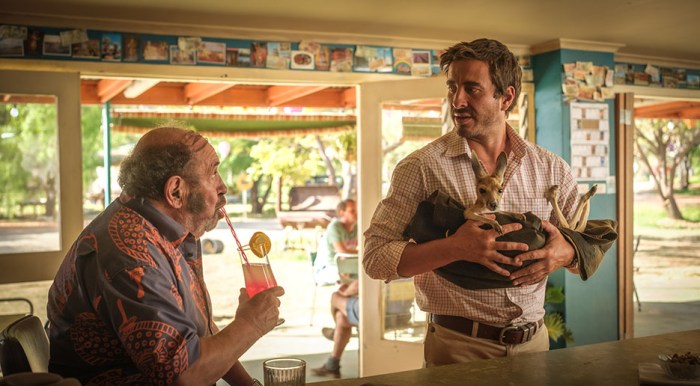
Roy Billing as Murray and Ryan Corr as Chris in Kangaroo.
Other than the incredible landscapes and kaleidoscopic production design, one thing that really jumped out at me was the paintings featured in the film. Is there a story behind them?
The two paintings that were supposedly done by Charlie’s father were made especially for us. The others were by local artists. We also had some local artists paint on camera so the audience could see the process. It was fantastic.
They add so much colour to the film, complementing the production design. It’s rare to see such a colourful outback town in an Australian film. Usually everything’s covered in red dust and dirt.
Thank you. We tried very hard to make it look different. Sam Hobbs, the production designer, did an amazing job. He created that town from pretty much nothing, and we wanted the colour as vibrant as possible. It echoes the natural colours of the outback while lifting it at the same time. It created a slightly heightened, joyful environment. We just sprinkled a little fairy dust on that town, and the intense colour was part of that.
As an Australian film buff, it’s impossible to talk to you without asking about Looking for Alibrandi, which is enjoying a new life with its recent 4K restoration. Were you involved in that process?
It’s wonderful. I’m constantly delighted and amazed by the longevity of Looking for Alibrandi. I put that down to Melina Marchetta’s beautiful story. I only recently found out about the restoration. It was screened at the Melbourne International Film Festival, so I went to see it and met up with the stars and Melina. It was absolutely fabulous, and audiences still respond so well to it. It thrills me that Josie keeps on keeping on. [Laughs].
Kangaroo is in cinemas now.
If you enjoy Cinema Australia as much as I love publishing it, please consider supporting Cinema Australia’s commitment to the Australian screen industry via a donation below.
I strive to shine a light on Australian movies, giving voice to emerging talent and established artists.
This important work is made possible through the support of Cinema Australia readers.
Without corporate interests or paywalls, Cinema Australia is committed to remaining free to read, watch and listen to, always.
If you can, please consider making a contribution. It takes less than a minute, and your support will make a significant impact in sustaining Cinema Australia as the much-loved publication that it is.
Thank you.
Matthew Eeles
Founder and Editor.Make a donation here.


 Cinema Australia