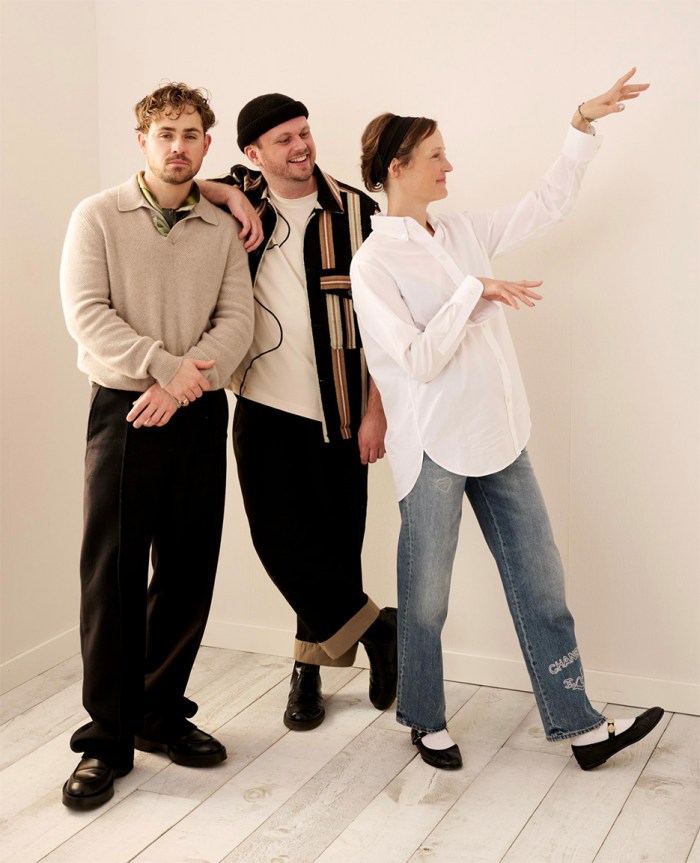
Dacre Montgomery, Samuel Van Grinsven and Vicky Krieps. Photo by Gareth Cattermole/Getty Images.
I’m a sucker for a great two-hander, and Australia makes so many of them. But how many two-handers have you seen in which the two leads each share an additional role — a third character? That’s what we get with Samuel Van Grinsven’s excellent and atmospheric sophomore feature film, Went Up the Hill.
The film follows Jack, played by Dacre Montgomery, who travels to remote New Zealand to attend the funeral of his estranged mother, Elizabeth. There he meets her widow, Jill, and the two are drawn into a strange, unsettling connection with Elizabeth who possesses both Jack and Jill, forcing them to face their deepest fears — abandonment, grief and guilt — while also testing their trust in each other.
Went Up The Hill is a modern ghost story and a psychological drama inspired by Van Grinsven’s own memories of growing up in New Zealand’s South Island. It’s a film about grief, memory and letting go, told in an intimate and haunting way.
Montgomery, who is well known for his role as Billy in Stranger Things and more recently appeared in Baz Luhrmann’s Elvis, stars alongside Vicky Krieps (Phantom Thread, Corsage) who plays Jill in the film. Their performances here are masterful.
Van Grinsven first made his mark with Sequin in a Blue Room, which won the Audience Award at the Sydney Film Festival in 2019 and went on to screen at festivals around the world. Went Up the Hill cements Van Grinsven as one of Australia’s most exciting filmmaking talents.
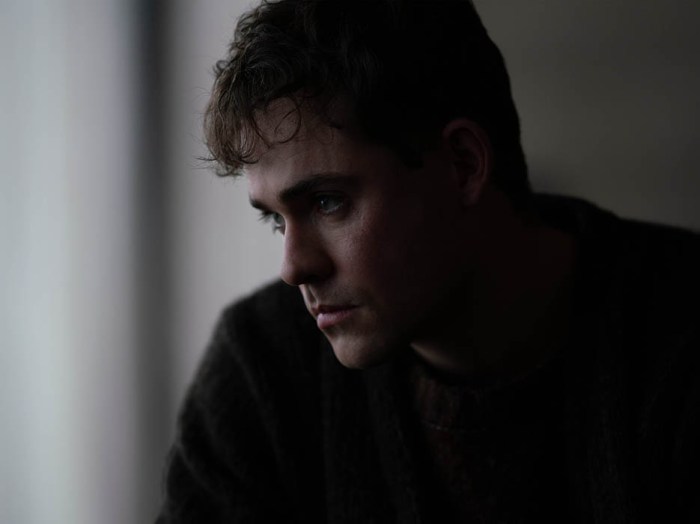
Dacre Montgomery in Went Up The Hill.
“Samuel is the shepherd of the entire process. We were on the South Island of New Zealand, in a very isolated location, shooting on location, and every single person there had given up something to be there.”
Interview by Matthew Eeles
Samuel, you’ve said that you were inspired by an image of two people standing in a glass room, a coffin between them, both equally mourning the person inside, but knowing next to nothing about one another. Can you elaborate on that initial image and how this film’s concept expanded from that?
Samuel Van Grinsven Well, I’ve made two films so far and I’m in prep for my third. Organically, the same thing has happened to me each time: when I’m in post-production on a film, an instinct or an image comes to me. I’m a very visual director. The scripts I write are very visual. You’ve seen Went Up The Hill, so you’ll know it’s visually focused. When I was in post on my first film, Sequin in a Blue Room, I had this overwhelming instinct that my second feature would be shot in New Zealand, where I’m from. I followed that instinct, and it started evoking memories from my childhood, growing up there. My parents are musicians, so we travelled up and down the country a lot. Once you have an instinct, you just investigate it and let it brew. I usually let it brew for most of post, and then when I come out the other side and I’m available, I begin writing. Went Up The Hill came from whatever was happening to me in post-production on Sequin in a Blue Room.
When you spoke about that image I mentioned, I wasn’t sure if you were referring to a physical image, or something more internal.
SVG I get hooked on something. I got hooked on the ideas that would eventually make up Went Up The Hill. The idea of returning to the South Island, and the legacy of that place. My first memory of learning that films actually get made in New Zealand was my parents talking about Peter Jackson making Heavenly Creatures in Christchurch. He’s an idol of mine. So when I trusted that instinct to go back to New Zealand, that film was probably floating around in my mind too. It’s strange—I guess my brain just sees what it’s going to look like before I know what the story is going to be.
You’re exploring some deep and complex themes in Went Up The Hill, from domestic control and toxic abuse to parental abandonment and more. I imagine it would be difficult to write about these themes accurately and authentically without having experienced them in some capacity. How much of Went Up The Hill comes from a personal place?
SVG Nothing in a literal sense. What I really love about this film—and what I’m really proud of—is that it’s a queer film. It’s not explicitly about being queer in any way, but the fact that these two characters are queer eliminates an audience expectation that they could ever fall in love. That’s such an ingrained narrative expectation when you see two people of opposite genders mourning someone. And what that creates is this ability for them to not know each other, to heal, and to have a common thread between them that’s never complicated by romance. That felt very true to me and my experience. I grew up in a conservative part of the country. I faced a lot of physical abuse for being queer, and that really shaped me as a person. It shaped my confidence. It shaped my narratives. Moving to Sydney was when I found a queer community—a chosen family, in a way. There’s a beautiful connection when someone has that shared experience. You just naturally heal each other without trying. They make you feel seen and heard. I think that’s what organically and authentically fell into these two characters from myself.
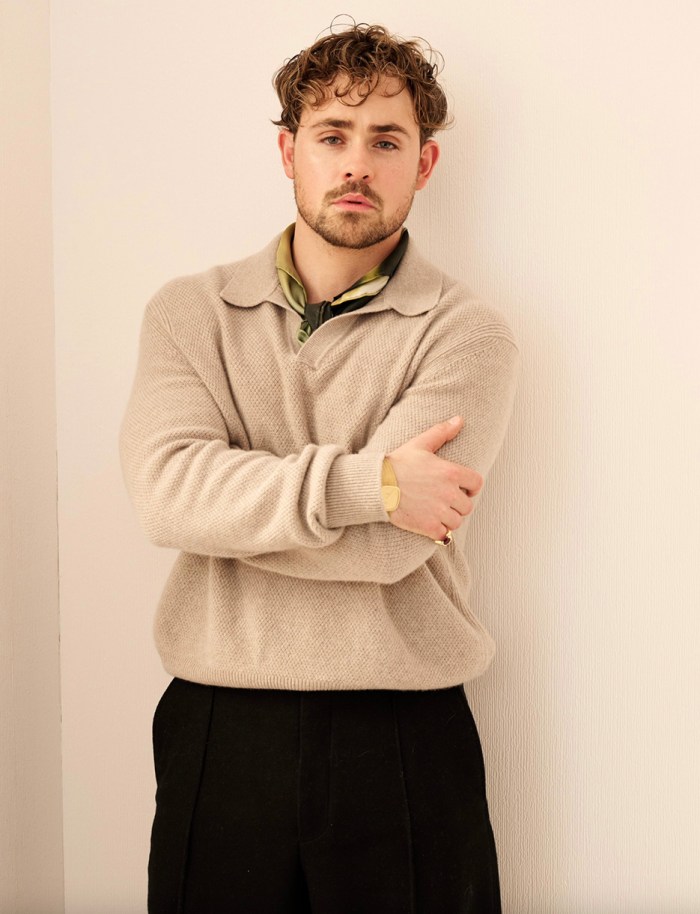
Dacre Montgomery. Photo by Gareth Cattermole/Getty Images.
Dacre, the ten-year-old inside me is very excited to be sitting here talking to a Red Ranger, but the more mature film enthusiast is thrilled to see you take on a much more dramatic role in Jack. Does this film mark a shift in your career trajectory?
Dacre Montgomery I hope so. It’s forever been my dream to make a movie like this. I also couldn’t have imagined how much I’d learn from Samuel in this process. I largely took the last five years off—aside from a small role in Elvis and another film that’s yet to be released—to find something like Went Up The Hill. I want every single person, including myself, to dissociate from Power Rangers and Stranger Things. Not because I didn’t love working on those projects—I did—but now I know that I want to work with filmmakers who have a very specific vision. I’ve always been someone who puts all of myself into a role, and I got to a point where I didn’t want to do that unless I could give my full spirit. I don’t want to be part of something that isn’t in line with the kinds of stories I want to tell or the messages I want people to take away. And this is a great example of that. I haven’t spoken about this in interviews yet, but listening to Samuel answer your question just now made me very emotional. The fact that Samuel allowed me—as someone who doesn’t identify as queer—to play this role means so much to me. You have no idea. For him to have that confidence in me is really important. The people you surround yourself with are a reflection of you. And this film is all of him. Even if he didn’t go through the exact experience presented on screen, it’s still all him. I came into this experience wanting to establish trust and understanding, and for him to put his trust in me as well.
Would you say this is the deepest you’ve embedded yourself psychologically within a character?
DM Yes, I definitely feel that way. But again, that’s a reflection of the crew too—including, obviously, Samuel as the shepherd of the entire process. We were on the South Island of New Zealand, in a very isolated location, shooting on location, and every single person there had given up something to be there. People often take the film industry for granted, not realising that everyone involved in making a film has given up time with their families and their personal lives. But this was another level. Every person you’d speak to on set had a deeply personal connection to the subject matter in their own way. That becomes very affecting as a crew. There was this shared push towards creating something real, and I think that’s so profound. Making Went Up The Hill was one of those rare and wonderful experiences where everyone was giving it their everything. That made it very special, and very intense. But because of that, and because of Samuel leading the charge, it’s a very specific movie. It’s the kind of movie I’ve yearned to make since I was a kid.
Samuel cemented himself as a serious talent with his debut, Sequin in a Blue Room. How familiar were you with Samuel’s previous work, and what drew you to want to work with him here?
DM I read the script for Went Up the Hill on a plane, and I just lost my shit. [Laughs]. I wrote him a note, then I read the script again. Then I looked at this incredible PowerPoint presentation he had as an accompaniment to the script, containing his creative vision, and I lost my shit all over again. [Laughs]. Then I Zoomed with Samuel within 48 hours of that whole experience. I knew straight away that Samuel is such an incredible creative. And I know it’s hard in these circles to have a level of authenticity when I say this, but I do think Samuel is the greatest filmmaker of my generation in Australia. People will laugh that off, but I believe it—because I’ve been on this journey with Samuel. I felt a specificity in his vision from the get-go. I’ve learned so much from him. He has so many great productions coming up that he’s told me about, and I’m so excited to see all of that come to fruition for him. I feel like this film is just the tip of the iceberg.
Samuel, art plays a big part in this film, and there are quite a few different artistic mediums used throughout. Can you tell us about those art pieces, and the people you worked with to bring them to life? I also love that they’re all black and white.
SVG Dacre’s character, Jack, is an artist in the film, and all of his work featured throughout is created by a Christchurch-based artist named Samuel Harrison. He was incredible to work with and extremely generous. His work, both tonally and emotionally, matches the film. There’s a brutality to it, which I think the film has as well, but there’s also a romance. Please note, this is not me speaking for Samuel Harrison; this is just my take. Jack having a creative outlet was always in the screenplay. Like Jack’s art, another character in the film, Jill, has her own creative outlet. Sherree Phillips, our amazing production designer and an incredible storyteller, asked me, “Where’s Jill’s space in the house? What is her art?” It was one of those amazing moments as a director when a head of department challenges you—I love that. Her question got me spiralling, but it was Sherree who came back and said, “I think it’s a loom. I think she’s a weaver. Because the film is so silent, we really want to play with texture.” And because the colour palette of the film is extremely strict, texture became really important. When you take colour away, you need texture—otherwise the image is boring. Weaving gave us what we were looking for, but it’s also thematically connected to her character. There was so much coincidence around this film: we were shooting in Christchurch, which happens to be the loom capital of the world. It has the highest concentration of loom artists.

Dacre Montgomery and Vicky Krieps in Went Up the Hill. Photo by Kirsty Griffin.
I can’t sit here talking with you both about this film without mentioning Vicky Krieps. Can you share your experiences of working with her?
DM Vicky is an artist who put all of herself into this. She’s so generous with her personal process of healing—her trauma, her demons—which I think is really scary. People really take for granted what an actor puts into a role. Most people think, “Oh, they’re just acting.” But it’s not my story to tell—Vicky was going through something deeply personal that mirrored, in many ways, what Jill is going through in the film. She was extremely open about that with Samuel and me throughout the process of building Elizabeth, the third character that we both play in this film. I personally found it very affecting to be confronted by an artist who was so willing to put so much of themselves into a role. Both Vicky and I are really intense people, so it was just about finding our rhythm together. I’ll tell you a story I haven’t shared with anyone yet. Through conversation, we discovered that we both use the same acting technique: finding a perfume for every character we play to help get into their mindset. I had already chosen a scent for Jack, and she had chosen one for Jill—but she also had a scent for Elizabeth. What we decided was that, when either of us was playing Elizabeth, we would wear the scent so the sensory experience would shift. If Vicky was wearing it, I could smell Elizabeth coming, and vice versa. Vicky is an amazing artist—truly. I felt like we were both in the trenches with Samuel, all of us trying in our own way to make the most of each moment.
SVG The fact that Vicky was willing to trust me when I had only made one film prior is such a testament to the type of artist she is, and how daring she is. She taught me so much. Both Vicky and Dacre did, in really different ways. They’re very different actors and artists. I’m saying this in the most loving way, but Vicky is a challenging artist—in the best possible sense. As I said earlier, I love working with department heads who challenge me, and Vicky is that kind of force. I can’t wait to make another film because of Vicky. Working with her felt like a masterclass, and I can’t wait to use what I learned on my next project.
There’s quite a dramatic scene toward the end of the film involving Dacre’s character, Jack, falling through ice. How much of a challenge was that to shoot?
SVG It’s a very ambitious film. Pretty much everything with ice was shot for real—none of it on a soundstage. It’s not a real frozen lake, but we built that surface in front of a real lake in New Zealand. When the characters are above the ice and wet, they’re genuinely facing those elements. The underwater elements were the only parts shot separately, in tanks. That was my first time working in that kind of space—it was an incredible learning experience. What’s most interesting about it is the trust these two had to place in me. You have to shoot so out of order and moment-to-moment for safety, for a million different reasons—continuity being one. It was just me and my DOP who knew how any of it was going to come together. It was freezing. We were shooting in New Zealand, where the cold gets into your bones. But again, there’s nothing I would change. I’m not the type of artist or person who wants to shoot on a heated soundstage.
DM I was freezing. I was the coldest I’ve ever been in my life—and it was really, really tough. Especially during the night scenes, where there’s no cloud cover, no snow, and it’s just me lying in the dirt. But I wouldn’t take any of it back. It was my dream project, so I don’t regret any of it.
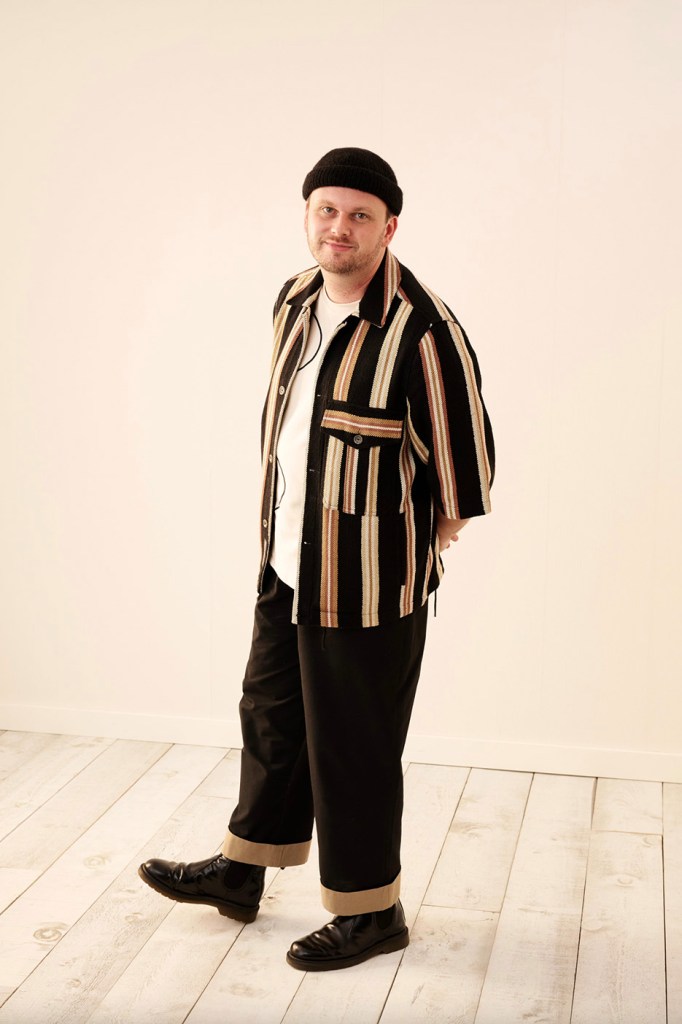
Samuel Van Grinsven and Vicky Krieps. Photo by Gareth Cattermole/Getty Images.
Samuel, you were born in New Zealand but you’re based in Sydney. New Zealand is making some incredible films at the moment. Is there something New Zealand does right in terms of nurturing and supporting filmmaking talent that Australia could adopt?
SVG This film was a co-production between Australia and New Zealand. We had an Australian team and a New Zealand team. Our skill sets are really different, and that surprised me. I grew up in both countries, so I didn’t think we’d have such different approaches to filmmaking and talent development. Australia is amazing at nurturing talent—we have incredible voices here, and incredible producers who champion them. Look at Causeway Films—they’ve discovered and elevated an amazing group of directors. New Zealand, on the other hand, gets to make films like Avatar and The Lord of the Rings, so their crews are trained differently. In Australia, we have a thriving indie sector. So our strengths lie more in things like resourcefulness, time management, and making the most of small budgets. Right now, I think both countries are absolutely punching above their weight and striving to be taken as seriously as we deserve to be.
Dacre, you directed two short films in 2020. Is directing something you’d like to explore in a feature film format?
DM I’m going to be directing my first feature film next year, which Jory Anast, who is actually Samuel’s writing partner, wrote. It’s all I’ve been thinking about lately. I’m beyond excited. Hopefully we shoot in New South Wales soon. I’m still trying to find the cast. It’s a very small film with a big message. Jory is an incredible screenwriter, and I’m so stoked to be working with the producers we have on board. I’ve wanted to direct since I was 10. I spent a lot of lockdown learning how to edit, and I spent all my own money on courses and short films with friends. This is the next step I want to take in my career, in my creative process, and in my life. I’m so excited. The creative process never ends.
Went Up The Hill will screen at CinefestOZ from Monday, 1 September. Details here. Went Up The Hill will open in cinemas nationally on September 11.
If you enjoy Cinema Australia as much as I love publishing it, please consider supporting Cinema Australia’s commitment to the Australian screen industry via a donation below.
I strive to shine a light on Australian movies, giving voice to emerging talent and established artists.
This important work is made possible through the support of Cinema Australia readers.
Without corporate interests or paywalls, Cinema Australia is committed to remaining free to read, watch and listen to, always.
If you can, please consider making a contribution. It takes less than a minute, and your support will make a significant impact in sustaining Cinema Australia as the much-loved publication that it is.
Thank you.
Matthew Eeles
Founder and Editor.Make a donation here.


 Cinema Australia