
Careless filmmaker Sue Thomson. Photo by Eddie Jim.
Few Australian filmmakers are creating social impact documentaries with as much heart and urgency as Sue Thomson. Over the past seven years, her work has explored issues around ageing, community, and dignity, giving voice to people whose stories are too often overlooked.
Her 2018 film The Coming Back Out Ball celebrated LGBTI+ elders and the joy of coming together later in life. She followed this with Under Cover, a confronting look at the reality that women over 50 are the fastest-growing group facing homelessness in Australia. Now, with Careless, Thomson turns her attention to the aged-care system — a sector that has become big business, but one that many families experience with fear and uncertainty.
The film was inspired by her father’s time in aged care, which Thomson recalls as being positive, but also by the darker reports that surfaced during the pandemic and the revelations of the Royal Commission. When her mother Margaret, now 89, began to need more support, Thomson realised she had to face the questions that so many Australians do: whether to consider residential care, and how to navigate a system plagued by stories of neglect.
Careless uses Margaret’s story as a personal entry point into a wider investigation of aged care in Australia, examining decades of policy decisions, the consequences of privatisation, and the future we want for our elders. Blending intimate family storytelling with insights from advocates, journalists, and even schoolchildren reflecting on what lies ahead, Thomson’s latest film offers a powerful and timely look at how we care for older Australians.
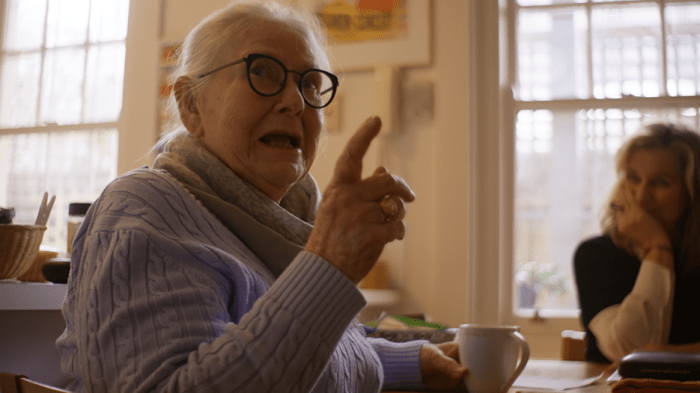
Margaret Thomson in Careless.
“This is a broad film about what we can do to improve aged care and take a look at why people are struggling.”
Interview by Matthew Eeles
The last time we spoke, you were releasing Under Cover. What social impact did that film have during and following its release? Did it reach the right people?
I am staggered, and continue to be staggered, by the impact Under Cover has had on the world. If I’m completely honest, probably every second week we get a request for a community screening somewhere in Australia. And wherever I go, I meet people who tell me they’ve seen the film. We had a full cinema at Rosebud recently and raised money for the local homeless charity. Seriously, Matthew, that film has had more of an impact than I could ever have imagined. And when you and I talked about the film, we discussed Margot Robbie’s involvement. Has that got something to do with its success? To be honest, I actually don’t think it does anymore. The people who request Under Cover are just people who are advocating in the homelessness space, whether it’s older women or not. They use Under Cover in all areas of homelessness as a tool to bring people together and then talk about the issues and how they can advocate for people or raise funds for certain organisations. It really is extraordinary. That film is now four years old, and every second week someone is asking us to screen it somewhere in Australia.
How has it performed on a bureaucratic level?
We got into Parliament in Melbourne, in Tasmania, and in Canberra. They screened the film, and it was mentioned on the floor of the House of Representatives as a very important documentary. So yes, we got in front of the politicians. Did it make a change? I think we have encouraged politicians to keep homelessness at the forefront of their minds rather than pretending it’s not happening. I don’t know if I could make larger claims that Under Cover has changed the world, but I certainly feel we’ve been a part of raising awareness.
Careless is a tremendous companion film to Under Cover. How long after making Under Cover did you start developing Careless?
As documentary filmmakers, or filmmakers in general, you’re always thinking about your next project. I didn’t think about my mum being in the film. I just started thinking about my dad, who was in aged care and died, and I started thinking about his experiences, which actually were really good. But I started hearing some very ugly reports. Then the Royal Commission happened during COVID. People were dying. And for me, and the work that I do, it made me think, “Okay, maybe there’s something that we need to look at here.” And as a filmmaker who likes to tackle these big issues, perhaps this is right up my alley. I didn’t really equate the fact that I was working, spending time with my father in aged care, and then ultimately my mother. Now, my mum, as you’ve seen in the film, lives at home, and I remember Adam Farrington-Williams, my co-producer and co-writer on Careless, would say, “Sue, surely we’ve got to get your mum in this film.” And I’d say, “No way. There’s no way I want to have that story told on the screen.” This is a broad film about what we can do to improve aged care and take a look at why people are struggling. Why don’t people want to go to aged care? And then ultimately, I couldn’t not have my mum in the film. I am experiencing what hundreds of thousands of people around Australia are experiencing, which is looking after a loved one and trying to give them some autonomy in their life. And it is incredibly complicated.

Luciana Martini in Careless.
Your mother is the central focus of this film, and whether she likes it or not, she’s going to be quite popular with a lot of people because she really does bring an entertainment factor to Careless. She seemed reluctant to be in front of the camera. How did you convince her to be a part of this documentary?
It’s funny. I asked her why she decided to do this film, and she said, “Because I didn’t help you with any of the other films.” And that was new to me. I’d not ever asked her to help with any of my other documentaries, but it was like she felt, as a mother, that she wanted to help her daughter in her work rather than spending most of her time telling me that my work annoys her because it keeps me from her. So look, is that the truth with Margaret? You never know whether what she’s saying is true, because the next day she might tell you something totally different. [Laughs].
You also spend a lot of time in front of the camera. How did you feel about that?
It’s interesting that you say “a lot of time.” I really worked hard not to be seen. [Laughs]. But yeah, there is a bit of me in there, isn’t there? It’s incredible because I’m someone who suffers from anxiety. But I managed with this film. I would sit in the edit suite for months and months and months, cutting Careless. And I saw Sue Thomson, this person, as not me. This person was a person in my film who needed to help carry parts of the story. And it was a very interesting experience. I needed that person on screen to complete the narrative of particular sections. I really managed to separate myself from her. I really enjoyed the experience of not judging myself on camera and just using myself as another person in this documentary.
What was it like to work with the other members of your family who were involved behind the scenes?
My daughter, Lola Nankervis, is an up-and-coming producer, so we upskilled her and gave her a role as co-producer. My other daughter, Claudia Nankervis, is also a producer on another section of the film filmed in Japan, which didn’t actually make it into the final film. So both of my daughters are involved in film and television. When you are making documentaries like I do, if they’re interested and want to work with me and Adam, then we’re happy to bring them on board. And when I decided that Margaret was going to be in the film, I knew that Lola could work as a buffer between my mother and me. [Laughs]. I have to say, it was incredible because Mum and I can get quite tense with each other. We have a tricky relationship. I love her dearly, but there are times when we clash. So when you have a grandchild there, like Lola, it really did change the dynamic between all of us. If I’d walk in first, Mum would go, “Oh, you’re all filming again today, are you?” And then Lola would come in, and Mum would push right past me and go directly to Lola and welcome her in. [Laughs]. So, to be brutally honest, I went into filming naively, not thinking that Lola would bring as much as she did to it. I think she helped get things from Granny, as we call her, that I wouldn’t have got without having her granddaughter there.

Margaret Thomson in Careless.
How did your three young narrators come about?
They are so good. The truth is, we struggled to get funding for Careless. There was a bit of pushback from funding bodies who were worried about a film focusing on aged care. I remember one person from a funding body telling us that their mother had just died in aged care and that they wouldn’t want to see a film about that. And no matter how much I would tell them that Careless was not going to be set in an aged care home, they just didn’t get it. I told them I wanted to use young narrators because I think the thing about aging is that it’s an issue that affects us all. As I say, if you’re lucky enough to get old, why do we not talk about aged care and the care older people should be getting until we’re old ourselves? I felt really clear about that, and I wanted to get young people involved in the film. It felt like the best way to do that was to have young narrators included in little scenes where we could talk about politics and policy and legislation through the eyes of children. And they loved it. And I was very proud of them. And they actually have been much more engaged with the issue than I expected.
So they understood the task, and the point you were making here?
Well, as a mother, you’d think I would know that, but they were so bloody smart and switched on, and perhaps that’s a sign of the times. I was really impressed with all of them—their questions and their commitment—because, also, there are political aspects to this film. We’ve tried to be bipartisan. We’re not slamming any political party, but we’re saying governments really need to step up, take more responsibility, and be accountable for this. And the kids got that. I was worried that their parents were going to pull me aside and say, “Listen, I don’t really want my daughter involved in something like this.” And they never did. In fact, it was the children who would come to me and say, “Sue, I read an article about aged care last weekend. I wonder, should I send it to you?” Or, “Sue, my grandmother was in a place, and we were very disappointed, so we moved her somewhere else.” They were genuinely committed. So when we were giving them scripts of lines to say, they actually believed what they were saying. And I was so delighted by that.
Was your mother really asleep during that cinema scene with the young narrators?
Yeah, totally. She’s 90, Matthew. [Laughs]. My mum doesn’t stay awake longer than about half an hour. She’s very together, but then she just has a little close of her eyes. [Laughs]. She likes to drink champagne—the cheapest, nastiest champagne known to mankind—but she does like to drink it. So at the cinema, I got her a glass of champagne to relax her because I knew she’d find the whole thing a bit stressful. Well, she drank that very happily and sat there quietly, and then all of a sudden she was sound asleep. [Laughs]. I had those young narrators working quite hard that day, and they were so respectful of Mum. The crew and I were also nudging each other and laughing at Granny being asleep. But the young girls were remarkably respectful. I was saying to them, “It’s okay, you can laugh. Mum’s falling asleep, and even she wouldn’t mind.”
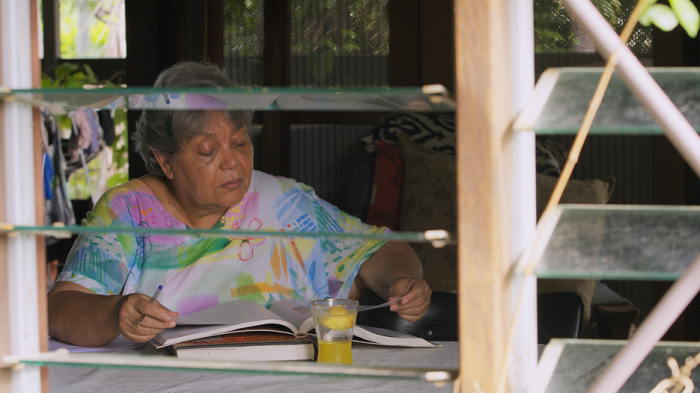
Linda Ford in Careless.
Through Careless, you paint a concerning picture of how the elderly in Australia are being left behind when it comes to aged care. Was there anything in particular about this sector of Australian society that surprised you?
That’s a good question. I feel like the systemic problems are going to be really hard to change in aged care. I haven’t felt that before about issue-based films. The whole sector has been privatised to a point where the profit motive is so important. And I understand that we live in a capitalist society, and I understand how it works—but what I can’t see is how we’re going to change it. Unless governments really cannot be swayed by these extraordinary lobby groups—and they have very powerful lobby groups in aged care, as they do in most things in the world—I don’t see how we’re going to change it, because people need to make money. They run these enormous organisations and businesses that look after our ageing. But the fact that we have combined a profit motive with care—I find that devastating. And I’m not sure what we’re going to do about that. I want to get Careless into schools and get young people starting to discuss it as they grow up, and not be so fearful and not be so disconnected from how it is in aged care facilities—or how it is when you’re looking to have a care package at home. Maybe that’s how we can affect change.
I’ve never thought about ageing more than I have since I turned 40 last year, and Careless has encouraged me to think more proactively about it in general. Has this experience made you proactive in your preparation for those later stages of your life?
One thousand percent. And you know who else? Lola and Claudia and my 23-year-old son. I can see we’re all thinking about it differently now. There’s a scene in the film where we go to what’s called the Dementia Café, and I interviewed some people—which didn’t make it into the film—but there was a man there who talked about living with his wife who has dementia. He now lives with his daughter and her family, as they do in Nordic countries. They bring families together as a way of saving money and having that extra support. And perhaps if there are grandchildren around, there’s a community—there’s a connection between old and young and different generations. I’ve started to think about that now. I’d never thought about that in my life until now. I thought, “Okay, maybe we need to somehow buy something out of town and get the kids to move with their partners if they want to. And we all live together.” But I mean, these are sort of ideological ideas and philosophies that I’ve heard about, but suddenly I genuinely am thinking, “Okay, I need to plan for my future.”

Olivia Cornwell and Jane Cornwell in Careless.
I’m pessimistic about any Royal Commission and how useful they actually are in the long run. Considering your research into this subject, has the Royal Commission into Australia’s aged care been a successful one?
Out of 128 recommendations, I think seven have been put into place. Annie Butler, the Secretary for the Nurses Federation, who’s in the film, says that there were some good things that came out of it. From just a person on the outside looking in, I feel like not enough came out of it. And we hold these royal commissions, and there’s a lot of talk around it—and maybe a lot of publicity—and it looks good for governments for a short time. And then one government’s out, and the next one comes in, and they say they’re going to make it better. And then the next one says they’re going to make it better. And it just seems to be a lot of talk. Commissions are important—don’t get me wrong. I really think we live in a democracy, and that’s the way we should be doing it. But it would be great if more came out of it. I do not feel that the Royal Commission into aged care has achieved a lot of what it should have.
During our Under Cover interview, I asked you why you focused on females only when homelessness transcends gender. This isn’t a criticism, but you’ve taken a similar approach with Careless. Why is that?
It’s interesting. I didn’t set out to, but I think I just do approach my life and my work through a feminist lens. And as you would know, aged care—and caring for people—is a feminised industry. The majority of people working in the industry are women. When I started asking people who had a parent that might be interested in being in the film, like my mum, they tended to be women—like Jane, who lives in London, and then there’s her mother, Olivia, who’s still in Australia. If Jane’s father had been alive, I would’ve very happily interviewed him. But it feels like women are still living a little bit longer than men. It’s not a deliberate thing, but I do approach life in that way. But there’s also gorgeous Mario, who’s in the film too. So I haven’t abandoned every man out there. [Laughs].
Will your mother be attending any public screenings of the film?
She’s seen bits and pieces so far. I am wondering how to achieve that—whether I just take her to the launch. She has said she doesn’t want people asking her questions, so maybe when we get the theatrical release, I’ll take her to a local cinema so she can sleep through the whole thing. [Laughs].
Careless is currently screening at the Melbourne International Film Festival. Details here.
Careless will screen at CinefestOZ from Sunday, 31 August. Details here.
If you enjoy Cinema Australia as much as I love publishing it, please consider supporting Cinema Australia’s commitment to the Australian screen industry via a donation below.
I strive to shine a light on Australian movies, giving voice to emerging talent and established artists.
This important work is made possible through the support of Cinema Australia readers.
Without corporate interests or paywalls, Cinema Australia is committed to remaining free to read, watch and listen to, always.
If you can, please consider making a contribution. It takes less than a minute, and your support will make a significant impact in sustaining Cinema Australia as the much-loved publication that it is.
Thank you.
Matthew Eeles
Founder and Editor.Make a donation here.


 Cinema Australia