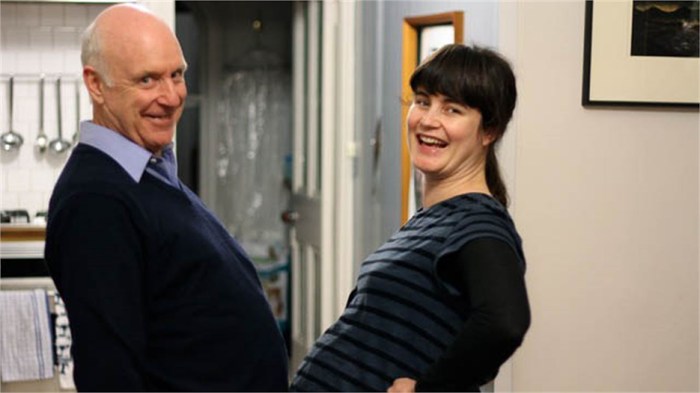
John Clarke and Lorin Clarke.
For more than 40 years, John Clarke made Australians and New Zealanders laugh with his sharp wit and brilliant satire. Whether on stage, screen, or in his long-running political sketches with Bryan Dawe, Clarke had a way of exposing hypocrisy while making it entertaining. When he died in 2017, he left behind not just a body of work, but a private life he rarely shared publicly.
In But Also John Clarke, filmmaker Lorin Clarke – John’s daughter – tells his story in a way only she could. The documentary draws on a remarkable series of recorded conversations between father and daughter, alongside rich television archives, personal letters, and memories from some of the world’s comedy greats. It’s a personal and heartfelt portrait of a man whose creativity shaped antipodean comedy.
Lorin herself has worked extensively in radio, theatre, and comedy, writing and directing plays and comedy shows, including performances for the Melbourne International Comedy Festival. She is also the creator, writer, and performer of The Fitzroy Diaries, an acclaimed audio series released by ABC Radio National, which ran for three seasons. One of her comedy festival shows was even shortlisted for the Golden Gibbo Award.
Despite her creative career, Lorin deliberately steered clear of working in her father’s shadow – until now. With But Also John Clarke, she’s offering audiences a rare look at the man behind the satire, and a tribute to his lasting impact on comedy and culture.

But Also John Clarke.
“I think the arts are undervalued. But actually, if kids get an arts education, they learn empathy. If kids get to be in a school play, they learn how to work together. They learn about the nuances of human behavior. All of that will be bypassed if you leave the arts behind.”
Interview by Matthew Eeles
Considering your theatre and podcasting experience, how did directing your first feature film come about?
I wrote and directed a short film a few years back, but that was more me wondering whether or not I could do it. I’ve written a lot of kids’ TV, and that’s been really good for building the writing muscles and learning how the system works. It’s also great working with other people and their creative ideas, working inside the screen production context. I worked a bit on series one of Bluey, I worked on Kangaroo Beach and Beep and Mort, and a bunch of shows that were really interestingly received. So that wasn’t directing, but it definitely helped me become so much more literate in screenwriting and storytelling.
Please tell me that writing on Bluey was a magical experience.
I’ve got a “story by” credit on the episode Fairies, so I’m not going to claim I built them out of twigs. They were completely brilliant. But I remember calling my mum from Brisbane on that first day and saying, “This show’s going to be a smash hit.” If not, I would’ve been disappointed, because those guys put so much thought into that show.
I ask this question with the utmost respect, but considering your lack of feature film experience, did you ever consider anyone else to possibly make But Also John Clarke?
Well, we came to this film in the sense that there were other people who wanted to produce it. Producers came to our family and said, “We’re keen.” One production company most recently, but there were a couple of different people interested in various versions of telling the story of Dad’s life and work. And I had nothing against what they actually wanted to do, except that I knew you can Google him, you can read his Wikipedia page, you can find his work on YouTube. Having been taught by him what his approach to such things was, I just knew that it’s actually a more interesting story than just what he achieved on screen. That’s interesting—but it’s more interesting if it’s about where he came from and what his approach was. And I also knew, of course, that we had material that nobody else had. I mean, I sat him down and chatted with him and recorded it—which we didn’t really know why we were doing at the time—but I’m so glad we did. Because you can hear me asking him how to tell the story, and he says things like, “I think possibly my perspective is more interesting than my biography,” and things like that. That helped set up the story for both me and the audience. And there were things he’d written that we could get these beautiful actors and personalities throughout the film to read. So I just had an idea in my head of how it could be a film that spoke not just to his work, but to the connection he felt with his audience. That’s why I wanted to make it in the end. I’ve never done this exact thing before, but I’ve worked creatively for decades now, and when I turned up to set on day one, I thought, “Oh, what was I worried about?” [Laughs].

But Also John Clarke.
A lot of this documentary is told from the perspective of friends and colleagues, but rarely from a family perspective, other than your own. Was there a reason for that?
My mum’s in it a little bit, and we interviewed family in a way that informed my perspective while making it more than it was going to be helpful in telling the story. There is also, from my perspective, the responsibility that a documentarian always has: you’re telling a story that’s part of someone’s life. And one of the things my family’s been really careful about is not being part of the public experience of John Clarke. That’s because our family wants to remain private. At the same time, we were happy to share a little bit of the home video stuff. I knew that would lend more authenticity to the story than us sitting in front of a camera telling his story. It just felt more natural, more ethical, and more honest to what his relationship with his audience and his work was. We inform him, and he informs us. We’re a close family, but we’re not part of that public experience.
You’ve written a memoir: Would That Be Funny? Growing Up With John Clarke. How often was your dad asking you if you thought something he wrote was funny?
He would often send us emails asking for feedback on things. He did that for a while. He wrote this hilarious idiotic column for The Age, and it was just the answers to a quiz from the previous paper—which didn’t exist—but he wrote the column as though the quiz had been there. So it congratulated someone who’d won the previous quiz, and said, “Here are the answers just for the record.” They were actually extremely funny. But he would send those drafts through. So I’d get those, and I’d write, “I don’t get this one.” Or my sister would write, “This is funny, but did you see this article that helps you understand the other bit that you obviously don’t get?” And things like that. Or Mum would write and say, “Needs to be shorter.” [Laughs]. He valued our opinions because we’re all writers. My sister’s a public servant, but she writes for her work. I’ve always written. My mum’s an art historian and a writer. We had table reads for all our plays and TV shows and anything else we were working on. You’d get to a point where you’d think, “I’m nearly done with this, but it’s bloated and overcooked and just needs other eyes on it.” So you’d say, “Can we do a table read?” And everyone would get around the table at an agreed time with a copy in front of them and a cup of tea, and we’d perform it as a family. Sometimes if there were collaborators, we’d invite them too—or some mate who happened to be in the house—and we’d read through it. It was great, because you’d immediately see what you’d overcooked, or how things could be edited differently, and so on. We did readings of early scripts of The Games, and so on. So yeah, it was always a very, very collaborative, creative experience at home for us.
We’ve all lost family members, and it can get quite emotional just looking at a simple photo of those people. How emotional was it for you to look back on this footage of your father? How do you cope with that?
It’s interesting how it can come at you sideways sometimes. And for me, I worked with a beautiful editor, Aleck Morton, who really did his research and found bits of footage I hadn’t seen before. I’d be watching something, and he’d sneak something in there that I hadn’t seen, and it would just catch in my throat in the most beautiful way. But for the most part, to me, it was a creative process. I’ve had Dad’s work in my life my entire life. This was just another creative project in that sense until Aleck and I were killing ourselves working to final deadlines that were flying past at the speed of light. We finally felt like we’d nearly cracked it. We said, “All right, let’s have a look.” We sat back, and we were exhausted. It had been a bit stressful. I think maybe because of that, I didn’t see it coming—but I thought, “Oh my God, there he is.” I literally thought the words, Hi, Dad. So, in a sense, that’s the catharsis of creativity. It’s amazing how something like that can take you completely by surprise. One moment you’re just bored in a room, and five minutes later, you’re overwhelmed by feelings.
Did you learn anything unexpected about your father throughout this process?
Dad was such a talker and an open book that I didn’t really expect to learn anything new. I didn’t learn anything that surprised me too much, although what I was perhaps delighted by was how joyful people were when they spoke about him. I think that’s partly because enough time has passed that the film doesn’t have to be a sad film. It’s not a funny film, but it is a heartwarming one. It’s about connection, the joy of making things, and finding fun wherever you can. I loved finding Dad in the people I interviewed—that was such a lovely thing. There’s a quote from Dad’s voiceover at the end of the film where he talks about how, in collaboration, you sort of become each other a little bit. That’s what I was trying to do with those readings, with the beautiful actors and comedians reading Dad’s actual words. He lends himself to them, and they lend themselves to him. That, to me, was the magic I didn’t see coming.

But Also John Clarke.
Your father and Bryan Dawe had a very funny satirical interview, which is featured in the film, where they’re interrupted by producers asking if their show is an arts show or a current affairs program—because it’ll be canceled if it’s an arts show. As someone who is involved in the arts, that sketch hits me hard every time I see it. It feels as relevant today as it did back then. What’s your opinion on the current state of the arts in Australia?
One of the things that’s so fascinating—and improbable—about those Clarke and Dawe interviews, which now have a life of their own online, is that people can leave comments on YouTube. I don’t know who these people are, and there’s something lovely in that. It speaks to the fact that there’s something in his work that I think is slightly democratising. All around you, there are reasons to be completely in despair. He could rail on those topics to beat the band, let me assure you. But I think there’s a bit of a nudge in not just the Clarke and Dawe stuff but also The Games and other things he did—something empowering. It’s a slightly patronising way of putting it, but some of his work suggests that you’re being made, by the media and the power structure, to feel incapable and insignificant. Hopefully, it reminds people to look more closely at what’s going on. Right now, there are so many things getting in the way of making meaningful, connective, creative work. It feels particularly crushing at the moment. But I do think that’s why we feel such joy when somebody breaks through. That’s why someone like Hannah Gadsby really took off during lockdown. And I think Dad says it in the film at one point—that it’s only if the creative enterprise pushes ideas further that those in power will follow. Perhaps that’s Pollyanna-ish of me, but that’s one of the things I was hoping the film would suggest: that there is a point to the arts. I think the arts are undervalued. But actually, if kids get an arts education, they learn empathy. If they get to be in a school play, they learn how to work together. They learn about the nuances of human behaviour. All of that will be bypassed if you leave the arts behind.
You mentioned YouTube. I’ve also noticed a lot of your dad’s comedy is being published to other platforms like TikTok, where it’s being introduced to an entirely new audience. Have you noticed this new audience discovering his work for the first time?
Yes, I do—definitely. For someone who insisted on not having a mobile phone, he was actually extremely forward-thinking when it came to technology and how audiences were consuming content. He was really aware of that. When Clarke and Dawe was on ABC in those final years, a series of events meant that his timeslot was moved around a bit. When that happened, he told the ABC he’d like the rights to upload Clarke and Dawe to YouTube as soon as it was recorded. So for the final few years, it was available on YouTube and Twitter, back when that was a vaguely functional platform. So to some extent, he could see what was coming. And don’t forget, this was two and a half minutes of content. That’s very fitting for today’s audience. So I’m not really surprised that it’s being rediscovered online.
How prepared are you emotionally to be answering all these questions about your father throughout the public release of this film?
I needed to get over that idea early on because I realised it wasn’t about my life, and it wasn’t personal. When he died, I was suddenly in the media answering questions about it three days later. So in order to get to this point, I needed to think that through. If I’d had a complicated relationship with my dad—or if the audience had, or his friends had, or his 57 ex-wives had—it would be a different story. [Laughs]. But for me, it’s all part of life and part of the creative process. Occasionally, the grief hits me when I’m least expecting it, but that can also just be emotional overload or exhaustion. Thankfully, Dad’s not someone people want to say mean things about. And I had a hilarious, delightful, and embarrassingly idyllic childhood and relationship with him. So to me, it’s a celebration—and I think that makes it so much easier.
But Also John Clarke will screen at the Melbourne International Film Festival from Friday, 15 August. Details here.
If you enjoy Cinema Australia as much as I love publishing it, please consider supporting Cinema Australia’s commitment to the Australian screen industry via a donation below.
I strive to shine a light on Australian movies, giving voice to emerging talent and established artists.
This important work is made possible through the support of Cinema Australia readers.
Without corporate interests or paywalls, Cinema Australia is committed to remaining free to read, watch and listen to, always.
If you can, please consider making a contribution. It takes less than a minute, and your support will make a significant impact in sustaining Cinema Australia as the much-loved publication that it is.
Thank you.
Matthew Eeles
Founder and Editor.Make a donation here.


 Cinema Australia