Penny Lane is Dead
The Adelaide Film Festival (AFF) has announced the first six films to screen at the 2025 Festival, with five of them directed by Australian women.
These must-see films include the outstanding documentaries Journey Home, David Gulpilil, by directors Maggie Miles and Trisha Morton-Thomas, and – having their World Premieres in Adelaide – The Colleano Heart from director Pauline Clague and visionary filmmaker Lynette Wallworth’s Edge of Life.
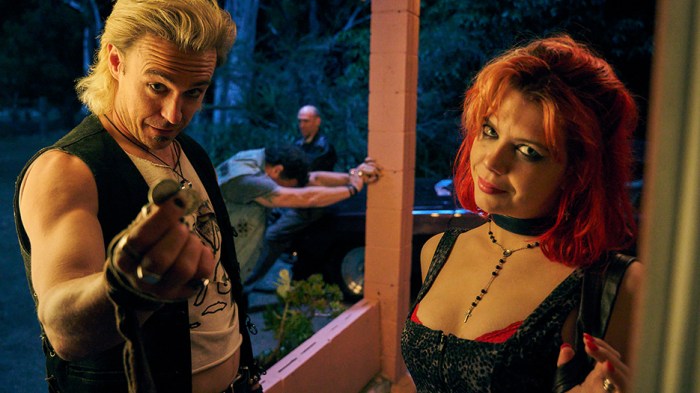
Penny Lane Is Dead, from debut feature writer/director Mia’Kate Russell, continues Australia’s horror genre revival, led by South Australian filmmakers, with the support of AFFIF.
Also announced today is Fwends, the charming first-time feature that has become an indie darling at film festivals around the world, including at Berlin, where it won the Caligari Film Prize, awarded annually to a film screening in the Berlinale Forum section which focuses on innovative and challenging cinema.
The Colleano Heart, Edge of Life and Penny Lane is Dead were each supported into production by the Adelaide Film Festival Investment Fund (AFFIF). Since 2003, AFFIF has premiered and seeded over 150 projects, including some of the most significant Australian films of the 21st Century. Major AFFIF titles include Talk To Me (Danny and Michael Philippou, 2022), Hotel Mumbai (Anthony Maras, 2018), 52 Tuesdays (Sophie Hyde, 2013), Tracks (John Curran, 2013), Snowtown (Justin Kurzel, 2011), Samson and Delilah (Warwick Thornton, 2009), Ten Canoes (Rolf de Heer and Peter Djiggirr, 2005) and many more acclaimed films and moving image works.
The electrifying cast of young Australians who star in Penny Lane Is Dead includes Sophia Wright-Mendelsohn, Bailey Spalding, Alex Jensen, Tahlee Fereday and Ben O’Toole alongside Steve Le Marquand and Fletcher Humphrys.
Penny Lane Is Dead features a rocking 80s soundtrack and is the first project from Sanctuary Pictures, produced alongside Buffalo Media and in association with Cyan Films. Julie Ryan, Ari Harrison, Andre Lima and Carly Maple are producers.
The film is set in 1986, during a scorching Aussie summer, where three best friends’ celebration at a beach house turns into a blood-soaked fight for survival when a prank goes horribly wrong.
The Colleano Heart by First Nations director Pauline Clague and producer Kate Pappas tells of the story of the famous Colleano circus family. Through the wisdom of their Aboriginal matriarch, the family outmanoeuvred 1900’s oppression and racism to rise to the highest echelons of international circus stardom. Generations later, flamboyant, American-born, octogenarian Molly O’Donnell meets Deb Hescott, an Australian family historian with a DNA connection to Molly’s Colleano line. They build a bridge across the oceans on a quest to reclaim identity, connect to ancestors and unearth family secrets. In doing so, Molly breaks the cycle of the Hidden Generation and reignites The Colleano Heart.
ADVERTISEMENT
Edge of Life is written and directed by Lynette Wallworth, with writer Chief Tashka Yawanawa and producer: Jo-anne McGowan. Filmed in Australia and in the Brazilian Amazon, the film is a remarkable exploration of the last great frontier in a human life – the doorway to death. We know intellectually our time will end and yet in the Western world at least, we often act as if death is a mirage, disappearing the closer we move towards it. Two doctors in Melbourne are using psilocybin to help ease the anguish of patients at end of life, and the results they have seen are remarkable. But this visioning tool, like other plant medicines, is not new, it comes from ancient traditions that are now being funnelled into Western medicine. It is possible the world’s oldest cultures have something important to teach us, not just about traditional medicines but about one of the most essential aspects of human life, its end. If we are humble, and they are willing, we have much to learn.
Journey Home, David Gulpilil is directed by Maggie Miles and Trisha Morton-Thomas and produced by Rachel Clements, Jida Gulpilil, Lloyd Garrawurra, Trisha Morton-Thomas and Maggie Miles. When Australia’s most renowned Indigenous actor DavidDhalatnghu Gulpilil passes away far from his Homeland, his family struggle against huge logistical challenges to fulfill his final wish, to bury him on his Homeland, over four and a half thousand kilometres away.
In the delightful Fwends, directed by Sophie Somerville and produced by Sarah Hegge-Taylor, Sophie Somerville and Carter Looker, old friends Em and Jessie reconnect for a weekend. Their conversations flow naturally, covering light topics and deep emotions. They represent a generation of resilient young women navigating life’s ups and downs with honesty and humour. From one of Australia’s freshest young filmmaking teams, Fwends captivates with its vibrancy and authenticity.
Mat Kesting, Adelaide Film Festival’s CEO & Creative Director, said: “2025 is shaping up to be a stellar year for the Festival and we are immensely proud to be showcasing the work of so many fine Australian women directors. The program will be entertaining, thought provoking and audacious. Cinema is where we can commune and contemplate the world and we can’t wait to welcome audiences at AFF in October.”
Minister for the Arts, Andrea Michaels, said: “It’s very exciting to be announcing the first six films that will feature at this year’s Adelaide Film Festival. Adelaide Film Festival is renowned for the extraordinary local and international films it screens including this year, the winner of the Cannes International Film Festival Palm d’Or prize for best film, It Was Just An Accident. This year’s Festival is not to be missed so keep an eye out for the full program soon!”
Adelaide Film Festival runs October 15 – 26, 2025. Details here.
If you enjoy Cinema Australia as much as I love publishing it, please consider supporting Cinema Australia’s commitment to the Australian screen industry via a donation below.
I strive to shine a light on Australian movies, giving voice to emerging talent and established artists.
This important work is made possible through the support of Cinema Australia readers.
Without corporate interests or paywalls, Cinema Australia is committed to remaining free to read, watch and listen to, always.
If you can, please consider making a contribution. It takes less than a minute, and your support will make a significant impact in sustaining Cinema Australia as the much-loved publication that it is.
Thank you.
Matthew Eeles
Founder and Editor.Make a donation here.


 Cinema Australia