
Philia.
This article has been prepared and supplied by the filmmakers of Philia.
It started with two characters: Dana and Veronica. Originally inspired by the names and characteristics of the Roman goddesses Diana and Venus; of the hunt and of love, respectively. Two women, one led by the head and one by the heart, who are inextricably linked through a deep, non-romantic, fraternal (or sororal) love, known as “philia” in Greek. This timelessness of theme and character extends itself to the story of Philia. The characters exist in a setting that is vaguely familiar, with aesthetic influences drawn heavily from the themes of 1930s Film Noir, with anachronisms revealing themselves as the film progresses.
The story of Dana and Veronica is not one of a certain period of time but of the very tried and true and continuous plights of mistreated women who must endure in times of adversity. And more importantly, the intangible bond between these women, who must hold onto each other for dear life in the face of difficulty, danger, poverty, and loneliness.
The film & characters
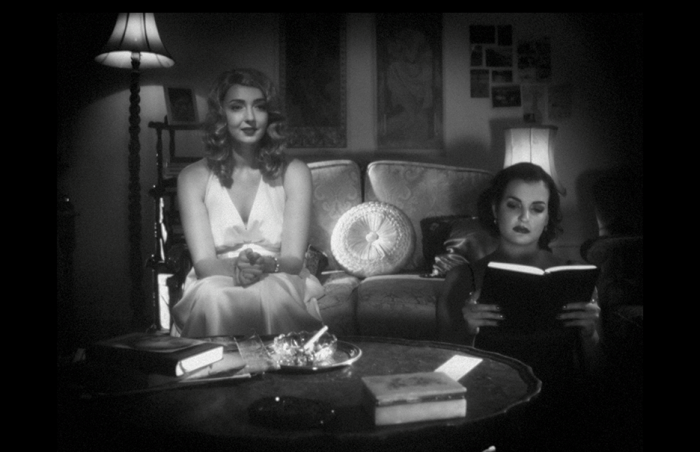
Veronica and Dana in their apartment, watching Sunrise (1927).
Veronica is a sanguine, animated dreamer clad in a white satin dress and blonde wig à la Marilyn Monroe in The Seven Year Itch, who subsists on romantic films and the potential of passionate and unconditional love with the perfect man. Unseen on screen but thickly present, are three generations of Veronica’s family. Her unnamed mother, herself, and her infant daughter Dolores (rooted in the word “pain” in latin), Dolly for short. There is a generational pattern of female sorrow going down the line, caused by a mélange of pining, pregnancy, poverty, paternal abandonment and consistent naiveté; all brewing into a misery that is painted over with lipstick and hope – that one day the right man will by struck by Veronica’s shining façade and reach his hand into this toxic cycle, pulling her and Dolly out. But every man stands at the water’s edge, has his fill, then leaves.
Who better to see this all than Veronica’s best friend and flatmate Dana. A vampy realist with a dark bob and shining, satin black dress – actually modelled from a dress worn by Marilyn Monroe – her presentation contrasts with Veronica’s moonglow appearance. At first glance, Dana is indeed everything that Veronica is not. Dana is more interested in the reality of ‘what is’ instead of Hollywood fantasy. Ignoring the romantic film playing, she is fixated on her book (Machiavelli’s The Prince), and, when prompted, will tear apart Sunrise with her honest yet acidic tongue. Informed by her own experiences with men, and witnessing the plight of Veronica’s situation with her daughter, Dana scorns Sunrise with a postmodern sensibility. Determined to pull herself into a better life through sheer force of will, Dana has learned what not to do from Veronica. In this world, Dana appears to be ahead of the times – but beneath her tough exterior, Dana is a woman who is tortured by her past.
The film within a film
Sunrise, A Song Of Two Humans is a 1927 silent romantic drama film directed by German director F.W. Murnau. A classic film that has stood the test of time, the Academy Award winner is a tale of love, betrayal, and ultimately, redemption. The logline is as follows:
“A married farmer is tempted by a seductive woman from the city to drown his wife, but ultimately chooses love and forgiveness, renewing his vows with his wife.”
It is this film that Veronica is enraptured by, and it is the actual soundtrack of the film that is playing in the first act of the film. Sunrise is now in the public domain – the soundtrack and film are now free to use by anyone, which was incredibly helpful for us indie filmmakers.
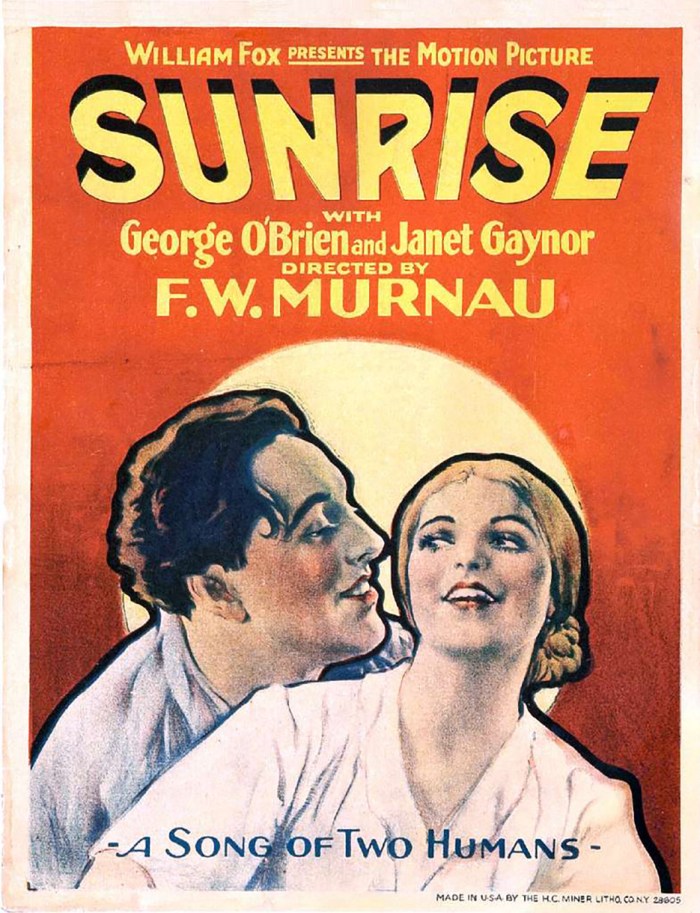
Poster for Sunrise: A Song of Two Humans (1927)
As writers, we watched and analysed the film deeply – categorised as a romantic drama, Sunrise actually has some quite horrific elements (F.W. Murnau is also known for another famous film – the 1922 horror film Nosferatu: A Symphony of Horror). As the unnamed farmer, bewitched by the charms of his mistress, rows his gentle wife out on a lake with the intent to drown her, we can only watch in dread until he decides to change his mind and begs her for forgiveness. What follows is a charming romp in the city during which any woman would be roused by his loving and charming behaviour ( which Veronica is so delighted by in Philia). The affair with the mistress is concluded when, believing his wife has died in a storm, he strangles her. Just before she dies, he releases his grip when he learns his wife is still alive.
Visually, the characters in Philia are inspired by the look of both the wife (Veronica) and the mistress (Dana) – the yin/yang of angelic beauty versus sensual vamp. We wanted to flip these aesthetics on its head however by making Veronica the ‘mistress’ in this case – and it also made sense visually for their personalities to suit the light vs shade. It was also a fun idea that the archetypes of the women of Sunrise – which are pitted against each other in that universe – could actually come together and be friends in the world of Philia.
Made almost 100 years ago, what makes Sunrise a classic is its true ode to what it is to be human. People have, do, and will let love and lust drive them to unreasonable and irrational, yet also heartfelt and wonderful actions, such as those of the farmer in Sunrise. As for women, like the wife, we are hard-wired and trained to forgive: particularly the testosterone-driven aggression and philandering behaviour of many men – ‘boys being boys’; knowing that there is a real chance that if we aren’t tolerant of these behaviours, we will end up alone, or potentially dead.
Although we have made great strides in the last century, we cannot say that Sunrise is purely a product of its time, it is very much reflective of human nature now as well. Domestic violence, particularly the death of women at the hands of their partners in Australia, is currently a huge issue. Even the “I can fix him” meme / attitude is quite revealing of the societal undercurrent and acceptance of toxic behaviour, and how it’s a woman’s job to somehow alter undesirable, often antisocial, traits to make a man a suitable partner. How many times must men repeat the cycles of their fathers and grandfathers until this behaviour is unacceptable in the first place? In this lens, Sunrise is a story that will likely stay relevant for many years to come.
Inspirations
Philia is a film in three parts, each part formed by a different style and time period of cinema. Both being long-time cinephiles (we met on a student film set and attended many film society screenings), we had an ocean of inspiration to bring to Philia.
The first act, with its old Hollywood aesthetics and more pointed style, was born from 1930s and 40s Film Noir. Pre-code films were also a great inspiration, one of which was the brilliant pre-code 1933 film Baby Face by Alfred E. Green, starring the iconic Barbara Stanwyck. Born into poverty, through unbreakable motivation and some inspiration from Nietzsche, Lily Powers (Stanwyck) climbs her way up to a life of luxury, stepping on one man after another to get to the top. Historically, this has indeed been the way for women to escape a life of poverty, through marrying rich or high-class sex-work, and this is reflected in the motivations of Dana and Veronica.
The second act sees a dimmer, moodier outlook by our characters, inspired by the French New Wave of the 1950s and 60s. Delving into their deepest thoughts, we sit with Dana and Veronica as they, framed by cigarette smoke and rain, talk. The third act sees us enter another world and time in the future, unflinching in its black and white realism; stripping away the style from the previous acts to reveal an unpleasant and jarring present.
Our writing, as well as cinematography, production design, performance styles and sound design reflected these three distinct styles, which was so exciting to explore as creatives.
Writing and production
Using Sunrise as a jumping point, Dana and Veronica started to emerge in the writing room through extensive discussion, improvisation and rewriting. There was a direct desire to make these characters, and their friendship, feel authentic and lived in. A lot of what happens to the characters in this film has been inspired by our direct life experiences and the wisdom that has come from that. ‘Write what you know’ is truly excellent creative advice.
It was important to us to explore the bond between these two characters, that thread that attaches them; despite how tangled or strained it may become, it does not snap. When women’s lives are so often drastically changed and upheaved by their boyfriends or husbands, we wanted to tell a story where two friends aren’t torn apart by a man -in fact, it is their friendship that prevents their complete downfall at the hands of one. Through lived experience, we understand too that women can harm other women, and this is something we did not want to shy away from either, exploring this intricately in both Veronica and Dana’s characterisations.
Philia was an independent co-production through-and-through; from writing and producing to directing and acting, we made this film as a pair. A true grassroots production, Katherine’s flat became the writing room, rehearsal room, and filming location! Through tenacity, grit, and collaboration with incredible local creatives, Philia was made possible. Through this experience, we have truly found that the filmmaking community in Sydney is an absolute goldmine when it comes to top-tier filmmaking talent.
The creators of Philia
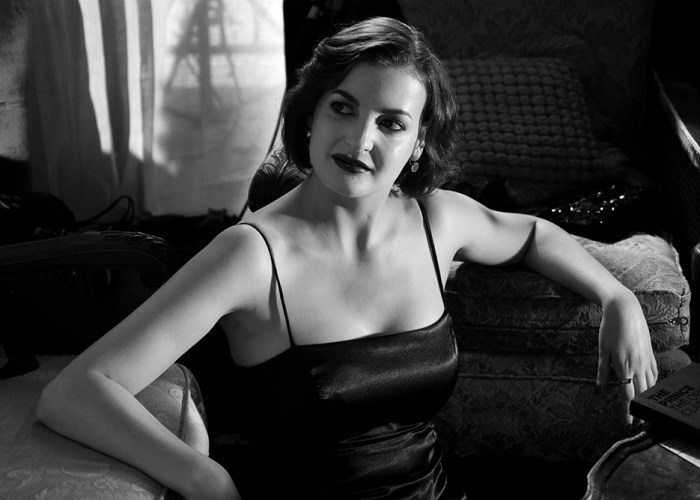
Chloe Callow on set as Dana. (Photo by Isabella Rosa)
Chloe Callow
Writer, director, producer and actor
Chloe Callow (She/her) is a Greek-Australian director, actor and artist working across filmmaking, photography and digital illustration. An ACU Graduate, Chloe earned a Bachelor of Visual Arts and Design earned First Class Honours for her short film Gestalt. Following her studies, Chloe worked as a cinematographer on grassroots indie feature Songs for a New World (Excelsia College). Within the Australian indie music scene, Chloe also shot and edited various music videos and promos for artists including Coterie. As a photographer, Chloe’s work has been exhibited in various galleries and earned a ‘Highly Commended’ in Capture Magazine’s Portrait Prize. Past acting credits include as ‘Clarissa Hailsham-Brown’ in Agatha Christie’s Spider’s Web & ‘Carla’ in Debra Oswald’s Sweet Road (Pymble Players); ‘Colette’ in John Patrick Shanley’s Four Dogs and a Bone & ‘Georgie’ in Teresa Rebeck’s Spike Heels (Sydney Actors Playhouse). Chloe will direct her first theatre production, Julia-Rose Lewis’ Samson with Luminar Theatre Co in October this year. Philia is Chloe’s screen acting debut.
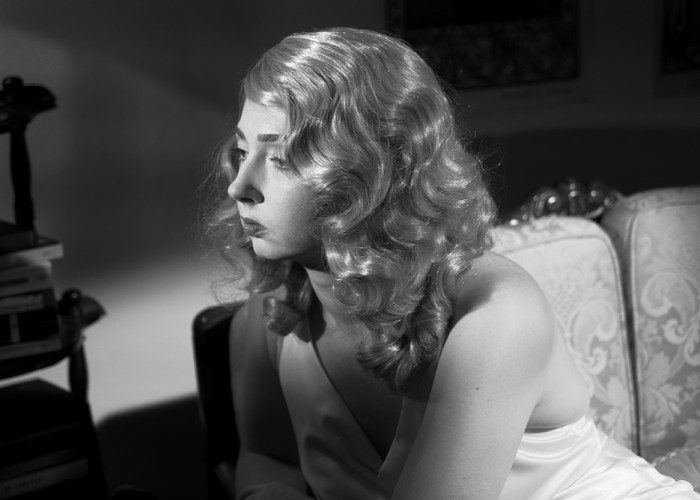
Katherine Grace on set as Veronica. (Photo by Isabella Rosa)
Katherine Grace
Writer, director, producer and actor
Katherine Grace is an emerging actor and filmmaker. Having been trained by some of Australia’s top acting coaches, including Lisa Robertson, Chum Ehelepola, Clara Voda, Miranda Harcourt, Ben Mathews, and Fern Nicholson, among others, she has worked extensively in Sydney’s independent film scene, including acting in several AFTRS productions. She won the award for ‘Best Self Tape’ at the 2024 Sydney Web Fest. Regarding Katherine’s previous short, The Curb film critic Andrew Peirce called Katherine “a talent on the rise that has me excited to see where Katherine progresses as a filmmaker.”

Katherine Grace and Chloe Callow on set. (Photo by Isabella Rosa)
The crew
Being surrounded by a great crew is non-negotiable if you want to make something worthwhile – and the pleasure of independent, early-career filmmaking is getting the opportunity to work with the greatest upcoming talent in the industry as well as experienced creatives. We are unimaginably grateful to our Philia crew, all of the creativity, dedication, and wonderful spirit brought to this production really made it a film we can be proud to share with the world. Our crew share some of their creative inspirations and experiences below.
Alex Shingles
Cinematography
Alex was assisted by camera team 1st AC Kevin Nguyen, 2nd ACs Emily Dunn & Luke Humphreys; and gaffers Finbarr Collins & Will Bush.
Alex is an award-winning cinematographer based across Sydney and Brisbane. A recent graduate of the AFTRS Masters in Cinematography, he has experience shooting in a wide range of mediums, including short form narrative, documentary, music video and corporate content. Alex prides himself on a perpetual curiosity with a story-first policy. He is an active member in the Australia Cinematographers Society, receiving recognition for his cinematography as well as serving on the Queensland committee in an executive capacity.
Alex says: “In responding to a screenplay full of intergenerational commentary on the nature of female bodily autonomy, Alex was thrilled at the chance to explore these themes across time through the use of historical cinematographic conventions. Reflecting the static nature of these existential dilemmas in a constantly evolving world, the film provided a unique opportunity to replicate classic Hollywood coding, and to subsequently subvert those pictorial constructs as the film progressed.”
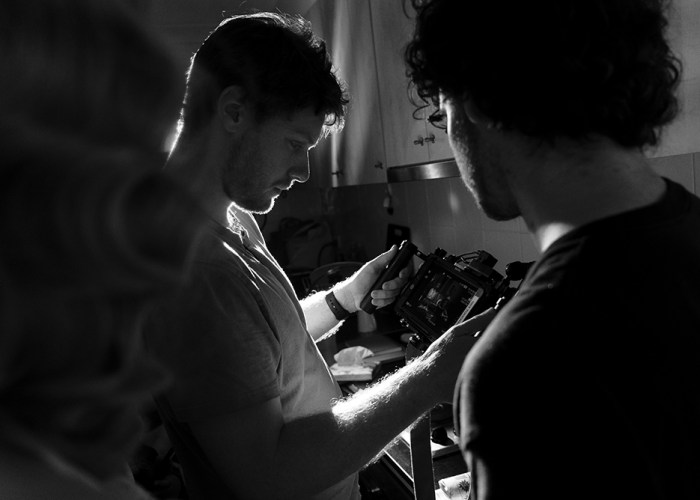
Alex Shingles and Will Bush viewing the monitor. (Photo by Isabella Rosa)
Robin Kalus
Dramaturgy
Robin Kalus is a German-born writer/director based in Sydney. He holds a Master’s degree in Directing from the Australian Film Television and Radio School (AFTRS). Over the past decade, Robin has directed several short films and commercial projects. His short thriller Popped premiered at the 2022 New York City Independent Film Festival, while his coming-of-age/magical realism blend Boy on the Roof was a Finalist at the 2024 AACTA Pitch: Focus. Robin is interested in stories that explore existentialist themes centred around questions of identity and self-discovery in the context of complex human relationships, using formalist techniques and raw, explorative performances.
Robin says: “My role as dramaturg on Philia was a rather comprehensive one that saw me getting involved in all three stages of the production process. From giving script notes, running rehearsals and assisting Chloe, Katherine and Alex in putting together their shot list during pre-production, to sitting in on the edit and helping shape the performances we had created on set, it was a very rewarding experience overall. Since our two creators were also the stars of the film, I oversaw the performances on the day which I directed based on my understanding of the characters they had outlined to me – a process during which I tried giving our directors several different performance options for the edit. To my surprise, the four-headed monster that was our editing panel (Jack, the two Directors and myself) moved very efficiently and mostly in unison, allowing us to test the film in different ways before ultimately arriving at what we felt was the strongest possible cut.”
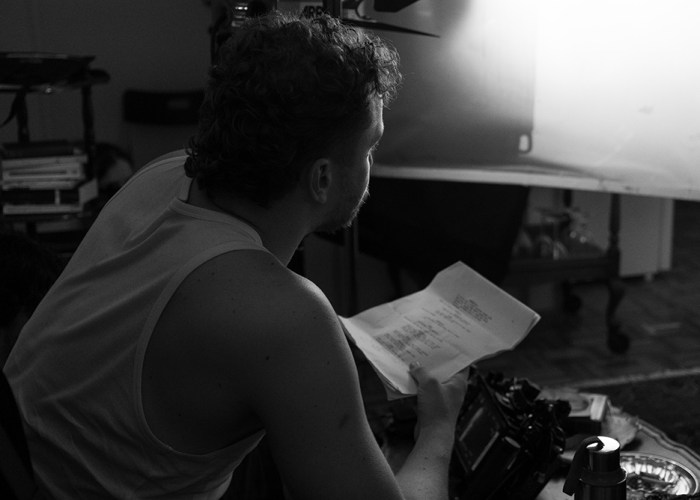
Robin Kalus giving performance direction on set. (Photo by Isabella Rosa)
Ruby Elliott
Production Design
Ruby Elliott, a recent graduate from AFTRS with a Master’s in Production Design for Screen, is passionate about creating immersive, visually striking story worlds, particularly through her love for surrealist and period design.
Ruby says: “For Philia, Ruby aimed to design a space that reflected the dreams, desires, and hardships of the main characters, Veronica and Dana. She incorporated textures, shapes, and retro aesthetics to bring the black-and-white story world to life, using thoughtful contrasts and nostalgic details to evoke the personalities of the characters.”
Ruby was assisted by Production Assistant Mrunal Jirwankar
Instagram mrunals_creativequest
Mrunal Jirwankar is a passionate architect and production designer, combining her background in architecture with a deep love for aesthetics and storytelling to create immersive visual narratives. Mrunal’s journey into production design is inspired by a desire to fuse her architectural knowledge with narrative storytelling, constructing cinematic worlds that resonate emotionally and captivate audiences. “Designing immersive spaces that serve as silent storytellers on screen has been my lifelong passion.” A Master’s of Production Design graduate from the Australian Film Television & Radio School (AFTRS), Mrunal completed her studies in 2024. She has worked on several short films and a few feature films, bringing her unique perspective and expertise to create visually compelling environments that enhance storytelling. She is a member of the Australian Production Design Guild (APDG).
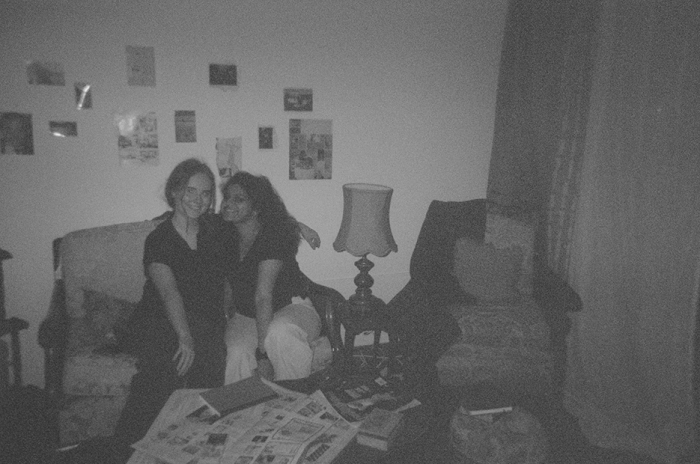
Ruby Elliott and Mrunal Jirwankar setting up the production design before the shoot.
Karyl Lee Durham
Hair and Makeup Artist
Karyl Lee Durham is an up-and-coming makeup artist with a focus in film and TV. She has completed training in a Diploma of Screen and Media, Specialist Makeup Services from TAFE, Ultimo. She has assisted in feature films such as Carmen and Bolude, The Horologist and Black Holes Suck, and as an attachment on Stan Original Nugget is Dead. Karyl has also worked for major events including Flickerfest and Australian Fashion Week.
Karyl says: “Working on Philia was super interesting in the way the makeup not only has a relationship with the characters and the era they present to be in but also its technological stance. The use of (or lack of) colour in a black and white film whilst making sure the makeup is visible on camera with our darker tone lipsticks and slight shading around the eyes. Hair was also very fun getting to work with our super-synthetic-budget friendly wig. We had a few moments of lesson-learned but all the more for the fun and creativity it presented as well as drawing my relationship with the actors closer as well. I can’t wait to see what Katherine and Chloe do in the future and maybe we’ll get a wig for Chloe too?”
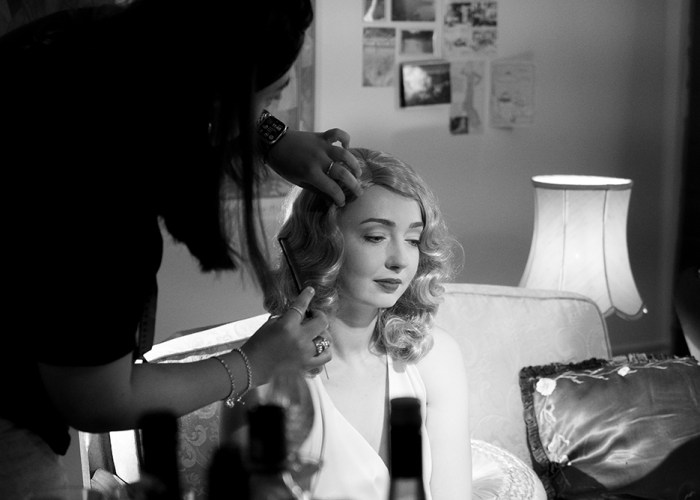
Karyl Lee Durham touching up Veronica’s wig between takes. (Photo by Isabella Rosa)
Jack Needle
Editor
Jack Needle is an emerging film editor living in Sydney, Australia. Fresh from his Masters at the Australian Film Television and Radio School, Jack brings a wealth of theoretical knowledge to his editing practices. From comedic timing to meditative pacing, Jack has a keen sense of rhythm in film which he utilises to engage audiences both emotionally and intellectually. He is easy-going, a great collaborator and fosters a deep passion for the craft of editing. He has recently edited the short films Withered Blossoms (Cannes Film Festival 2024), Dirty Laundry (Flickerfest 2025) and Last Goal Wins (DocPlay 2024).
Jack had a blast emulating the editing styles of the three film periods that Philia traverses: the snappy repartee of Golden Hollywood; the cool restraint of 50s Noir; and finally the powerful realism of the French New Wave. It was also his first time editing with multiple directors which was a pleasure and surprisingly efficient.
Greg Stace
Sound Engineer
Greg Stace is an ARIA nominated engineer-producer from Sydney, Australia. Highly regarded as one the country’s leading vocal producers, Greg specialises in organic productions from acoustic singer-songwriter through Country, Rock, Punk and Metal. Greg first earned notoriety as the man behind the desk during the punk pop movement of the early 2000’s starting with the breakthrough of “One Dollar Short” which debuted at #3 on the ARIA singles charts and was the first ever song of its genre to reach top 10 In Australia. This led to a decade long run that saw Greg produce over 100 records, achieving commercial chart success with acts such as Boy & Bear, Gordi, Something With Numbers, Tonight Alive, Buried In Verona and Kid Courageous. Greg spent much of 2016-2019 in the US, working in some of Seattle’s most prestigious recording studios, learning the art of hip hop production earning a reputation amongst his US peers as potentially ‘the fastest Pro Tools engineer in the world.’ Now, back home in Australia, Greg is again at the top of his game working at Paramount Studios on promotions for productions such as Days of Our Lives, Deal or No Deal, Love Island and A Gentleman in Moscow; and Ralph Street Studios, being instrumental in a number of recent break-through recordings.
Greg’s recent work on the Australian short film Philia—a feminist-noir drama exploring deep, resonant themes—proved both challenging and immensely enjoyable. “Working on Philia was challenging and immensely enjoyable. We got to explore every option of sound, exploring three different eras and creating its own challenges that ultimately blended seamlessly. It was one of the most fun projects I’ve ever worked on.”
Kali Bateman
Colourist
Kali Bateman has developed a reputation for impressive work through a career spanning over a decade, multiple continents, and tentpole features and episodic content. She recently had the pleasure of co-colouring Baz Luhrmann’s Elvis. During Kali’s time with DNEG Vancouver, Kali delivered VFX colour for a slate of titles including,The Last of Us, Dune, Wonder Woman 1984, Westworld, Ghostbusters: Afterlife, among many others. Kali is Dolby Vision certified, a certified Baselight trainer, a contributor to Mixing Light, an ACS sponsor, a member of the Colourist Society International, and is published in the Australian Cinematographer magazine.
Kali says: “I awarded Alex Shingles the ACS 2024 Student Encouragement Award. The prize was one full day of grading in my Brisbane suite. Alex and I worked closely on Philia to create three distinct black and white looks, working on my Baselight system. The first look was a high contrast “golden age of Hollywood glamor” look. The rushes were captured in colour so we made use of the tonal ranges of “base grade” tool and adjusted the luminance of different colour channels to make the skin glow against the actors clothes and hair. The second look had less contrast and was darker to reflect the narrative. The third look was a clean digital black and white look designed to look more contemporaneous. We also made use of different grain structures and levels of texture to distinguish the looks.”
Lara Brighton
Assistant Director
Lara Brighton moved to Sydney from Adelaide in 2023 to study a Bachelor of Arts Screen: Production at the Australian Film Television & Radio School (AFTRS). During her studies she has written and directed short fiction and documentary films, first assistant directed numerous shorts, and was an impact producer for an AFTRS factual short series Finding Chahari. She hopes to create work that entertains, inspires, and offers fresh perspectives.
Lara says: “I was drawn to work on Philia for two reasons; I wanted to support Katherine as she has been so great to work with on my own projects, and secondly I loved the script that Katherine and Chloe had written! The relationship between the women felt multi-layered and I was intrigued by the style of the script which felt both classic and new. On set, I worked with the fantastic crew to keep us running on time. As the film is one scene, we split up filming into sections depending on the camera movement, lighting setups, and the needs of production design. We were filming in a tight and warm space, so I was also in charge of turning the air con on between takes! Katherine and Chloe were both brilliant to work with and their talents really shine in this wonderful short film.”
Chloe Russell-Alexander
Sound Recordist
Chloe Russell-Alexander is an Australian filmmaker with experience spanning multiple departments. With a musical background, Chloe has an ear for sound recording and design. An AFTRS Bachelor of Arts Screen Production student, Chloe will complete her studies in 2025. Credits include feature films Black Prince (TBR), Haven’t You Heard Everyone Hates Me(TBR), web series The Detention Diaries (SWF), documentaries Heroyam Slava (SBS), Jasha (TBR) and short films Oi (nominated for AACTA, MFF, FlickerFest), Get On With It (SXSW), Joan the Kid (QSFF) and Bad Asians (SWF).
Chloe says: “Philia is a love letter not only to female friendships but also to film history and technologies. The craftsmanship of the team to pay homage to 1930s/40s and 50s lighting and sound design is breathtaking. As a solo sound recordist/boom operator my job involves recording the best quality sound while remaining invisible to the camera. Working on Philia I was in a delicate dance with shadows. The incredible complex and gorgeous lighting accomplished by Cinematographer Alex Shingles and his team turned a small apartment into what could’ve been a 1940s studio. Working with this style from my end meant experimenting with boom placement to make highly conscious choices to find the perfect position in each shot where dialogue was crisp and I was casting absolutely no shadows. The directionality of the Sennheiser MKH 416 was a great help for at times odd and unconventional placements. To mic the stars, Katherine and Chloe, I opted for the small but mighty Rode Go II’s, as the lightweight transmitters were easily hidden under the satin dresses and almost weightless for the actors, while still delivering crisp and clean audio.”
Isabella Rosa
Stills Photographer
Isabella Rosa is an emerging Sydney-based BTS and stills photographer for film. She has worked on a variety of projects, including music videos, drama shorts, and feature films. Her work focuses on documenting intimate on-set moments and capturing images that bring the director’s creative vision to life.
Isabella says: “As the stills and BTS photographer for Philia, I aimed to capture the complex inner worlds of Veronica and Dana. I focused on capturing moments of raw emotion and quiet intimacy, while also documenting the creative intimacy shared by the crew behind the scenes.”
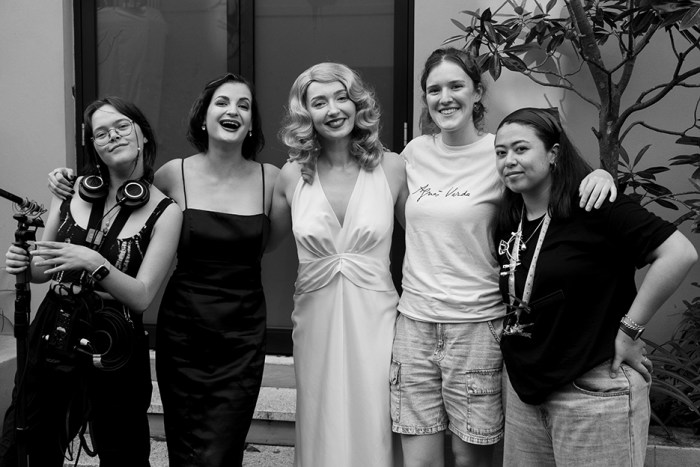
After a successful day of shooting. From left to right: Chloe Russell-Alexander, Chloe Callow, Katherine Grace, Lara Brighton, and Karyl Lee Durham. (Photo by Isabella Rosa)
Philia is currently on the festival circuit; follow for updates on instagram.com/philia_film. You can log, review, and add Philia to your watchlist here.
If you enjoy Cinema Australia as much as I love publishing it, please consider supporting Cinema Australia’s commitment to the Australian screen industry via a donation below.
I strive to shine a light on Australian movies, giving voice to emerging talent and established artists.
This important work is made possible through the support of Cinema Australia readers.
Without corporate interests or paywalls, Cinema Australia is committed to remaining free to read, watch and listen to, always.
If you can, please consider making a contribution. It takes less than a minute, and your support will make a significant impact in sustaining Cinema Australia as the much-loved publication that it is.
Thank you.
Matthew Eeles
Founder and Editor.Make a donation here.


 Cinema Australia