
Arthur Angel.
Veteran Australian actor Arthur Angel has taken on many roles over his decades-long career—convicts, bushrangers, mystical warriors, and more. But in his latest film Fear Below, Angel dives into dangerous new territory… literally.
Set in post-war Australia, Fear Below follows a rag-tag team of divers attempting to recover a sunken car from a river, only to find themselves face-to-face with a highly aggressive bull shark. It’s a tense, action-packed period thriller directed by The Legend of Ben Hall filmmaker Matthew Holmes which utilises incredible practical effects.
For Angel, Fear Below offered a chance to reunite with a trusted collaborator in Holmes, explore the rarely depicted world of 1940s Australian diving, and to help develop his character of Ernie Morgan.
In this interview, Angel opens up about his early days acting in student films, his audacious first audition with Romper Stomper director Geoffrey Wright, and the physical challenges of working in vintage dive suits. He also reflects on the state of the Australian film industry and why, despite its difficulties, he remains passionate about local storytelling.
Fear Below is available now via VoD.

Arthur Angel in Fear Below.
“I just thought he was a beautiful curmudgeon and a real failure of a man. When we talked about Ernie, Matthew told me the archetype for the character was Ed Harris’ character in The Abyss.”
Interview by Matthew Eeles
IMDB tells us that your first acting credit was in the TV mini-series Snowy. How accurate is that?
I think it was. [Laughs]. It was so long ago. I was about 21 or 22. I’m originally from Sydney, and I had moved to Melbourne because a friend wanted to enrol at Swinburne University and asked me to go with him. We went on a bit of a road trip and just fell in love with Melbourne. We started making a whole bunch of short films with film students at Swinburne, so I was learning a lot. I’d studied drama, but I just have a real love for film. You’ll get a lot of actors who talk a lot about theatre—and of course, theatre has its place, and I think it’s a beautiful thing to do as an actor. You have to do your theatre. It’s like going to the gym. But film, to me, is magic. Absolute magic. So I did a lot of short films at Swinburne, got myself an agent, and the first gig was Snowy.
Do you remember much about those short films? Did any of them go anywhere?
They were just student films, second years, third years. They were learning the craft at the same time we were. I was learning how to work in front of the camera as an actor. It’s important to actually work in front of a camera. There are so many courses out there teaching camera technique, and they are useful, but there’s nothing like going out there and getting your hands dirty as an actor.
What was your biggest takeaway from your time on Snowy?
It really gave me confidence. After Snowy, I’d seen Romper Stomper, and I absolutely fell in love with that film. I wanted to work with Romper Stomper director Geoffrey Wright. So I sought him out and kind of stalked the guy. [Laughs]. This was back in the day when I had a really crappy showreel on a VHS tape, and I got word to him that I wanted to drop it off. I found out where he lived, went to his house, dropped the tape on his doorstep, knocked on the door, and ran. [Laughs]. You can’t do that stuff nowadays. About a week later, he left a message on my answering machine asking me to audition for his next film, which was called Speed at the time. It had to be changed to Metal Skin, for obvious reasons. And then I was on my way. That was a great experience because I got to work with people like Ben Mendelsohn, Aden Young, and Nadine Garner. Aden and I are still friends to this day. It was such a great experience, my first feature film.
Was it then that you knew this was what you wanted to do for the rest of your life?
Absolutely. But I knew before that too. I knew back in school. I’d wanted to work in the industry since primary school. I know it sounds ridiculous, but even then, I knew I wanted to be an actor. I did try other things—of course, I’ve had to do odd jobs and things like that—but working in film as an actor was my all-time dream.
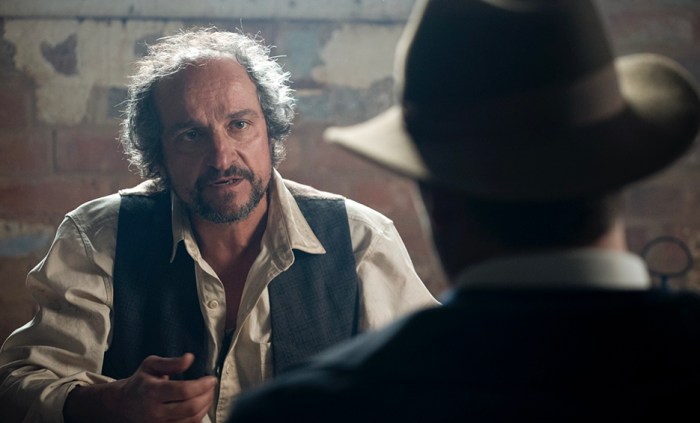
Arthur Angel and Jake Ryan in Fear Below.
You worked with Matthew Holmes on his 2017 epic, The Legend of Ben Hall. Was that the first time you met Matthew?
Matthew got in touch with my agent, and I didn’t know who he was at the time. He’d seen a film that I’m really proud of called Van Diemen’s Land. I think he really liked that film and wanted to work with me. I’ve always had a love of bushrangers and historical period dramas, especially in Australia. That’s why Van Diemen’s Land was such an interesting film to work on. So I worked with Matthew on The Legend of Ben Hall, playing Edward Morriss—an actual historical figure. I really loved the way Matthew worked. He approached me for another film, which I didn’t think I was right for. That was The Cost. He made the film anyway, and I said, “Look, if you’ve got another film, I’ll find any reason to work with you again.” And then he came to me with Fear Below.
Why didn’t you want to do The Cost?
I didn’t want to be the victim. I was interested in playing one of the guys who go out and seek revenge, but I didn’t want to put myself through the harrowing experience of being beaten around. The actor who ended up doing it, Kevin Dee, was fantastic. I’m so glad he found this beautiful actor who did such a great job. I just didn’t have the stomach for it, I guess.
What drew you to the character of Ernie Morgan in Fear Below?
I just thought he was a beautiful curmudgeon and a real failure of a man. When we talked about Ernie, Matthew told me the archetype for the character was Ed Harris in The Abyss. He’s got this ragtag bunch of people, and he’s almost like a father figure to them. He’s not perfect as a leader, but he’s a beautiful man, and a beautiful character who would sacrifice himself for the good of his crew. And that was Ernie for me. Also, a big part of it for me was that it was set in 1946 Australia.
Yes, there aren’t too many contemporary Australian films set in the 1940s.
Gallipoli, which I absolutely love, is one of Matthew’s favourite films. I think period films like this are Matthew’s specialty.
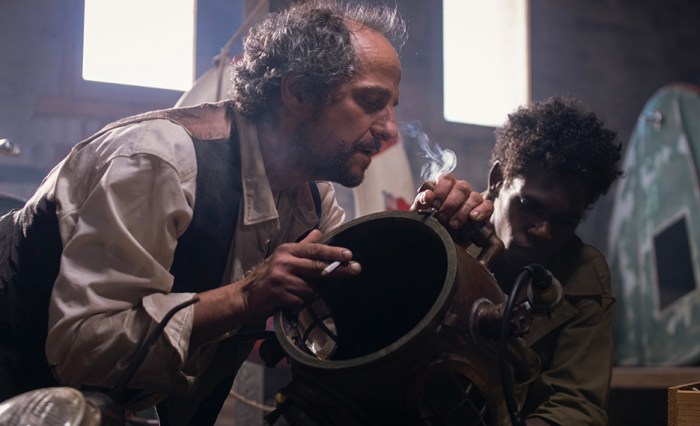
Arthur Angel and Jacob Junior Nayinggul in Fear Below.
Matthew told me recently that you worked with him to help develop Ernie’s backstory. Can you tell us about that?
Well, he’s a deep-sea diver, so I did a lot of research on deep-sea divers, especially those from the Northern Territory and Darwin area. What was really interesting about that period was that Australia had the White Australia policy at the time, but if you were an experienced diver and happened to be Japanese or of another nationality, you were allowed to work in Australia. Pearl diving in general is really fascinating stuff. I mean, there were people from all over the world coming to Australia at that time to work. It was a little loophole. So Ernie is an old World War I veteran. He was well-respected in the Navy, where he learned how to deep-sea dive. That’s where he met a lot of people from around the world. He eventually decided to open a diving business, but along the way he became an alcoholic.
And I believe that Ernie’s gold tooth was your idea too?
Yeah, that’s right. I was in the process of getting an implant myself, and I was wearing a denture for a while. We decided to incorporate that into the Ernie character. We’re talking about a period in Australia where dental hygiene wasn’t as good as it is now, so we gave him a gold tooth.
And it plays in so well with the rest of the story, considering the gold aspect of the narrative.
I hope so, because it was really hard for the makeup department to paint that gold tooth every day. [Laughs].
How would you describe your working relationship with Matthew?
Look, it’s just one of those unexplainable things where you collaborate with someone and it feels effortless. I mean, if there’s something I don’t agree with, he’ll say, “Okay, well fight for it. Justify why you don’t want to do it my way.” We’ve got great chemistry, and he’s just so easy to work with. He’s an actor’s director. He trusts his actors. It’s really important to have a director who trusts the actor. He strikes a fine balance between letting you go as an actor but also pulling you in if it’s not working. And if it’s not working, we’ll go again and again and again.

Arthur Angel and Hermione Corfield in Fear Below.
Can you tell us about trying on the dive suit for the first time? Was it a full suit?
I really don’t know how these guys did it back in the day. The helmet itself was 3D printed, and the boots were also 3D printed—they weren’t the real thing. The diving suit itself was pretty heavy and very claustrophobic. I honestly don’t know how these guys did it. It was pretty amazing walking in the suit. It was very tough and very hot.
How does it compare to any other costume or outfit that you’ve worn throughout your career?
It was good. I worked on The Chronicles of Narnia: The Voyage of the Dawn Treader many years ago, and I had to wear a heavy outfit for a while and walk around with a sword virtually every day. That was a bit tough, but this was probably the toughest.
Break down some of the film’s magic for us. Most of the underwater scenes are filmed in a studio without any water at all, and the results are quite incredible. Can you talk us through shooting those scenes?
I remember when we were doing the dry-for-wet studio stuff, there were a lot of takes where we had to walk in a particular way to simulate walking underwater. That was tough. We got really, really hot. I’m not a geek when it comes to this stuff, but I found it really interesting: they filmed us in a studio dressed to look like a riverbed. They pumped in a lot of smoke from a fog machine, then lit it from above to simulate the sun coming through the water. We were told we had to practice this. We rehearsed in our suits for ages, walking in a slow, moonwalk-like manner. They filmed us at 34 frames per second and played it back at 24 frames per second so we looked like we were wading through water. They added bubbles and sound in post-production. It’s a really old-school technique, which I believe they also used in The Abyss.
It works so well.
Well, thanks for that. Matthew Holmes should be proud of it, and of course the DoP, Peter Szilveszter. Technically, we didn’t go underwater, only to the surface of the river for the external shots.
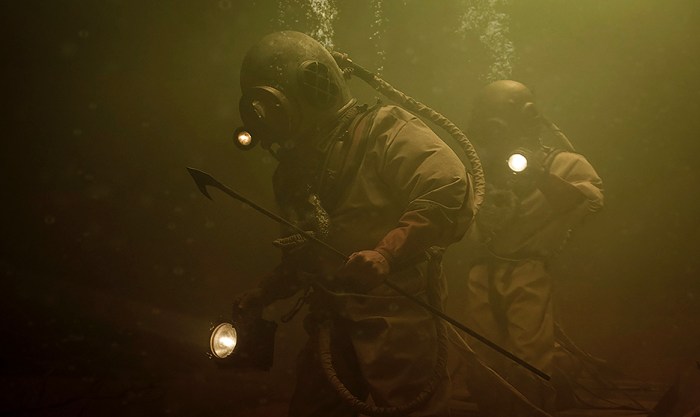
An “underwater” shot from Fear Below.
Matthew is known for being as historically accurate as possible. How does that sit with you as an actor?
It’s an absolute pleasure. I love detail, detail, detail. That’s what acting is all about. Also, audiences today are incredibly smart. They’re not idiots. They can see when things have been done in a half-arsed manner. I absolutely love it.
How do you find working as an actor in Australia at the moment?
Well, it’s not for the faint-hearted. It’s a really tough gig. I’ve always told people that they’ve got to be tough enough to handle rejection, but sensitive enough to do the work. It’s really tough when people tell me their child wants to be an actor here in Australia. I know this probably sounds terrible, but I often tell them not to do it. If you’re doing it for clicks, or to go viral on TikTok, then don’t do it. It’s a very tough industry here. We don’t have the sort of system a country like France does, where so much money is invested back into the industry. I wish we had that here in Australia to sustain a solid industry. We really punch above our weight here as far as talent goes. I just wish we were supported a lot more. Matthew Holmes is a great example of someone who generates his own work. He’s got a good family, a good crew of people around him. If you can make it here, you can pretty much make it anywhere.
Fear Below is now available via VoD.
If you enjoy Cinema Australia as much as I love publishing it, please consider supporting Cinema Australia’s commitment to the Australian screen industry via a donation below.
I strive to shine a light on Australian movies, giving voice to emerging talent and established artists.
This important work is made possible through the support of Cinema Australia readers.
Without corporate interests or paywalls, Cinema Australia is committed to remaining free to read, watch and listen to, always.
If you can, please consider making a contribution. It takes less than a minute, and your support will make a significant impact in sustaining Cinema Australia as the much-loved publication that it is.
Thank you.
Matthew Eeles
Founder and Editor.Make a donation here.


 Cinema Australia