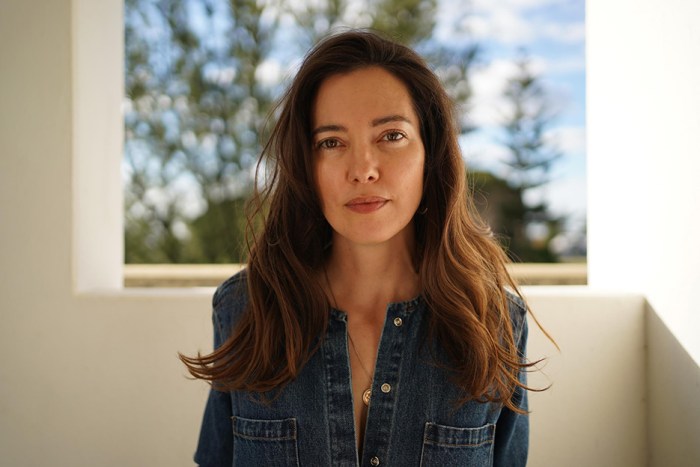
Zoe Pepper.
If you’re a younger Australian currently wading through this country’s nightmarish property market, you’d be forgiven for mistaking Birthright for a documentary.
Of course, that’s a stretch—but only just. Zoe Pepper’s razor-sharp debut feature is a satirical black comedy that’s as hilarious as it is confronting. With its biting commentary on the Australian housing crisis and sharply observed characters, Birthright is bound to hit close to home for many viewers. It’s also a brilliant introduction to one of Australia’s most exciting new filmmakers.
Birthright follows Cory (Travis Jeffery, arguably one of Australia’s finest actors) and his pregnant wife Jasmine (the always-impressive Maria Angelico), who find themselves evicted and unemployed. With nowhere else to go, they move in with Cory’s baby boomer parents, Richard and Lyn, played by Michael Hurst and Linda Cooper.
What starts as a temporary arrangement soon spirals into something far more unsettling. As the stay drags on, Cory’s increasingly desperate attempts to prove himself to his parents begin to unravel his grip on reality, leading him down a bizarre and unexpected path to success, one that ultimately detonates the fragile family dynamic.
Zoe comes to filmmaking from a successful theatre career where she honed her distinctive voice and darkly comedic sensibility. Her theatre work has toured widely, including a Helpmann-nominated season of The Irresistible at Dark Mofo and the Sydney Opera House.
In addition to Birthright, Pepper has written for the comedic thriller series Population 11 for Jungle Entertainment, and co-created the acclaimed web series The Big Spaghetti, which screened at Slamdance.
She has won both Australian Writers’ Guild and Directors’ Guild awards and is also the co-founder of Audioplay, an award-winning interactive audio platform for children.
Cinema Australia recently caught up with Zoe to discuss Birthright ahead of its Australian premiere at the Sydney Film Festival.
Birthright will screen at Sydney Film Festival from Thursday, June 12. Details here.
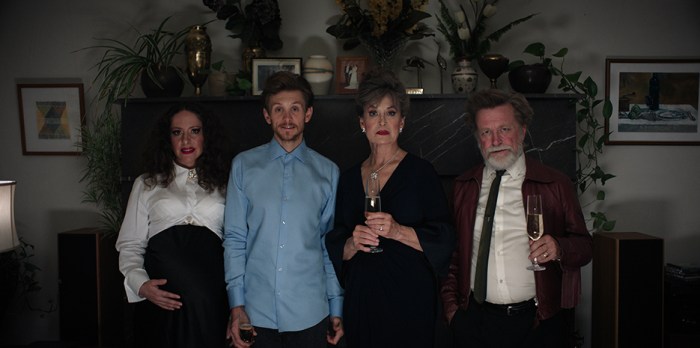
Maria Angelico, Travis Jeffery, Linda Cropper and Michael Hurst in Birthright.
“I absolutely feel that it’s my job to make entertainment and to move people, but to also have something to say. I have a responsibility to add to a social discourse, but to do so in a way that is entertaining.”
Interview by Matthew Eeles
Take us back to 2022, when you were successfully selected for West Coast Visions. What does something like that mean to a filmmaker?
It was huge, especially for a script that was very true to my voice and my style. To get that backing from Screenwest for something that has so many idiosyncrasies was a huge boost and really changed everything. So I’m incredibly grateful for Screenwest’s support. This was a project that I had been tinkering with in the background. It was a project that was more about the writing for me, and writing in a way that very much operated in a style and a tone that I had honed through my theatre work. The writing had more of an absurd quality and pushed more into the surreal, rather than trying to be a “filmmaker” and write what I thought a film should be. This was more about me writing for me because that’s what I enjoy.
What stage of development was Birthright up to at that time?
It was quite early. Cody [Greenwood, producer] and I had been working together for a long time, and we’d been developing other projects together, so we had that solid foundation, which meant we were a team that Screenwest were happy to back, rather than being a freshly formed team.
I remember at the time Birthright was being touted as a revenge tale. But it’s far from it.
I feel like maybe someone extrapolated that on their own, because the script actually wasn’t changed radically. [Laughs]. It is quite true to what it was back in 2022. Obviously, many more drafts were written, but the bones have largely stayed the same.

Michael Hurst and Linda Cropper in Birthright.
Birthright covers some incredibly timely themes, mostly the disconnect between baby boomers, the housing market and younger generations. What inspired you to explore those themes on film?
I was living it and experiencing it myself in a very visceral sense, and a lot of people I know were being forced to move back in with their parents. My own sister moved back in with our parents during the pandemic. So just knowing that that was becoming more and more common, and that it was not ideal for either generation. I was looking at real estate in 2021, and it feels like it’s only gotten worse since that time. Every week you’re getting priced out of a different area or suburb, and the urgency was kind of palpable. The housing market was very stressful then, and it’s even worse now.
These themes certainly feel more relevant now more than ever.
Yes, sadly. I kept thinking the film was going to lose heat because I was writing it during the housing crisis of 2021. I thought I was going to miss the boat, but sadly, it’s just gotten worse and worse.
I might be jumping too far ahead here—and we will talk about the cast and characters in a moment—but is Michael Hurst’s Richard rubbing a lump of coal during the office scene?
[Laughs]. I hadn’t written it as coal. Richard is a geologist. We’ve got all these precious rocks around his office, so he is picking up this precious bit of rock, but it’s not coal. I should actually find out what kind of rock it was. But it is interesting to know that you’ve interpreted it as coal because that makes it a bit more on the nose and a bit more pointed. [Laughs].
You’ve said in your director’s statement that, “Birthright is unsettling, irreverent and emotional. But best of all, it’s fun.” When you’re exploring such melancholy themes, how do you stop yourself from going too deep and too dark?
I wanted the darkness to have its place in the film while keeping it enjoyable. There should be an intensity to wanting to know what’s going to happen next, and to keep it clipping along at a pace that makes it entertaining. And I sometimes talk about my work—more so in theatre—as being highbrow wrapped in lowbrow. I absolutely feel that it’s my job to make entertainment and to move people, but to also have something to say. Especially in film, when you’re spending so much money to tell a story, you absolutely have a responsibility to add to a social discourse, but to do so in a way that is entertaining. You kind of have those highbrow ambitions, but wrap it up in lowbrow—wrap it up in entertainment and in a way that is accessible and fun and emotionally engaging for the audience.
Did you reference any particular films while writing Birthright?
I referenced Who’s Afraid of Virginia Woolf quite a lot. I like that old-school melodrama, which is not in vogue at the moment. I’m also a big fan of early Paul Thomas Anderson films and his pacing. I think his films have a real sense of fun, and even though they’re dramatic and high-stakes, it’s still a real joy to watch them.

Maria Angelico and Travis Jeffery in Birthright.
Birthright is your debut feature film. Describe your first day on set.
It was pretty tough. It took a while to wrangle everyone and to get everyone on board with the tone of the film. [Cinematographer] Mick McDermott and I have a really great relationship, but we had not worked together before, so I think it took a couple of days for us to understand each other and for him to really understand what I was after. But we absolutely got there. Mick went above and beyond to execute my vision and to really give me what I needed to tell this story.
What are some differences between directing theatre and directing a film? Would you say your theatre work has shaped you differently to other filmmakers?
I think it means that I have a really specific tone and style—something I’ve honed from making a lot of theatre. Also, the way that I use music as part of that tone. I’m always chasing a really particular performance style. Because I studied theatre arts and trained as an actor, I think that maybe how I differ from other directors is that I’m pretty tough on actors. I give them a lot of hell. [Laughs]. Performance is king, especially in the edit. Everything else took a backseat to performance because that’s where my focus is, which is probably largely to do with my theatre background.
How did your actors take to that style of actor-focused directing?
Look, they love and hate you for it. [Laughs]. I had a great relationship with the entire cast, and it certainly didn’t come as a surprise to them. The audition process gave a good indication as to what was in store for them.
Music seems very important to you as a filmmaker. Talk us through this film’s incredible score.
James Peter Brown did the score, and he did such a great job. I still love listening to the score. Music is so important for Birthright because it creates a sense of grandeur and gives it an operatic, melodramatic quality that really transcends the one location and four people in a house. You could execute that in a way that’s kind of drab, but the music lets it be more than just four people in a house and invites the audience into the emotional world of the characters. It’s big in terms of pacing and drive, but it also gives those emotional cues to the audience on the scale that I want the story to be playing at.
How did you settle on James?
We’d worked together in theatre before. He’s a really impressive composer, and he was happy to go the distance to keep reworking the material. Often, I’m looking for the music to affect me in a way where you can’t see the mechanics of it. So often, he wrote music that was amazing, but I’d be like, “But I can see what you’re trying to do.” I could see the mechanics that were trying to emotionally manipulate me in different ways, so we looked at how we could rewrite the music in a way where the mechanics aren’t on show, so that it’s more unexpected, that it gets you emotionally, but you don’t necessarily completely understand why.
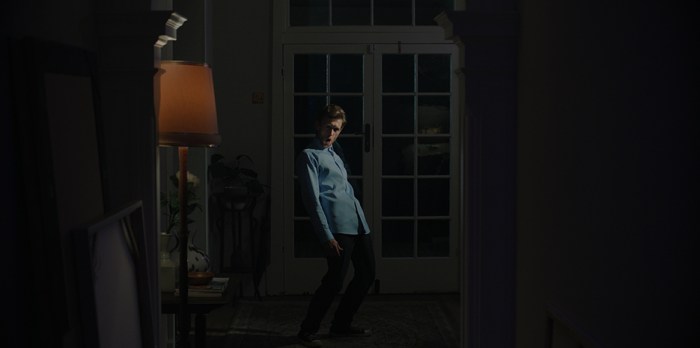
Travis Jeffery in Birthright.
Because this film is a four-hander, it’s impossible to single out one performance. Talk to us about casting your four lead actors and ensuring that their dynamic would work on screen.
It was stressful. We did a lot of chemistry tests between Travis [Jeffery] and Maria [Angelico] to get that right and to make sure that their relationship felt believable, which was really important. And Travis was important in terms of casting because we needed to find a Corey with the vulnerability that undercuts his obnoxiousness. That was something that was really important to me. There were other actors who were maybe a more obvious leading man, but they didn’t necessarily have that quality that Travis really had, and that goes for the entire cast. It was about finding actors who were happy to really swing for the fences and play with absolute conviction, and that was a big deciding point on how to form the ensemble.
I guess there is a fifth character in Birthright, and that’s that incredible jacket. Where did you find the jacket?
That’s my husband’s jacket. [Laughs]. I mean, we had duplicates made, but you can’t replicate 25 years of wear. Not that he wears the jacket anymore, and the tassels were retrofitted just to give it a little bit more pizazz.
While the jacket is aesthetically great, it wouldn’t have worked as well as it does without that incredible sound design. Did you instruct the emphasis on the jacket’s sound design?
Oh, absolutely. And it was great fun to work with across the whole process. Everyone would tell me that the sound’s not realistic, but I didn’t care. That seemed to be an unexpected card to a lot of people—that my care for naturalism and realism is very low, and that I like to be far more playful.
How did you come across this incredibly grand home? Did the house require much re-decorating and production design?
Ocea Sellar, the production designer, did a great job with that house. The house was very much fitted out in a much more modern aesthetic. They did have to redress the whole home to make it feel more like a Baby Boomer’s home. And it was important that it displayed an understated wealth of a Baby Boomer, so we didn’t want it to be too flashy. These aren’t people who think of themselves as rich, and by some people’s standards they’re not rich because they’ve essentially built their wealth from nothing. They don’t consider themselves wealthy, and that is reflected in the production design, which was really important.
Can you break down some behind-the-scenes magic for us and talk us through the extraction of the backyard pool?
That’s just a hole in the ground and some plywood, which is kudos again to my husband, Nathan, who made the pool. He did a really great job. We had to shoot that chronologically, and I think it just brings so much production value that he did such a great job. But yeah, that’s just some black plastic and plywood, really. That’s all just smoke and mirrors.
Birthright will screen at Sydney Film Festival from Thursday, June 12. Details here.

ADVERTISEMENT
If you enjoy Cinema Australia as much as I love publishing it, please consider supporting Cinema Australia’s commitment to the Australian screen industry via a donation below.
I strive to shine a light on Australian movies, giving voice to emerging talent and established artists.
This important work is made possible through the support of Cinema Australia readers.
Without corporate interests or paywalls, Cinema Australia is committed to remaining free to read, watch and listen to, always.
If you can, please consider making a contribution. It takes less than a minute, and your support will make a significant impact in sustaining Cinema Australia as the much-loved publication that it is.
Thank you.
Matthew Eeles
Founder and Editor.Make a donation here.


 Cinema Australia
Pingback: Cinefestoz $100,000 Film Prize finalists announced | Cinema Australia
Pingback: MIFF unveils full 2025 program! Which Australian films will you be seeing? | Cinema Australia