
Kate Blackmore.
When actress Maria Schneider spoke out about her traumatic experience filming an unscripted sex scene with Marlon Brando in Last Tango in Paris, it shocked the film world and sparked global conversations about consent in cinema. Her story has now inspired Australian filmmaker Kate Blackmore’s debut feature documentary, Make It Look Real.
Blending documentary and scripted scenes, Make It Look Real takes a close look at the growing role of intimacy coordinators through the perspective of Claire Warden—one of the industry’s leading figures. It’s a timely and thought-provoking film that explores power, performance, and the importance of consent, especially relevant in Australia, where intimacy coordinators are not yet standard practice in film and television.
Blackmore is no stranger to bold storytelling. She has written, directed and produced more than 25 short documentaries for the ABC, including the Walkley Award-nominated The Movement. In 2018, she was selected for the prestigious Hive commission to create The Woman and The Car, a hybrid documentary about artist Margaret Dodd.
She is also a founding member of the artist collective Barbara Cleveland, and her work has been shown in major exhibitions in Australia and overseas. Blackmore holds degrees in Moving Image and Film Theory from UNSW and a Master’s in Visual and Media Anthropology from Berlin’s Freie Universität.
Cinema Australia caught up with Blackmore to talk about Make It Look Real, the changing culture on film sets, and the future of safe and ethical filmmaking in Australia.
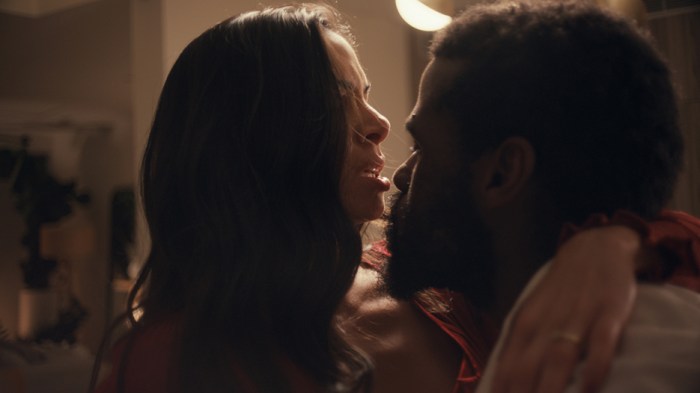
Sarah Roberts and Albert Mwangi in Make It Look Real.
“It’s still not mandated in Australia to have an intimacy coordinator as part of an intimate scene, unlike stunt coordinators, who are such a valuable part of the industry.”
Interview by Matthew Eeles
When did you first hear the term Intimacy Coordinator?
I read an LA Times article about an intimacy coordinator back in 2017, which described the work that she was doing and that this was a very new role. At that point, it was coinciding with the MeToo movement. I thought it was a really fascinating role. Also, around that time, I read about Maria Schneider’s experience on Last Tango in Paris and the infamous butter scene that a lot of people know about, and how she was coerced into performing the sexual assault scene without knowing the full details of the scene beforehand. She was traumatised by that experience, and it really affected her throughout the rest of her life. I was really shocked reading about her experience and that it was in 2017 that the intimacy coordinator role was only just emerging. I really wanted to know why there hadn’t been any support for actors prior to that point, and how intimacy coordinators were going about legitimising their role and professionalising it within a film industry that is so male-dominated and patriarchal. I thought it was a really fascinating area to explore. Then I did a bit of research and found Claire Warden’s name, who is at the centre of our film. She’s our key protagonist and was part of a company called Intimacy Directors and Coordinators based in New York. I contacted Claire because I was already going to New York for a different project, so I asked her if she would like to have a coffee. We had lots of discussions. We started shooting four years ago, incrementally, as every documentarian does—as you get funding, you sort of shoot a bit more. [Laughs]. This film took a long time to make because of COVID as well, but we got there.
Your 2021 short film The Butter Scene explores Maria Schneider’s story. Was that short film inspiration for you to make Make It Look Real?
I was already in development at that time for Make It Look Real, but I was itching to experiment dramatically with the story of Maria Schneider. The opportunity came up for me to make The Butter Scene, and I decided to do it. It was actually really interesting to explore that terrain in a narrative film before making a documentary. I collected all of the interview transcripts that I could find of Bernardo Bertolucci and Maria Schneider talking about that scene separately. They never talked about the scene together on record, as far as I know. With the interviews, I then created a script where they were speaking in tandem, in a dialogue back and forth. And then I got some actors to play the roles of Maria [Tara Morice] and Bertolucci [William Zappa]. It’s a two-hander that really focuses on the scene and the impact that it had on Maria’s life. It was just a way for me to get something out of my system, knowing that the documentary was going to take years to get up.
I remember being very young when I first watched Last Tango in Paris. At the time, I remember thinking the butter scene was odd, but I was too young to realise the true impact that scene would have had on Maria. It wasn’t until years later that I heard Maria Schneider’s story. What was your first introduction to that film, and subsequently, Maria’s story?
Well, at the time I just assumed that they were acting. So I don’t think it had an effect on me then. When I saw the film, I was also quite young, but then when I rewatched it, knowing what had actually happened on set and what I was watching, I was really affected by it, because I knew that I was actually watching someone being exploited and abused on screen. It wasn’t acting, and it was all very intentional and deliberate on the part of Bertolucci. So that was really quite affecting. I played that scene out to Claire and Kieran Darcy-Smith in Make It Look Real and asked them to watch it and respond to it in real time, and that was actually so hard for all of us. Claire was in tears, and Kieran couldn’t watch it. In the context of Last Tango in Paris, it can wash over you, I guess, because you’re so immersed in the story and the world of that film. But on its own, the scene is such a stark reminder of how horrible it is. It’s just very emotional. Knowing that Maria was so powerless in that situation, and she’s so young, and she looks so pure and innocent in that film, and there were these older men colluding against her—it was really horrible to look at it again years later knowing all of that information. The film was scandalous when it came out anyway. I think a lot of people thought that a lot of the sex, intimate scenes, and the nudity were gratuitous. And certainly, when I watched it at the time, I felt like it was too much. It was just one man’s fantasy. This is Bertolucci’s fantasy getting played out, and it’s just a bit icky. I think it has dated badly, and we don’t see those kinds of films being made as much anymore, with the female just being such a titillating object without any real agency in the story.
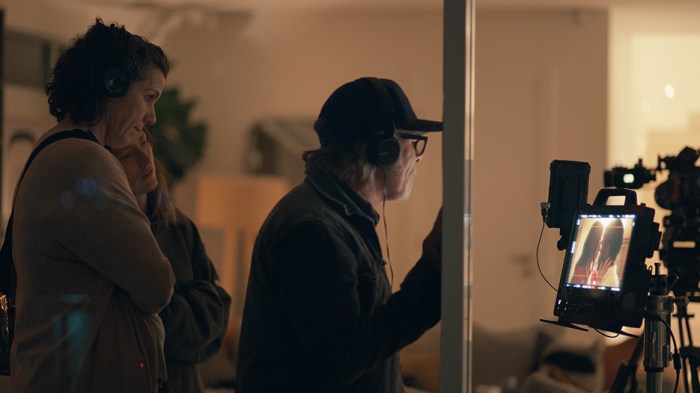
Claire Warden and Kieran Darcy-Smith in Make It Look Real.
You’ve worked in the film industry for over a decade now, predominantly on your own films. Have you been on a film set before, or heard about a particular production that really could have utilised an intimacy coordinator? And I don’t expect you to name names.
I mainly work in documentaries. I have made a couple of drama shorts before, but none with any intimate scenes. I know a lot of local actors who have told me about their own horror stories on set. I know that it is an issue in Australia and that there’s rarely any support for actors. It’s still not mandated in Australia to have an intimacy coordinator as part of an intimate scene, unlike stunt coordinators, who are such a valuable part of the industry. I’m sure that these issues are still happening. Actors are having their boundaries pushed and doing things that they don’t really want to do because they feel like they have to, or they don’t have a way to navigate that situation or someone to support them through it.
As you mentioned, Claire Warden is the protagonist of Make It Look Real. Can you expand on when you first heard of Claire?
I learned very quickly that Claire was part of a group of intimacy coordinators who had joined forces to create this company in New York to start to create some protocols around the discipline of intimacy coordination—because it hadn’t existed in film and TV, but it had in theatre. There had been other people who were responsible for supporting actors on film sets, but it wasn’t a formalised role. So Claire and her colleagues got together and started to write some protocols, and then they established themselves as an organisation because there was so much demand for this kind of work, but not enough coordinators out there to do it. So they started to train an army of intimacy coordinators. I think they are now the only organisation that certifies intimacy coordinators internationally. A lot of Australians will go to Claire’s company to do the training and get certified. She was one of the pioneers of the discipline. I thought that going to the source was the best thing to do in terms of wanting to make a film about intimacy coordinators. I needed to talk to her. And it just turned out that she’s a very charismatic, poetic, and very open and generous person, so she was the perfect person to make a film about.
She’s so articulate in her descriptions and guidance. What was your biggest takeaway from your time working with Claire?
The thing that really surprised me is how involved she is in all aspects of production—even at script level. This doesn’t happen on all productions, but in an ideal scenario, she’ll be brought in to really interrogate the script and make sure that the sex scenes are all pushing the story forward and not just gratuitous. She’ll really ask questions and interrogate those scenes. She’ll also do that as a way to understand the writers’ and the director’s vision, as you see in Make It Look Real. I wasn’t aware that she was involved so early on as part of the key creative team. I really just assumed that her job was about the physicality and choreography of sex scenes and making the bodies fit together in a way that created the illusion of intimacy—but it’s so much more than that. She’s also there to support the crew. A lot of people don’t realise that the crew are the ones watching these scenes—particularly if there’s a sexual assault scene that they have to create on set. There are people watching actors go through this stuff over and over again, and it’s really harrowing for everyone, not just the performers. So Claire is there to support everyone on set and to make sure that no one’s taking the work home in a way that could damage them after the fact.

Claire Warden and Kieran Darcy-Smith in Make It Look Real.
Would you say that Claire has reshaped your approach to filmmaking?
Definitely. I think the way that Claire leads with kindness and care—as a female director, especially when you’re starting out, you think that you have to assume a dominating, authoritative kind of presence on set. And Claire certainly does have that, and she isn’t a director, but I think to see how people respond to kindness and care and to having open conversations was so beautiful. I felt like I really absorbed some of her language and some of her manner around having those conversations and putting everything on the table and making sure that everyone is okay. I think if you have a healthy workplace, then everyone will do the work better. That’s really something that Claire modelled for me. That’s what I’ve taken into my filmmaking, but also into my own life as well.
Make It Look Real is part mockumentary in that the film within this film, Tightrope, isn’t real. The scenes were written by filmmaker and actor Kieran Darcy-Smith specifically for this film. How closely did you shape these scenes with Kieran, or were they created entirely by him specifically for a male perspective?
Well, just to backtrack a little bit, I want to try to avoid saying that Tightrope is a fake film, because it was actually a real film. We tried to get access to some film sets and productions that Claire was working on, but because her work happens on closed sets, no one wanted a documentary crew accessing those particular scenes. So we really had to think hard about how we were going to show Claire’s work on screen. I’m a director, I’m a writer, and Bethany Bruce, my producer, works across film and documentary. We have the skills to create our own production and then document that. So basically, we hired Kieran, who was one of the first people to respond to our call-out for a writer, to basically write an outline for a film that contained some intimate scenes, and we wanted it as a vehicle to show Claire’s work. Kieran was one hundred percent on board, and he dealt with it in the same way that he would’ve dealt with any job. He responded to the brief. He came up with this really interesting and compelling outline, which had three different characters and three different intimate scenes of varying levels of intensity, which is actually what I asked for. And I actually pushed for a threesome at the end, which was actually a really interesting dramatic point in the film. Kieran gave us these scenes and an outline, and also the characters’ backstories, as he would on any other job. And then Kieran and I cast it together. We chose the actors together, and then they came on board. Claire then had real meetings with Kieran on set. Everything you see at that point is as it would’ve been on any other production. So basically, we created the framework for reality to unfold within. There was nothing actually fake about it— it was just that it came from us, as opposed to us going to someone else.
I guess there’s an illusionary aspect though in that Tightrope itself isn’t a complete film that’s going to eventually release.
No. Although when we were filming Make It Look Real, Kieran was hoping to shoot the rest of it. It was all planned. He was really, really excited about it, and he was really excited by the actors. But then after Make It Look Real wrapped, he went onto another job, and then too much time had passed. The momentum fell flat, but he was intending to turn it into an actual film.
It’s never really explained in the marketing for the film or the synopsis for the film. Is there a level of audience manipulation here to get your message across?
We did quite a few audience test screenings before we released the film publicly. And that was my main question at the end of the screenings: Do you feel manipulated? Do you feel like you wanted to know that Tightrope wasn’t a real film upfront? There were a couple of people who said that they wanted to know that, but most people said no, and that it didn’t change anything for them. If they knew that Tightrope was constructed at the start, then it would’ve changed the way that they were absorbed into the action, and they might’ve felt a bit more disconnected from it. And we felt in the end that it would’ve just distracted people from the point of the film. So we decided not to include it, but I’m also very open to talking about it, and it’s something that I always bring up in audience Q&As. Most people love the way that we’ve approached it, and it is actually the only way we could have done it. And also making sure that the cast and crew were entirely aware and informed and were consensual before we did any of the filming. If we went onto someone else’s production, we wouldn’t have been able to get consent from every single person prior. So we wanted to present best practice in the creation of the documentary as well as through the subject matter. It would’ve undermined what the film was about if we didn’t do it that way. In the end, we decided not to include it, but I think it was the right decision. But I’m sure everyone will have different opinions.
I definitely think it was the right choice, but I was curious about your reasoning behind it.
Every documentary has an element of construct, and this is something that I always talk about with my students. Most of the time you’re asking people to re-stage or re-enact something. And the line between reality and fiction is so blurry in every reproduction. So in a way, I felt like I didn’t want to draw attention to that, and I didn’t think it was important. Maybe I’m sounding a bit defensive because I don’t want the audience to feel manipulated. But it’s a constant question for us as documentarians.

Claire Warden, Sarah Roberts, Kieran Darcy-Smith, Albert Mwangi and Tom Davis in Make It Look Real.
How did you settle on these three actors specifically?
Well, I think we really wanted to make sure that our actors were comfortable talking about their process, but could also act in a convincing way. So we wanted to find really good actors who were also very articulate people. We didn’t go through an official casting process, we just pitched to people who we wanted, and we were really lucky that those people responded. I’d done some pre-interviews with them and realised that they were super articulate and that they were excited about this project. It was a bit of an experiment, actually. We didn’t really know how it was going to turn out or what was going to happen during the filming, but they were really up for it. And I knew I wanted people who were quite inexperienced around intimate scenes. So that narrowed our focus a little bit. We also wanted people who looked good together, and Albert and Sarah are so beautiful, and they were a convincing couple. Tom was someone who Kieran had worked with previously on Last King of the Cross, and he loved Tom, so Tom was so happy to join the crew.
We spoke then about certain things being constructed for documentaries. How much of Albert, Sarah and Tom’s specific requirements were genuine?
We knew that they didn’t have much experience working on intimate scenes, and I knew that none of them had worked with an intimacy coordinator. That’s all I knew. So I didn’t know what their consent levels were. They’d read the three intimate scenes that Kieran had created, although the third scene was in draft form. It wasn’t fully fleshed out. So they knew what they were getting into, and we had a lot of conversations prior to them coming on board. I was actually really surprised when Sarah said that she didn’t want any nudity, because she knew that this was a documentary about performing sex scenes. All of that was a real surprise. It was absolutely real.
In Australia, it’s not mandatory for productions to use an intimacy coordinator, but it is encouraged. Where does Australia sit at the moment in terms of intimacy coordination? And I guess I ask that question because Claire is British, and I wondered if there is a lack of intimacy coordinators in Australia?
I think we’re a little bit behind the eight ball. We’ve had quite a few big intimacy coordinators come to Australia. Claire and her team have come out to do some training workshops. And then there was another big UK-based intimacy coordinator called Edna O’Brien who came out for some talks. There is definitely a group of very strong advocates here, but maybe I can’t comment so much on that specifically. Going by what Claire says, we are a little bit behind in the discipline compared to America and the UK. I’m not one hundred percent clear on exactly where Australia is at, but the fact that it hasn’t been mandated is a big deal, I think. There are production companies overseas who are starting to mandate it within their own organisations. HBO was the first one to mandate intimacy coordinators. I hope there will be more companies doing that.

Albert Mwangi and Sarah Roberts in Make It Look Real.
I really do feel like it should be mandated across the entire screen sector.
And it’s interesting to ask why it’s not. I think for me, intimacy coordinators are primarily a female-focused job. And I wonder if that’s the reason that people don’t feel that it is as important as a stunt coordinator, which is a male-dominated industry. The film industry is very male-dominated, and maybe any job to do with women is not considered a priority. And it’s also the fact that often the violence or the injury that occurs when you’re doing intimate scenes is psychological as opposed to physical. So you can’t see it, and therefore there’s no blood and there’s no spectacle around it. So people just think, “Oh, they’ll be fine. Just go home and have some tea.” So that could be more the reason why.
I don’t often ask filmmakers to offer advice, but other than watching Make It Look Real, do you have any advice for independent filmmakers who want to include an intimate scene in their film but can’t afford an intimacy coordinator? Are there alternative resources for them to access, or is your advice that it simply shouldn’t be done?
Don’t do it if you can’t afford it. Would you do a stunt without a stunt professional on set to make sure everyone’s safe? You wouldn’t, so either raise more money and postpone the production or don’t have that scene in the film. That’s what I would say. And I think that’s what Claire would say too. Money is always an issue, but you can make very sensual films without showing the act. Portrait of a Lady on Fire is a great example of that. So be creative in how you tell that story, and maybe you don’t need to depend on the physicality of actors to do it.
Make It Look Real will screen at the Sydney Film Festival from Thursday, 12 June. Details here.

ADVERTISEMENT
If you enjoy Cinema Australia as much as I love publishing it, please consider supporting Cinema Australia’s commitment to the Australian screen industry via a donation below.
I strive to shine a light on Australian movies, giving voice to emerging talent and established artists.
This important work is made possible through the support of Cinema Australia readers.
Without corporate interests or paywalls, Cinema Australia is committed to remaining free to read, watch and listen to, always.
If you can, please consider making a contribution. It takes less than a minute, and your support will make a significant impact in sustaining Cinema Australia as the much-loved publication that it is.
Thank you.
Matthew Eeles
Founder and Editor.Make a donation here.


 Cinema Australia