
Yaara Bou Melhem.
Having been born in the 1980s and lived my entire life in Western Australia, the devastating legacy of the Wittenoom asbestos mines has always loomed large. This environmental and human tragedy, where more than three million tonnes of deadly mineral waste were dumped over 60 years ago, remains the largest contaminated site in the Southern Hemisphere.
As children, my siblings and I were told about the horrors of the mines by our parents and grandparents. These warnings shaped our awareness of the dangers of asbestos in general, especially growing up in a small country town where asbestos extensions were common in heritage homes like the one we grew up in.
That sense of vigilance made my experience watching Yaara Bou Melhem’s documentary Yurlu | Country deeply personal and emotionally affecting. While my understanding of Wittenoom had always been passed down through conversation, seeing the poisoned landscape, stained like tumours across Country, was confronting in a way I hadn’t expected.
What makes Yurlu | Country even more heartbreaking is the personal story of Aboriginal Elder Maitland Parker, who takes centre stage in the documentary and is also credited as the film’s co-writer and executive producer. Parker spent his final year confronting the impact the mines had on his land, his people, and ultimately, his own life. Yaara Bou Melhem’s film is an intimate and unflinching portrait of a man determined to preserve his culture and begin the long journey of healing.
Yaara Bou Melhem is an award-winning Australian writer, director and producer known for her powerful social justice documentaries. Her debut feature, Unseen Skies (2021), explored surveillance and artificial intelligence and screened at major international festivals. She also wrote, directed and co-produced The Whiteley Art Scandal (2023) for the ABC. Her acclaimed short films cover topics ranging from the creation of a secular democracy in war-torn Syria to Nobel Laureate Maria Ressa’s fight against disinformation. A former investigative journalist with SBS Dateline and Al Jazeera English, Bou Melhem has received two UN Media Peace Awards and five Walkley Awards. Yurlu | Country is her second feature.
In this interview, Yaara shares her experiences making Yurlu | Country, from the weight of filming its most difficult scenes, to the safety measures taken while shooting in Wittenoom, and the impact she hopes the film will have on audiences.
Yurlu | Country will screen at the Sydney Film Festival from Saturday, 7 June. Details here.

Yurlu | Country team with Maitland Parker at Karijini National Park.
“As a former foreign correspondent, I used to go to a lot of war zones and disaster zones. But I don’t think I’ve ever been as terrified as I was in Wittenoom Gorge.”
Interview by Matthew Eeles
Where does your interest in social justice filmmaking come from? Is this something you’ve always wanted to do?
I’ve always had this bent towards social justice issues. I trained as a lawyer, but I was drawn to journalism and documentaries. I worked as an investigative journalist for about 15 years, mostly for public broadcasters or broadcasters where content was made freely available. For me, that kind of equity of access to the work and the journalism was really important. Because of that, I always approached the work as something that should be a public good and part of a service to the public, so there was that instillation of being civic-minded in the work. But at the same time, I love storytelling and the artistry of it all. I was making half-hour, long-form current affairs material as a public broadcast journalist for Dateline at SBS, Foreign Correspondent at ABC, and Al Jazeera English all over the world. Even though that was fantastic and I was making films that I really loved, what I found was that there was some disconnect between putting the story out there into the world and then activating change. That’s when I started to look towards documentary. The other reason I started to look at documentaries was that I noticed facts aren’t enough to sway opinion or change a person’s mind. With documentary, you can make people feel something—you can use music, sound, and incredible visuals to really get to the heart of a person and the heart of a story, and translate that intimacy on screen. Hopefully, that will make people feel something. Even if you know something in your bones—like the fact that Wittenoom is the largest contaminated site in the Southern Hemisphere, and that Aboriginal people in Western Australia have the highest rates of mesothelioma in the world—these are all facts that are shocking on their own. But how do you make people feel that? For me, that’s the power of documentary, and that’s what drove me to making social justice films.
It must be difficult to separate emotion from the craft when you’re making a documentary as affecting as Yurlu | Country is. How well do you deal with that aspect of documentary filmmaking?
Well, I think it’s important to mention that this film was a collaboration with Maitland Parker. He is a writer and an executive producer on the film. He had made accommodations for who we would liaise with from his family in the event of his passing. But he passed during the process of making this film, so we were able to finish it with his family. He also did something quite extraordinary—he gave us permission, as the filmmakers, to use his name, voice, and image even after his passing. For someone who is a senior lore man, that is extraordinary. He was a very cultural man. He decided to break with tradition and allow us to use his name, voice, and image in the film because he believed his name and story would have power and help effect change—specifically, the cleanup of his country. So that’s one thing. But to segue into my personal emotions in making the film—this was an absolute emotional rollercoaster, not just in the making of the film but in being embedded in his life and legacy, and the kind of trauma that came from his passing. It wasn’t peaceful. It was a difficult death. It was terminal cancer, but also he was struggling to breathe. It was painful. Anyone who has had a loved one pass away from mesothelioma, an asbestos-related disease, or cancer—I think anyone can relate to that. And we were there filming throughout that whole process. What we were filming was extremely emotional. These were the most difficult moments of a person’s life, and there was trauma that his family was experiencing—and we were there throughout it. We were there throughout sorry business. We weren’t necessarily filming the whole time, at the request of the family. We would film certain parts. We were there for the funeral. What you see on screen is probably one percent of that whole experience—of being there throughout that very tumultuous and terrible time. It is terrible when a loved one passes away, especially when their death was completely wrongful. If his country wasn’t contaminated, he wouldn’t have developed mesothelioma, and he wouldn’t have passed away in the way that he did. So there’s that—capturing that emotion and being enmeshed in it. But I suppose I’m reminded that Maitland wanted me there to do a specific job. I had a specific role, and that was to communicate his story. That’s what I tried to do. My emotions are nowhere near as important as the emotions of his family. I had to set aside anything I was feeling.

Senior Banjima Elders Trevor and Maitland Parker at Peedamulla Station.
As you’ve mentioned, this documentary is very revealing when it comes to Maitland’s illness, and some scenes feature intimate moments that are usually shared between family behind closed doors. Was Maitland open to filming these scenes from the beginning?
It was Maitland who was driving a lot of this. He invited us to film what he intuitively knew was going to be a very difficult prognosis from one of his doctors. It was very intimate. It was very raw. He obviously had an inkling that it wasn’t going to be good news, but he still wanted us to document it. He still wanted us there. The reason he wanted us there was to show the full story. People need to understand the impact of this contamination—on people and on land. He was the people. He symbolised what happens to people. He said, “Okay, well, if we’re going to do this, we need to do it properly, and people need to understand what I’m going through and what my family is going through.” So he very much drove it. He would be the one to call us when things were getting quite rough. He wanted us to record his message the day before his passing. I think he really understood that this is how to get into the hearts and minds of people. Because at the moment, we all know about the issue—we know it’s a big problem—but there isn’t enough will to do anything about it. And he was hoping that his story would change that.
Were you ever concerned that those more difficult and personal scenes may come across as being exploitative?
We would pull back if we ever felt that way, and nothing was ever done without the permission of his family. We would talk about it—what it was, how much time we’d spend there, what we’d be filming. Did we want audio only? Did we want faces? It was very much controlled and workshopped beforehand. It was done in consultation with his family, because these are very private moments. The other thing I should tell you, that you may not be aware of, is that we also made sure there were provisions for us to fly back to the Pilbara and show his family—often four generations of his family—the rough cut. We went back for the fine cut as well. We sat down with them and showed them a very raw version of the film. What you’ve seen is very emotional and deliberate, but what we showed them was even more emotional because it wasn’t polished. I think I’ve never felt more accountable to the people I’ve filmed than I did at that first rough cut screening. I was literally on the edge of my seat, almost wincing at certain scenes because it was so raw, so intimate, so personal. But the reaction was absolutely phenomenal. The family said thank you at the end of that screening, which was huge. I don’t think we could have aired this film without that validation from them.
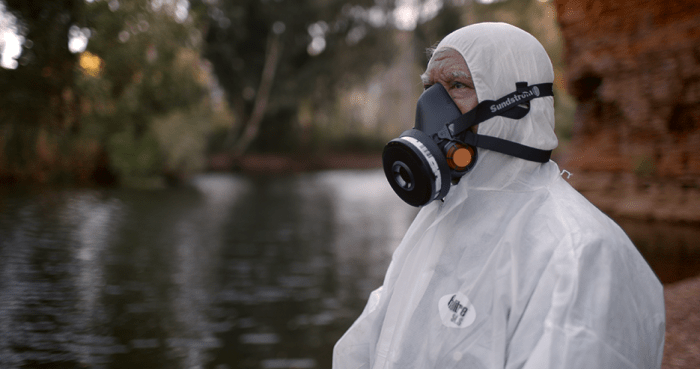
Banjima Elder Maitland Parker at Wittenoom.
Let’s go back to the beginning of this documentary. Did you come across Maitland Parker’s story first, or Wittenoom itself?
I started looking into the 60,000 legacy mines that exist around Australia. There are 60,000 abandoned or inactive mines across the country, and I just thought, “Wow, that is quite a legacy.” A lot of those mines have major environmental, health, or social impacts. So I started looking into which ones were the worst. I wanted to make a film that looked at different communities around Australia and how they’re dealing with the legacy of these mines. I came across Maitland’s story, and initially we envisioned that he would just be one character among many. But he had a terminal illness, so we decided to go out and film with him first and spend time with him. I think he just went along with my initial idea and then slowly but surely nudged me in the direction of making the film about him. I don’t know if you’ve ever spent time with elders from the Pilbara region, but they do have their ways. He was very charismatic and magnetic, and his story was just so shockingly profound that it took me a few months to change the original premise of the film. Part of the reason it took me a while was because I didn’t feel I had the authority, as a non-Indigenous filmmaker, to work on this story. Maitland changed all of that. He was a natural storyteller and loved this new way of telling stories—stories he’d been telling for a long time. In the film, we tell cultural stories as well as his personal one. I think he really appreciated this new way of storytelling. Once we figured out that he would love to be a co-author of the film, then I felt we could embark on this film with Maitland.
Did it take him long to warm up to the camera, or did that come naturally to him?
He’s been at the forefront of his community talking about this issue for a very long time. He is accustomed to being put forward as a spokesperson. So what I needed to do was make him unlearn a little bit of what he’s learned about what you do when a camera is in front of you. He often felt the need to talk to the camera, and I had to keep reminding Maitland that we’re a fly-on-the-wall camera and that he didn’t need to talk to us and should pretend we weren’t there. So in a way, it was the opposite. He was very comfortable with the camera.

Maitland Parker and Yaara Bou Melhem before they head into the contamination zone.
Describe the feeling of being in Wittenoom.
Look, I’ve got to say, as a former foreign correspondent, I used to go to a lot of war zones and disaster zones, and I was even based in the Middle East during all the Arab uprisings, so I covered a lot of that for Dateline at SBS. But I don’t think I’ve ever been as terrified as I was in Wittenoom Gorge. It is frightening because it is the source of a slow and painful death. The mounds of mining waste, contaminated with asbestos, sit 40 metres high on these stunning red gorges, clinging to the sides like a cancerous tumour. What you are looking at is a metaphor for what it would do to your body. You’re looking at it and you’re walking into this silent killer. It is eerie because there are no people around, and you’re walking in these protective suits and masks, constantly thinking about the dangers. You’re with someone who is a living example of the consequences of being near this substance. And it’s not something I would ever do in a hurry again.
What measures were taken to ensure you and your crew were adequately protected?
We undertook some health and safety training with asbestos disease experts who have been out there for the past 20 or 30 years conducting studies. All of our crew were briefed on decontamination procedures, the safety equipment, how to put it on, and how to decontaminate afterwards. We also purchased all the necessary safety equipment. The biggest thing we were mindful of was minimising our time in the contamination zone, and then trying to workshop what we could capture from outside of it. A lot of the drone photography was quite important for that. Our interaction with the contamination zone was quite surgical, and we made sure that we had a safety protocol in place at all times.

DOP Tom Bannigan ACS and director Yaara Bou Melhem.
As well as being an impeccably crafted documentary overall, there are two technical elements of this film that give it an incredibly spiritual touch—and that’s the cinematography and the music. Can you talk to us about working with Tom Bannigan and Helena Czajka?
Tom was also a co-producer because he was quite instrumental in our liaison with the family. This is probably my third or fourth collaboration with both Tom and Helena, so there’s a kind of shorthand we have in terms of our creative approach to filmmaking. The thing about Tom that really elevates his landscape photography is that he has a science background in geology, believe it or not—which is interesting for a film that touches on mining impacts. He sees the landscape in a more layered and nuanced way, and that’s how he approaches a lot of his cinematography. So this was an incredible project for him, and we were very lucky to have him. He’s also someone who grew up in the country, so he has this understanding of landmarks and cattle stations and a shorthand for how to communicate with a lot of the folks in the Pilbara who are also working the land. Did you grow up on a farm, or know any people who’ve grown up out in the country?
I grew up in a regional farming community, yes.
So you’d know there’s a different approach to looking at the land. It’s hard for me to describe because I didn’t grow up on a farm—I grew up in an urban landscape—but there’s a different sense of landmarks, and also a different sense of working on things that break down or being able to fix things. There’s this kind of mechanical nature of having to rely on yourself in order to make things work. And I think it becomes evident in the film through what we focus on—not just Maitland, but also his brother Trevor, who actively manages a million-acre cattle station. There’s an approach that you see in the film: big landscapes and feelings of vastness, then coming down to the intimacy of that tactile nature of working the land and being of the land. Tom’s able to capture that really cleverly because it’s innate within him. You’ll feel a sense of vastness and then that intimacy very quickly—almost in the same scene. He understands that intuitively. Helena is incredible as well, in terms of her ability to pick the right emotional notes. We knew we were working with Helena pretty much from the outset of making this film. One of the things I like to do with Helena is give her production sounds, and if she likes them, she’ll synthesise those into the compositions. So, for instance, on this film, there was a bird call that one of our sound recorders captured specifically for Helena, and she just fell in love with it. It’s one of the key calls that runs throughout several of her compositions at the beginning and toward the end of the film. Each time she synthesises it, she’s playing on a different emotional note. I remember when I thought we were almost done with the bird call—she created this track just before the credits roll, where we dedicate the film to Maitland. That track absolutely floored me. She’s a master of knowing what notes will work to enhance the emotional response we’re trying to elicit in a particular scene.

Wittenoom is the largest contaminated site in the Southern Hemisphere.
Modern mining companies that are currently active in these areas are rarely included in Yurlu | Country, which I appreciated. But there is a moment where they do come out looking like the good guys towards the end of the film when they grant Maitland’s family permission to visit the birthing tree. What were these mining companies like to deal with while making Yurlu | Country?
It is a bit of a tricky one because these mining companies are all interacting with Banjima people—they’re obviously mining on their Country. We were co-creating the film with a significant Banjima elder. There was also a lot of support from the Banjima Native Title Aboriginal Corporation, which was given to us in order to make the film and collaborate closely with them on all aspects of the filmmaking and release. So we were in this strange position where we weren’t just outside filmmakers coming in to make a film about the Banjima mob—we were making it with them. I think there was almost a repositioning in how the mining companies dealt with us as filmmakers, because the filmmakers included Maitland Parker. That was an interesting dynamic, and I think in the end, it allowed us to film certain things—like the visit to the cultural women’s site we see towards the end of the film. It was never straightforward, but I think our positioning—making this film with Banjima—was quite important to how we interacted with the mining companies.
Will you continue to follow Maitland’s family’s fight?
Are you asking me if there’s going to be a Yurlu | Country Part 2? [Laughs].
I mean from a personal perspective—away from documentary filmmaking.
Yes, absolutely. With a film like this, you go through fire and brimstone together, and there will forever be a link because of that—at least on my end. The family and the Banjima Native Title Aboriginal Corporation are also working with us on the impact campaign we’re developing for the film and its release. For instance, at the Sydney Film Festival, Maitland’s wife and daughters will be coming out, as well as a few other members of the Banjima community, as part of the impact campaign. We have a couple of events and activations we’re running in June that the family will be involved with. So we are in this for the long haul. We will continue to work with the family and with the community. I don’t think it can be done any other way when you’re dealing with a legacy film like this. It’s a hard one to just walk away from.
Yurlu | Country will screen at the Sydney Film Festival from Saturday, 7 June. Details here.
UPDATE 4.1.26: Yurlu | Country will screen at the Capricorn Film Festival from Thursday, 15 January. Details here.

ADVERTISEMENT
If you enjoy Cinema Australia as much as I love publishing it, please consider supporting Cinema Australia’s commitment to the Australian screen industry via a donation below.
I strive to shine a light on Australian movies, giving voice to emerging talent and established artists.
This important work is made possible through the support of Cinema Australia readers.
Without corporate interests or paywalls, Cinema Australia is committed to remaining free to read, watch and listen to, always.
If you can, please consider making a contribution. It takes less than a minute, and your support will make a significant impact in sustaining Cinema Australia as the much-loved publication that it is.
Thank you.
Matthew Eeles
Founder and Editor.Make a donation here.


 Cinema Australia
Pingback: MIFF unveils full 2025 program! Which Australian films will you be seeing? | Cinema Australia