
Justin Rosniak
From amateur porno filmmaker Gary in Mr. Inbetween, to Leslie ‘Squizzy’ Taylor in the original Underbelly series, to Neck in Broke, Ditch in Down Under, and Warney in Packed to the Rafters, Australian character actor Justin Rosniak has been bringing depth, authenticity, and relatability to both the big and small screen for decades.
In his newest film, The Surfer, where he stars alongside Hollywood heavyweight Nicolas Cage, Rosniak plays The Cop—a manipulative, snakey and ocker enforcer for a group of territorial surfers who have taken control of a pristine beach in Yallingup, Western Australia.
Over the years, Rosniak has often stolen the show in whatever film or series he appears in, thanks to his likability, charm, and sheer excellence as an actor. The Surfer is further proof that he can hold his own alongside the very best, including Cage. When the two share a scene, it’s easy to forget Cage is even there, such is Rosniak’s presence.
During our phone call from his home in New South Wales, Rosniak was exactly the kind of person I expected him to be—just like the characters I’ve enjoyed watching him play over the years. It’s always a pleasure hearing one of your favourite actors share their stories. Here, Rosniak talks about attending the Cannes Film Festival, some of his favourite Australian films, working with The Surfer director Lorcan Finnegan and co-star Nicolas Cage, and filming some of the movie’s more intense scenes.
The Surfer is in cinemas now, before landing on Stan. June 15.
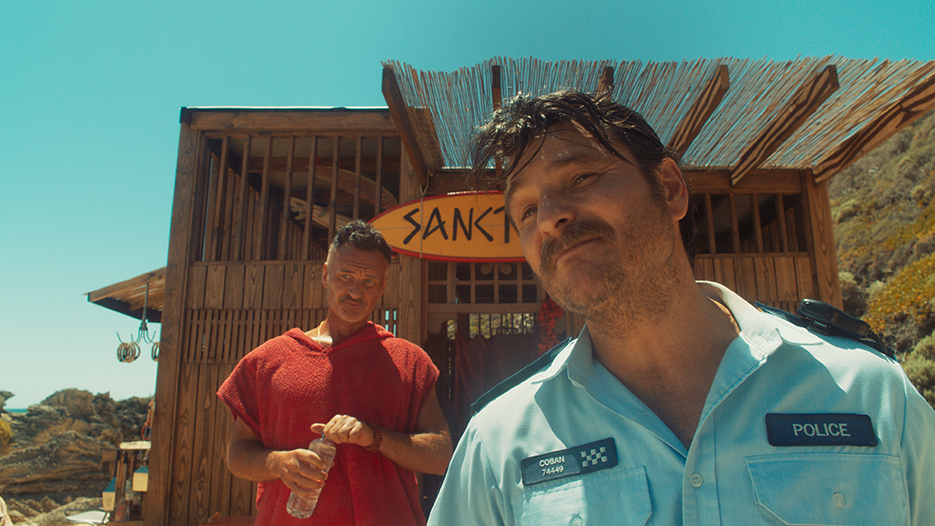
Julian McMahon and Justin Rosniak in The Surfer.
“Figuring out The Cop’s tone and style was the biggest conundrum. The more you grow with a character, the more you start to see some clarity in how you want to go about playing it.”
Interview by Matthew Eeles
The Surfer has been a long time coming, considering filming wrapped quite a while ago and the film premiered at the Cannes Film Festival one year ago. Was the experience of making this film a good enough one for you that it’s still fresh in your mind?
Oh, definitely. It’s been a weird ride because it’s been a year and a half now since we finished filming, and it’s actually been very hard to fathom. We originally finished the film in, say, late October 2023 or something like that, and all of a sudden we were at the Cannes Film Festival. That was just this massive reception with a six-and-a-half-minute ovation—all that stuff. It was rockstar treatment for all of us. It was surreal. I’ve never experienced anything like it. And then the film just went away for ages. To us, it felt like the film had already been released, but here we are talking about it again. It’s a weird feeling. It’s almost like it’s getting a re-release. [Laughs].
Can you elaborate on that Cannes experience?
Oh, mate. I almost wasn’t going to go. I was humming and harring a bit—with life, kids, work, all that stuff. But it was always going to be a quick window, so I actually only flew over for three days, and then I flew straight back. Most of it was flying. And then to land in this town, in the middle of the Cannes Film Festival—probably one of the most iconic film festivals in the world—and to see it all happening was incredible. We were thrust into this hurricane of craziness where everyone’s just going mental. And then all of a sudden, you find yourself in a 13-car police escort heading towards a red carpet at midnight in Cannes, on the beach, and you go, “What the fuck is going on?” Then you get out and do the whole red carpet. You get up to the top of the stairs and give everyone the royal wave. [Laughs]. You get into the cinema where everyone is cheering like you’re rock stars. They can see you on the big screen, and they can see you all walking in. And obviously Nicolas Cage is there, so everyone’s excited. I don’t think he’d been there for 20 years or something. And then there are two-and-a-half thousand screaming people. You walk into the middle of the cinema where your chair is set aside with your name on it. You sit down, and in an instant, it goes dark and the film starts.
You must have been thrilled to experience it.
I was, mate. It was a once-in-a-lifetime experience, really.
Yesterday I spoke with Lorcan about the Australian films that influenced the visual style of The Surfer. As someone who has been working in the industry since the late ’80s, it got me wondering—do you keep up with films currently being made in Australia? Do you have any favourite Australian films made recently?
I really should have a pre-prepared answer for a question like that. [Laughs]. I’m not a big film buff. I love films. I love watching films, but I’m not your typical film-loving artist guy. I can definitely appreciate good film and good cinema, but I don’t go out and actively watch it as much as I should. Obviously, I love all of the Ozploitation films of the ’70s. I love Wake in Fright, and I love Mad Max, The Road Warrior, and all of those classics from that time. I love the feeling of that whole era. A film like Malcolm has really stayed with me, and Storm Boy. So I really do love that time in Australian cinema. And of course, there are the greats like Two Hands, and I love Getting Square. I know they’ve just made Spit. I think Getting Square is even better for me now. I ordered the DVD about 12 months ago, just to own it. I saw the bible for The Surfer, which referenced a lot of these older Australian films. Apart from doing a film with Nicolas Cage—because, let’s be honest, that’ll always be the number one reason to make a film—the second reason was discovering Lorcan’s work. Those were the two most exciting things that made me want to make The Surfer.
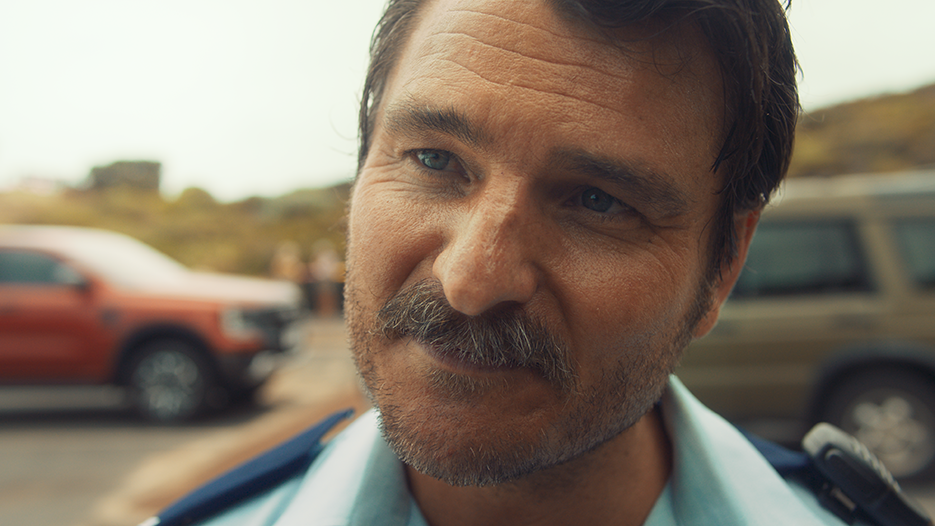
Justin Rosniak in The Surfer.
I tried to research this the best I could, but is The Surfer the first time you’ve worked with an international filmmaker on an Australian production?
That’s a good question. And one I should know the answer to. [Laughs]. I think it is. Yes, I think so. There might be someone else who springs to mind as soon as this phone call ends, but I think it is. So I couldn’t really compare this experience to anything else. It was one location that was locked into this car park on the beach. We were either in the car park or we were on the beach. To me, it felt like the first half of the shoot we were up on a stage, and then the second half we were on the beach. Being in Margaret River and Yallingup definitely has a localist vibe. That really helped with the general feeling of the film and this story. It was unlike anything I’ve ever done—just in terms of the landscape, the story, the director, Nicolas Cage, Julian McMahon. It was just fantastic.
And you’ve never made a film in Western Australia before?
I haven’t made a film in Western Australia, but I did tour with the Belvoir St Theatre in 2014. We did a national tour through Perth and Mandurah—but never that far south. So yeah, that’s the only bit of work I’ve done in WA.
Are you a surfer yourself, or someone who enjoys water activities?
I love water activities. But I’m not a surfer. [Laughs]. I grew up on the northern beaches of Sydney, so we were always at the beach. Surfing was too hard for me. I tried, and I fell up once, and then I gave up pretty easily. Body surfing and boogie boarding were the ones for me. I spent a lot of years growing up at the beach. I don’t want to give anything away, but thankfully I didn’t have to do anything on a board in this film.
What did you bring to this character, The Cop, that may not have been in the script? Did you put your own spin on him in any way?
Figuring out The Cop’s tone and style was the biggest conundrum. The more you grow with a character, the more you start to see some clarity in how you want to go about playing it. So I did the audition for Lorcan, and he obviously liked me because he cast me. [Laughs]. So I already had a fair idea of just how dark and menacing this character was going to be, and just how much he was going to mess with The Surfer’s head. The main thing I concentrated on was that this guy was a member of the Bay Boys, and that this film was about reclaiming your manhood in these modern times. I just made sure I immersed myself in all of that so that when I arrived, there was this sense that I really owned this place—and that anyone from the outside had to either earn their way in or they didn’t belong there. So I drew from that emotion and that feeling. This film is a psychological bloody head fuck. [Laughs]. Lorcan gave us permission to do anything we wanted within the character’s framework. He really threw the rulebook out. So there was a lot of wiggle room for me to play with this character. There’s an audiobook called Hard Times Create Strong Men, and because it related so much to this character, I just kept listening to that over and over and got myself into that headspace of having to reclaim something and stand for something—like The Cop does.
When I saw your character arrive in a police car, I immediately wondered if I was finally going to see Justin Rosniak play the good guy. But it’s obvious very quickly that you’re playing the bad guy. Are you drawn more to playing bad guys than you are to good guys, or is it simply typecasting?
There is a lot of typecasting that happens in the Australian film industry. We’ve all got our wheelhouse. We all sit in our own pockets. Within the Australian film industry, there are too many seagulls and not enough chips. So it’s pretty much the same casting over and over again. That said, there aren’t too many people who can play everything. Everyone’s pretty much cast within a certain range. I expect that, and I do try to lean into it. It is nice when you get an opportunity to play something different. I’ve had more opportunities of late to play characters with a bit more range—especially with comedy. Probably within the last five years, I’ve been able to step outside of my usual areas a little bit more. But you’re always going to be cast within your wheelhouse.
Your performance is really impressive here, and you really do hold your own opposite Cage. What did you take away from working opposite someone of Cage’s calibre?
Well, first things first, it was very refreshing to watch him work. He’s a man who really loves doing what he does. That’s the first thing you notice—he’s an actor who wanted to be there. His number one concern was getting it done. And it didn’t matter to him if he had to read lines off-camera. He did whatever it took. You would think that someone of his stature wouldn’t hang around while another scene was being shot that he wasn’t in. But he would often say, “I’ll read offscreen lines and lie under the camera so I can give you an eye line as well.” Seeing stuff like that is really refreshing, and it restores your faith in what we do. It doesn’t matter what level you get to as an actor—they’re still humans, and they’re people who love to collaborate. He was very collaborative and very forthcoming with suggestions. He would ask if I needed a line delivered a bit quicker, and things like that. So having that experience with someone like Nic was very, very refreshing.
That’s so great to hear.
He was so approachable. He was in The Croods, obviously, and my daughter absolutely loves The Croods. I asked him, “Nic, can you sign something for my daughter?” and he said, “No problem.” The next day, he came back with a handwritten card for her, and it was just such a special thing that I could bring home to show her. She’s got that in her room.
How beautiful.
I was a little bit taken aback the first day I met him. After we finished that first scene—where I rock up and tell him to wait by the car—that was my first day of shooting. When I’d wrapped the scene and was walking off, he came up to me and said, “Hey, I love your voice. Do you mind recording your voice into my phone so I can use it for something I might possibly want to do for a shoot?” So here I am, holding Nic Cage’s phone, recording a scene of dialogue that he wanted to try and replicate in an Australian accent. I had a little moment there where I thought, “Oh, well, that’s nice.” Normally I get complaints about my voice and get told to shut the fuck up. [Laughs].
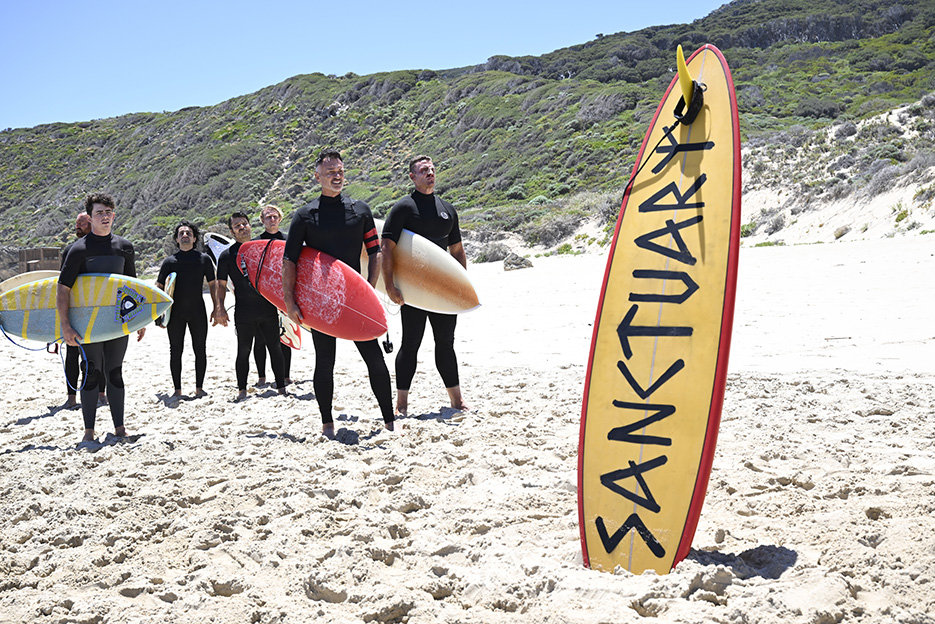
Finn Little, Rahel Romahn, Justin Rosniak, Julian McMahon and Alex Bertrand in The Surfer. Photograph by David Dare Parker
Lorcan told me that I needed to ask you about something you do with your tongue during a close-up shot of your face. Can you elaborate on that?
There’s a scene where they get the camera right up in my face with an extreme close-up. Lorcan called something out spontaneously like, “Lick your lips just slightly.” It made The Cop look a little more like a lizard—kind of snaky. The Cop character may have been down at the beach earlier, having a line of cocaine with the boys. If you look closely, you can see the moustache has a little bit of white on it. So licking the lips slightly was to give it a feeling of, “Fuck, is this cop all right, or what?” [Laughs].
I don’t mean for this question to sound morbid—I’m just interested from an actor’s point of view—but I grew up in the era of Brandon Lee being killed on the set of The Crow, and most recently Halyna Hutchins was killed on the set of Rust. What is it like as an actor to have a gun pointed at your head in such an intense way as it’s done in The Surfer? Is it something you’re conscious of? Can you talk us through that?
I trust that process. I’ve never really thought about that once. It’s being the one holding the gun that has worried me in the past. I’ve been the one holding the gun to other actors’ heads. Obviously, there were no bullets in those guns. But I’ve held a gun to someone else’s head in a scene and accidentally pulled the trigger—and it made the click sound. I remember doing that with an actor. I did that with Joel Edgerton on a film called Sample People many years ago. I had a gun to his head. Joel was obviously right in the moment, believing he had a gun pointed to his head, and I did that. It clicked once, and he really didn’t like it. I’ve also experienced a real gun being pointed at me—during the making of that same film, actually. It was in Adelaide in 1998, and we were blocking a scene in a kebab shop on Hindley Street. I don’t think the production had gotten clearance, and someone from the general public saw me waving a gun around. They obviously called the police, who then lined me up. Someone from the production had to run across the road to tell the police we were filming a movie. That still actually sends chills through my body when I think about the reality of it. So back to your original question: I don’t really freak out about it, but I have had an experience with a gun on set that I still feel the effects of.
I have a final question here about another one of your characters, who I know a lot of my readers would love to know more about. The last time we saw you in Mr Inbetween, Gary’s pornography business had taken off. Where do you think Gary is today, and what do you think he’s up to?
[Laughs]. I haven’t really thought that far ahead, but I know Scott Ryan had plans for Gary. I think Scott wanted Gary to take his porn business international. So that may provide a little food for thought about where Mr Inbetween and Gary may have gone. If there was a fourth series, it could’ve been that Gary’s porn business had gone international—and that he possibly could have even relocated to the States. You never know. [Laughs].
The Surfer is in cinemas from May 15 before landing on Stan. June 15.

ADVERTISEMENT
If you enjoy Cinema Australia as much as I love publishing it, please consider supporting Cinema Australia’s commitment to the Australian screen industry via a donation below.
I strive to shine a light on Australian movies, giving voice to emerging talent and established artists.
This important work is made possible through the support of Cinema Australia readers.
Without corporate interests or paywalls, Cinema Australia is committed to remaining free to read, watch and listen to, always.
If you can, please consider making a contribution. It takes less than a minute, and your support will make a significant impact in sustaining Cinema Australia as the much-loved publication that it is.
Thank you.
Matthew Eeles
Founder and Editor.Make a donation here.


 Cinema Australia