
Josh Hale thanks the many crowd extras for a job well done on the set of Blue Horizon.
Filmmaker Josh Hale is no stranger to shifting gears, but with his latest feature Blue Horizon, the American-born, Gold Coast-based writer, director, and producer has taken a massive leap into deeply personal territory.
Known for his indie horror House of Inequity and the comedy Digital Athletes: The Road to Seat League, Hale’s new film is a heartfelt dramedy that explores themes of inclusion, adversity, and unlikely friendship.
Blue Horizon follows the story of Maris Le Marcus (David Cook), a troubled, self-absorbed musician whose life takes a turn when he’s sentenced to community service at a wellness centre for people living with disabilities. There, he meets Douglas, a reclusive man with Cerebral Palsy, played by Damian McCoy. Their shared upbringing in state care becomes the foundation of a powerful bond that alters both their lives.
The film was inspired by Hale’s own experiences—from his early childhood lessons in empathy, taught by his grandmother, to his adult years volunteering with the Special Olympics. These influences are on full display in Blue Horizon.
In this interview, Hale opens up about the journey from horror to heartfelt, the responsibility of writing characters outside his lived experience, and how McCoy’s moving performance helped bring the story’s core message of inclusion to life. Cinema Australia would like to take this moment to thank Josh for sharing his story about a poem recited in Blue Horizon—an adapted piece from Hale’s own eulogy for his late parents. We understand that it wouldn’t have been easy.
Blue Horizon will close the Gold Coast Film Festival on Sunday, 11 May. Details here.

Josh Hale and David Cook on the set of Blue Horizon.
“I wasn’t going to be motivated by finance. I wasn’t going to be motivated by applause. I was going to be motivated by the craft.”
Interview by Matthew Eeles
Your previous feature film, House of Inequity, was an entirely different beast compared to Blue Horizon. How do you reflect on that film now, four years later?
It was so good. That was the first set that I was able to build as a filmmaker, so it’s always going to have a piece of my heart in terms of my growth as a filmmaker. I’ll always have love for House of Inequity, but I see flaws in the film—as most creatives do. I see the things I wish I could have done better, and if you were to screen Blue Horizon and House of Inequity as a double feature, you would see that I really went and did my homework. I took House of Inequity, studied it, and realised where I fell short and where it was lacking. That film takes place in one house with about seven or eight actors. Blue Horizon is shot all over the Gold Coast, with 43 speaking parts and over 200 extras, which changed every single day. It was so daunting and a complete change of gears, but I felt that the lumps I took with House of Inequity really allowed me to step in the right direction to make Blue Horizon, which is a far more ambitious film and a total genre flip. But I’ve always seen myself as a storyteller—I just want to tell stories. And sometimes they’ll be horror movies, sometimes comedy, sometimes dramas, and who knows what else. So it’s very good to reflect. I’ll also take what I learned on Blue Horizon into my next film. I’ll always be fond of House of Inequity. It was very fun to work with everybody, and I do love spilling that stage blood. That was pretty fun. We have zero stage blood on Blue Horizon in case anyone reading this was expecting a follow-up to House of Inequity. [Laughs].
Blue Horizon feels much more personal.
Look, I love horror. But Blue Horizon is the first time I feel like I’m talking as a writer and director, and that I’m telling something a little more personal to me. I always say a good horror film is when you take a bunch of good-looking people and kill ’em creatively. [Laughs]. Blue Horizon is more of a think piece with feeling. It’s more gratifying right now than it was with House of Inequity.
Blue Horizon is at its absolute best when a scene or a moment in the film is prioritising inclusion, which is a central theme to the entire film. Why is inclusion so important to you?
It goes all the way back to when I was a young fella. My Nan and my Mum were very much on me about this. They taught me a lot about inclusion and that people are out there fighting adversity and having it tough. They really taught me to include people. My Nan was this lovely person who used to do these wonderful things that I would witness, and I was very close to her. We went to lunch together when I was little, and I remember there was this young man who would always wave to the cars. He had a mental disability, and my Nan would always say, “Hey, let’s stop and give him something.” If it was Easter, she’d buy him a chocolate bunny and things like that. She had this empathy for people who were fighting a battle. She saw the pureness within. I remember she gave me the bunny to walk up and give it to this young man, and the joy on his face was amazing. Being exposed to that kind of vibe early on and seeing the difference something small can make to someone who is fighting a battle—it was quite enriching for me. It made me feel really good. Not about myself, but it gave me pride in who we were as people. That was something I always carried with me. When it came to my schooling, I was always trying to be friendly with the people who didn’t have friends. I also did some volunteer work with the Special Olympics as an adult. It was my first time being exposed to unbiased competition. That’s why I wanted to include a character like Douglas in Blue Horizon, who’s a pure soul, played brilliantly by Damian McCoy.
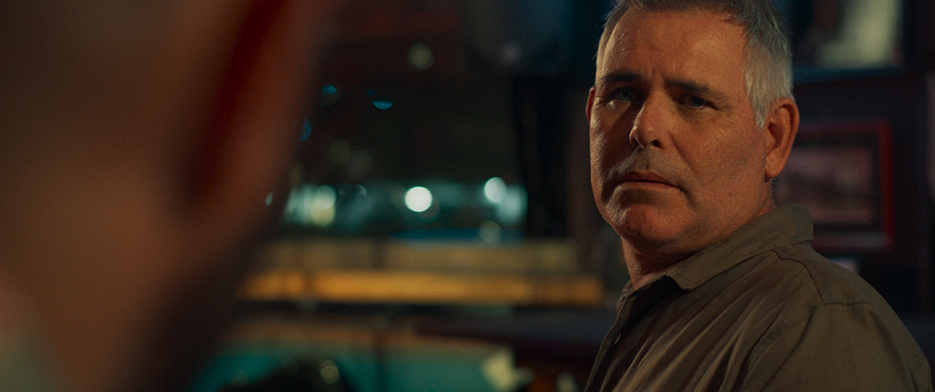
Damian McCoy as Douglas in Blue Horizon.
With your three main characters, you’re dealing with a successful musician, a man with a physical disability, and a woman experiencing depression, as well as a wealth of side characters. How important was it for you not to stereotype your main characters?
I tried to give them their own unique voice. With my lead character Maris, I wanted to stereotype him as much as possible. I wanted him to have the girls, the drugs, the jewellery, the money, the big house, the nice car—all of the stuff that people associate with that kind of lifestyle and profession. But slowly, as the movie goes on, his clothes change, he’s wearing less jewellery. It’s subtle, but we start stripping him back from the image he’s projecting. He begins to connect with kindness rather than the girls, the drugs, and the money. Douglas was the hardest character to write because I didn’t want to exploit something I had no real experience with. So I did a ton of research on that disability. I was so nervous when I had to give that script to Damian, whose dream it was to be in a film. It’s a film about someone with his disability written by someone who doesn’t have it. I waited a few days and was panicking. He finally got back to me and said, “I don’t know how you did that, but it was like you wrote this film from inside my head.” That was the best compliment I’ve ever had as a writer. And then, as far as Theresa’s depression goes, I’ve actually experienced depression a long time ago. I battled through it. I tried to put some of the angst in there as well. Theresa projects anger that comes from turmoil within. So I tried to steer away from too much cliché—but sometimes it’s okay to be a bit cliché, because people can relate to that.
Let’s go back to the Douglas character for a moment. Can you tell us about working with Damian McCoy to develop this character?
Absolutely. Damian and I met at a film school. I was doing a filmmaking masterclass and he was sitting in the front row, leaning forward. He was so enthusiastic. He was asking all the questions. He caught my attention because his personality is so different from Douglas. He’s a real go-getter and he’s just the life of the party. I did another masterclass sometime later, and I saw him again. He’s walking down the hall high-fiving all these people. When I was writing Blue Horizon, originally Douglas had Down syndrome, which came from my experience with the Special Olympics. But when I met Damian, I wanted to re-write the character in the direction of cerebral palsy. We went out to lunch and I just said, “Hey, I’ve got this project and I was wondering if you’re interested.” His eyes lit up, and it went from there. He was so present and so beautiful to work with, and he knew the dialogue so well. He was just an absolute delight. His acting is beautiful. When I first showed him a cut of the film, I was watching him go through a range of emotions. He was hysterically laughing, then he was crying, and in the end, he was sobbing. I was just going, “Whoa, man, where’s this coming from?” And he said, “I’m just so proud that I get to be the actor that shows people with a disability that this is what can happen.”
There’s a beautiful moment in Blue Horizon where Douglas recites his poem to an audience. Tell us about the poem.
I’ve tested the film with people who know me and my backstory, and they get a little emotional during that scene because part of it was taken from the eulogy I once delivered when I lost my parents as a young person. So part of that poem came from that eulogy. The poem very much comes from a place in my life, and I related it to how Douglas might feel through the writing. But it definitely was very personal to me. Still, it’s Douglas’s poem—he owns it. In the early stages of the script, it was a much longer poem. We shot the original long version, but we pulled it back to where it is now. It’s concise. It has that quick little joke in there, then a couple of emotional beats, and the whole story comes together in that little moment. So yeah, it was very personal for me. And Damo was able to connect with it as well because he also lost his mother at a young age, and the film is dedicated to his mum. So he connected with it on a personal level. I think anyone who has ever lost someone important in their life, or leaned on their friends for any reason, is going to connect and feel emotional at that moment—which I think is most of us at some point. I’m kind of detached from it now, but it came from a much darker time in my life.

Chantal Elyse as Theresa in Blue Horizon.
You’ve worked with David Cook and Chantal Elyse before. How important is it for you to surround yourself with people you might have a shorthand with?
Usually, when I do a film, I try to connect with my lead actors one-on-one first. Some people like a lot of direction, while others just need a little bit, and I like to get an understanding of where they’re at. I like to have a shorthand with my actors. I also like to know that there’s a clear comprehension of character and text. I feel like I have that relationship with both Chantal and Dave. I first met Chantal when I was in film school a long time ago, and I finally had something that I think showcased her abilities to the best of my ability. I’ve worked with her before, but I don’t think those moments were quite as good as this character was for her. She does a lot of deeper acting and character work here, but she also shows this really light side. There’s that great moment at the bar, which I think is going to surprise a few people. And working with Dave is brilliant. I worked with Dave on House of Inequity. He’s very good with his fellow actors. He’s very present and great at being in the moment with them. And of course, we had some fun. We would have so much fun on set together. David and Damian acted very well with one another. The three of them developed such a strong bond. They were staying together a lot, going to breakfast together, and they spent a lot of time really developing a shorthand with one another—which I thought was so important.
You mentioned Chantal’s moment in the bar. Having known Chantal for a while, did you know how well she could sing before casting her?
I didn’t know she could sing. [Laughs]. I knew she had the acting chops to deliver a spiteful, hateful, and depressed character who develops over time. And then, in that bar scene where she really has to open up, she put her whole heart into it. I don’t think I’ve talked about this to anybody yet, but in order to get the rights to that song she sings, we had to have approval from Robert Smith—because it’s a song by The Cure, and he’s very particular. So I had to make a screener that said “In Consideration Robert Smith Universal” and send it off to Robert Smith for approval. That was nerve-wracking because we recorded the scene before getting the approval signed off. It was a great scene, and I couldn’t lose it. So I was losing my mind for about 72 hours. And then finally, Universal told me that Robert had approved it. [Laughs]. I don’t even think I’ve told Chantal that her song was approved by the man himself. [Laughs]. He liked the way it was put together.
Her voice is amazing.
It was really good for the moment, and I am a massive fan of The Cure. I thought that song would suit her being a little bit darker, and it suits the whole character. Dave sang a song too, but in the end, it was six minutes of karaoke in the middle of a movie. [Laughs]. We had to cut one of the songs out. Chantal just absolutely took the spotlight and ran with it. There are about four scenes I just can’t wait for audiences to feel—and that’s definitely one of them.
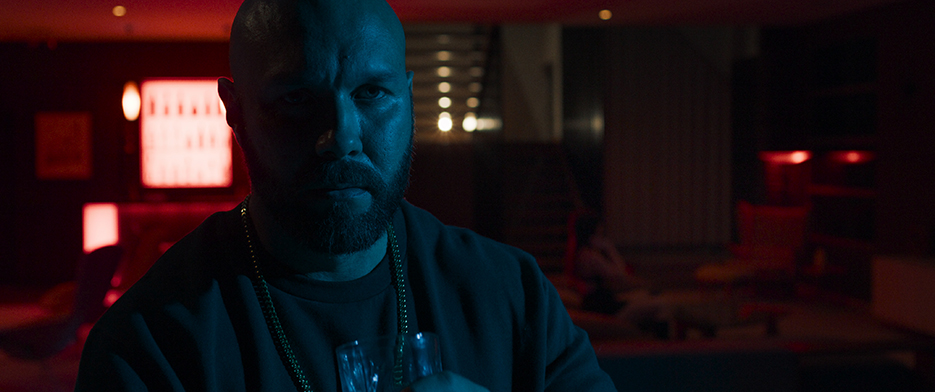
David Cook as Maris in Blue Horizon.
David is making a name for himself as a filmmaker, having recently made the feature film Heart of the Man. Do you discuss your approach to directing with David, or does he stay in his own lane?
Dave’s very good at switching hats. He’ll go off and do films—he’ll direct shorts and features and do his thing. But when he’s on set, he knows he’s number one on the call sheet as an actor. He knows the lane to stay in, and he gets it. He’s so present with how he conducts himself on set that he knew what I was trying to achieve, and he’s smart enough and talented enough to just get it. So it was very easy. And I hope that maybe he picked up a thing or two. I wasn’t on Heart of the Man, but I’m very close to Dave. I read a very early draft of the script and gave him some feedback. I knew it was going to be a great film. And I’ve got to give a shoutout to Nathan Jermyn, who shot Heart of the Man and Blue Horizon. He is honestly one of the most underrated cinematographers. I just love his work. He’s the best guy to work with. He shoots beautiful films, and he’s super talented. I don’t think Nathan gets his cookies as often as he should, so I definitely want to give Nathan a shoutout, because this movie and Heart of the Man are both beautiful films.
How did Pete Murray’s casting come about? This isn’t his first acting gig, but it’s always a surprise to see him acting rather than performing.
I think it gets reported that Blue Horizon is his first, but he was in a movie called Thicker Than Water. He had a small part in that. I think this might’ve been his first film where he’s part of the main ensemble. Pete is an amazing human and a very talented man. He and I were attached to a project for a couple of years where a producer friend of mine had hired me as the director and Pete as an actor. He and I started doing rehearsals, we would catch up from time to time, and then the finance fell out and that film fell apart. When I had this part for the Benjamin character, I knew Pete would be really good for it—and it’s totally not who Pete is. Pete’s like a rockstar. [Laughs]. And then he’s playing this guy who’s buttoned up so tight—it’s really quite insane. I sent him the script, and he came back and said, “Dude, I love it. I’d love to give this a go.” He was so present. You don’t become a guy like Pete Murray without having that work ethic. This was a bit daunting for him, but he was born to do this. This guy is talented all the way to his core. I don’t want to speak too much for him, but he’ll say things to me like, “It’s weird looking at the screen because I don’t see me.” And I thought that was a funny statement—because he was acting. He’s not supposed to see himself. [Laughs]. The fact that he didn’t see himself means he really embraced how stuffy Benjamin is, and how nerdy and buttoned up he is. Pete is one of the coolest people on the planet—literally the most down-to-earth guy.
In your director’s statement, you’ve said that “happiness is the real pursuit we should chase above all else in life.” How happy are you in life at the moment?
Oh wow. Great question. I’m actually quite content in life right now. I’m happy. I prioritise happiness. A couple of years ago, I went through some heavy stuff. I went through a divorce. It was very amicable, but it shakes you to the foundation. So I actually went in on myself for a little while. I started meditating, I started going to the gym, I started eating better, and I started treating myself better. In chasing indie filmmaking, I had been neglecting others and myself, and I really wanted to change that. I think if you are content and happy on the inside, it projects outwards. I used to focus 20 hours a day on filmmaking, and I would block out everything else in my life. I think I just needed to work on what made me happy—and what made me happy was having good times with my friends and treating people well. I have gone through very, very dark times. I’ve had things happen to me in the past that were very dark and painful. There was a time, when I first started writing movies back in 2007 or 2008, where I was literally living in a van, eating two-minute noodles every day, and just suffering for my passion. And I kept telling myself that I wasn’t going to be motivated by finance. I wasn’t going to be motivated by applause. I was going to be motivated by the craft. I was just going to keep working and earn my way. My goal now is always to make my newest film better than my last film. That’s my goal—just make a better film. That’s it. That’s where you set the benchmark, and then you jump ahead of it. But during that pursuit, I found I was neglecting myself and others. Now, I’m trying to be a little more present with myself. I believe the universe doesn’t give you what you want—it gives you what you need. And sometimes, you need a little bit of pain to get to the sunshine that’s coming. So yeah, I’m happy right now. But that said, I’m always in pursuit of happiness.
Blue Horizon will close the Gold Coast Film Festival on Sunday, 11 May. Details here.

ADVERTISEMENT
If you enjoy Cinema Australia as much as I love publishing it, please consider supporting Cinema Australia’s commitment to the Australian screen industry via a donation below.
I strive to shine a light on Australian movies, giving voice to emerging talent and established artists.
This important work is made possible through the support of Cinema Australia readers.
Without corporate interests or paywalls, Cinema Australia is committed to remaining free to read, watch and listen to, always.
If you can, please consider making a contribution. It takes less than a minute, and your support will make a significant impact in sustaining Cinema Australia as the much-loved publication that it is.
Thank you.
Matthew Eeles
Founder and Editor.Make a donation here.


 Cinema Australia