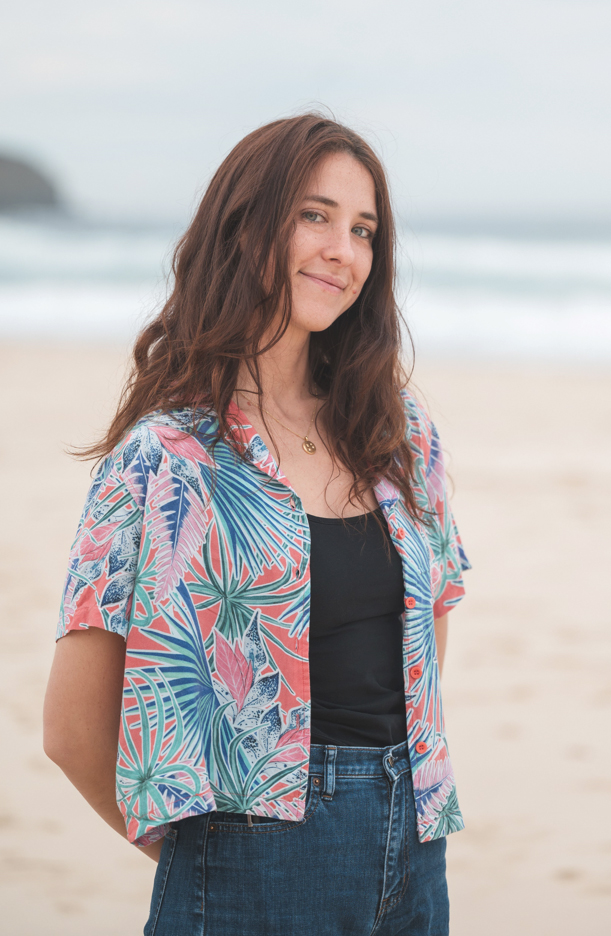
Hannah Smith. Photo by Dylan Robins.
It’s hard to describe just how outlandish My Tai is.
The debut feature film of director Hannah Smith and the brainchild of writer Jake Ashton, My Tai is a genuinely hilarious, truly bonkers, and completely batshit crazy comedy that sits comfortably alongside another gutsy, offbeat and irreverent Australian film – Welcome to Woop Woop.
Like Woop Woop, it’s hard to comprehend exactly what you’re experiencing — but somehow, it just works.
My Tai follows two best friends, Tai (played by Ruben Wilkinson) and Noah (played by Ashton), as they strive to create the perfect cocktail before their bar is demolished by an incoming cyclone. As the dysfunctional duo pursue the perfect ingredient, they’re confronted by a mysterious faction that stands in their way.
Hannah Smith’s sharp comedic direction on My Tai marks the arrival of an exciting new filmmaking talent — and you’d expect nothing less from an emerging filmmaker with a résumé as impressive as hers.
She began her career in various roles on films like Dora the Explorer, Monster Problems, Godzilla vs. Kong, and Elvis, and worked as a 2nd Unit Director and storyboard artist on notable projects including NBC’s Young Rock, Disney’s The Clearing and The Artful Dodger, ABC’s Mother & Son, and most recently, Netflix’s Apple Cider Vinegar, alongside friend and mentor Jeffrey Walker.
In this interview, Hannah discusses the beginning of her career, where comedy fits into her filmmaking future, her time on the international Netflix sensation Apple Cider Vinegar, working with Jake Ashton as both a writer and actor, and the cyclonic chaos that is My Tai.

Hannah Smith (R) on the set of My Tai.
“I’ve never been on a set where everyone is laughing so much every single day. We left with a massive core workout from laughing every day.”
Interview by Matthew Eeles
What sparked your interest in filmmaking?
The Lord of the Rings trilogy. [Laughs]. I’ve always been a bit of a creative, and I love telling stories. I feel like film was just the perfect medium for that. I obviously went to uni like everyone else, and I studied gaming, animation, and scriptwriting. I ended up falling into film. I knew that this was the medium for me.
In what way?
Well, I’ve always been obsessed with films. I always watch the behind-the-scenes documentaries for films. I remember there was a pivotal moment for me following a Lord of the Rings marathon when I watched every single second of the extended versions and every single second of the behind-the-scenes features. There was a moment in a behind-the-scenes feature where Elijah Wood wrapped for the very last time, and everyone was crying and everyone was clapping, and I was also crying, and I was like, “Oh my gosh, it’s such a family. It’s so beautiful.” I now look back on my very first day of work experience on Sea Patrol when I was in Grade 10. I was there for one day only, and when my mum came to pick me up early and they announced to everyone that it was my last day on set, everyone started clapping and I started crying, and I was like, “Oh my God, this is what it’s all about.” I need to chase and follow this feeling.
That’s beautiful. I love that story. How do you incorporate your animation and gaming skills into your filmmaking?
I’ve definitely carried it with me. I wouldn’t classify myself as a professional artist or animator, but I am a very visual director and I do storyboard a lot of the time. So I do utilise a lot of those skills that I’ve picked up over time. And now I am very big on the storyboards. They help a lot.
I’m so excited for filmmaking in Queensland. I’ve seen some incredible Queensland-made films already this year. What’s it like to be a filmmaker in Queensland at the moment?
It does feel like there’s a lot happening at the moment, which is really incredible. I feel like the indie scene is really big. In my personal experience, I found the scene quite hard to navigate at first, especially when it came to opportunities, directing, and whatnot. But I think I’m reaching a point now where I’ve learned a lot about the business side of showbiz, and now avenues are starting to form. But the industry itself is amazing, and the people are wonderful, and it’s really thriving. I would love to see more shows like Boy Swallows Universe and that sort of high-end, high-budget stuff come to Queensland.
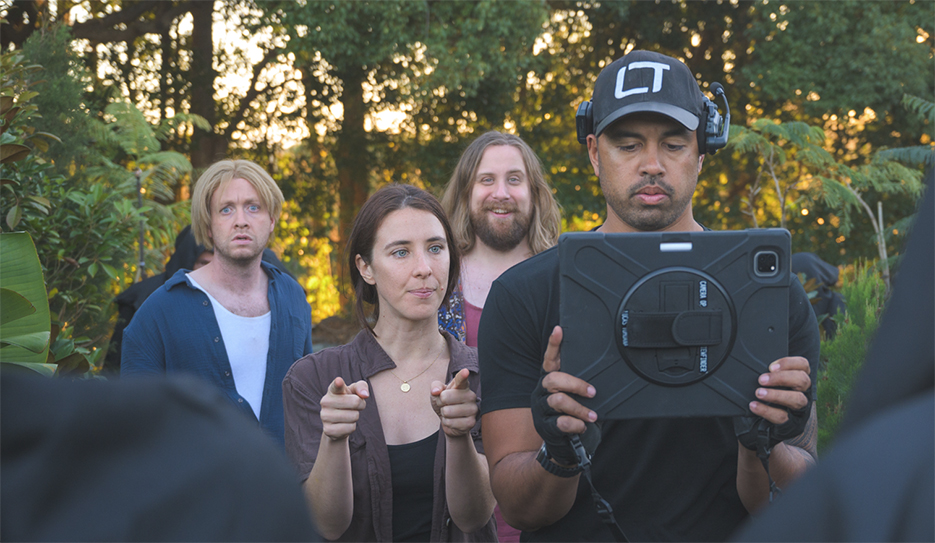
Hannah Smith on the set of My Tai.
You’ve had an enviable amount of on-set experience on some big local productions including Young Rock, The Clearing, and Mother & Son, but I have to ask you about Apple Cider Vinegar, which made a lot of noise both at home and overseas. Tell us about your time working on Apple Cider Vinegar and what you took away from that.
Apple Cider Vinegar was so much fun. I’ve managed to get so many of those amazing opportunities because Jeffrey Walker became a very good mentor of mine. Apple Cider Vinegar is really special to me in a work sense because it was the first time Jeff and I were able to direct anything together. He directed all six episodes and I was second unit on all six episodes. There were a few days where he wasn’t available, so I was able to step in and direct main unit. That was a very big opportunity for me. A lot of my stylisation ended up in that show. I was working with Jeff from the very beginning, and we were able to design visually what the series would look like. That was fun.
That must have been a thrill for you. What was it like to direct main unit?
Butterflies. [Laughs]. It was the best. It was nerve-wracking because I was given pretty much twenty minutes’ notice. I had my little meltdown, and then it was just so much fun. The crew was already such a well-oiled machine and everyone was very supportive of each other. There was no way anything could go wrong.
I grew up watching Jeffrey Walker on TV. Bronson Twist is an icon of Australian television, especially to my generation. Were you aware of that side of Jeffrey?
Well, I also grew up watching him on TV in Round the Twist. [Laughs]. Also, every second person I encounter in the industry knew Jeff when he was ten years old. I feel like this industry brought Jeff up and helped him grow. He is a child of the industry, and he’s so wholesome and sweet. It’s amazing what he’s managed to achieve.
I’ve met and interviewed Jeffrey a few times over the years. He really is one of the nice guys of the Australian film industry. He’s credited as an Executive Producer on My Tai. What was his involvement?
Much of it was his major support of myself. He really helped us to connect with people too. If there was anything we didn’t know, he’d help fill the gap in our knowledge. He was shadowing and guiding the whole film as a mentor, which was very invaluable.

Jake Ashton as Noah in My Tai.
How did Jake Ashton’s script make its way to you?
I’ve known Jake for a while. I think he’s the funniest person on planet Earth. There was a moment when we tried writing another script together, but we ran out of time. During COVID, he wrote a script in ten days. I read it and I thought it was hysterical. I was working and I had two weeks off, and that aligned with two weeks he was taking off. So we decided to film this ridiculous movie in two weeks and make it happen.
How did you first meet Jake?
We have a mutual friend called Ben Tilney, who’s an extremely amazing and talented composer. He also composed music for My Tai. He also plays the guitar solo at the end of the film. He’s a very charismatic fella. I was filming a music video for Ben, and we needed someone funny to be the lead in that music video. And Ben said, “Oh, I know a funny guy, my friend named Jake.” And I said, “All right. Well, we’ll see how funny Jake is.” I was sold on day one of meeting him. I was immediately sold. This guy is something special.
The film is completely bonkers and batshit crazy in the best possible way. Was Jake’s vision for this outlandish comedy clear to you in the script, or did it take some explaining?
It was very clear from the get-go. [Laughs]. I think our only limitation was budget, so we had to edit out a few jokes here and there, but the gist of it is still present. Jake has always had a very, very clear vision. He’s very talented. We often describe Ben, our composer, as a jukebox—you just ask for a song and he magically creates it. Jake is very similar with film concepts. He just thinks of something funny, and I’m always on board with it.
Now I need to know about the scenes you removed from the script due to budget limitations. Because it felt like anything was possible with this film.
We had a lot of very intense action sequences with motorcycles. There were a lot of very big visual gags with the bar actually coming apart at the end of the film. We needed to rewrite the end sequences and do our best with what we had because we couldn’t actually tear down the bar.
How much of Jake’s comedy dialogue was written into My Tai throughout the filming process? Or was it all written on the page from the beginning?
That is a very good question, actually, because Jake and Ruben are such good improv actors that getting what is scripted is very difficult. A lot of my direction, a lot of the time, is wanting to get what’s scripted first, and then we will do it again, and the guys can do whatever they want. Although I think you can tell sometimes that there are a few moments in My Tai where a shot goes for way too long and the boys just go on a tangent, and that’s one I’ll often not call cut on just to see them play off each other. And there are so many of those little moments that made it to the final cut that still crack me up.
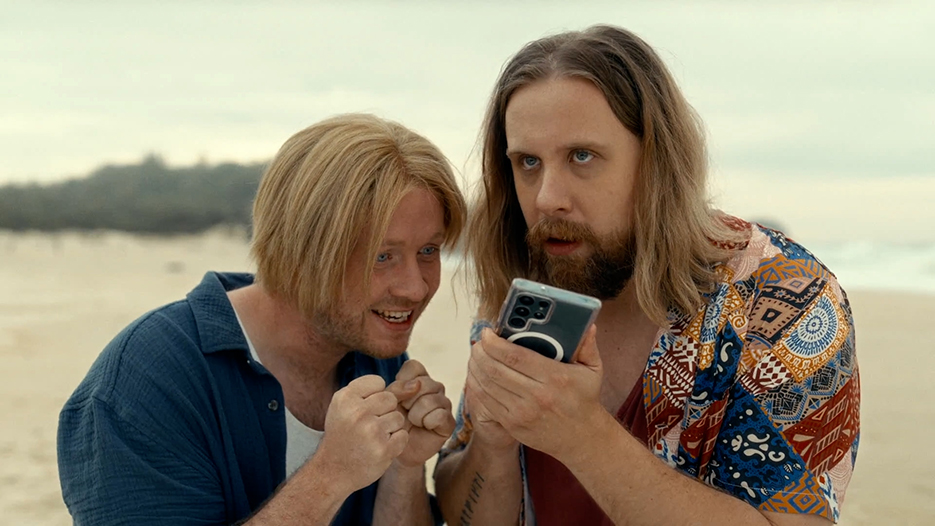
Jake Ashton as Noah and Ruben Wilkinson as Tai in My Tai.
Describe what it was like for you to maintain that playful discipline on set.
It’s all about embracing the chaos. Because Jake and Ruben are very good, and everyone on set was so passionate, and because it’s a comedy as well, if anything went wrong, we leant into it. So it’s all about having a good time problem-solving as much as we could. And because it is a comedy, I’ve never been on a set where everyone is laughing so much every single day. We left with a massive core workout from laughing every day. I feel like, all things considered, not much actually went wrong, and there wasn’t too much chaos to control.
Considering he wrote the script, and no doubt knew the film inside out, how well did Jake take your direction?
Jake is very, very good at taking direction. If I bring something up, it will always be considered. Sometimes he might have to sit with it and then walk away and come back and say, “All right, I’ve got a solution for this.” And he’s very good, both as a writer and an actor. He always has a vision in his head as well. So we do bounce off each other collaboratively, on set and away from set. It’s best to embrace all ideas, and he’s very, very good at bringing the funny to the table.
Do you consider yourself a funny person? Where does comedy sit for you in terms of genre?
Comedy is wonderful. I don’t know if anyone would classify me as a funny person, but I am a person who finds many things funny. I classify myself as a director who has funny friends who make me laugh. Because comedy is quite subjective, quite often on set I’ll say, “All right, we’re in a good place, so we’ll just see what happens and hope for the best.” As a director and a writer, I love every genre, but I think comedy is something that blends seamlessly into every genre too—whether it’s in drama or horror, I’m there for it. I think there’s always room for comedy.
My Tai is an incredible comedy, and I know that it shouldn’t be taken seriously, but was I picking up a subtext about the resilience of Queenslanders in the face of natural disasters?
Definitely! That was actually a very exciting point that I also picked up on when I read the first draft, because I grew up in the Tully and Mission Beach area. I went through Cyclone Yasi as well. We had the cyclone come over the top of our house, and when we went outside, we were in the eye of the storm. We looked up, and all we could see was a beautiful starry sky surrounded by cloud. You’ll notice that exact shot in My Tai. It’s a very lived experience that many Queenslanders can relate to, especially after the last one we just experienced. I think Queenslanders do tackle storms with a very “she’ll be right” attitude. The aftermath of a cyclone is always my favourite because the community comes together and helps each other out. Rebuilding is what Queenslanders are really, really good at.
Have you ever experienced a pre-cyclone party, like the one in My Tai?
I’ve experienced many pre-cyclone parties, yes. [Laughs]. Very windy pre-cyclone parties. There’s a few around.
The film utilises special effects for some of its more physical scenes. How much of a challenge was it for you filming those special effects scenes compared to the rest of the movie?
We had a talented special effects supervisor named Nash Lawrence on set helping us out, and he even played a role in the film. He plays the assistant whose mum sleeps with Tai in one throwaway scene. [Laughs]. I think the most challenging part for us was, weirdly, the white room sequence. I think there were moments there where, because it was one of our earlier days of shooting and we only had the space for a very limited time, and the dialogue was only recently reworked, there was a lot of pressure on actors to just know their lines almost overnight. So they did a very, very good job, and Nash was very helpful in the making of that. But I think that was the only real struggle, considering we had flame swords and everything. [Laughs]. We were just totally ready for that. We had a very clear vision and a “no worries at all” attitude.
It shows. The special effects are great.
Thank you. We had a really good team—and such an efficient team too. They were really on top of everything.
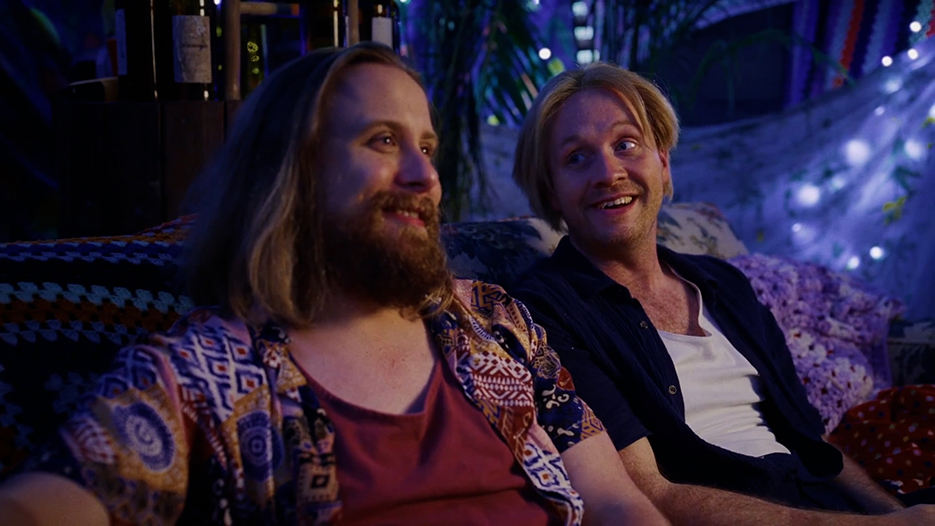
Ruben Wilkinson and Jake Ashton in My Tai.
I was so impressed with this film’s third act. I don’t know why, but I was actually moved by it in that I was so proud of you all for pulling together a film that’s so different to the types of films that are commonly made in Australia. I was so impressed with the inclusion of a guitar solo, and the fact that a corny Nickelback song plays into the silliness of this situation. How do you reflect on filming that final act, and are you happy with how it turned out?
That means a lot to hear that. All things considered, we’re really stoked with it. A little fun fact is that whole guitar solo was improvised on the day. We actually filmed 14 pages’ worth of script in that one night, as well as an improvised guitar solo. So that was one of the chaos days that I mentioned earlier. We said, “Hey, what would be really funny is if Ben came in and did the guitar solo while Tai was making the cocktail.” Everyone agreed that it was genius. Genius! So then we had to find a guitar from an op shop and bring it in quick smart.
And it was written on the night?
Yep. On the night.
Incredible. Tell us about obtaining the rights to use the Nickelback song? I know that’s always a challenge for independent filmmakers because it eats into so much of the budget.
We had to message the publishers and the master and get permission from both. We do have Nickelback at the end, but we also had Nickelback in two other places in the film. It is corny in the greatest way humanly possible. We did get it at a discount, which was very, very nice, but in the end, we had to limit it to just one song. [Laughs]. We took it to them and we had to provide a scene, and so Chad Kroeger himself has signed off on our film, so we’ll add that one to the résumé. [Laughs]. If Chad Kroeger said yes, then we had to have it in the film. I’m also the biggest Spider-man fan and now I own a document from Sony that references Spider-man and my name on the same page! It’s the closest I might ever get to Spider-man in my career. [Laughs].
Considering this was your first time directing a feature film, how would you sum up your overall experience?
Because this film really is about all of us coming together and having a good time, it was the best experience. I don’t think we auditioned a single person. We called in our friends for every single role. And the way we’ve described it since wrapping on it is that we captured lightning in a bottle. And now we’re asking ourselves how we keep this feeling going forever. We know that My Tai felt very electric, and all of us loved working on it so much. All the crew have been reaching out to me, asking when are we doing the next one. [Laughs]. I keep telling them that as soon as we have a budget, we’re on again. So I guess we’ll see how it goes. Hopefully it’s well received in a few festivals, and then we can do it all over again.
I can’t praise this film enough, and I honestly can’t praise you enough for your work on it. What can you tell us about Deficiency?
Thank you. Deficiency is still happening, but it’s had a title change, which is confidential for now. I’m working on that one with Flying Bark Productions. This film is one of the big feature films on their slate. If all goes well, we’ll be filming that in Queensland. It’s all early days, but it’s a horror comedy, and I like to think of it as a love letter to Mission Beach, where I grew up. It’s very, very silly. I love silly concepts treated seriously, and that’s what this one’s going to be. It’s going to be a very beautiful horror.
My Tai will screen at the Gold Coast Film Festival on Saturday, 10 May. Details here.

ADVERTISEMENT
If you enjoy Cinema Australia as much as I love publishing it, please consider supporting Cinema Australia’s commitment to the Australian screen industry via a donation below.
I strive to shine a light on Australian movies, giving voice to emerging talent and established artists.
This important work is made possible through the support of Cinema Australia readers.
Without corporate interests or paywalls, Cinema Australia is committed to remaining free to read, watch and listen to, always.
If you can, please consider making a contribution. It takes less than a minute, and your support will make a significant impact in sustaining Cinema Australia as the much-loved publication that it is.
Thank you.
Matthew Eeles
Founder and Editor.Make a donation here.


 Cinema Australia