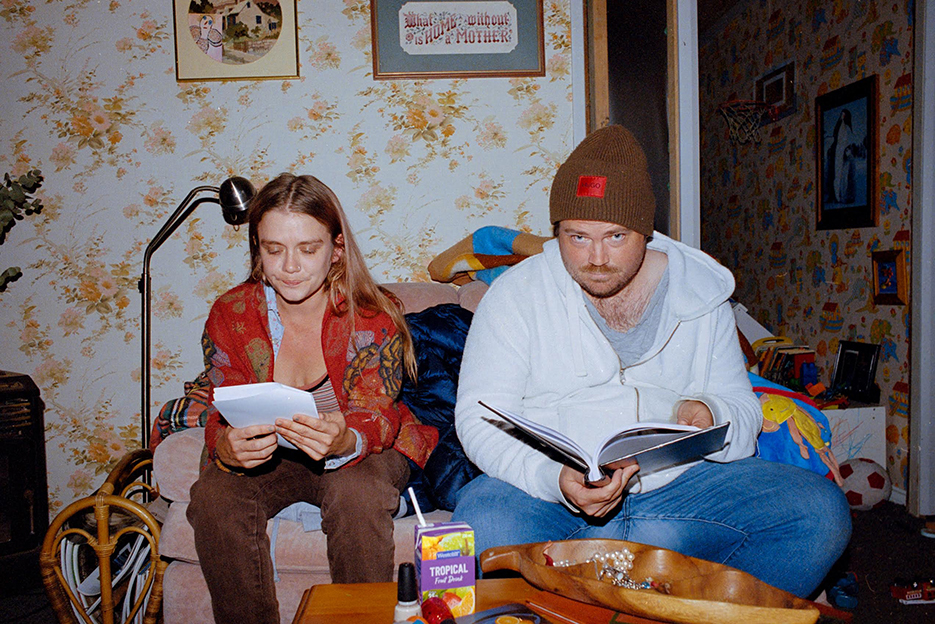
Sapphire Blossom and James Robert Woods on the set of Moonrise Over Knights Hill. Photography by Tim William Baker
Australia has long punched above its weight when it comes to coming-of-age dramas aimed at younger audiences. But bold, mature relationship dramas are still a rarity. James Robert Woods’ Moonrise Over Knights Hill steps into that space with confidence, bringing to mind the sharp intensity of Michael Bentham’s Disclosure while carving its own path through the emotionally charged terrain of adult relationships.
Set against the polished backdrop of a six-star farmstay in the Southern Highlands, Moonrise Over Knights Hill explores fractured friendships, relationship power plays, and unspoken tensions. When three former high school best friends reunite for a birthday getaway with their partners in tow, the weekend slowly unravels into a tangled mess of loyalty tests, quiet betrayals, and class divisions.
The film is the latest from writer, director, and cinematographer James Robert Woods, whose journey from puppet shows and parody bands in Sydney’s Sutherland Shire to international viral success speaks to a filmmaker unafraid of experimentation. From his early days on community TV sketch series Sketchmen, to co-creating the popular Mortal Kombat: Fire & Ice web series, Woods ability to blend humour, tension, and sharp character work is on full display in Moonrise Over Knights Hill.
Moonrise Over Knights Hill will screen at the Inner West Film Festival on Thursday, 17 April. Details here.
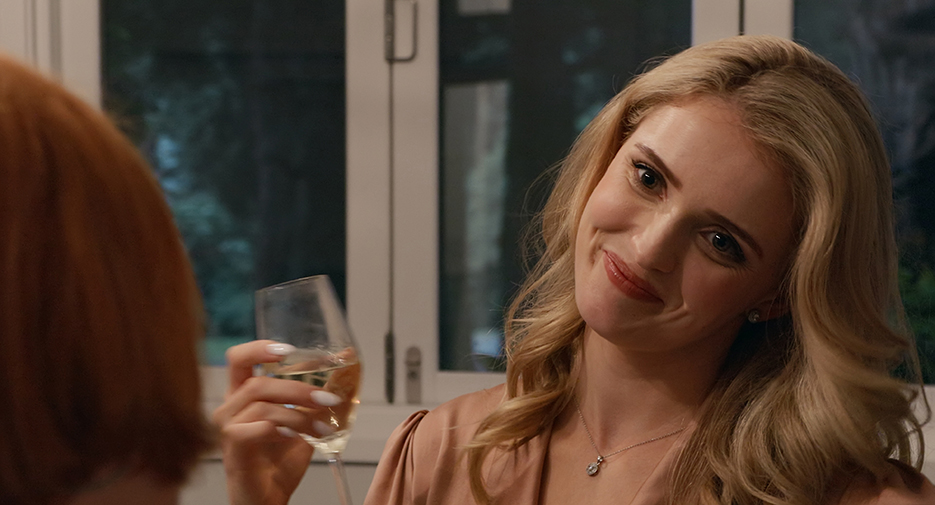
Annelise Hall as Isabel Mcdonald in Moonrise of Knights Hill.
“I don’t think you can make a film in Australia—or certainly a film that tries in some way to speak truth to power—without addressing our country’s unresolved colonial past. I just think that’s necessary.”
Interview by Matthew Eeles
You’ve had an interesting career leading up to Moonrise Over Knights Hill including a raft of successful short films, viral videos and commercial work. Was making a feature film a natural next step for you?
Yes, it absolutely was. I’ve never necessarily been a film guy or a cinephile, but I’ve always strived towards the best iteration of my own screen product. And that iteration is a feature film. I feel like that’s the pinnacle of screen creation. In my own ham-fisted way, I have been moving away from viral comedy, YouTube shorts, and political satire towards short films that were trying to delve into a more interesting place, perhaps in terms of drama, but also cinematic storytelling. So yeah, I’ve always been slowly moving towards a feature film—something that’s fully rendered, and a cinematic product that people can watch in a cinema.
How confident were you in your ability to make a feature film?
Well, I was confident enough that I’ve done it. [Laughs]. Myself and my co-producer, Stephanie Jane Day—an incredible director and writer in her own right—have made quite a few shorts together, as well as music videos and plenty of corporate videos. So we had a lot of experience pulling together shoots that were gradually getting bigger and bigger. I think my last big short film before this was around 20-something minutes long and a four-day shoot. So, logistically, there was a confidence that I’d be able to pull it off. As far as the story goes, I mean, it appeared fully formed in my head during the writing process. I knew all the beats and everything that needed to happen. But I guess there is a kind of tunnel vision once you commit and say, “Okay, we’re doing this.” You’re just blindly forging ahead, and you don’t have time to look left and go, “Hang on, is this going to work?” or, “What about this?” There was certainly a confidence—and I think there needs to be when you’re embarking on something like this.
You’ve said that Moonrise Over Knights Hill has been, “a labour of love, and sometimes hate”. Can you elaborate on that?
It was a 15-day shoot, but it was incredibly tumultuous logistically and emotionally. As far as my whole “love and sometimes hate” statement goes, it’s something I’ve been thinking about a bit lately. I feel like a feature film is like a prison you slowly build for yourself, brick by brick, until you’re fully ensconced in it and unable to escape. Moonrise Over Knights Hill has been 30 months of work at this point—sometimes full-on 80-hour weeks, and sometimes just thinking and ideating while other shoots and jobs are happening. There’s a lot of love that has gone into this film, but sometimes you absolutely resent that it exists, and that you had the gumption and the blind ego to embark on something like this. Just given the scope of any feature film, it’s driven by love—but often you really need to try and find that passion again, or rediscover the passion that went into writing it. Especially when you’re 20 months down the track and there’s new post crew coming on, or whatever the case may be.

Robert Preston as Felix Doyle in Moonrise Over Knights Hill.
Moonrise Over Knights Hill speaks to themes of class privilege and even colonisation, especially when it comes to the character of Felix played by Robert Preston. Why are these particular themes important to you as a filmmaker?
That’s a really good question, and a great pickup. I don’t think you can make a film in Australia—or certainly a film that tries in some way to speak truth to power—without addressing our country’s unresolved colonial past. I just think that’s necessary. I’ve seen too many films that have a five-paragraph land acknowledgement and zero exploration of Indigenous issues. I’ve seen that in a lot of films, and it always trips me up. If you do care about this issue, then why isn’t it present in the work? That’s maybe a macro answer, but coming down to the story level, this film looks at the class privilege of these three couples, and they’re all phenomenally privileged. They’re all upper-middle class. While I think the film treats them with honesty and authenticity, it’s not punching down on these people. It’s not ridiculing them. Their arcs and emotional motivations are certainly treated with respect. They are still incredibly privileged in an Australian context, and I think that’s really important to highlight. And the film does highlight that in a very, very loud way through the character of Felix, as you mentioned. So Felix and Sapphire—played by Robert Preston and Sapphire Blossom, two incredible actors—are the in-world embodiment of that class divide that I think still exists in our country. And I thought these characters needed to be confronted with that firsthand, because I don’t think that happens a lot in the lives of people like this. I thought it was really interesting to explore that. My intention was to explore it in a really honest fashion. I really love the scene where Angie, played by Josephine, meets Sapphire for the first time. Angie’s got these politics and a moral code that she’s very comfortable with—something that would be described as centre-left liberal, or somewhere around there. But professionally, she’s making this documentary about the Faroe Islands and the position of women in that society. Yet when she’s confronted with that very same issue right in front of her face, she’s very uncomfortable and conflicted by it. So it kind of exposes a little bit of hypocrisy on that character’s behalf—but hopefully in a very honest, authentic, and interesting way. I think these issues are important, and when you are exploring upper-middle-class characters with that level of comment from the cinematic artifice—I think it needs to be there. Because film is an expensive medium—a privileged medium, perhaps. So I think it needs to have that comment in there somewhere.
Writing a film made up of eight main characters with equally engaging storylines would be a challenge for any filmmaker. Can you talk us through the complexities of creating and developing so many characters?
Another really good question. I wanted to explore different versions of relationship dysfunction, basically. Each couple has quite a different version of relationship dysfunction, so that’s where I started prior to building each character’s personality. Who are they? Where are they from? Why are they together? Who are they together with? Where do they work? Who do they vote for? All that stuff. That was my jumping-off point. So Mark (Ben Gerrard) and Izzy (Annelise Hall), for example, have this power gradient, and she’s made this bargain deal with the devil, if you will. That’s one version of dysfunction that’s a problematic power imbalance. But then you’ve got Lars (Luke Jacobz) and Angie (Josephine Starte), who have quite a different type of dysfunction. They have a power imbalance as well, but with the genders reversed. Their level of dysfunction is that they maybe have a disparity in their IQ. [Laughs]. Their relationship has stifled. A lot of my writing comes from witnessing, or being a part of, relationship dysfunction—either small or large—and then wanting to try and render that authentically. Those personal experiences allowed me to build these characters authentically.
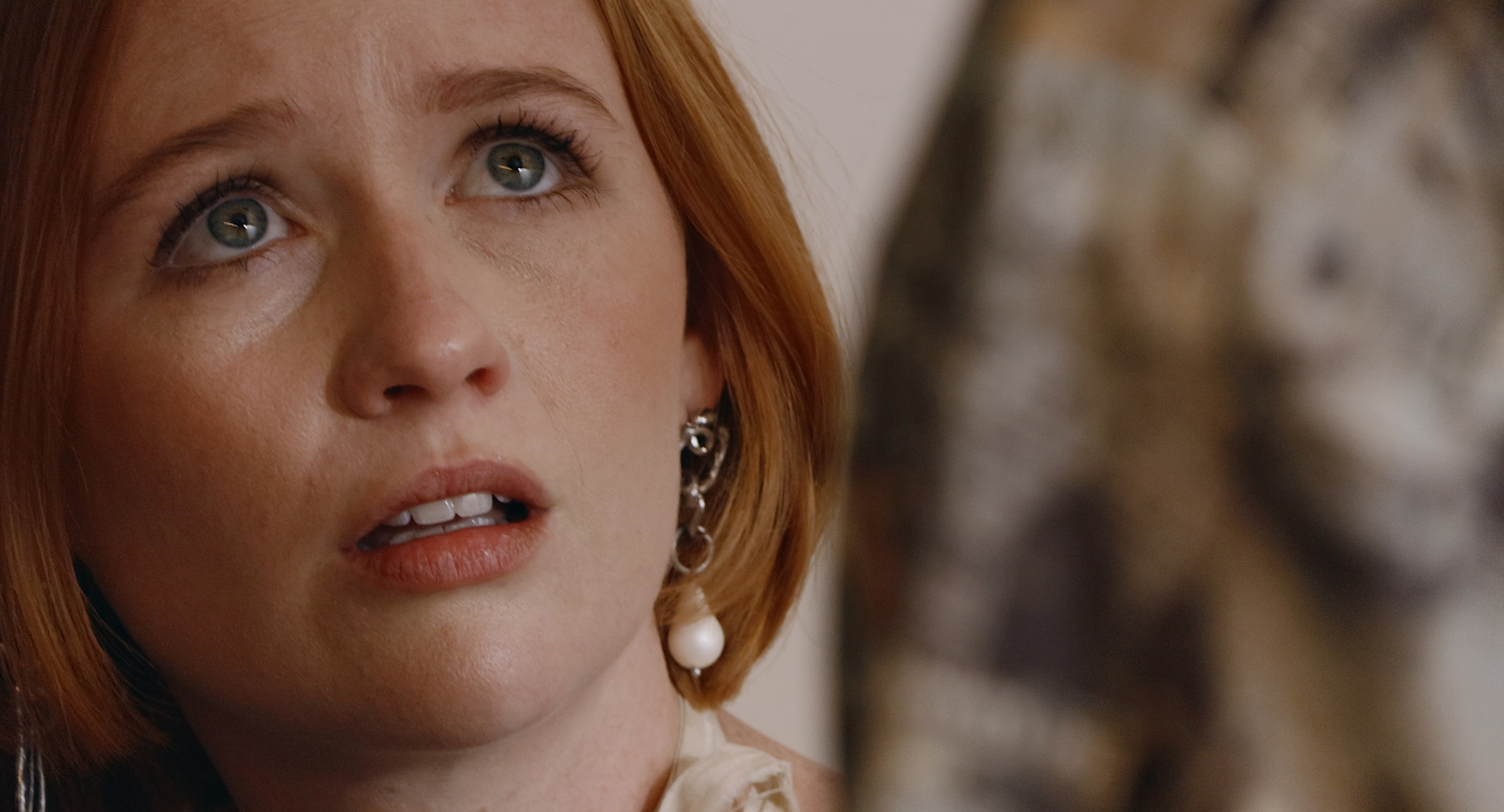
Nicola Frew as Clare Lapsley-Smith in Moonrise Over Knights Hill.
This film is one of constant dialogue. I’m not comparing it to Mamet or Sorkin, but it’s certainly a riff on their style. How do you restrain yourself when writing so much dialogue.
I love to write a lot of dialogue. [Laughs]. From my experience growing up and sitting around the dinner table, my family were always engaged in robust discussion. There were always lots of big words, and everyone throwing lots of shade back and forth. Then there’s me, the youngest kid, just sitting there absorbing all of that and getting involved. That’s where my love if heavy dialogue comes from. But yes, it’s very wordy. [Laughs]. I love writing dialogue that has a certain rhythm and timbre—and then working with actors who are so incredibly skilled at bringing that to life. There are 14,176 words in this screenplay, and I know that because I did a calculation recently. [Laughs]. The script allows the characters to be fast-talking because that’s what feels real to me. I don’t like watching films or television where the actors only express the subtext, or they just say the bare minimum to kick the scene along. Or if a scene starts with a character saying, “What are you doing?” then I tune out immediately. Surely there’s a more authentic way to get to the subtext without, “Hey, what is it that you are doing now?” I’ve always resonated with film and TV that’s fast-talking because I love the rhythm of that.
Did you use a script editor, or did you have a companion to bounce off of while writing Moonrise Over Knight’s Hill?
No to a script editor, but yes to a companion. My co-producer Stephanie Jane Day and I are married. She was a sounding board and has been for many years, but maybe not in a critical way until the script was complete.
I know it’s a cliche question, but how much of the dialogue is improvised compared to what was written on the page?
I would say ninety six percent. It’s pretty close to what’s on the page. The exception to that is the birthday cake scene, which on the page wasn’t much of a scene. It was just the happy birthday song written on the page. On the day of filming that scene the cake came out and it was on fire because we had too many candles, and I said, “Whatever, let’s just take the cake out and see what happens.” [Laughs]. So that scene was a hundred percent improv. I would say most of the scenes are ninety six percent of what was originally on the page. There was a level of collaboration with the actors, and they would always have ideas for words or a different way to phrase something, and I’m very open to that. But for the most part, what they say on screen is what was written on the page.

Luke Jacobz as Lars Adam Jansen in Moonrise Over Knights Hill.
Well that gives me even more admiration for what these actors were able to pull off here. How extensive was the casting process considering how big this ensemble is?
Maybe half of the cast were people that I’d worked with already, so I knew they would nail these roles. David Quirk, Ben Gerrard, Josephine Starte, and Sapphire Blossom all pretty much had the role written for them—or with them absolutely front of mind. So I guess the casting was half done at the script stage. As for the rest of the cast, it was a difficult process. It did take a while to find actors who had exactly what we wanted. A good example of that is Luke Jacobz who plays Lars Jansen. What he’s doing is incredibly hilarious but also very complex. There’s one scene where he’s watching a rugby highlights package, but because it’s a highlights package and he already knows the result of the game, he has to respond in a way that shows he’s still enjoying it—but not so much that he’s surprised by the outcome. It’s quite complex, but what he does on screen is incredible. Two of the most interesting casting stories are probably Nicola Frew and Robert Preston—for the reason that they both came to the film very late in the piece. And that was because we couldn’t find anyone else who had what those roles required. In Robert’s case, it was the sort of intensity that he had to bring to the role. In Nicola’s case—there are so many amazing actors in the world and in this country—but I think Nicola had this unique control and grace over her character, Clare, but still maintained a sense that she was fighting for her space—within her onscreen relationship and in the broader social milieu of these characters. You can really feel that on screen.
I don’t want to single out anyone’s performance, but seeing Luke Jacobz in this film is a reminder of how great an actor he actually is.
I agree. He absolutely embraced his character with grace and vulnerability. I mean, there’s that five minute monologue where he is talking about sharting himself, which is maybe the dumbest thing in the world. But before we shot that, he had every line down to a tee. He was finding the rhythm of it and his voice. He was treating it with complete sincerity because that’s who he is and what he does. And you can feel that because while Lars provides a lot of comic relief, Luke didn’t treat the role in that way. He really embraced it with total professionalism.
And the sharting story is so good that we get to hear him tell it twice in the film.
[Laughs]. Yes. I don’t know how the audience will feel, but I think the voice of the film is really clear at the conclusion of that first monologue. There’s a lot of words. There’s a lot of shaky camera, and the way that Ben Gerrard’s Mark responds to the absurdity of that anecdote, is the first clear moment where the audience will understand where the film is swinging from, and where it sits intellectually. And maybe that’s through the eyes of Ben responding to Luke. I don’t know. But it was a very fun scene to shoot.

Josephine Starte as Angie Olsson in Moonrise Over Knights Hill.
As with most films, location plays a huge role here. Where was the film shot, and how did you go about securing it?
It’s an old farm stay in Robertson in the Southern Highlands of New South Wales. It’s a place that my parents bought for their retirement. They bought this old farm stay and had been renovating it.
And is it really near where Babe was shot?
It absolutely is. One hundred percent. The old house which gets demolished in the film, that was a house that was being prepped for demolition anyway. It’s a beautiful location, but it was also pragmatic filmmaking which had logistical advantages.
Talk us through the filming of the demolition?
So the Caretaker’s Cottage was an old house next door to our main location. We took the unique opportunity to dress it up and knock it down within the world of our film. The original scripted ending packed slightly less of a punch. It was a pretty incredible achievement from our design team. We had to strip it back to its bare bones, literally the wooden foundations, to get rid of mould and asbestos, then completely redress the house in under two weeks. So everything you see in that space was brought to life for the film—literally everything, every surface, every prop. When it comes to the stunt itself with Robert Preston driving a Caterpillar D6 bulldozer straight through the house, it was a pretty unique cinematic undertaking. We ran fourteen cameras in one take. As a filmmaker, it was absolutely invigorating.
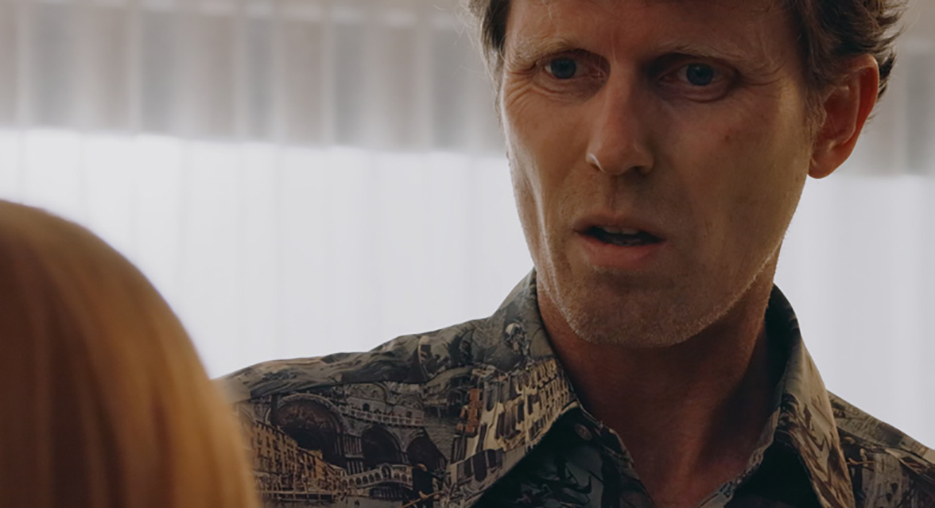
David Quirk as Jim Conrad in Moonrise Over Knights Hill.
That scene is just one of many great moments in Moonrise Over Knights Hill, but one of my favourite scenes is the group painting session which is filmed in one shot. Talk us through that scene. How long did it take to shoot and did it require many takes?
I think it took 19 takes. And I think we used the seventh one from memory. It was difficult. I had this idea of wanting to have the slow rotating camera and one shot, because considering where it sits in the film, it’s a more relaxing moment before we get back to the dysfunction of our characters. You’ve had 30 minutes of talking and yelling, so I wanted this scene to have a tranquil feel. As far as the technical side of the shoot goes, I did start to get greedy because I wanted particular lines on camera. So we tried a bunch of different combinations of rotation, speed, and starting points to ensure certain lines were on camera. But in the end, that wasn’t really necessary. The seventh take was the best performance, and at the end of the day, if I didn’t get certain lines on camera, it didn’t really matter because the performances were so great.
Who painted the final paintings that are seen in the film? They’re very good.
Clare’s painting was painted by Lisa Twomey, who was one of the production designers. Luke Jacobz on a lion on a mountaintop was painted by Amelia Fell, the hair and makeup designer who’s also an incredible painter. She also painted Ben’s square painting. Lisa also painted the colour-by-numbers painting. And then Steph painted the unfinished fruit bowl and I painted the Birth of Venus attempt. That’s the extent of my painting skills. [Laughs].
Please tell me that you’ve kept them, and that they haven’t been destroyed.
No, no, no. Absolutely not. They’re in our office. They’re sitting on a window sill at the minute. If the film is a hit I might auction them off. [Laughs]. We had this silly idea of some sort of epilogue with them all hung in a sci-fi art gallery in a thousand years time. [Laughs].

Ben Gerrard as Mark Mcdonald in Moonrise Over Knights Hill.
It’s common for a key creative to perform multiple roles on an independent film, and in your case you were also this film’s cinematographer. I understand this film’s cinematography style, and how it’s used observationally to make the audience feel like they’re a part of this inner circle, but how did you find balancing both roles?
I find it really easy because I like to be close to the drama. I like to be in there with the actors, and usually, if I’m sitting at split, watching in the next room, I can’t handle that. I’ll just start vibrating. I need to be amongst the action. On set, it wasn’t really a balancing act because the two roles absolutely complement each other. As far as the cinematography style goes, I love that style. I love a loud camera. If I watch a film like Conclave, which is a great film, its cinematography is modern and conventional shot in more of a prestige TV cinematic style which I find quite alienating. That’s a barrier to immersion for me. Whereas when I watch something with a loud, self-aware camera, I’m fully immersed. I feel like no one’s trying to trick me—this is an honest story I’m being shown. That’s the sort of feeling I want the camera to have. It helps with immersion, but I also think the camera should have a direct line from the creator to the screen, and it’s as unfiltered as it possibly can be. Through this film, you are seeing me, in real time, respond to those emotional beats and those performances. And you’ll get a neurotic rack focus or a whip pan or whatever the case may be. And that’s what I love in cinema.
How many cameras were used throughout the shoot?
For about ten days of the total shoot we had two cameras. Miller Best, who I’ve worked with in the commercial world, came on board to shoot B camera for seventy percent of the scenes. So mostly the six handers, those bigger scenes. It was just a case of we’ve got so many amazing performances happening at once. It would be criminal to just have one camera. It was two cameras for the larger scenes, and one camera for the rest.
There’s a moment in the film that feels like it comes from a personal place, where Luke Jacobz’ character Lars asks the group if they’ve seen any Australian films lately, and the most recent films he can reference are Babe and Kenny, but nothing really recent other than The Dry which no one had seen. Do you have an opinion on the current state of the Australian screen industry? Because there are a few other moments throughout the film that take a swipe at our local screen industry.
I think there’s a lot of incredible things being made and a lot of incredible artists working in the local industry. But I certainly do find that there’s a type of genre of Aussie film that’s homogenised, designed by committee, very safe and sanitised. And there is certainly a certain type of Australian film that I don’t connect with, and I think maybe audiences don’t generally connect with either. So with this film, we’ve tried to make something that is the antithesis to that, and I hope people enjoy it.
Moonrise Over Knights Hill will screen at the Inner West Film Festival on Thursday, 17 April. Details here.

ADVERTISEMENT
If you enjoy Cinema Australia as much as I love publishing it, please consider supporting Cinema Australia’s commitment to the Australian screen industry via a donation below.
I strive to shine a light on Australian movies, giving voice to emerging talent and established artists.
This important work is made possible through the support of Cinema Australia readers.
Without corporate interests or paywalls, Cinema Australia is committed to remaining free to read, watch and listen to, always.
If you can, please consider making a contribution. It takes less than a minute, and your support will make a significant impact in sustaining Cinema Australia as the much-loved publication that it is.
Thank you.
Matthew Eeles
Founder and Editor.Make a donation here.


 Cinema Australia