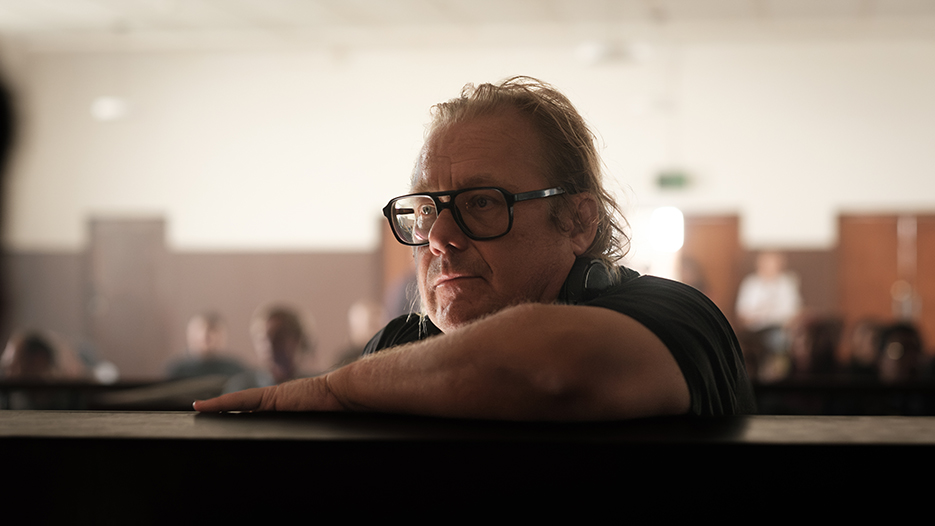
Kriv Stenders on the set of The Correspondent.
It’s not every day a filmmaker gets the chance to tell the story of someone they’ve known since childhood—let alone a story as important and politically charged as this one.
But that’s exactly what happened to acclaimed Australian director Kriv Stenders (Red Dog, Danger Close) when he was asked to take on The Correspondent, a new feature film based on the shocking true events surrounding journalist Peter Greste’s arrest and imprisonment in Egypt.
When Greste, played by Richard Roxburgh, touched down in Cairo in 2013, he had no idea he’d soon become the centre of an international media firestorm. Sent to cover for a colleague over Christmas, the experienced war correspondent found himself caught in a brutal political game—targeted not for what he did, but for who he worked for. His employer, Al Jazeera, had drawn the ire of Egypt’s newly installed military regime, and Greste quickly became a pawn in a crackdown on press freedom.
For Stenders, the film is more than just a gripping political thriller—it’s personal.
“About four years ago, I got a phone call from Carmel Travers, this film’s producer,” Stenders tells Cinema Australia.
“Carmel asked me if I knew anything about Peter Greste’s story, and I laughed. I knew Peter when I was a kid. Our families know each other. My father and Peter’s father, Ian, are both architects, and they’ve known each other since the fifties.
“So when the story broke ten years ago, it was big news—obviously internationally—but it was also big news amongst our families. So I followed the story very closely.
“When Carmel said she was making a film about it, I said, ‘Well, sign me up. I’m on board. I don’t even have to read a script.’”
In this Cinema Australia interview, we chat with Kriv about bringing his friend’s powerful true story to life, the challenges of telling it authentically through world-class production design and dedicated performances, and what it was like working with Roxburgh in such a vital role.

Richard Roxburgh as Peter Greste in The Correspondent.
“I knew everything that was in the script was allowed to be there. I had permission to film that script. I had the confidence to actually go out and realise it, and knowing that it had Peter’s approval meant a lot.”
Interview by Matthew Eeles
Do you remember first hearing of Peter’s arrest?
Well, I must admit it was pretty disturbing. I guess I was confronted. I didn’t realise this job was so dangerous. I thought he was just a foreign correspondent. I’d seen him on the ABC, I’d grown up seeing him on TV and hearing him on the radio—and suddenly, now here he is, arrested. It was a real wake-up call. It made me realise that this job isn’t as easygoing or as safe as I thought it was. And then, when he got convicted, it was really, really sickeningly horrifying to know that that was going to be perhaps his life for the next seven years—being stuck in an Egyptian prison just for doing his job. That was quite profoundly disturbing.
As a filmmaker, did it cross your mind at the time that Peter’s story would make a great film?
Look, to be honest, I can’t remember it being an idea, but it probably did shoot through my head. But I probably had so much going on at the time that I didn’t really pursue it, and I’d forgotten about it, really, until that phone call from Carmel.
Peter’s story is one of great international significance that continues to reflect the current state of journalism. Describe the weight of responsibility you felt to accurately represent Peter’s story through this film.
I think the responsibility would’ve been there even if I didn’t know Peter. I just wanted to do it justice. I wanted to make sure that I could make something that’s credible, that’s authentic, and that’s truthful—and that also engages an audience. But that’s the job. That’s what I love about movies. What I love about making films is that each one of them presents its own unique challenges and asks of you something, maybe, that you haven’t done before. And that’s what I always go by—what a project asks from me. And once I worked out a way to unlock the story and a way to tell it, then it became a matter of me having to do it. I now knew how I wanted to do it; therefore, I had to do it. And you get that fire in your belly where you just have to will the film into existence.

Richard Roxburgh as Peter Greste in The Correspondent.
How does it compare to making a film of fiction? Is it more or less liberating as a creator?
Look, I would say that it’s the same, to be honest. It’s still a story, and in a funny kind of way, truth is always stranger than fiction. But in a funny kind of way, it’s almost easier because reality is the best reference. We had all the footage from the court case, we had all this real footage of the reporting of the time. We were able to always cross-reference it with reality. And what you’re doing, really, is instead of taking a photograph, you’re making a painting. So you’ve always got reality there, but what you’re doing is interpreting it and making it artful and making it cinematic—and you’ve always got the truth to fall back on.
How involved was Peter as an advisor? Was he already involved prior to you coming on as director?
Peter Duncan and Peter Greste had worked on the script. The script was based on Peter’s book. And when I got the script, I knew that it had been vetted by Peter Greste. So I knew everything that was in the script was allowed to be there. I had permission to film that script. I had the confidence to actually go out and realise it, and knowing that it had Peter’s approval meant a lot. Peter Greste made himself available to us throughout the whole pre-production period. He only came to set once, really—he didn’t hang around much—but he was very generous, very candid, very open. We had these long lunches with all the heads of department where we grilled him about everything from the toothpaste he used to the underwear he wore, to what he ate for breakfast, dinner, lunch, how things smelt, to how things sounded. So it was great having that resource throughout the pre-production period. Peter was very gracious and very generous with his time.
When comparing the sets to real-life footage, it quickly becomes apparent how well the production designers have done replicating these real-life locations—especially the courtroom. How important was that for you?
It was important in that we had to shoot something. We had to create something, so we wanted to base it on what it was. And we tried, wherever we could, to duplicate or emulate what the courtroom was like or what the prisons were like. But we also took a lot of licence as well. Interestingly, when Peter Greste saw the film, he said that cumulatively the film was very close to his experience. While specific things were different, he said that, as a whole, the film was very true to what he experienced.
The psychological impact that this event has on Peter is no doubt one that he endures every day. How did the production ensure Peter’s mental health was nurtured throughout this process?
Peter had already worked a lot on his mental health prior to us filming. The amazing thing about Peter is that even in prison—and the film talks to this—he meets a character who basically advises him to say, “Listen, what has happened to you isn’t because of something you’ve done. What’s happened to you has just happened to you. And the sooner you accept that, the sooner you’ll be able to survive.” So Peter was already very mentally strong through his ordeal because he had to be. I think by the time he was let out, he had the mental health tools to cope with it. But we did have this one lunch where I really talked to him very specifically about his experiences in Africa, which is this subplot that we visit throughout the film. And he spoke very openly about that. I could tell he was still traumatised by it. But the fact that he spoke to us about it so openly really hit me, and I really wanted to be true to that aspect of his life. The first time Peter watched the film, I watched it with him, and I was shitting myself because I didn’t know what he would think. He was sitting next to me throughout the whole film, and then the film finished and he said, “Look, I’ve just got to step out for a second.” He went out for about five minutes, and I was just sweating bullets. I didn’t know what he felt. And he came back, obviously very emotional, gave me a big hug and said, “That was amazing. Thank you.” And I realised we’d done good. I said, “Are you okay?” He said, “I’m fine. I’ve lived through this a lot in my mind. I was ready for this. I was prepared for this.” And he’s an amazing human being. He’s very strong. And we always knew that. We always knew that he would be. The fact that he gave us permission to do this—we knew that he would be prepared for it. And he was. He has been fantastic.
I’ve watched the film multiple times now, and I’m drawn more and more to Richard Roxburgh’s performance each time. I think he’s quite brilliant here. Knowing both Richard and Peter, what aspect of Richard’s performance would you say most accurately embodied Peter?
I think Richard’s performance is remarkable. Richard is doing what any great artist does, in that he’s interpreting something. It’s not an impression—it’s an interpretation of Peter Greste. Richard brought his own humility, his own humanity, his own empathy, his own gravitas to the role. And I think, again, it’s greater than the sum of its parts. It’s not one specific thing that’s very Peter-like. It’s more in the whole that I think he’s captured Peter’s soul and his spirit as opposed to his personality. I think that’s what’s remarkable about Richard’s performance.

Saif Alawadi, Richard Roxburgh and Kriv Stenders on the set of The Correspondent.
What made Richard so right for this role? Were you involved in his casting?
I was, yes. Casting films is always such a nightmare because it’s such a crapshoot. I tend not to try to think of actors for roles while I’m developing a film, because you are always bound to be disappointed, and you always colour your idea of what the film is. If you think of someone, it’s much better to keep an open mind about who could play the role, because you’ll never know what comes out of the woodwork, what comes out of the transom. And sometimes it’s the most tangential casting that becomes the most brilliant casting. One day I remember Peter Duncan, the writer, called me up and said, “Listen, I’ve got an idea for who could play Peter.” And he mentioned Richard Roxburgh. And at first I thought, Isn’t that a bit obvious? And then I realised, “Oh my God, it’s perfect.” It was perfect in its obviousness. And I also realised that beyond it being obvious in that Peter Duncan and Richard have known each other for years, it was more the fact that he was actually perfect. Richard can play anything, and he has such great bandwidth. He’s got this wonderful ability to play a whole gamut of characters. And the fact that he was able to access this kind of character so effortlessly just made it a no-brainer. It was such a great idea because it’s so clear, it’s so crystal, it’s so simple, and it’s so brilliant in its obviousness. So that was one of those wonderful surprises, and I’m so happy that Richard said yes.
Richard keeps emphasising the fact that this was one of the most physically challenging roles of his life. Can you talk us through the physical and emotional demands on Richard as a performer?
Every film’s a marathon. Every film’s hard. And this was hard. It was cold and wet. It was also very hot and smoky and dusty. It was everything. And the thing is that Richard is in every shot from this first-person perspective. He’s in every scene. We never leave Peter’s side. Richard mentioned that this is the first time he’s ever done a film where he is in every scene. I knew that that would be really hard for any actor. But you know what? He was just incredible every day. He just had so much to do—in the morning, he was running; in the afternoon, he was crying. Every day was like four emotional seasons in one, continually in and out, day after day. And he never missed a beat. He was such an incredibly strong, calm, and precise instrument. He was wonderful. And that makes my job so much easier because I was able to then make sure that I was getting the best out of him, making sure the camera was in the right place, making sure I was telling the story as clearly and as succinctly and as powerfully as possible. So in a funny kind of way, you really are the sum of your parts. You really are the sum of your crew and your cast, and that’s what you do as a director. You cast your cast, you cast your crew, and if you do it right, it can become very joyful and a very smooth experience. And it certainly was in this film.
And of course you’d worked with Richard before on Danger Close.
Yeah, he had a support role in Danger Close. That was a great experience. I only worked with him for a week on that one. I call him a Rolls-Royce. You get in him, the suspension is great, the seats are comfortable, and it’s beautiful to kind of feel and look at. He’s one of our great national treasures.
Speaking of performances, you’ve assembled an incredible support cast here, including Julian Maroun and Rahel Romahn who are doing great things at the moment. How exciting is it for you as an established director to be working with these relative newcomers? Do they bring a fresh energy to the set?
I remember when we were trying to make the film and we were trying to get it financed. Everyone was telling me that this film was going to be impossible to shoot and make in Australia. People were telling me that we wouldn’t be able to cast Egyptians. They told me we would have to shoot it out of London and get the Egyptians from there. But I knew that we could cast it out of Sydney, because Sydney’s got a rich, wide, and deep Middle Eastern diaspora. And I’d made a show about ten years ago called The Principal that had a Middle Eastern cast. So I worked with a lot of the cast that were in that. I had already had Rahel in mind right from the very beginning. And it was just such a joy to cast the film from this really deep reservoir. I was able to cherry-pick exactly who I wanted and still had wonderful options left over. So it was an absolute pleasure to cast and to direct. These are actors—people with really diverse backgrounds and, in many cases, traumatic histories—who’ve come to Australia to start new lives. So they bring this incredible life with them, and this wisdom, and also this talent. And it was one of the most wonderful experiences I’ve had casting a film.

Kriv Stenders and Richard Roxburgh on the set of The Correspondent.
You’ve worked with cinematographer Geoffrey Hall on so many of your films, including Red Dog, Australia Dayand Wake in Fright. Any film shot by Geoffrey is all the better because of him. Can you tell us about your professional relationship with Geoffrey and why you love working with him so much?
I’ve known Geoff ever since I was at film school. My very first film school attachment was on a film called The Punisher, and Geoff was a young focus puller on that. So we go way back to the beginning of my career, and what’s wonderful is that we’ve grown up together, and I’ve just seen him go from strength to strength. Geoffrey is a very gentle, very unassuming man, but he’s also a strangely philosophical kind of guy. And what I like about Geoff is that he thinks deeply about what he’s doing. He gets really quiet and doesn’t say much during pre-production. I know what he’s doing—he’s just absorbing it. And what he’s doing is very clever. He’s absorbing the script, he’s absorbing the cast, and he’s also absorbing the production. He’s taking in where the budget’s going, where the breaking points for the budget are, and he’s just holding off on making his decisions until he really knows what the landscape is. Because you don’t want to make demands on the film that the film will never be able to meet in terms of too much gear or something that’s going to compromise the schedule. So he is very, very dexterous in that way. Then, a few weeks before we start production, he’ll come up with some great ideas. He found these uncoated lenses that he wanted to test, and he showed me these tests of the lenses he found, which just blew my mind. They flared in this really extraordinary way. The light was blooming. And I went, “Geoff, that’s a genius idea.” It gave us a number of opportunities. These flares became this fantastic device that I could use as a flashback device. What it also did was cover up a multitude of sins, because we were shooting this film in Sydney for Cairo. We were able to really create this patina and this feel and this atmosphere that really felt like we were in the Middle East. It had this transportive effect. And that’s Geoff. That’s Geoff waiting for the right time, coming up with the perfect choice at the perfect time, and then that choice informing everything. And he lights so effortlessly and so brilliantly, and he’s such a wonderful energy and presence on set. He just makes my day a joy. He always makes me laugh. He makes the crew laugh. He makes the cast laugh. He’s just a wonderful human being, and I love him to bits, and I love working with him.
Considering how long you two have been working together and your professional longevity, do you feel comfortable challenging each other? Does he challenge you in some aspects and vice versa?
We do. Sometimes he’ll come up with an idea, and I go, “No, Geoff.” Or sometimes he’ll let me know if he thinks an idea isn’t going to work. We have a shorthand, and that’s what you want. A lot of the time, when you work with someone like that over a period of time, you don’t have to say much to each other. You’ve been through enough tight corners, and Geoff’s so experienced. He brings so much experience to everything that the trust is everything. We know we can look at each other and know if the day’s going south, what we need to do. Or we know that if we’re going to try and risk something or try a new idea, we’re able to do that. And if it doesn’t work, we’ll know. We’ll find a solution. So it’s just this very intuitive, trust-driven process that we have, which is great.
Your son, Kade, recently shot a music video for the band Bricolage. That must have been a proud dad moment for you.
I’m proud. [Laughs.] He’s only 19. He’s studying film at UTS and it’s wonderful, but he’s his own person. He’s making his own decisions. He’s mad about cameras. He loves shooting. He’s really, really fascinated and interested in cinematography. He’s developing his own eye. He’s on his own journey. And if I can help in any kind of way, I will—obviously with advice and whatever. But he’s on his own path, and I’m proud of him. And I know he’s got a long way to go. But the thing is, I think with anything in life: find something you really love doing, enjoy, and have a passion for, and you’ll have a happy life. So I’m just saying he’s found something that really motivates him.
Filmmaker Matthew Holmes recently published a very candid open letter to the Australian film community and industry leaders. Did you get a chance to read Matthew’s letter, and if so, what did you make of it?
Look, I know Matthew. I’ve known Matthew for years, and I think he’s a really talented filmmaker. I know his frustration. I know it’s a tough business. I’ve been through the wringer myself so many times. It really is a tough, tough game. And it’s not for the faint-hearted. Everyone has this perception that this industry is a glamorous job, or that there are these people who are the gatekeepers, that there’s this inner crowd or inner sanctum that gets all the gigs or all the breaks. It’s not like that at all. No one knows anything. It’s a completely mercurial business. The whole thing is very transient and ephemeral, and nothing’s guaranteed. You can work on something for years and it can fall through at the last moment. At the same time, something can happen out of the blue, and you can never predict it. And that’s what Matthew and I discussed during these conversations. It’s tough, it’s brutal, and it’s becoming tougher, and it’s becoming more brutal. But this is a global problem. The world is changing. The economics of filmmaking is changing—but it’s always been changing. It’s always been in crisis. I’ve grown up with the film industry continually in some kind of crisis. It’s always hard. I think it’s more that you’ve got to find a way to cope with it. Find a place within yourself, find an equilibrium point, and remind yourself why you’re doing it and why you want to do it. I had to push my way into the industry. I had to self-finance my first feature film, which was Blacktown. I had to create my own opportunities. I’ve had to create my own destiny. And ultimately, 20 years on, I’m still at the same place I was 20 years ago. I’m still just another filmmaker trying to get my dreams up. And there’s no guarantee. It’s just the reality of the business.
The Correspondent is in cinemas from April 17.

ADVERTISEMENT
If you enjoy Cinema Australia as much as I love publishing it, please consider supporting Cinema Australia’s commitment to the Australian screen industry via a donation below.
I strive to shine a light on Australian movies, giving voice to emerging talent and established artists.
This important work is made possible through the support of Cinema Australia readers.
Without corporate interests or paywalls, Cinema Australia is committed to remaining free to read, watch and listen to, always.
If you can, please consider making a contribution. It takes less than a minute, and your support will make a significant impact in sustaining Cinema Australia as the much-loved publication that it is.
Thank you.
Matthew Eeles
Founder and Editor.Make a donation here.


 Cinema Australia