
Emilie Lowe.
Perth filmmaker Emilie Lowe is a force.
With determination and creativity, she starred in, wrote, directed, edited, and co-shot her debut feature film, The Canary, alongside a small team of just three others: cinematographer and sound designer Peter Renzullo and her parents, Suzanne and Steve.
The production faced numerous hurdles, including working with a 100-year-old boat, enduring a record heatwave, losing an antique prop, and navigating a tight $10,000 budget. On top of that, the team had to create a feeling of isolation while filming in populated areas.
Despite these obstacles, Lowe delivered an impressive period survival film that showcases talent well beyond her years and her filmmaking experience.
“It was a huge learning experience,” Lowe says.
“I hope the fact that a four-person team with a micro-budget could bring such an ambitious project to life inspires other filmmakers to follow their passion.”
Set in the 19th century, The Canary tells the story of Florence (Lowe), who is left adrift on the open ocean after a transport vessel sinks.
With only a wooden lifeboat and a caged canary for company, Florence must defy the societal expectations of her time and find the strength to survive the vast ocean and the unforgiving Australian wilderness.
The Canary explores themes of persistence, self-discovery, and acceptance, both for Florence and Lowe who brought the story to life.
The Canary will screen at The Backlot Perth on January 18. Details here.
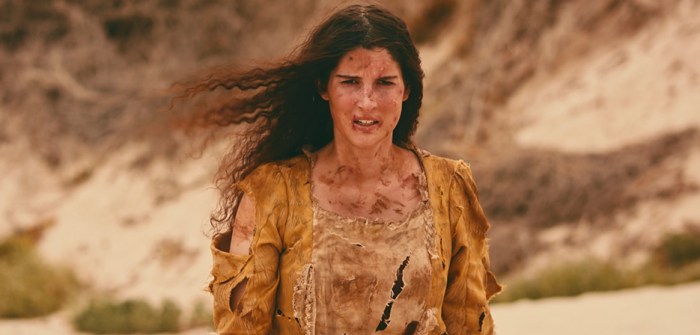
Emilie Lowe in The Canary.
“For a lot of the film, Florence thinks that she’s destroyed herself, that she’s corrupted herself, and that she doesn’t deserve to be here anymore. But as she accepts herself and grows into her own power, she realises she can defy this. She’s not defined by what other people say or think about her.”
Interview by Matthew Eeles
You graduated with a degree in screenwriting while filming The Canary. Was there a reason you wanted to study screenwriting only, rather than filmmaking in general?
Well, I’ve always loved writing. Writing was my first love. I’ve loved writing and acting ever since I started making films with my sister when I was six or seven years old, which are pretty horrific to look back on now. [Laughs]. But they laid the foundations for what I’m doing now that I’m a bit older. I love the process of writing, and I really wanted to hone in on that one area. The Canary actually came from a poem that I wrote in university, which then developed into a short story, followed by the short film, and then the feature script. So I really love just being able to explore character arcs and transformations and put a lot of imagery, symbolism, and meaning into my work. For me, screenwriting was the best way to develop those skills.
Who are some screenwriters that influence you the most?
Female screenwriters influence me the most. But I also love Darren Aronofsky and his film Black Swan. The imagery in that film also inspired The Canary. I love any screenplay that presents a really strong and clear character arc. With anything that I write, I want my characters to start one way and then completely change and develop to look, sound, and act completely different by the end, which was also a lot of fun as an actor with The Canary. It’s an actor’s dream to be able to really play someone at the start, have them go through all this stuff, and then end a certain way.
Considering The Canary is a low-budget feature film with a skeleton crew, are you drawn to lower-budget independent films as a general filmgoer?
Oh, definitely. But I also have such a diverse taste in film, and that definitely comes from my parents showing me films from a really young age. I really love foreign films, independent films—pretty much any genre of film. I think as filmmakers, the more that we consume, the more it makes our own work better. If we only watch very mainstream movies, like Disney and Marvel movies, we’re not going to actually challenge ourselves or challenge our viewpoints. So I think consuming independent media is one of the best things you can do as a screenwriter and as a filmmaker.
The Canary is inspired by a poem that you wrote. Tell us about that original poem.
I really like to add animal symbolism into things that I create, and I like to use animals to exemplify human emotions because, as much as people like to think humans are fully evolved, in the end, we are just animals. I think it’s a really beautiful way to showcase human emotion through the animal form. I remember when I first started the poem, almost four years ago now, I had the idea of the angel wings in the canola field—that’s how it ended up showing in the film. I really love angel symbolism and wings and feathers, so I wrote the poem about a woman in the Victorian era feeling trapped within society. From there, I added the survival elements. Then, when it became a short film script, I added the moments of her being on the lifeboat and actually having the canary with her, and it kind of developed from there.
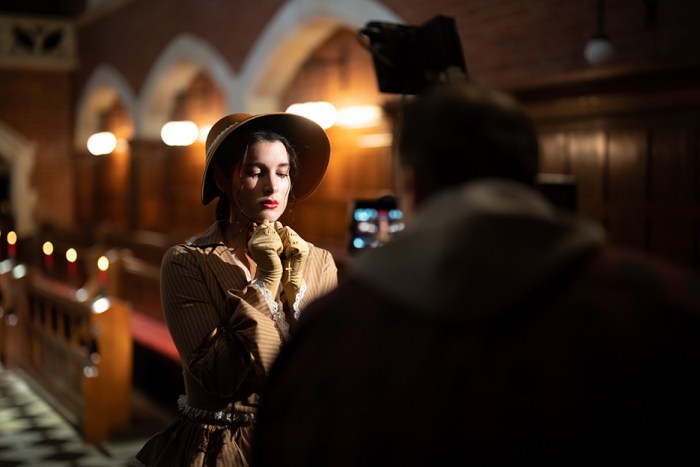
Emilie Lowe and Peter Renzullo on the set of The Canary.
So, you wrote two separate screenplays? A short film and a feature film?
Yes. I never thought that I’d actually get the feature version made, so I also wrote the short film version. But that short film was really well received, so I decided to make the feature version as well. I always knew what I wanted to do, but when it became possible with the small crew we had, we decided to make the full feature.
Was it an easier process to adapt the feature film version, considering you already had the short film script?
I wouldn’t say it was easier. It was good to have a backbone, and we’d filmed some of those dream scenes for the short film version, which was good. I always knew where they would slot into the script if I was going to adapt it into a feature film. The original script was set entirely on the open ocean, so there was no Australian bush element to it at all. We figured out, after doing a couple of shoots on the open ocean, that that was going to be very, very difficult. [Laughs]. I was a bit naive in that aspect. I wanted the major storm to be out on the ocean, and we only had a tiny little wounded dinghy. After I accidentally almost drifted out to the open ocean, I realised it would be best not to set the entire thing on the open ocean. [Laughs]. I rewrote it and added in elements of the Australian bush. I’m actually really glad I did because we could showcase the WA landscape, which looks so beautiful in the film.
The film is set in the 1800s, and there are obvious parallels between Florence’s story and how women are still treated to this day. What was the extent of your research into this era?
I’ve always loved this time period in history because it was a time of a lot of dichotomies. A lot was changing, but a lot was still staying the same, which I think is also mirrored in our society right now. I wanted to make sure to be as accurate as possible with a few aspects of The Canary. We tried to make the costumes as accurate as possible, which was quite difficult to do. The signature yellow dress was hand-sewn by a local WA sewer. We picked all the fabrics, seams, and everything. I wanted to make sure that the yellow dress was an iconic symbol throughout the film. We tried to get that as accurate as possible, and we also tried to have the language be somewhat accurate. But I didn’t want it to feel disconnecting for a modern audience, so there are aspects of the film that are a little more modernised than they probably should be. I thought that was important to keep the character relatable. A lot of films nowadays wrongfully portray a woman coming into her own strength and defying societal standards as someone who has to cut her hair short, rip her dress, or wear pants. I wanted to go against that and show that Florence is still very much in her femininity, but she uses that to gain her power. She uses her corset and her dress—she doesn’t reject her femininity in any way. She changes and becomes a stronger version of herself, both internally and externally, but she doesn’t completely reject her femininity. That’s something I really wanted to make clear in the film.
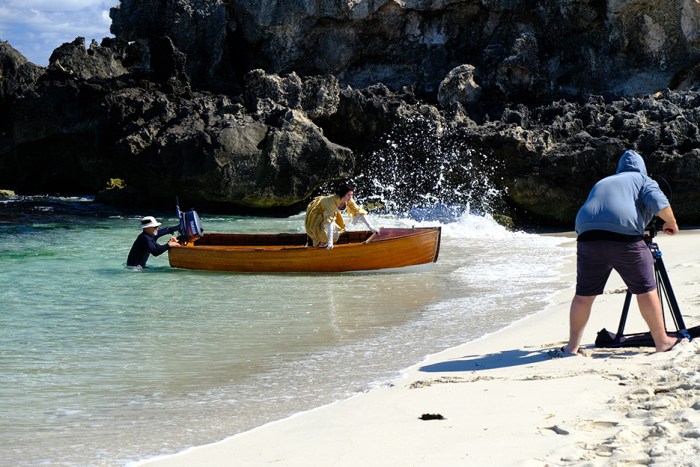
Steve Lowe, Emilie Lowe and Peter Renzullo during filming of The Canary.
Considering the film’s scope, it’s quite incredible that The Canary was made on just $10,000. How did you maximise those funds to get the most out of them?
That $10,000 includes locations, costumes, post-production—everything. We had to use all the equipment we already had. The most expensive thing was probably getting the dress made, even though it should have cost a lot more than it did. All the props were vintage as well. For example, a pen knife shown throughout the film is a vintage piece, and it actually got lost in the ocean at one point. We thought that was going to be the end of production because you can’t buy another one like it. We’d already ripped the dress and filmed shots with the knife that we couldn’t redo. That was a bit of a mental breakdown moment. But we got a metal detector guy to search the entire beach. It took him four or five hours, but he found it, luckily. That was a very stressful night! We also had to film the entire movie in sequence because we only had one dress. We couldn’t do reshoots since the dress got wrecked over time. We saved a lot of money by taking on about a million roles each. The film was made with just four people, and we all did upwards of five to ten roles each. That was the hardest part, but it’s also how we saved a lot of money.
I’m curious to know more about the pen knife now. Where did you get it? All of the antiques in the film look genuine.
I got it from an online vintage auction store. The mirror is vintage as well, and the boat is over a hundred years old. We definitely tried to make everything as historically accurate as we could with such a small budget. That boat was a trooper—it survived everything we threw at it, which is a miracle.
Now I have to ask you about the boat. How did you get access to that? It was treated with much delicacy on screen.
[Laughs]. It was! The boat came from a local couple in Margaret River. We couldn’t find an old wooden boat without the metal features of modern boats. Someone in a Facebook group recommended this couple to us. We contacted them, drove all the way to Margaret River, and towed it back to Perth. Honestly, I think the boat is one of the best-looking parts of the film. I believe it’s from the early 1900s, so that’s pretty special.
Can you break down some of the film’s magic for us and talk us through the logistics of filming with that boat? I noticed that in most scenes, we only see one half of the boat.
We always had to film in locations with a boat ramp because we couldn’t get it into the water without one. That restricted a lot of our locations, especially for the river scenes. The half shots are like that because my dad was actually in the open water with flippers and a wetsuit, holding the boat steady so it stayed level with the camera and didn’t drift off. [Laughs]. There were strong currents, so it was very hard to keep the boat parallel with the camera shot without twisting or drifting. There was also a rocky outcrop in the middle of the ocean. When we filmed drone shots of me completely alone, the crew would return to our metal dinghy, which was far away, so we could capture those solitary ocean shots. Meanwhile, I was slowly drifting towards this rocky outcrop with nothing on the boat to stop me—just me and the canary. I’d often think, “Is this how I die? This is going to make an interesting eulogy.” [Laughs]. But it worked out well, so we’re happy with that.

Emilie Lowe in The Canary.
You mentioned your dad there. How important was it to have the support of your parents throughout the making of this film?
It would not have been possible at all without my parents’ support. They were fundamental in both getting the film done, encouraging me to get it done, and helping me believe in myself. There were many times when I didn’t think it would be possible. It was actually very, very hard to get this film made. But my mum and dad have always been extremely supportive of me, both in my film career and in myself. They’re the most incredible parents. My dad ended up being the boom mic holder—he knows nothing about that. [Laughs]. He was always with the boat, trying to kick it so it wouldn’t drift away. My mum has been the most incredible person to help me with everything. She shot some of the scenes, did some producing work, and helped with the costume and props. They’ve literally been my lifesavers throughout this, so I’m very grateful to them.
Tell us about this skeleton crew you’ve assembled here.
So, my mum and dad helped me with pretty much everything. They’ve had a role in every element of the production. I also brought on Peter Renzullo, who I’ve known since 2018, when he made his first feature film, Anticipation. We’ve worked on so many projects together because we have this really great synergy. We both just know what we want and what we need, and we get it done. He’s legally blind and only has three percent of his vision. I gave him some pretty difficult scenes to shoot. He was in a little dinghy, a hundred yards away, trying to film with manual focus, out in the elements. He had no assistance and no one to help him. He was also doing the sound design for the entire film. The whole process really pushed all of us to our limits, but luckily everyone has been very supportive. There were some really hard times, but we also had a lot of funny moments. This was an incredible team to work with.
I’m a big fan of Peter’s cinematography work. I’ve been following his career for years now. Personally, I think he’s one of the best cinematographers working in WA right now, if not Australia. What did you take away from your time working with Peter?
Firstly, I think you’re spot on about Peter’s work. He’s honestly been one of my best collaborators since we first met all those years ago. It astounds me that before 2018 he’d never touched a camera, set foot on a set, or written a film. He’s such a ray of light. He’s very positive, and he has a can-do attitude. There’s no complaining with Peter. I’ve never heard him say, “I can’t do that.” He always finds a way when faced with a challenge. He never wanted a break. Even when we would stop to eat and drink, he’d say, “No, no, let’s keep going. I’m enjoying this. Let’s keep shooting.” We work really well together. I did the shot lists for all the scenes and then gave them to him. We had no time for rehearsals. All the shots you see are pretty much the first take, and that’s it. I’d say, “Can you do this, this, and this?” Then I’d set it up, we’d roll, get it, and move on because we didn’t have the time or permits to film in certain locations. We just had to get in, not make a fuss, and get out. He worked under such difficult conditions, and he never once complained. His work speaks for itself. I think his cinematography is one of the best elements of the film, and what he’s been able to capture is incredible.
Quite often, a one-hander like The Canary will be filmed in one location to save on costs and other stresses. But The Canary is really quite broad as far as set pieces go. You’re filming on open water, in an antique boat, on the SS Leeuwin in Fremantle, the Brig Amity Ship in Albany, the canola fields in Wongan Hills, in the forests of the South West, and more. Which location was the biggest challenge for you?
Anything shot in the Australian bush was extremely challenging because there was no power or charging stations. We had no cover from the sun or the rain during filming. It was also one of the hottest summers on record in Australia, and I was in that really heavy, thick dress. We had all the equipment out in the elements. Dogs would run by, trains and cars would go past, and we’re meant to be on a deserted island in the 1800s. [Laughs]. We couldn’t have a dog barking. Filming on the beach was also very difficult because it was bright and windy. It was hard to ensure there were no people in the background, no signposts or anything like that. A lot of the bush scenes were actually filmed very locally, and it just happens that WA has such a unique landscape that you can make it look like a deserted island. That was quite helpful, as some of those locations were just down the road from my house.

Stomp the canary.
One of the most impressive scenes in the film is the storm scene. It’s epic, poetic, and philosophical. I really felt for Florence during this scene. How difficult was it to shoot the storm?
That’s quite a funny one, actually. That was filmed at Herdsman Lake. There were four of us, including myself. We used a gutter cleaner from my garage to make it look windy. We used this tiny little flashlight as lightning. My parents were throwing leaves at me and hurling branches down at us to make it look like it was stormy. A lot of why that scene works so well is, honestly, the sound design. When I wrote it in the script, I did not know how it was going to happen, and we didn’t really know what it was going to look like until we checked the footage when we got back. So I’m really happy with it. Originally, that was going to be shot on the open ocean, which I don’t think would’ve been possible. I think it’s good when she wakes up after, and that whole area is kind of destroyed. That was just like that naturally. So we kind of utilised what we had in front of us, and it made it look like we’d had the budget to create this destroyed landscape. But that’s just what the local park looked like, so we utilised that. [Laughs].
As I mentioned, The Canary is mostly a one-hander, but you do have a co-star in the form of the titular character, the canary. I believe there were multiple birds involved in the making of the film?
There were multiple birds in a sense, but it’s not what you think. We just had the one bird. Her name was Stomp. She’s very cute. She passed away a couple of weeks ago, but she was the family pet, so she was very brave and a trooper throughout the film. We used her for close-ups and whenever the canary’s face is shown. Then we had two stunt doubles for things like long shots, where she wasn’t necessarily needed, or for scenes where the cage was rattling around a lot or anything like that. We obviously didn’t want to frighten the real bird. The first one was a little ceramic ornament of a canary that we hand-painted. We used that for any kind of action scenes, I suppose you would say, because, of course, we did not want to frighten the real bird. For the end scene where I am holding the canary, we knew we didn’t want to have the real bird, just in case my grip loosened and she flew away. So, on eBay, I purchased a taxidermy canary, and I hand-painted the feathers yellow to make it bright and vibrant. Then we had someone from Melbourne CGI the eyes opening and closing and blinking so that it seemed like a real bird. Movie magic. [Laughs].
While we’re on the topic of animals, I have to ask you about the snakes. Not only are you handling real snakes here, but they also have a deep symbolic meaning throughout the film.
Those snakes were provided to us by a local reptile rescue, where they also teach you about reptile safety. They were given to us by Phil, who was very generous to let us use them for the shoot. I love snakes. I had a great time with them. They were very active. We put them down, and they went where they wanted to go, and then we shot around them. That was a lot of fun. We shot that at the Secret Garden, which does not exist anymore. But they were really good actors for snakes. [Laughs]. They just did their own thing, and we captured it. That scene is really important for Florence. It represents the Garden of Eden. Her biting the apple is suggested to be the corruption of her character. Now, this is what society at the time views as her misdeeds. She’s destroyed herself; she’s corrupted herself. But, of course, as she understands herself more and accepts both herself and the symbolic canary, she realises that she can defy this. She does not have to be defined by how society views her. She does not have to be this image of what they expect her to be. In some of the whispering that happens, if you listen really closely, you can actually hear little things being said about her. For a lot of the film, she thinks that she’s destroyed herself, that she’s corrupted herself, and that she doesn’t deserve to be here anymore. But as she accepts herself and grows into her own power, she realises she can defy this. She’s not defined by what other people say or think about her.
The Canary will screen at Luna Leederville on April 6. Details here. Keep an eye on cinemaaustralia.com.au for more screening announcements.
If you enjoy Cinema Australia as much as I loved publishing it, please consider supporting Cinema Australia’s commitment to the Australian screen industry via a donation below.
I strive to shine a light on Australian movies, giving voice to emerging talent and established artists.
This important work is made possible through the support of Cinema Australia readers.
Without corporate interests or paywalls, Cinema Australia is committed to remaining free to read, watch and listen to, always.
If you can, please consider making a contribution. It takes less than a minute, and your support will make a significant impact in sustaining Cinema Australia as the much-loved publication that it is.
Thank you.
Matthew Eeles
Founder and Editor.Make a donation here.


 Cinema Australia