
The Great Kimberley Wilderness filmmaker Briege Whitehead. Photo by Luke Riley.
Directed by Briege Whitehead and narrated by Luke Hemsworth, The Great Kimberley Wilderness is a 35-minute virtual reality documentary that transports you to one of the most spectacular and pristine landscapes in the world.
Guided by science and Traditional Owners, you will journey across magical coastlines, and venture into the heart of this ancient landscape unlike anywhere else on Earth. Fly over the edge of the thundering King George Falls, explore the vibrantly striped domes and majestic gorges of the UNESCO World Heritage-listed Purnululu National Park and travel back over 350 million years to the great Devonian Reef to explore ancient geology, that has been pivotal to life as we know it.
Almost two billion years in the making, The Great Kimberley Wilderness is an opportunity to experience the wonders, culture, and magic of this unique and precious landscape like never before!
Briege Whitehead is an award-winning producer, director and writer of factual programs for the global television market, as well as an acknowledged pioneer in the world of immersive and VR documentary films.
Since establishing White Spark Pictures in 2017 she has sought to push creative and technical boundaries to share incredible stories from around the world and give viewers experiences they would not ordinarily have.
Her first VR film, The Antarctica Experience, is one of the most commercially successful and in-demand VR films of all time. Briege’s TV projects include the 12-part natural history series Impossible Planet (Animal Planet and Discovery+) Poisonous Liaisons, a 13-part true crime series (A&E, History Channel) and she has written and produced on titles such as the 72’s (National Geographic and Netflix).
Briege has also been recognised for her business acumen. Recently, she was selected for Realscreen’s Factual Under 40 list, a Top 10 Trailblazer in the Global 100 list for 2024, is a West Australian 40U40 and was awarded enterprise funding from Screen Australia to develop an innovative new virtual reality technology and company Surround Sync. The new business and patent-pending technology is set to be a game-changer in expanding the distribution and commercial opportunity for VR.

Ian Waina and Briege Whitehead travelling to set. Photo by White Spark Pictures.
“Being able to film that final scene with the nighttime time lapse was so incredible that I just had to cry. It’s so visceral.”
Interview by Matthew Eeles
What was your first introduction to VR?
It was back in 2017. My background is in film and television, and that still remains a big part of our company as well. We still make international television for Discovery Channel, the History Channel, A&E, and those sorts of broadcasters. In 2017, when VR was really taking off, I had always had a personal passion to want to tell impactful stories, especially about our world and our climate. I’d lived in Canada for a while, where they’re really seeing the environmental effects of climate change on their front doorstep. The same thing is happening in Antarctica. If everyone was living in Antarctica, there would be no debate about climate change. So, when VR started to take off, I wanted to take people to Antarctica without having to physically take people there and tell a story that’s going to leave people really moved and inspired to take action. That’s not going to happen from just another TV documentary about Antarctica. That’s only going to happen when people feel like they have a really visceral connection to the place. So, that’s what inspired me into the VR medium.
Do you keep an eye on VR trends, and if so, where is it sitting at the moment as far as personal or home entertainment is concerned?
I absolutely do. I talk to Apple, PICO, and Meta, and I tell them the same thing: trying to get a piece of hardware into everyone’s homes without the content that drives it and supports it is a backwards way of doing things. VR has tried to skip necessary steps. Home theatres and amazing TVs and streaming services are the reason that there’s a decline in cinema attendance. That didn’t just happen overnight. Everyone used to go out to the cinema for their movie nights, their date nights. And what we’re seeing now is an experience culture boom, where people are still wanting to do that, but it’s a much more immersive experience, and it’s new, and it’s different, and it’s exciting, and it’s giving people a reason to come out of their homes. And VR technology tried to jump ahead to the endpoint without giving people a reason to want to do it. And these companies are trying to then justify really expensive headsets that are still emerging technology. So, what our company has been trying to do is to be that middle point in that our synchronisation system can already go in the homes. So, I have absolutely no doubt that we will have surround sync in the home within the next five to ten years, but headset prices need to come down, and people need to have more experiences like you did the other night. More and more amazing content will be created. And we’re seeing that now with Marvel’s six-part What If series for the Apple Vision Pro. So, it’s going to get there.
Do you think VR is best enjoyed in this communal environment, like the way The Great Kimberley Wilderness is being presented?
Definitely. I think that’s part of the reason it also hasn’t taken off. People get over the gimmick really quickly of watching others have an isolated experience. TV is a communal experience, especially when it’s enjoyed with family and friends. At the moment, if a household does have a VR headset, it’s probably only one, and it’s for an individual’s purpose. If it’s accessible via their Netflix or their Alexa or whatever it might be, and everyone in the home can chuck on the headset and share an experience together, it will be more common in homes. But not for another few years, when headsets get lighter and cheaper.
How does your technology differ from other VR production companies?
We have patented our technology. We’re the only ones in the world that are doing this. Our biggest difference is the ability to plug and play into any theatrical system, and it’s synchronising the greatest number of headsets or screens. We’ve got hundreds of synchronised VR headsets with Dolby Atmos Surround Sound, so the highest possible sound quality, or at 7.1, which is what you would’ve experienced yesterday, or 5.1. We’ve even put it into the Royal Institution in London, which is a 200-year-old lecture theatre. It’s very plug-and-playable, or I call it numpty-proof, which means it’s very easy to use. [Laughs.] The museum literally presses a button, and it triggers everything, and away it goes. And that’s been really, really difficult to do because getting perfect synchronicity with a very high-quality surround sound system has been something people have tried and failed to do, but also just haven’t known that that’s really where the demand has been. Other companies have tried to do bits and pieces like that, but no one’s been able to do it like this, where it just triggers simultaneously to this high level of quality. And what we’re doing now is expanding into traditional cinemas, because it’ll all be automated. It’s going to be seamlessly integrated into the cinema network.

Briege Whitehead and Benn Ellard at Purnululu National Park Landscape. Photo by White Spark Pictures.
Before I ask you about The Great Kimberley Wilderness, I want to ask you a technical question about filming VR. How do you view the footage to make sure all of the eight cameras have worked? Do you have rushes like a traditional film would?
That’s a good question. We have a live preview. It’s very much app-based. We’re quite often in remote environments, so I’m watching the footage on my phone, but you can view it from an iPad or a tablet or something like that. It’s live-streamed directly, so you’re always viewing what is being filmed. As part of the creative process as a director, I have to preplan how everything’s going to look through a VR headset. On the fly, it can be difficult, and you only get a low-resolution preview. When we get back in the edit suite, we might see a few mistakes, like a fly landing on the lens that we didn’t catch at the time. We future-proof everything for technology. Everything is shot between 8K and 12K, and we back that data up every night and preview it.
How did The Great Kimberley Wilderness come about?
It actually started years ago when we first made The Antarctica Experience and saw the success of that. The WA Museum approached me to make something similar for the Kimberley filmed in remote locations. VR lends itself to locations, people, and experiences that are difficult to access. It was a no-brainer in terms of the location and topic. Three major museums have commissioned three new projects from us, and the first in that series is The Great Kimberley Wilderness. We travelled to the Kimberley to meet with the communities. We’d literally sit on the riverbanks with some of the First Nations communities and put VR headsets on them just to show them our past work and what’s possible and say, “What would you like this opportunity to be? What stories would you like to tell with this medium?” It has been a really collaborative community-led process. We’ve travelled back up there several times across different seasons, at different times of the year, like when the king tide happens and phenomenons like that. It has been a very collaborative experience with First Nations people. Everything’s very much in their own words. I worked really closely with our on-screen talent before, during, and after to make sure that it’s shining and saying exactly what they want it to say, which is why everyone who is seen on screen is credited as a co-writer of this film. It has been a joy, to be honest. It’s rare that you can have this level of collaboration and it be really, really genuine, and it was only going to be successful if that was the case. So, I’m really, really glad that we were able to do that.
Your team was granted special permission to film in some of these locations by traditional owners. Were there any locations that you wanted to feature that you weren’t given access to?
We’ve been so lucky in that regard. Everyone has been so welcoming. There are lots of places that we would’ve loved to have included overall because the Kimberley has so many amazing locations. It’s just impossible to fit everything in, and there’s a lot that we filmed that hasn’t made it to the final film as well, which is also what’s cool about working in this space. A lot of that footage that might have been on the cutting room floor we can utilise in different ways. So, no is the short answer. A lot of people are telling us that the film runs for the perfect duration. You don’t want people to feel like they’ve been in the headset for too long, and you want them to leave wanting more.
How much time had you spent in the Kimberley region prior to making this film? I’m sure it’s not lost on you how much a privilege it is to spend time up there.
It’s definitely not lost for me, and there are so many times you’re just standing out there absolutely pinching yourself. I hadn’t spent a huge amount of time up in the Kimberley. A lot of it was through the development process. I had to educate myself on what were the best locations and which ones we were going to prioritise. So, a lot of my early immersion into the Kimberley was just that really strong development time. We have family that live up there, and they’d been telling us for years how amazing it was. We knew lots of different groups up there who were telling us the same thing. But, for the most part, it was just us networking and collaborating and going up there and listening to the community.
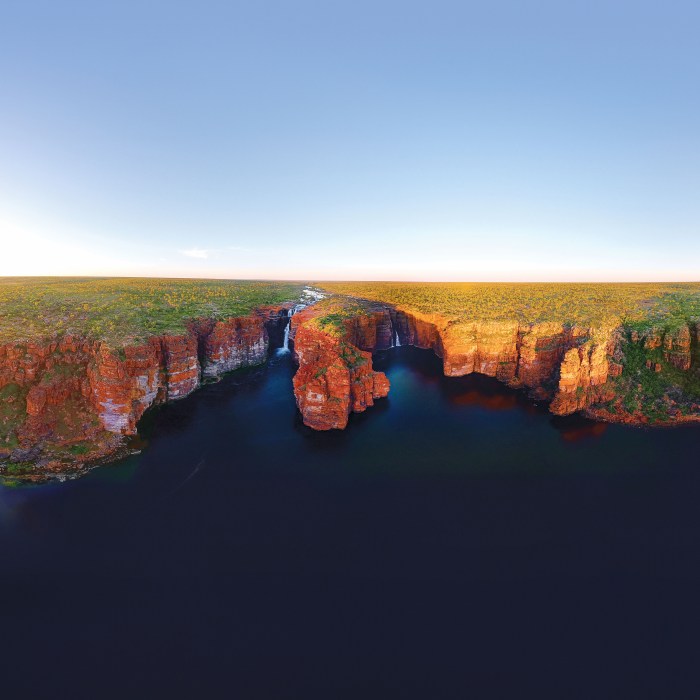
King George Falls, North Kimberley Marine Park. Photo by White Spark Pictures.
This film takes place in some extremely remote locations. What challenges did you come up against while filming?
To say that this film project was ambitious would be an understatement. It was far more ambitious even than our Antarctica project because, while we took three of everything down to Antarctica, we knew that if anything went wrong, we weren’t going to be able to get gear, help, or support. This experience in the Kimberley was kind of like that but on steroids because it’s so big, and when you’re super, super remote, everything’s really expensive and really hard to get to. From the get-go, we had to build our own custom portable production office so that we could charge everything that we needed overnight. It was fully custom-built because even if we had hired something pre-built, it still wouldn’t have done the job properly. We had to do a lot of driving, but then a lot of it is only accessible via helicopter. And then, you obviously want the traditional owners going with you out onto those countries, and there’s a lot of cultural safety that’s involved as well. There’s also a lot of trekking with lots of heavy gear, but you also don’t want to leave a very big footprint. So, you’re often doing it with very light crews because you’ve only got three people that can fit in the helicopter anyway.
And I assume you’re not afraid of heights?
No, I love heights. [Laughs].
A lot of this film is seen from a birds-eye-view with your camera mounted to a helicopter. What risks are involved in that?
We have redundancies on redundancies, and safety was paramount. We had done a lot of helicopter work in Antarctica before too, flying over UNESCO World Heritage Centre and Macquarie Island, which is the highest level nature reserve in the world. So, we had that experience. We also have a lot of trust in the helicopter companies. All these guys know what they’re doing. You basically strap it down twice so that, in the event that something goes crazy wrong, the cameras aren’t going to detach, and the worst-case scenario would be that it flies up into the chop blades, and no one wants that.
I noticed there’s not much wildlife in the film and that any wildlife that is featured is caged. Is it too difficult to capture wildlife, or was it not a focus?
A bit of both. Birds, for example, just don’t show up on 360 because they’re so far away. I really wanted to go underwater with crocodiles, but that was a danger. So, it’s not that we didn’t want to focus on wildlife, but we only had a limited amount of time. We were wanting to try and focus on the connection to country and the natural history of the area. There are so many different stories to tell, and it was always a focus to make sure that it feels very much like one narrative. And so, I think there would absolutely be an entirely other experience that is more wildlife-focused in the future. We have a few more projects coming up, including Journey of the Giants, which will take viewers underwater with humpback whales. I personally love wildlife, so being able to capture that would be amazing. On The Great Kimberley Wilderness, we flew our drone over a whole bunch of kangaroos, and it looks amazing, but it’s just so far away. So, we would have needed to spend a lot more time and money that we didn’t really have. We had a very ambitious project as it was.
Do you have a favourite location from the shoot?
All of them. [Laughs]. The one that immediately comes to mind is being on top of King George Falls and landing the helicopter and standing there and having that powerful moment. That’s such a rare opportunity. Even if you’re a millionaire, you’re not going to get that experience. Same for Cathedral Gorge. When you’re there, it feels like there’s something there singing to you. Being able to film that final scene with the nighttime time lapse was so incredible that I just had to cry. It’s so visceral. There are very few places like that in the world, and it’s one thing to go in there yourself, but to go in there with someone who’s so deeply connected to their ancestors and country is indescribable. But even things like standing on top of Waterfall Reef while the 11-meter tide is happening, and the ocean’s literally draining away in front of your eyes, I was just grinning from ear to ear thinking, “How lucky am I right now?”
The Great Kimberley Wilderness season runs from 23 November 2024 – 28 April 2025 at WA Museum sites before seasons at the National Museum of Australia from December and Tamaki Paenga Auckland War Memorial Museum in April 2025.
UPDATE 26.5.25: The Great Kimberley Wilderness VR experience is showing at the WA Maritime Museum in Fremantle from May 31.
Tickets available from visit.museum.wa.gov.au.


 Cinema Australia