
You Should Have Been Here Yesterday director Jolyon Hoff. Photo by Ella Burton.
Jolyon Hoff’s latest documentary, You Should Have Been Here Yesterday, is a beautiful tribute to Australia’s early surf culture, blending nostalgia with artistry. Featuring restored 16mm footage and an electrifying score by surf rock legends Headland, the film captures the untamed spirit of a generation that chased waves and carved out an alternative way of life along Australia’s coast.
The documentary features iconic figures like Albe Falzon, Wayne Lynch, Bob McTavish, Maurice Cole, and Pauline Menczer, along with insights from writer Tim Winton. You Should Have Been Here Yesterday brings to life the raw beauty of surfing’s early days and the passionate and wild community behind it.
Hoff returned to Australia in 2020 after 15 years of international filmmaking in Nigeria, Nepal, Indonesia, and Washington DC. Known for powerful films like Watandar, My Countryman – a Screen Producers Australia nominee – and The Staging Post, which explored refugee resilience in Indonesia, Hoff has a knack for weaving heartfelt, cross-cultural narratives.
In You Should Have Been Here Yesterday, Hoff merges his love for storytelling with a deep respect for surf culture’s legacy which he discusses in this interview.
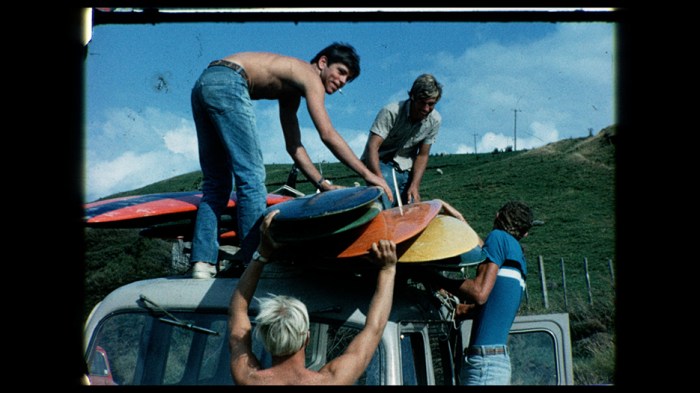
Children Of The Sun (1968). Credit: Andrew McAlpine.
“I think surf culture has been through a whole trajectory. It has swung from one extreme to another, and surfers have often been at the forefront of major cultural shifts in Australia.”
Interview by Matthew Eeles
What was your introduction to surfing?
I came across surfing when my grandparents moved from Sydney to just behind Byron Bay when I was about four. I was raised by a single mother who would send me off to my grandparents every holiday. My uncle, who was a surfer, had moved up to Lennox Head in the seventies, and I thought he was the coolest guy ever. All I wanted to do was surf. My grandparents would take me to the beach, and I’d spend hours paddling out, trying to catch a wave, over and over again. I was completely absorbed, entertained, and obsessed from that time on.
Did your uncle give you lessons?
A couple of times, he put me on his longboard, and I stood up for the first time on green water. But back then, the idea of having coaches or teachers wasn’t really a thing. You just went out and kept practicing until you figured it out. It was a very frustrating way to learn. [Laughs]. Nowadays, if someone shows you the basics, you can learn a lot quicker, but that just wasn’t how things were back then. Still, my uncle was great. He took me surfing quite a few times and taught me some valuable things.
Do you still surf today?
I do—only as much as I can, which is never enough. [Laughs]. Surfing is in a beautiful stage right now. I’m 51, and for the first time, there’s a whole movement among the generation above me—those in their seventies and eighties—pushing the boundaries of how long you can keep surfing and getting out into the ocean. There’s this collective goal to surf for as long as possible, and that’s my goal too. You’ve got to keep your hips in good shape; that’s the key. The popup can be tough, but once you’re up and running, it’s not too bad. I might not be as radical as I used to be, but the trick is to keep your hips flexible so you can pop up and get those legs under you.
You Should Have Been Here Yesterday has been described as a true representation of surf culture from a time gone by. Can you describe what that particular time in Australian surf culture meant to you and why you wanted to make a film about it?
I came into surfing right after the generation of surfers featured in this documentary. As a teenager, I looked up to those older surfers from the sixties and seventies and was particularly enamoured with that period. What does it mean to me? I think surf culture has been through a whole trajectory. It has swung from one extreme to another, and surfers have often been at the forefront of major cultural shifts in Australia. In the fifties and sixties, surfers were the first to leave the cities. Their parents wanted them to get jobs at factories or local businesses, but the surfers saw how miserable their parents were and wanted something different. Surfing became a way to begin that journey of exploration. I wanted to remind people that surfers played an important role in Australian culture as these leading figures who sometimes get forgotten. Of course, the seventies brought mistakes, particularly with drugs and the exclusion of women, both of which had devastating effects on the surfing community. Surfing nearly died out, but then in the early eighties, it exploded again during the era of commercialism and capitalism. Today, surfing is in a great place. It’s inclusive and healthy, with physical and mental benefits. Women are welcomed and encouraged in the water. You can ride any kind of board—longboard, shortboard, ski, windsurf—you name it. Surfing has come of age, and the footage we’ve compiled in this film helps tell the story of that journey to where we are now.
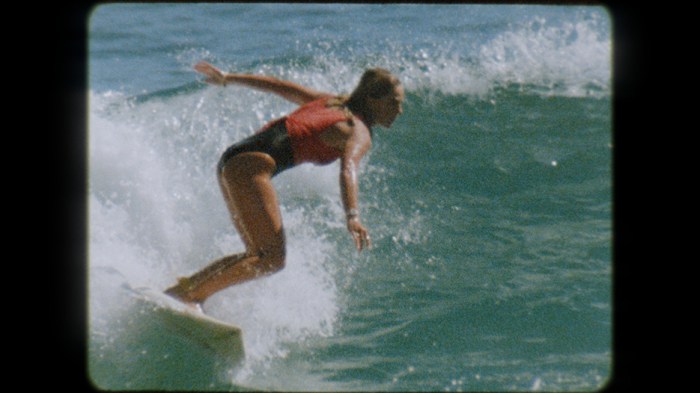
The first all-female surf film, Women In The Surf (1986). Credit: Esta Handfield.
And speaking of that footage, you came across these reels while making your previous film, Searching for Michael Peterson. Was that unexpected, or did you know those reels existed?
When I made Searching for Michael Peterson nearly 20 years ago, I was a film student. Michael Peterson was the ultimate mythological guru of Australian surfing, but he was notoriously elusive. Even when he won events, he’d get someone else to collect the cheque for him. He was schizophrenic, so he couldn’t be around people. There was hardly any footage of him. As a film student trying to make a documentary about this iconic surfing figure, I had to dig deep. That search led me to Dick Hoole’s garage, where I found some footage of Michael. Dick is one of the early filmmakers who lives out behind Byron Bay on a hill. While searching for footage of Michael, I saw all these other film reels stacked in the corners of the garage and piled in cupboards. I wondered what other treasures might be hidden there. That was the first kernel of this idea. Dick has an incredible collection. He’s very methodical and keeps everything well-documented and organised. Altogether, we found about 150 hours of footage, which was scanned by a young guy named Kade Bucheli, an amazing film enthusiast in his twenties. He spent 14 months scanning all the material full-time for the film.
Was there any particular film you wish you could have used but couldn’t because it couldn’t be saved?
Unfortunately, there’s so much that has been lost. This footage is really important to me. It’s not just the surfing footage, though I love that, but also the footage of the beaches, cities, kids, cars, and fashion. It’s a treasure trove of a really seminal period in modern Australian history. It’s culturally significant not just for surfing but for Australia as a whole, particularly as we move forward into a more modern, multicultural, sophisticated, and connected era. But these filmmakers are getting older. Film is heavy, it stinks, and it starts deteriorating. They don’t know what to do with it, and it’s very expensive to transfer. When filmmakers pass away—which is happening now—their kids often don’t know what to do with the footage. They don’t even know what’s on it and just see it as a pile of smelly old reels. But hidden in there is culturally relevant and important material for Australian history. So, yes, there was a lot of footage out there that we knew we couldn’t use because it couldn’t be saved.
Considering there was so much footage, did the film’s narrative change throughout the making of the film? Or is what we see on screen what you had set out to make?
I had an idea to make this film using archive footage to tell the story of Australian surfing in an intuitive and experiential way, but I didn’t know where it would end up. I didn’t know what we’d find. That scanned footage was like our rushes. Once we had everything, we looked at it and thought, “Okay, this is what we’ve got. How can we tell a story with this?” We stuck with it for quite a while until we landed on the idea of letting the footage tell the story. We decided to show it in chronological order, and the footage itself illustrates the trajectory of Australian surf culture—moving out of the cities, gaining confidence, pushing boundaries, and then exploding commercially in the ’80s. You can see that really clearly in the footage. So, yes, we followed what we found in a lot of ways.
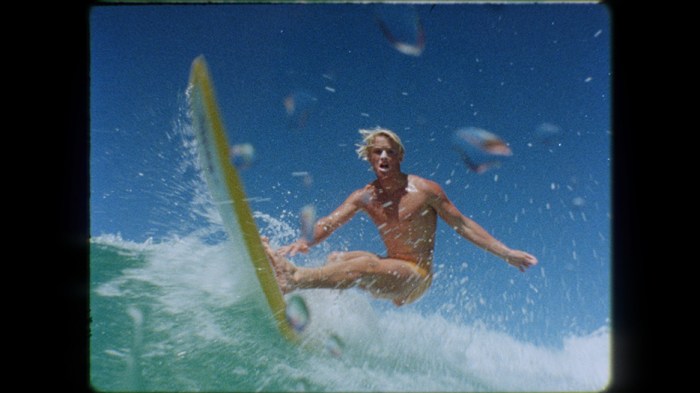
New Wave (1980). Credit: Steve Otton.
You’re educated on the subject, but did you learn anything about this time in Australian surfing history that surprised you?
I’m always gaining a more nuanced understanding of what it is and what it was. The stories behind the stories are what keep fascinating me. For example, there’s an island called Nias in Indonesia, home to a beautiful right-hand point break. Dick Hoole shot some incredible footage there, including a majestic cutback by Thornton Fallander. We restored that footage and included it in the film. But when Thornton spoke at a Q&A, he shared that it was the worst surf trip of his life. He described being stuck in port for ten days eating only noodles, the boat’s anchor falling off, the boatman pulling a gun on him, and accusations of being stoned on hash. It was a wild story behind what’s shown in the film, and it adds so much depth.
I’m going to call them narrators because we rarely see them on screen. Did you know most of these narrators, or did it take some work to track them down?
I’ve been filming ever since Searching for Michael Peterson. Many of the narrators were people I’d interviewed over the years for various projects, so I knew most of them. They were really generous in sharing their insights. I’m particularly interested in the older generation who’ve lived through so much. As I go through life, I’m gathering wisdom, and I feel it’s important to capture those stories and perspectives and share them with the next generation. I wanted this film to be experiential—something the audience could interpret for themselves rather than being told what to think through talking heads. The footage is so stunning. Why watch talking heads when you can experience this incredible imagery?
Are there still remnants of this era and lifestyle out there today?
Definitely. If you go to any beach, you’ll see communities coming together around the ocean and waves. They’re deeply local and connected, forming parochial communities around specific surf spots. What’s been great about the Q&A screenings is seeing the diversity of people attending—from salty old surfers to mums, dads, kids, teenagers, and twenty-somethings just getting into surfing. Surfing culture is incredibly rich and thoughtful, with many facets. From the outside, people might only see the competitive side of surfing, but that’s just 5% of what it is. There are surf clubs, longboarders, shortboarders, big-wave riders, and older surfers working to keep their hips limber to get back on their boards. It’s a deeply influential part of the broader Australian community.
I get the feeling you’re not done with this story yet. Is there more you’d like to explore and share?
Absolutely. [Laughs]. Out of the 150 hours of footage we scanned, there’s still so much incredible material. We’ve created the Surf Film Archive, a website and YouTube channel where we share this footage with music in short clips. We’re also working on another film, focusing more specifically on the early exploration of Bali and Indonesia. There are incredible stories of wild, adventurous surfers seeking hidden treasures across the archipelago. There’s so much to uncover, and we’re excited to bring those stories to life.
You Should Have Been Here Yesterday is in cinemas now.


 Cinema Australia