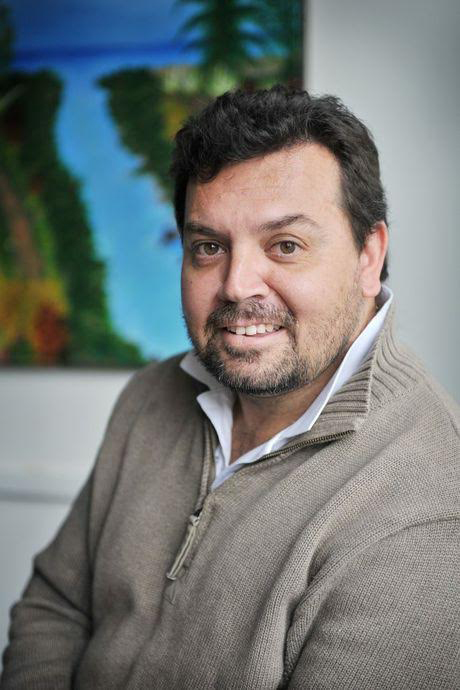
Jon Bell.
Jon Bell, an Australian filmmaker and storyteller from the Bundjalung/Wiradjuri nations, is no stranger to weaving cultural heritage into his narratives.
In his chilling new horror, The Moogai, Bell explores the struggles of Sarah and Fergus, a young Aboriginal couple whose lives take a dark turn after the birth of their second child. When Sarah starts seeing a spirit she believes wants to take her baby, Fergus, torn between love and disbelief, can only watch as she descends further into fear. The film walks a fine line between reality and imagination, leaving viewers questioning the true nature of the threat facing their family.
For Bell, The Moogai is rooted in Indigenous lore. “There are three words we’ve traditionally used to describe spirits – Moogai, Wongai, and Dogai,” he explains. The term “Dogai,” historically used to describe white settlers, reflects the complex layers of Aboriginal spirituality and history that permeate his work.
Bell has been a driving force behind some of Australia’s most acclaimed series, including Redfern Now, The Warriors, and Cleverman. With his directorial debut, The Moogai, Bell is preparing to bring his booming voice to the big screen, continuing to challenge audiences while honouring the stories of his community.
The Moogai is already resonating with audiences having recently won the CinefestOZ Film Prize where it was awarded $100,000 by the festival jury headed by Australian acting icon, Rachel Griffiths.
The Moogai is in cinemas now.

Meyne Wyatt and Shari Sebbens in The Moogai.
“I’m basically just somebody who’s loved making movies since I was a kid.”
Interview by Matthew Eeles
I grew up in a small rural town with a large Indigenous population. I remember being told stories about Featherfoot, which seemed to bring a lot of fear to the Indigenous boys whenever the name was mentioned. Is there a culturally significant story that frightened you the most as a child?
Growing up, there were a lot of stories about the unknown, and I think that’s what makes horror films so great as well. That’s what Featherfoot is too. It’s the unknown. Featherfoot holds knowledge that you don’t, and they can do things with that knowledge that you don’t know how to do. That’s a big part of what the Moogai is for Sarah, but it’s not any one particular thing for me. We still use Moogai as a word that’s similar to “boogeyman,” but I think that lack of knowledge around things, around processes and Cleverman, Featherfoot, whatever you want to call that character – that person who has a deep, deep knowledge of not just how this world works, but the next world and the world beyond that too. I think that’s very specific to First Nations people, but it’s also a pretty universal thing. Every culture, from the Druids to a medicine man or witch doctor or whatever name people give it, has that kind of learned, knowledgeable cultural person in their mythology. And that role goes either way. Sometimes they work for you, sometimes they work against you, and you don’t have any say over it. It’s that powerlessness and that lack of knowledge that I think scares us all.
Did the Moogai and stories about the Stolen Generations go hand in hand for you growing up?
There were certainly family stories that weren’t necessarily all based around the Moogai, but both of them had that same element of the unknown. In a lot of ways, when the government makes decisions around situations, it feels like you don’t know and understand their process from one day to the next. They’re constantly doing a 180, and you can’t work out how to get any consistent interaction with this entity. But yeah, maybe that’s the dominant opinion for a lot of Blackfellas, I reckon, around how we deal with those kinds of big entities that are bigger than ourselves.
When did the idea first come to you to incorporate the Moogai into a film?
It probably first came to me around seven years ago, which I think is pretty much the average for an Australian film to go from inception to the screen. The notion of trying to make horror or sci-fi films with scary big monsters has been with me since I was a kid. I always wanted to tell these kinds of stories in which survival is paramount. I like films where people are trying to stay alive.
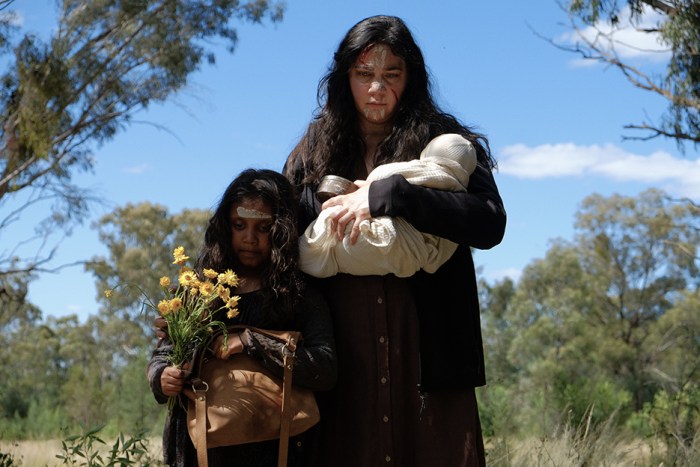
Shari Sebbens in The Moogai.
The idea to make the original proof-of-concept short film came from your producers. Did you understand the importance of doing that at the time? Were you frustrated that you couldn’t just jump straight into the feature film version?
I’d originally written a feature film script, so a short film wasn’t something I had thought about. But in terms of funding, I’m a realist about what motivates money and how investors and funding bodies work. There’s nothing certain in the film industry – otherwise, everybody would be millionaires. In reality, it’s only the people at the top who really make the money; the rest of us do it for the love. Making a proof of concept is still filmmaking, and I’ll take any opportunity to do that.
That short film became very successful, winning a stack of awards, including the Grand Jury Prize for Midnight Shorts at SXSW. Did that success add extra pressure on you to equal the short film’s success?
I thought it would, but it opened up so many doors for me. I’m an untrained filmmaker. I’m basically just somebody who’s loved making movies since I was a kid. In terms of my filmmaking training, I just listened to DVD commentaries, picked up tricks from directors, and watched and read as much as I could. With filmmaking, I’m always fighting for my life. I’ve never really been a comfortable filmmaker. I’m not even sure I know how to do it now. [Laughs]. When I get on set, I’m always asking myself, “Is this how you do it?” [Laughs]. So I didn’t feel the pressure, but the pressure is just constant anyway. You never know if something is going to be your last. Filmmaking is this crazy industry where you put some words on paper, then ask people for millions of dollars, and they actually give it to you. You just go, “Oh my God, I can’t believe that worked. Now I’ve got to make this thing.” Or you put your life into something and people can’t see what you can see, and you feel like a failure. But neither of those things are true. You’re not a success or a failure; you’re just somebody who thought it could work, and people gave you money because they have the same taste as you. I think Spielberg said something like he’s not a popular filmmaker – it’s just that a lot of people share his taste.
I watched the short film and the feature film back-to-back recently, and I guess the main difference that really stands out is Sarah’s corporate success. Did you have Sarah and Fergus’ backstories in mind while making the short, or did that come later?
Absolutely. I absolutely had their backstories in mind. I wrote the feature first and then reduced it down to the short. I had their journey in mind from the beginning. Having those backstories and that world-building really helps when talking about the feature film with potential investors. When they ask questions, you’ve got to make sure you have the answers.
Were Shari and Mayne always guaranteed to return for the feature film version, or was there a moment when you thought you might have to recast for one reason or another?
It was always going to be them. I kept as much of the team as possible. I’m a big believer in “if it ain’t broke, don’t fix it.” I felt like I was going to have a lot on my shoulders with the feature film, so I wanted everyone who could come back to return.
ADVERTISEMENT Click to watch now!
It must have been reassuring that two actors of their caliber had enough faith in you to follow your vision all the way through.
It was, man. They’ve been in some pretty big projects and have given powerful performances. They’re both real artists, but they’re also trained actors who bring a lot of experience. I’m very much an observer of their work throughout the process. I interacted with the rest of the cast that way, too. There were a number of non-professional actors and first-timers involved, so having those two on set helped me up my game.
Tell us about working with the non-actors.
I think everyone can act to some degree, though some are naturally more talented. I love letting people give themselves permission to pretend. Just reaching that point allows first-timers to go out there and do something that might feel awkward in real life. But on set, it’s a heightened state, and giving people permission to pretend is key. Many of the kids were my grandkids, nephews, and nieces. Through our relationship, I could be an authority figure while genuinely giving them permission to play and say, “You’re not wasting people’s time. Feel free to do what you want to do.” We also had extra prep time, which I wouldn’t have had without working with so much family. This helped the young people enter that space with a sense of play.
Did they understand the significance of the story, or was it just about having fun?
They definitely understood. Our family emphasises the importance of staying together, moving forward, and being a loving presence in the family. Seeing a family torn apart in this story, they definitely got it.
I don’t want to single out one particular performance here, but Shari’s switch between a caring mother and a woman on the brink of losing her mind is phenomenal. Can you talk about guiding her to those darker parts of her character?
She’s such a professional. At the end of the short, there’s a moment where Shari is lying on her back after a car accident. She’s broken her back, and the Moogai takes her baby as she calls out, “Bring my baby back, listen to me.” She keeps calling out, and it was so powerful I was tearing up. It was around 4 a.m., and we were trying to finish before sunrise, so everyone was exhausted. And in the midst of all this, she suddenly stops and asks, “Do you want me to do another take?” I was stunned by her ability. This is what I mean about true professionals who have studied the craft. She brought herself out of the scene for a moment, and it took me completely out of it. I was just like, “Yeah… sure. Okay.” I knew she was acting, but I didn’t realise just how in control she was, if you know what I mean. [Laughs]. Shari has the bravery to push herself and go to these places. She’s an incredible performer.

Meyne Wyatt in The Moogai.
Mayne said he based a lot of Fergus’ character on you. Were you aware of that? Did he tell you he was doing that?
He never told me that. We had conversations about Fergus and where I was coming from, but he didn’t say that. I’m a big fan of hiring people to do a job and then getting out of their way. That’s the beauty of hiring intelligent actors. They brought in all this extra depth, which shows on screen. I just give nudges, but neither of them needed it. They understood the project, and they’re thinkers, writers, directors, and artists in their own right. I love what Mayne brought to this.
Regarding the Moogai itself, how close was the finished design to what you envisioned?
Pretty close. The makeup effects team are wizards. It’s deeply unsettling to see Paul Chambers, who’s quiet and soft-spoken, transformed into this monster. It’s disconnecting and shocking. But the design was influenced by several 80s films like The Thing by John Carpenter. There are moments in The Thing that are very unsettling, and I wanted to incorporate that. It was exciting because those guys are as nerdy as I am, so it was a meeting of minds.
Will you continue exploring horror with future feature films, or are you keen to explore other genres?
First and foremost, I’m a film fan. I grew up on Westerns and musicals, so I’ll do anything as long as I love it. If they give me the budget, I’ll make it.
The Moogai is in cinemas now.
If you Cinema Australia as much as I loved publishing it, please consider supporting Cinema Australia’s commitment to the Australian screen industry via a donation below.
I strive to shine a light on Australian movies, giving voice to emerging talent and established artists.
This important work is made possible through the support of Cinema Australia readers. Without corporate interests or paywalls, Cinema Australia is committed to remaining free to read, watch and listen to, always.
If you can, please consider making a contribution. It takes less than a minute, and your support will make a significant impact in sustaining Cinema Australia as the much-loved publication that it is.
Thank you.
Matthew Eeles
Founder and Editor.Make a donation here.


 Cinema Australia