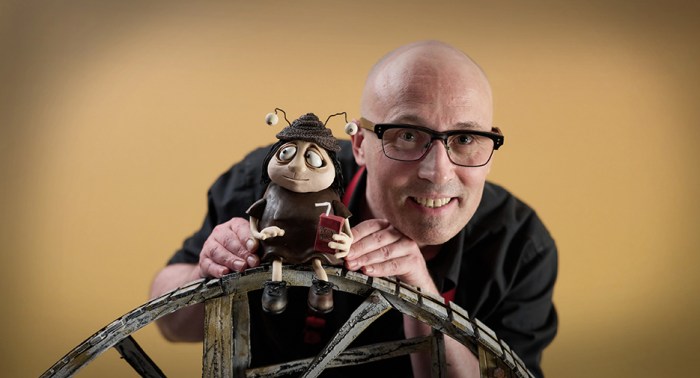
Grace Pudel (Sarah Snook) and Adam Elliot.
Adam Elliot’s latest stop-motion film, Memoir of a Snail, is packed with so many emotional moments that I was left feeling exhausted by the end.
I can’t remember the last time I watched something so sad, yet uplifting at the same time.
“I’m glad you felt that way,” Oscar-winning Elliot told Cinema Australia during our recent interview. “If you’re not an emotional wreck by the end of one of my movies, then I’ve failed.”
Memoir of a Snail follows Grace Pudel (Sarah Snook), a lonely misfit who collects ornamental snails and loves books. Separated from her twin brother Gilbert at a young age, Grace spirals into anxiety and angst.
Despite a string of hardships, she finds hope and inspiration through a lasting friendship with an eccentric elderly woman named Pinky (Jacki Weaver), who has a zest for life.
In our chat, the funny and affable Elliot shares why he’s so tough on his Memoir of a Snail protagonist. He also advises against parents taking kids to see the film, talks about what another potential Oscar win would mean for his dedicated crew, and explains how the real-life Gracie puppet helped him meet some of the biggest names in filmmaking.
*SPOILERS*
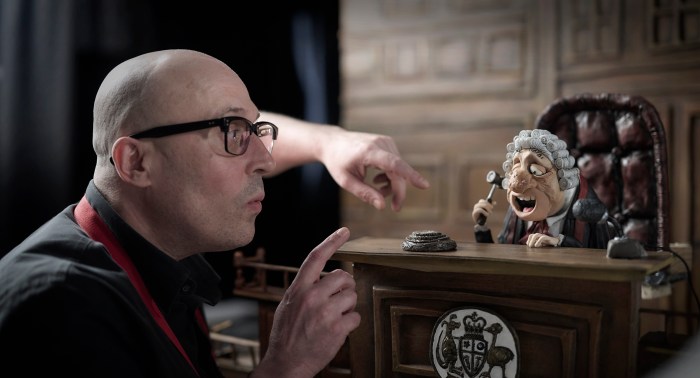
Adam Elliot with James The Magistrate (Eric Bana).
“We have a very eclectic and diverse cast and crew—not intentionally, but it just happened that way. Of course, we want inclusivity and diversity, but these are simply the people we employ. I think having such diversity really enriches the process.”
Interview by Matthew Eeles
I was surprised to see so many kids at the screening I attended, especially since this is obviously not a film for kids. Have you noticed many kids at other screenings?
Look, there’s always a handful of kids, and it does worry me because the film is rated M. I’ve even had a few parents come up to me and tell me they didn’t realise it was such an adult film. I don’t have kids, but I wouldn’t take anyone under the age of 12 or 13 to this film. I understand that some kids are more mature than others, so it really is hard to judge. We’re encouraging parents to check the rating because I certainly don’t want to traumatise any children. [Laughs]. There’s some really challenging stuff in this film, as you know — attempted suicide, nudity, swearing, and the gay conversion sequence. I worry that parents aren’t being attentive. In a way, it’s not the parents’ fault because we’ve all been brainwashed into thinking that animation is a genre, but it’s not. It’s a medium. There’s a long history of adult animation in countries such as Estonia and the Czech Republic. Less so in Australia and America, but adult animation has been around as long as cinema. We’re just not as aware of it. I chose an art form similar to Wallace and Gromit to tell more mature stories. [Laughs]. I can’t be too harsh on parents, but I do warn them to be attentive and really make their own judgment about whether their children should watch it or not.
Gracie is now one of my favourite film characters of all time. So much happens to Gracie throughout Memoir of a Snail. The poor thing is put through the wringer. Did you know early on how far you wanted to push Gracie, or did her tragedies develop during the making of the film?
I was always very conscious of how far I wanted to push her. I dragged her through the mud quite a bit, and I was quite cruel to her. In one of the drafts, I worried that I’d gone too far and pulled back because I thought it was becoming too unrelenting. No matter how much comedy I crammed in to balance it, there’s a point where the audience thinks, “Oh, this is getting ridiculous. This is too much.” I can feel that point too. Now, when I watch the film with an audience, I can sense them getting uncomfortable, wanting the torture to end. That’s when I introduced Ken and the whole love component of the film. Just as the audience starts thinking, “Come on, Adam, give her a break. Let her have some joy,” Ken comes along at the right time.
I mentioned her tragedies, most of which are sudden and unexpected losses of her loved ones. I couldn’t help but wonder if Gracie was a conduit for your own grief and if this character allowed you to express some of your sadness.
She was, for sure. When I was writing the script about eight years ago, I went through a period of depression, anxiety, and a midlife crisis. I turned fifty and started analysing why I was doing this. Then, my father passed away. Life got in the way. I spent a lot of time feeling self-pity and wallowing in my own pity pit, feeling sorry for myself. Stephen Fry had a great take on this. I read in one of his biographies, “Someone should write a book about self-pity, and every page would be blank except for the first, which tells you to get over yourself.” [Laughs]. Self-pity is so destructive. I’ve wasted so much time feeling sorry for myself, worrying that I don’t fit in, thinking I’m a fraud or no good. It’s destructive. I think most artists go through periods of feeling like a fraud, and it’s unhealthy. It’s okay to wallow a bit, but you’ve got to move on, get out of the pity pit, be brave, be stoic, and all that. Gracie is definitely an extension of myself, and Gilbert, of course. I tried to create Gracie as a relatable character that everyone can identify with. She’s very phlegmatic, very passive. A lot happens to her, and her character arc isn’t a dramatic transformation toward the end. She’s best described as a survivor. She just endures and then becomes whole. Gilbert’s return is her reward for all her trauma and suffering.
ADVERTISEMENT Click to watch now!
You’ve been posting some great snaps on social media, showcasing your travels with the Gracie figurine. It made me wonder about the connection you form with the characters you create, especially since it’s such a tactile art form. Most other characters are handed over to actors, but with this medium, you create every aspect of them.
When I’m writing, I don’t even imagine them as animated or cartoon characters. They’re real people in my mind. I try to create very believable, authentic characters that just happen to be animated or made of clay. It’s all about suspension of disbelief. I’ve been carrying one of the puppets around with me, and I’ve never done that before because, for me, they exist only in the film. But I’ve learned people are genuinely fascinated by how we make the films. It’s a bit like a magician giving a glimpse into their tricks. I’m happy for Gracie to travel with me, though she doesn’t even have legs at the moment. [Laughs]. It spoils the illusion too — people say, “Oh, they’re only that big?” But they’re fascinated by how they’re made. It’s amazing when I bring her to Q&As. I was really shocked at how interested people are. But I’m happy for her to come along. She’s a great icebreaker, especially when meeting famous actors. She’s met Angelina Jolie, some big-name actors, and even Ken Burns. I was so excited to meet Ken Burns. She also met Leonard Maltin, one of my favourite film critics. She’s a great icebreaker. [Laughs].
I’d love a Gracie figurine on my office desk.
We’ll see how the film goes. [Laughs]. I always tell people that I don’t think any of my characters would end up in a McHappy Meal. [Laughs].
Maybe an Unhappy Meal.
[Laughs]. Very good.
She practically says it herself in the film, but was Pinky modelled after a testicle?
[Laughs]. I love drawing Pinky. I’ve drawn hundreds of Pinkies, and I love wrinkles. I love giving my characters as many wrinkles as possible. We’re never certain of Pinky’s age, but she’s certainly around one hundred when she dies. In one of my drawings, she just looked like a testicle, and I thought that’d be a great way for her to describe herself in the film. That always gets a big laugh in the cinema. I think everyone can relate to her.
Your cast does a terrific job bringing these characters to life. How involved are you in the casting process?
Very involved. They’re all my decisions. My producer, Liz Kearney, and I had a wish list. We threw names around, but very early on, Sarah was one of the actors in my mind. We considered other big Australian female actors, like Nicole Kidman, but none of them had the qualities Sarah has. She’s got such a beautiful quietness to her voice, sincerity, vulnerability. She’s quite shy herself, very different from the characters she plays, and she just ticked every box. It made sense.
How did Tony Armstrong’s casting come about? He’s unstoppable at the moment.
Tony was a late decision because I just couldn’t make up my mind about who was going to voice Ken. Ken doesn’t actually say that much. I was watching ABC News Breakfast one morning, and Tony came on, and I thought, “Oh my God, that moustache! Ken has a moustache!” Then I noticed he has that bass in his voice. Also, in terms of ethnicity, Tony is obviously Indigenous, and Ken is more Mediterranean. Originally, Ken was Russian, and so we approached Tony, and he said yes straight away. Sometimes you get voice casting wrong. Sometimes the voice just doesn’t match, but in this instance, Tony was perfect.
How much fun was it to have members of your family voice some of the characters in the film?
So much fun. All my nieces and nephews are now at an age where they’re very curious about what I do. My brother Luke is an actor, so he’s in there as well, along with myself and my producer Liz, who’s a West Australian. We involved as many non-actors as possible, and to be honest, it saved us a lot of money. [Laughs].
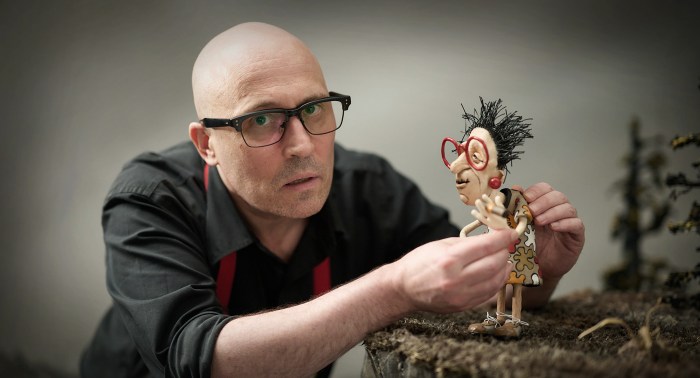
Adam Elliot with Pinky (Jacki Weaver).
Your films are branded with your name, and you’re the face of the production after the fact, but it takes an army of people to bring something like this to life. How do you choose your crew? Is there much of a vetting process to ensure these artists are up to the challenge of such an arduous process?
Luckily, we don’t have to advertise. Word gets out. This film is a mix of older crew, like cinematographer Gerald Thompson and my editor Bill Murphy. Three of the animators were from Mary and Max, so it’s a real mix of the old and new. We are very keen to try and get a gender balance, along with inclusivity and ethnic diversity. As it turns out, a lot of our crew are on the spectrum, and some of our actors, like Bernie Clifford, who plays Owen, have unique stories. He has one leg, having been in an accident years ago. We have a very eclectic and diverse cast and crew—not intentionally, but it just happened that way. Of course, we want inclusivity and diversity, but these are simply the people we employ. I think having such diversity really enriches the process. I involve the crew in the creative process, and if they have ideas, I encourage them to contribute. We just attract the people we need, and we’ve never had to advertise. The only mandate we have is that most of the crew be Victorian citizens, as VicScreen wants to support local talent, which is fair enough.
Would you ever consider making a film that isn’t claymation?
I’ve contemplated it over the years, but I think I’d be a lousy live-action director. In animation, we have so much creative control and freedom, which allows us to be megalomaniacs. We can play God. Our characters can look however we want them to. I think I would miss those luxuries if I made a live-action film. I’d enjoy the speed of live action, as it’s much quicker to produce, but I’m quite happy where I am now. It’s what I’m known for, and I think I’d be betraying not only my art form but also my crew, who’d be very annoyed if I jumped ship.
I was watching the AFL Grand Final recently and heard a few players say that one premiership isn’t enough—they just want another after the first. Is that the case for an Oscar winner? Or is one enough?
Well, look, the first one was a big shock and certainly wasn’t something I was aiming for. Awards are nice when they come along. I always say they’re like a bottle of wine—they make you feel good for a night, but the next day, you’ve got a hangover and have to move on. One Oscar certainly changed my life, and another would probably alter the course of my career, I assume. But no, I think being in the feature category, we’re eligible, but it’s a strong year for feature animation, with wonderful films like Inside Out 2 and Flow, which is by my friend Gints Zilbalodis, and of course Wild Robot. I haven’t seen it yet, but from all accounts, it’s pretty amazing. I know it sounds cliché, but just being nominated would be lovely, and it would help the careers of not just me but all my artists. I call my crew artists because that’s what they are. Many of them are sculptors and painters, and for a lot of them, this is their first film. It’s a unique film—there aren’t many stop-motion features being made in Australia or around the world. Only a handful get made each year. So, if we were lucky enough to get a nomination, it would really help validate the art form. There’s so much CGI out there, and we’re the odd ones out, but yeah, we’ll wait and see. Because I already have one, I don’t feel like not getting nominated would be a big loss, but for my crew, it’d be a huge buzz.
I have one final question, and I saved this one for last because it’s a major spoiler. We don’t talk about sound design in film enough, and the sound design in Memoir of a Snail is incredible. During the church fire scene, I noticed the prominent sound of a window smashing, and I knew instantly that Gilbert had escaped the fire. Can you talk about the sound design here and the discussion around the smashing of that window?
I totally agree—sound is rarely spoken about, which is such a shame because David Williams, our sound designer, put in so much work, way beyond the call of duty. He left lots of hints and clues, like the one you’re talking about. He added things I’d never have thought of. This film has a very dense soundscape, and it’s accompanied by Elena Kats-Chernin’s score with the Australian Chamber Orchestra, which really elevates the film. The music, score, and soundscape are crucial—they drive the film and accompany the characters’ psyches and moods. Regarding the smashing of the window, that was all David Williams. I love it. We thought it was a great little clue, and it’s on the second viewing that you notice all these little hints. Thank you for asking that question. I’m so glad you did.
Memoir of a Snail is in cinemas now.
If you Cinema Australia as much as I loved publishing it, please consider supporting Cinema Australia’s commitment to the Australian screen industry via a donation below.
I strive to shine a light on Australian movies, giving voice to emerging talent and established artists.
This important work is made possible through the support of Cinema Australia readers. Without corporate interests or paywalls, Cinema Australia is committed to remaining free to read, watch and listen to, always.
If you can, please consider making a contribution. It takes less than a minute, and your support will make a significant impact in sustaining Cinema Australia as the much-loved publication that it is.
Thank you.
Matthew Eeles
Founder and Editor.Make a donation here.


 Cinema Australia
Pingback: Late Night with the Devil leads Australian Film Critics Association Awards nominations | Cinema Australia