
Aarushi Chowdhury.
Aarushi Chowdhury’s fun but unsettling short film Clown is set to round out its festival run at the upcoming Byron Bay Film Festival and Canberra Short Film Festival following successful screenings at prestigious film festivals like MIFF, SXSW Sydney, Heart of Gold Film Festival and Australian Women’s Film Festival where Aarushi won the One to Watch award.
Clown follows eight-year-old Sami (Deeya Saxena) who can’t wait to play “serial killers” with her older sister Jiya (Shaina Chowdhury), but her sister-time is threatened when Jiya’s cool new bestie arrives.
Aarushi Chowdhury is a writer and director who is passionate about telling stories that subvert expectations and explore the concept of ‘otherness’. She has recently written research for a television show by Tony Ayres and NBCUniversal.
Aarushi also works as a freelance commercial director for brands like Subway, ACMI and Telstra. Aarushi is currently in pre-production for her short film Gullak, which was developed through AFTRS Talent Camp. Whilst her body of commercial work sits primarily in the comedy genre, her narrative work hopes to explore the complexities of familial relationships, class and power through a more dramatic lens.
In this interview, Aarushi talks us through the making of Clown.
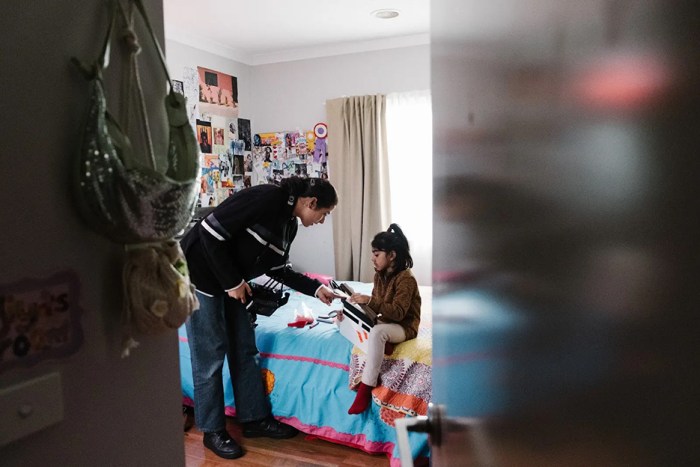
Aarushi Chowdhury and Deeya Saxena) on the set of Clown.
“I think scary movies offer a unique space to express any trapped anxiety freely. They provide all the adrenaline rush that the characters experience, but without any of the real-life consequences.”
Interview by Matthew Eeles
You’re working with an impressive cast here who are all talented beyond their years. Firstly, can you tell us about directing Deeya, who plays 8-year-old Sameera in the film?
They’re all first-time actors so I was very grateful that they all had such natural performances. Deeya has a very magnetic on-screen presence so I wanted to play into those moments a lot more. I did explain the story to Deeya and why I was making the film, but I don’t think the significance was front of mind for her. I would usually present moments as something fun to spark her interest—each action and intention had to feel like a game, or she would naturally lose interest. However, it was nice to see her absorb some of those themes of self-acceptance and apply them with her own sister and friends at school. She already has such a vibrant and confident personality so I encouraged her to lean further into that, hoping that she never gives that part of herself up. All three of the child actors had very different styles of visualising and working so there was a lot of learning on my end regarding what safely evokes the most natural performances from each of the kids. As you know, there are always some roadblocks when it comes to working with kids, there were definitely some things on set that were unexpected. Thankfully, we had an adaptable team that supported me as I adjusted some of the shots to accommodate a new three-take maximum for Deeya.
You also cast your own sister, Shaina, in the film. How did this casting come about?
I was always advised not to work with family, so I never considered anyone at home for the role of Jiya. But soon enough, I ended up casting both my mum and sister in the film. I found Deeya almost immediately but I was struggling to find an actor who could balance Jiya’s selfishness with her care for her sister. I then auditioned Shaina, who was nervous at first, but we worked together to move past the awkwardness of performing. She ended up bringing complexity to a character who isn’t intentionally hurting her sister.
What was Shaina’s reaction to seeing herself in the film on the big screen?
Shaina first saw herself on screen at the SXSW premiere of Clown in Sydney at Palace Cinemas. We watched it with our parents and some of the crew. I sat next to her, and we held hands the whole time. When I asked how she felt, she said she was great! But when we got home, she admitted she was really nervous and didn’t want that to be the focus of the evening. I was taken aback and wished she had told me how she truly felt. She’s the most supportive sister ever—anytime I get good news, she’s the first person I tell, and I’d like to think she tells me first too (or maybe her best friend, but I’m not jealous … at all). Right now, she’s a little embarrassed anytime Clown screens in Melbourne, worried someone from school might see her. But almost always, her nerves give way to excitement when she hears all the wonderful things people are saying about her.
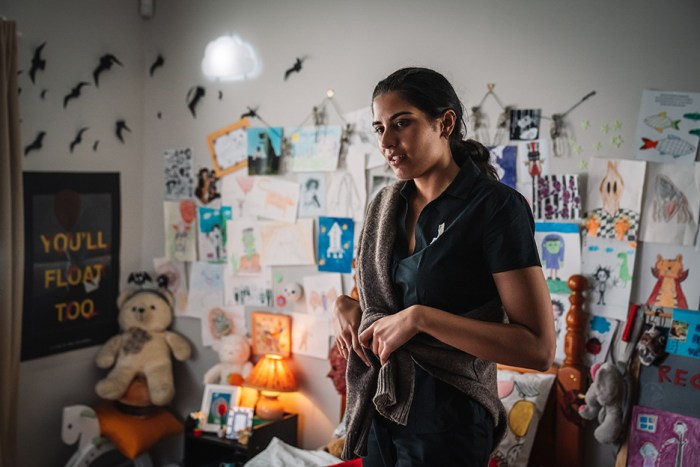
Aarushi Chowdhury on the set of Clown.
There’s some singing in the film which involves both harmonies and rapping. Did this come natural to Shaina and Alessia?
I have to say, the script of the rap was elevated by that performance. Both Shaina and Alessia carried that one home. We rehearsed fortnightly for about 2-3 months which seems quite major (and it was) but the first few weeks were just full of fun activities that allowed Deeya and Shaina to build a relationship as well as Shaina and Alessia to form a friendship. We played Uno, tiggy, charades, and other games to help naturally build a dynamic between the three of them, making them much less embarrassed about playing and being silly in front of each other. One of these activities was Karaoke and both Alessia and Shaina love music so we got some inspiration from their favourite rappers. I didn’t want to be too rigid when directing the performance for this scene so we left quite a bit of room for improv and from there, Alessia and Shaina carried us to the finish line. It was so great to see that cheekier side of Shaina come out during the improvised parts of the rap. She’s amazed at how positively the audience has responded to that side of her, and reminding her of that was one of the reasons I wanted to make this film. The rap scene was a one-take shot with so many moving parts so naturally, we would’ve loved multiple takes but we only did about three takes of this scene. And of those three, only one was usable because of little issues like continuity, timing or tech. Watching the rushes, we were up to the last take, nail-biting and teeth-grinding, hoping this one would work and luckily, it did! This shot was probably the most fun to film because the performances made everyone belly-laugh. The hardest scene to shoot was the last scene of the film, particularly the dolly shot. Deeya was excited to get out of the clown makeup, and we had so many beats to hit with her gaze and Shaina’s blocking in just one take. To adhere to our three-take maximum and ensure Deeya got out of that makeup ASAP, we re-engineered the edit plan to make the one-take smaller and shot it in parts.
You co-wrote the film with Diane Vu. Tell us about that collaboration, and the importance of maintaining the same moral values throughout the writing process?
Co-writing this film with Diane taught me how important it is to be on the same page not only creatively but also in the principles that guide that creativity. We met at this program called AFTRS Talent Camp in 2022 and she gave me feedback for a script I had written. I was drawn to the way she expressed characters, they felt like characters I’d have a lot of fun watching. She was unafraid to explore the grimey and grey bits of humans both creatively and personally which are exactly the type of characters I was interested in creating. On Western screens, Indian characters are seldom given the luxury of being flawed and any character who isn’t complex is much less interesting to watch. As such, I was eager to write a young Indian girl who is unabashedly selfish and devilishly evil – I thought Diane would be interested! I had written a version of Clown in 2019 but we completely burnt that story to the ground and created something new together over approximately three months. We both have a strong work ethic instilled in us from our cultural backgrounds, but learning what a work-life balance looks like on this shoot was invaluable. It was important for us to make something that was really honest in hopes that it would relate to the young women we were making this for.
You’ve said that your sister influenced the film, but how much did your own upbringing play into the film’s narrative?
Everything in the film was in service to our own experiences growing up, the gonorrhea rap was akin to the presentation a young Diane gave in high school, I loved watching movies with my whole family, Diane and I loved dressing up, running fake businesses and putting on singing performances as teenagers. Whenever I was rejected, my mum, who plays Sapna, would try to play games with me, but there is only so much fun an eight-year-old can have with chess – not to mention the added humiliation of feeling that your mum pitied you. I was a horror fanatic and still am so it was important that Sami too had this off-kilter interest, not many eight-year-olds know who Leatherface is (and that’s probably for the best). My sister and I are ten years apart, so when she was younger, she had an experience similar to Sami’s. But as she grows into her teen years, I find myself relating to Sami more, hoping Shaina will think I’m cool enough to finally want to hang out with me. As a six-year-old Indian girl who suddenly moved to Australia, I found myself focusing on what would help me to fit in rather than exploring my own likes and dislikes. Until a few years ago, I didn’t really have many hobbies because I was so busy surviving and focusing on doing what others found fun so I wouldn’t be left alone, and that’s a huge part of the Clown story!
You’ve said that you found comfort in watching scary movies as a child. What’s your earliest memory of watching a scary movie?
Such a good question! My earliest memory of watching a horror movie was the Hindi film Bhool Bhulaiyaa, which married some of my favorite things—horror, dark comedy, thriller, and psychology. The story follows a young woman who seems to be possessed by the spirit of an ancient dancer wrongfully murdered. The all-star cast must find a way to save her without getting killed themselves, all underscored by the eeriest soundtrack. I couldn’t sleep for a few days afterwards but it was totally worth it. Even now, the most exciting Sundays are when it’s raining outside and my family and I sit together to rewatch Bhool Bhulaiyaa.
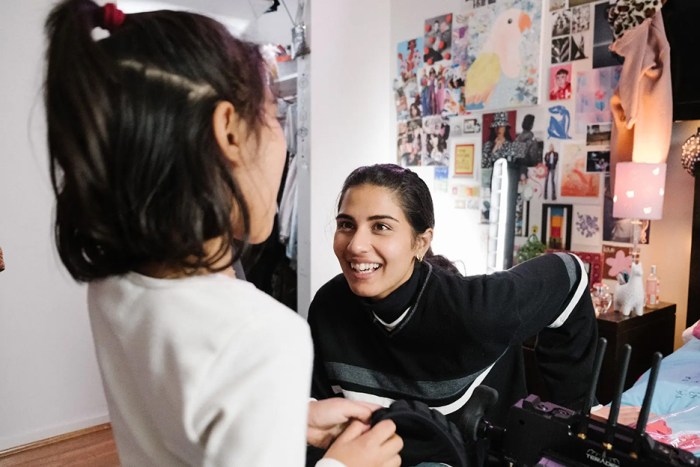
Aarushi Chowdhury and Deeya Saxena on the set of Clown.
What is it about scary movies that you find so comforting?
I think scary movies offer a unique space to express any trapped anxiety freely. They provide all the adrenaline rush that the characters experience, but without any of the real-life consequences. There’s something comforting about being removed from the actual experience of fear while still being able to engage with it. Nothing bonds people quite like watching a scary film together. I wasn’t allowed to go to sleepovers when I was younger, so now that I’m older, I try to recreate that thrill by watching scary movies with my friends.
I noticed that there’s an IT poster on Jiya’s bedroom wall, which is probably the most famous clown film of them all. Was that placed there intentionally.
Yes! The IT poster was actually on Sami’s wall and also handcrafted by our production designer, Tiffany Dias. She has exceptional attention to detail and we had a lot of discussions about the specifics of Sami’s personality which could inform the design of her room. The IT poster was an intentional choice, serving as the inspiration for Sami’s decision to mimic her favorite character, Pennywise (hope they don’t sue me). We also aimed to create a character that seamlessly blended into both Sami and Jiya’s worlds, incorporating elements of a scary clown and the art of transforming yourself with makeup. By the way, Tiffany even hand-designed a Bhool Bhulaiyaa poster for Sami’s room too.
What can you tell us about your next short film, Gullak.
Gullak is a proof-of-concept short in which Ten-year-old Ananya has been meticulously saving up to buy a Nintendo DS, but when she discovers that her hard-earned cash has been stolen, she concocts a questionable plan to steal it back. With Ananya; think the sass of Lady Bird, the blissful ignorance of Moonee from The Florida Project with the chaotic ambition of Ricky Baker from Hunt For The Wilderpeople. It’s a distinctively North Indian story set in Craigieburn and was developed through Screen Australia and Vicscreen via AFTRS Talent Camp. I’m currently wrapping up the newest draft of the film and Creative Victoria has just funded the film’s production to shoot in early 2025. I enjoy investigating morally ambiguous characters who are forced, by the system, to commit crimes against society and often the ones they love most, in order to provide for those very same people. This is why I am excited by the success of favourites like Jojo Rabbit, The Favourite and Beef which thrust controversial characters into places that aren’t built for them. In addition to being a personal experience, I want to tell stories like this because it allows my specific tone to find a home and gives me a space to practice telling stories.
Clown will screen at the Byron Bay International Film Festival, Canberra Short Film Festival and Cannes Indie Shorts Awards.
If you enjoyed this feature as much as I loved publishing it, please consider supporting Cinema Australia’s commitment to the Australian screen industry via a donation below.
I strive to shine a light on Australian movies, giving voice to emerging talent and established artists.
This important work is made possible through the support of Cinema Australia readers. Without corporate interests or paywalls, Cinema Australia is committed to remaining free to read, watch and listen to, always.
If you can, please consider making a contribution. It takes less than a minute, and your support will make a significant impact in sustaining Cinema Australia as the much-loved publication that it is.
Thank you.
Matthew Eeles
Founder and Editor.Make a donation here.


 Cinema Australia