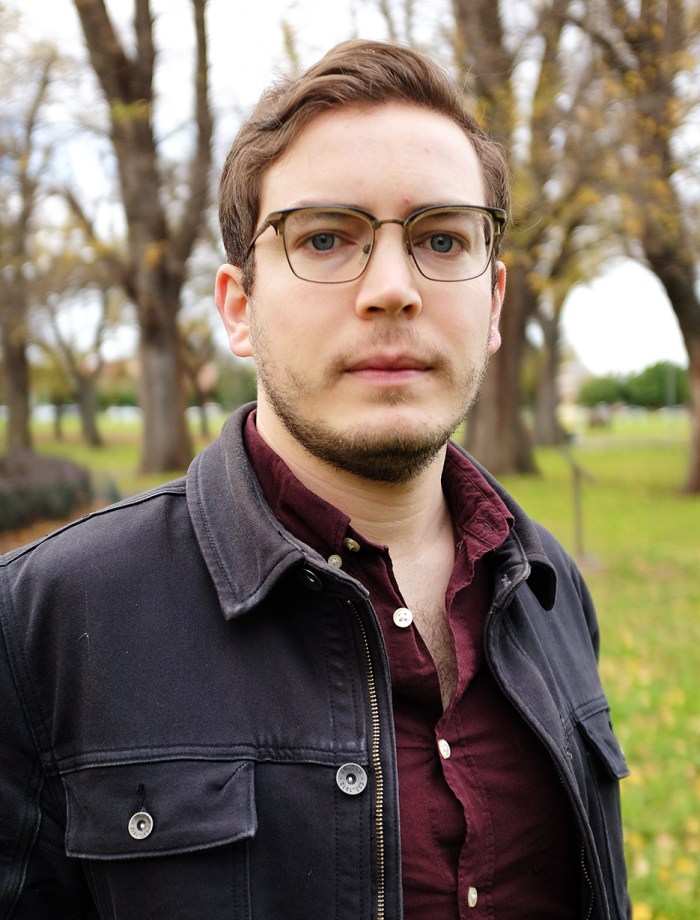
Henry Boffin.
Henry Boffin is no stranger to family drama, drawing on his own real-life experiences as inspiration for his debut feature film, Strange Creatures.
The new dramatic comedy follows two estranged brothers, Ged (Johnny Carr) and Nate (Riley Nottingham) who are forced to reunite to scatter their mother’s ashes in the town where she grew up.
Henry is an award-winning screenwriter, director and author based in Melbourne. As a founder of the production company Humdrum Comedy, Henry co-created the hit TV comedy series Metro Sexual, which ran for two season and has been aired in multiple countries around the world. Humdrum Comedy were finalists for Breakthrough Business of the Year at the 2022 SPA (Screen Producers Australia) awards.
With Strange Creatures, Henry perfectly blends humour and drama and delivers a witty and emotional take on family dynamics, which has been a common theme throughout the filmmaker’s impressive filmography of short films prior to Strange Creatures.
Strange Creatures is set to premiere at the Queer Screen Film Festival this week before heading to CinefestOZ. The film will then release nationally through Bonsai Films.
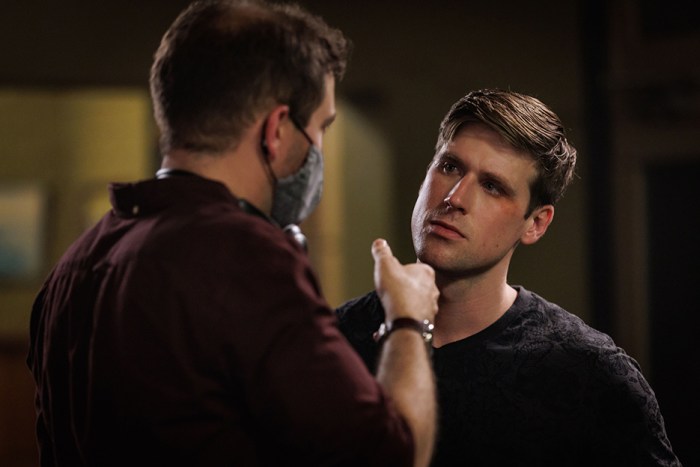
Henry Boffin with Strange Creatures actor and co-producer Riley Nottingham.
“I think one of the scariest things is to cast two people to be brothers because brothers have such a history and familiarity with each other, even if they haven’t seen each other for a long time.”
Interview by Matthew Eeles
Strange Creatures was featured at the Cannes Film Festival this year as part of the Marche Du Film initiative. Did you travel with the film?
Sadly, I did not get to go this time. I’ve been lucky enough to attend the Cannes Film Festival before, but it was a little while ago. This time, we sent over our superstar producer, Riley Nottingham, who also plays the younger brother, Nate, in the film. He’s got the wonderful gift of gab. [Laughs]. He is such a brilliant producer and salesperson, so we sent him as our representative to do the smooth talking. From what I’ve heard, it was a fantastic experience over there. Riley got to watch the film with an audience, which I’ve yet to do. I’m really excited about being in an audience with actual people where it’s not just me and an editor or me and a sound designer. He said that it was hitting the right beats and everyone was reacting brilliantly. So personally, I’m absolutely excited. It’s all very nerve-wracking. You always hope that it’s going to hit the right way, especially when you’ve got all these other people watching.
How did that selection come about?
We flagged it with Queer Screen. We submitted it, and then they selected it to take over as part of their Marche Du Film initiative showcase, which they’ve been doing for a few years now. That was really special. Nate is a pansexual character, and I think they wanted a nice spread of different diversities in their different sexualities. It was really, really lovely and a very proud moment to be picked for that. And it’s such an honour to be taken over there because it’s such great recognition for the film.
After I watched Strange Creatures, I took a look at a selection of your short films, including Lavender, Follow My Way, and Ouroboros. It’s interesting that these three films, in particular, are so steeped in drama, while your other work, like Metro Sexual and HitstrokeFM, is very comedy-driven. It must be a joy to shift between both genres.
Well, the grass is always greener on the other side, isn’t it? I love bittersweet stuff. I love happy, I love sad, I love the lighter and darker areas of storytelling. I think all of my work treads the line between the two, whether it’s something darker and moodier but also has sweetness to it. Or if it’s more of a comedic show or movie, it can still have depth. I grew up watching a sci-fi sitcom called Red Dwarf. Does that mean anything to you?
Yes, of course. We were forced to watch it in high school.
[Laughs]. My two main favourite genres are sci-fi and comedy. I blame that on Red Dwarf. My best friend and I used to love that show so much growing up. We used to go to each other’s houses every week and make our version of the show, which was very imaginatively called Green Dwarf. You can see that we were true fountains of imagination. [Laughs].
Do you find yourself leaning more towards drama or comedy in your writing and directing? A lot of writers have told me there’s a thin line between the two.
That’s a good question. I mean, you can’t have one without the other. As someone who’s seen Strange Creatures, you’ll know that I’ve positioned it as “dramedy.” And I think there are a lot of underlying themes in there, like mental health in men, sexuality, and identity, that are underpinned by the hilarity of this fish-out-of-water buddy comedy. These are two brothers who are complete polar opposites trying to get along, and it covers the joys and difficulties of being family as well. Ultimately, I hope that people come away from it having had a few laughs, but I think the drama usually wins out at the end for me because you want someone to come away from a movie with something to think about.
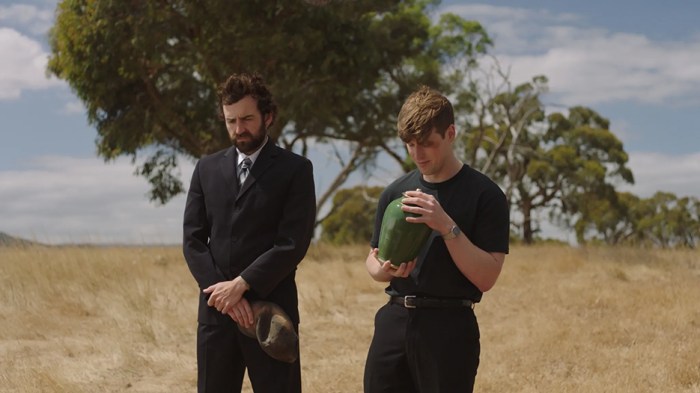
Johnny Carr and Riley Nottingham in Strange Creatures.
Strange Creatures really is the perfect mix of both comedy and drama. Does that happen organically for you?
I really didn’t want to play it as a comedy. I think a lot of the comedy in the movie comes from the situation and dropping these characters into that situation. At the end of the day, it’s a road trip movie where the two characters travel from one location to another in a hearse. These two brothers are stuffed into this hearse and forced to be together. I wanted these two actors to play it as straight and natural as possible. And then the comedy just comes from that. So in many ways, I was trying to stay away from it being contrived. I think one of the scariest things is to cast two people to be brothers because, obviously, brothers have such a history and familiarity with each other, even if they haven’t seen each other for a long time. Siblings are familiar with how each other thinks. I think everyone can relate to family situations being genuinely hilarious while also being very difficult at the same time. There’s a natural inclination to the ridiculousness of family. Even if you are polar opposites in personality, you are thrust together by this bond of being related, which sparks these often hilarious situations, which I absolutely love. The seed of the film was first planted for me when my brother and I did a road trip across Australia 15 years ago where we drove a Wicked Camper down from Darwin to Perth. At the time, we were just two kids over from the UK, so we were so unprepared for a trip like that. We had no comprehension of how big Australia could be, and essentially, it was just a comedy of errors the entire way. We nearly ran out of money, ran out of fuel, and we only gave ourselves 10 days to do the whole trip. So there’s something very endearing about the naivety of that. It had great potential for comedy.
So how much of Strange Creatures is based on your own experiences?
The overall story is fictional, but I’d also say it’s quite a personal film for me. The initial impetus was that road trip, which always had great potential for comedy. My mum used to call me and my brother the Cuddle Brothers, which is what the brothers are called in the movie. The film’s title is actually taken from a quote in Jane Austen’s Mansfield Park, “What strange creatures brothers are.” It’s about how the two brothers in the novel only ever communicate to tell each other the most important and terrible and grave news and never talk about anything else. I came across that one day, and that really struck a chord with me. It’s 200 years later, and that hasn’t changed much, to be honest. So that kind of communication was definitely something that I also wanted to explore. We also have a history of dementia in our family. I was going through that with my grandmother when I was writing the script for Strange Creatures. I live on the opposite side of the world from my grandmother, so every time I went back to visit, there were glaring changes. Dementia is very difficult to deal with at the best of times. Every time I’d visit her, she was more and more a hollow shell of her former self. So that also inspired a lot of the film when Ged was coming back for his mum’s birthday when she’s come down with dementia, and he thinks it could be the last chance he gets to see her.
Family is certainly a common theme I noticed running through your films, especially the more dramatic ones. Most of them explore the loss of a loved one, either physically or mentally. Do you think you will continue to explore this going forward?
Definitely. There’s a lot in there about nostalgia and maybe a longing for certain stages of my past. I think a big part of what’s influenced me is the fact that I moved to Australia when I was 18 from the UK. I’ve been so far away from home for so long. Originally, I was going to stay in the UK and study chemistry, but then I actually failed to get into chemistry by one mark in a physics exam and ended up coming to Australia to study film instead. My family was always moving all over the place. My parents divorced, and my mum actually moved over to Australia too. Everything shifted so dramatically, and I think that has definitely affected my connection to my parents. We shift and evolve in their eyes, and they shift and evolve in our eyes as well. Thankfully, I don’t have any specific traumatic tales to tell though. [Laughs].
I want to go back to what you said about the Jane Austen novel. Do you often look to novels for inspiration?
Definitely. I think if you come across something that speaks to you, you should run with it. It was also odd to think about how it was so familiar to how we still are today. Two hundred years have passed, and we’re only now starting to identify how communication breakdowns can relate to mental health. It’s okay to talk about your feelings with your brothers. But yeah, I think that one novel specifically just struck a chord with me. I think it’s great to get inspiration from a wide range of places. I love reading, actually. Novels are definitely a great source of inspiration.
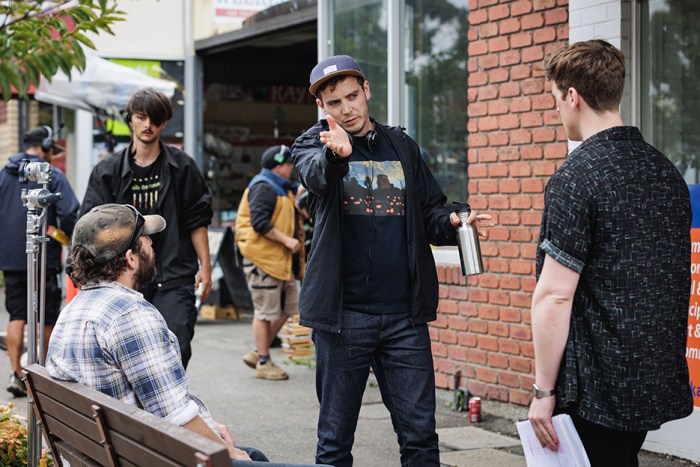
Johnny Carr, Henry Boffin and Riley Nottingham on the set of Strange Creatures.
Johnny Carr and Riley Nottingham have a great on-screen dynamic as brothers Ged and Nate. They bounce off each other very well. Did their casting require screen tests to ensure they had the right chemistry, or was it obvious from the beginning?
We screen-tested. Johnny was in Melbourne at the time shooting Five Bedrooms, which he stars in. We got the two together, and we could tell immediately that they had that perfect balance. I think Riley is not a million miles away from the character of Nate, but he is such an upbeat, persistent, passionate, driven guy who has a positive attitude that just played so beautifully against this kind of gruffness that Johnny was bringing to the character of Ged. We could see that these two were going to be the yin to each other’s yang. And that was what we wanted ultimately. We wanted these two people who really rub up against each other but who you could tell were from the same stock, and you can see where their point of love comes from as well. They understand each other. We were super happy with the casting.
Is there a story behind Lyn Pierse’s casting as their mother, Trish? Lyn has been acting since the 80s, but she only has a handful of screen credits to her name.
Lyn came via a casting director. Lyn has had things happen in her personal life similar to what her character is going through. A lot of the time with actors, you do find that the ones who do the best screen test are the ones who have had something similar happening in their own life at the time. And sometimes you only find that out later on down the line. It’s almost a way of exorcising through their performance some of what’s happened in their real life. When we first met, Lyn came to Riley’s house. She’s quite into method acting and improvisation, and we did a really long session at Riley’s house. We were there for hours with Lyn and Riley just sitting there in character essentially, and I was playing a nurse, and then Lyn was playing Trish and Riley was playing Nate. Nate is the brother who’s been left to look after their mum while Ged has run away to Perth. It was a brilliant experience to just be there for that long with these two in character without a script or cameras. It was great. We explored so many things. I was just talking to the actual characters, Trish Taylor and Nate Taylor, while I was under the guise of this nurse character. And then we set up a few scenarios. I really wanted to drill home the difficulty of the dementia for Nate. So we did this thing where I got him to come in again and again and again to kind of say hello to his mum as if he was greeting her every morning, and then she was increasingly difficult every time he came in. We kept doing that again and again and again. [Laughs]. I think by the end of it, Riley was getting pretty fed up, but I think it really drove home this idea of the fact that dementia is unrelenting and it doesn’t stop. That was a great experience for me.
Can you talk to us about the logistics of filming a road movie? How much planning is involved in something like this? Or was there less travel involved than appeared?
There was less than is apparent; however, that does not detract from the fact that it was a gargantuan effort to organise. I bow down to the producers, Rachel Forbes and Riley, as well as our fantastic locations team. We had a lot of locations, and we were quite a low-budget film, and locations are what eat up your budget. All of our locations were within 40 minutes of the Melbourne CBD, so it’s all a carefully crafted illusion, not to spoil the magic for anyone who hasn’t seen it. [Laughs]. All the driving scenes were actually done pretty much on one road out near Lara, which we managed to close down. We went out to the end of the road and took the hearse, Riley, myself, and the cinematographer, Jonathan Haynes, and just went as far as we could.
How did you get access to the hearse?
We got the hearse from a guy named Phil. [Laughs]. Our art department actually got in contact with him. It was this old, beat-up thing where they used to make them from an old Ford that had just had its back chopped off, and then this oblong was basically welded onto it. Phil was great. He always had to come with the hearse, as he was the expert hearse driver, and he was super accommodating. It was one of those lucky finds. I just love the fact that it was this beat-up thing. It’s such an important character in the film, and I just love that image of it driving through the dusty outback, which was one of the first images I pictured in my head when I was conceiving this film. It’s wonderful.
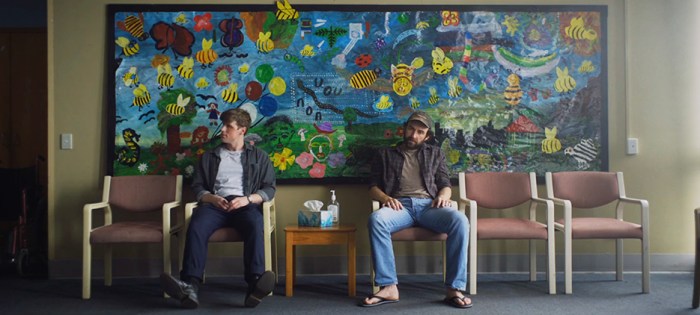
Johnny Carr and Riley Nottingham in Strange Creatures.
Was the hearse originally written into the script? Did you have a backup plan if you couldn’t get your hands on one?
It was originally a Wicked Camper, but eventually, that evolved into a hearse. The idea that they’re essentially at an extended funeral for a month is quite nice. That wasn’t a super late draft, but it was probably about midway through the drafting process that we knew the hearse needed to happen. As I said, the idea of a hearse just driving down this long, straight highway in the Australian outback is so delicious to me. [Laughs].
What can you tell us about Before the Dying Light, another film you have in development?
We’re still getting all the pieces together for that one. Fingers crossed. I would love for that to be my next feature. That’s actually more of a science fiction piece. I actually wrote that before Strange Creatures, as is often the case. Filmmakers will often write something that’s a bit bigger, and then you put that on the back burner for a little while until you’ve got a few notches on your belt with smaller films. Before the Dying Light is essentially a science fiction thriller. It’s about memories. It’s about this group of friends who attend a reunion at the home of a global tech giant, an Elon Musk type. I won’t give too much away, but it’s about implanting fake memories. And it’s all about temptation—if you could make your life more exciting with fake memories, would you do it? And then what defines you, in terms of memories? If you start doing that too much and start putting in memories that don’t belong to you, then where does the line end in terms of where you start and where someone else begins? So it starts to get dark and enters the paranoid thriller territory. But as I said, it’s still in development, so that’s the rough pitch.
Shaun Grant has worked with you as a mentor on Before the Dying Light. Shaun’s a writer known for some of the darkest, most heinous Australian films like Snowtown and Nitram, but he’s such a lovely guy in real life. He really couldn’t be any further removed from the films that he writes. How was the experience of working with Shaun for you?
That was part of this screenwriting accelerator I did called Imagine Impact, which is run by Imagine Entertainment, Ron Howard and Brian Grazer’s company. Shaun’s great. I remember they asked me what one of my favourite films was, and I said The Prestige. I remember in one of my first meetings with Shaun, he told me how much he really hates The Prestige. [Laughs]. I think that difference in opinion actually helped in the end because sometimes it does help to have someone whose sensibilities are a little bit different from yours to push and challenge you and seek out areas where maybe you’re not comfortable. I have a tendency to try to find the light within the darkness, whereas, as you mentioned, Shaun can find the darkness within the darkness. [Laughs]. I found it a really, really valuable experience and learned so much from him. It helped craft the script in a way that’s really exciting. So I’m excited to dig into that one and finish it.
Strange Creatures will celebrate its World Premiere at the Queer Screen Film Festival on Thursday, 29 August. Details here. Strange Creatures will then screen at CinefestOZ from Sunday, 1 September. Details here.
If you enjoyed this interview as much as I loved publishing it, please consider supporting Cinema Australia’s commitment to the Australian screen industry via a donation below.
I strive to shine a light on Australian movies, giving voice to emerging talent and established artists.
This important work is made possible through the support of Cinema Australia readers. Without corporate interests or paywalls, Cinema Australia is committed to remaining free to read, watch and listen to, always.
If you can, please consider making a contribution. It takes less than a minute, and your support will make a significant impact in sustaining Cinema Australia as the much-loved publication that it is.
Thank you.
Matthew Eeles
Founder and Editor.Make a donation here.


 Cinema Australia