
Giles Chan
In case anyone had any doubts, there’s no shortage of talented filmmakers in Western Australia right now. While more commercial, state, and federally funded films might be a bit slow off the ground at the moment, the indie film scene in the Golden State thrives.
While Sarah Legg’s Honeymoon and Adam Morris’ Frederickstown might be making the most noise in the media, other independently produced films like Taylor Broadly’s Stubbornly Here, which recently premiered at the Revelation Film Festival, and Hassib Kushkaki and Claire Wesley’s I Hope This Will Fix Me should be equally anticipated among many others.
Another film that should be on your radar is Giles Chan’s Jellyfish, which is set to screen at Luna Leederville tonight (Thursday, 18 July 2024).
A captivating, impressively performed and thought-provoking debut feature from Giles, Jellyfish is an absolute punch to the gut that will resonate with audiences due to its accurate portrayal and interpretation of a man experiencing the extremes of depression and loneliness.
Jellyfish delves into the life of Henry, a young man adrift in a sea of stagnation, earning a meagre living by letting others use him as a human punching bag. As Henry navigates his seemingly purposeless existence, he begins to question whether there is more to life than the physical and emotional blows he endures.
In this interview, Giles Chan shares his journey from Hong Kong to Australia and how it shaped his path to filmmaking. Giles opens up about his inspirations, challenges, and the journey that led to the creation of Jellyfish, providing a great insight into a rising talent in the Australian film industry.
Jellyfish will screen at Luna Leederville in Perth in Thursday, 18 July. Details here. Keep an eye on cinemaaustralia.com.au for future screening announcements.

Aidan Rynne as Henry in Jellyfish.
“I’m very grateful for everything Aidan Rynne did in the movie. I don’t think I could have done this movie with anyone else.”
Interview by Matthew Eeles
You were born in Hong Kong. What brought you to Australia?
We moved to Australia in 2008, starting in Brisbane. My dad wasn’t happy with his job in Hong Kong. He was a programmer for the Hong Kong Police Department before finding a job in Brisbane. We lived there for about a year, and then we moved to Perth in 2009. I remember it quite clearly. We lived in a one-bedroom flat in Hong Kong, and I remember my last few weeks at school. I was in year four because the Hong Kong school system is six months ahead of the Australian school system. So when I moved here, I had to drop down a year. I remember saying goodbye to all my friends. I used to live with my grandma a lot, so I had to say goodbye to her. It wasn’t goodbye forever; we went back to visit her. I remember I had to make new friends when we moved here. I knew English already because I went to an international school in Hong Kong and my dad is from the UK, so I always knew English. I didn’t have to learn English when I moved here, so that wasn’t a difficulty for me. The main thing for me was making friends.
Were you taken aback by Australian culture? Or was it much the same for someone so young?
The kids in Australia played outside a lot compared to Hong Kong because, obviously, in Hong Kong we get a lot of cloud cover, and it’s pretty grim most of the time. When we were at school in Hong Kong, the school was not like a school you’d have here. It was just a massive Orwellian building with a concrete playground and no trees. Whereas over here, you have the school classroom building in the middle of a field, and you just run and do whatever you want. There were playgrounds with sand here and whatever else. [Laughs].
Do you remember the movies or TV you were watching at the time?
I wasn’t really into movies at that age. I mean, obviously, I’d be watching movies as much as any normal 8-year-old would, but I wasn’t really connected to movies back then. I started getting into all of that when I was around 15.
Was there a particular film that caught your attention at the time?
It was Inception. I just randomly discovered it. I’d read about Inception, and I’d seen some of Interstellar. My parents were watching it on TV a few months earlier, and I’d probably discovered that it was directed by this guy named Christopher Nolan. [Laughs]. Then I watched Inception, and wow. I didn’t know at the time that movies could have an impact like that. I didn’t know that was a thing. Inception instantly became my favourite movie. And I think up until now, I’ve probably watched Inception almost twenty times. Before that, movies were just consumption for me. They were an activity to pass the time. When I watched Inception I realised there were many layers to that film—not only layers to the meaning and thematic elements but also the fact that you can watch that movie several times and still not understand it.
Did you dive deeper into Nolan’s filmography?
That was certainly my Nolan era. [Laughs]. I think every film buff has a Nolan era. I was obsessed with Christopher Nolan for about two years. I think I’ve watched everything he’s done, including Doodlebug, Following, and The Quay Brothers.
Would you say that Nolan inspires your filmmaking today?
He’s a massive inspiration, and it’s really embarrassing to say that because there’s a kind of snobbiness and pretentiousness associated with being a Christopher Nolan fan. But I think he’s been a massive influence on what I enjoy from films and my own style. I really appreciate the way his films are very conceptual in nature. They sell you on a premise. You watch Inception, you read about this movie where there are dreams within dreams, but there is more to the premise than just that. It’s like these movies have really emotional and very thought-provoking elements that stem from the original premise and branch off, and then you get something more out of it than just a wacky movie with an interesting premise.

Aidan Rynne and Orly Beringer in Jellyfish.
Did you study film?
I did. I went to ECU straight out of high school. I studied film and video as part of the Bachelor of Media and Communications, but I didn’t actually finish the course. COVID hit when I was in my second year. One of the units was screen production, and there’s a lot of in-person collaboration that we couldn’t do, and I think we ended up having to cancel the film shoot for our end-of-semester project. So that derailed my whole film school experience, and it was at that point where they changed the final assessment since we couldn’t shoot it in person. They told us to make something at home and that they’d assess that. I made this stupid little Minecraft film. It sounds more stupid than it really was, but I tooled around with the Minecraft game. There’s a tool you can use to install graphics, like shaders, to make it look photorealistic. And I ended up doing Hardcore Henry in Minecraft. I composed all the music at home. I recorded my own foley, and it ended up being quite a sweet little COVID film. That experience made me realise that it was infinitely more fun just to make something by myself with no oversight from my lecturers. I could do anything I wanted to do. It was much more liberating than having to make stuff for assignments. So that’s when I decided to drop out of ECU and I ended up finishing my Bachelor of Arts. I switched over to a Bachelor of Arts at UWA to study English. And then, while I was doing that, I came up with the idea for Jellyfish and committed myself to that.
Do you have any regrets about dropping out?
Some. It’s very liberating to make something by yourself, but the inverse is something I think about a lot, which is that when you go to film school, you get to meet a lot of people, and you’re able to network and develop relationships with whom you can collaborate going forward. That is something that probably would have been beneficial for me if I had kept on doing the course because I’m a very introverted person, and I don’t like networking, but film school would’ve been that opportunity to network naturally and to bond with a DOP, a sound editor, recordists, and composers, which I’m having trouble with now because I’m not in that film school ecosystem. I went away from everyone else for three years to make my own feature, and now I’m trying to get back into the ecosystem again. It would have been so easy if I just stayed there and came through with everyone.
I guess you did take some steps to inject yourself into the local film community, because you worked on a handful of local independent films, including Good For Nothing Blues and True Reflection, which were both well-received. How were those experiences for you and your development as a filmmaker?
True Reflection was my first on-set experience. I got onto that because I responded to one of [writer and director] Aaron Kamp’s Facebook posts. I was surprised I got onto that film. I had no experience. I was probably three months into my course at ECU, and that was very fun. It was very cool to learn about set dynamics and who does what on a set. Out of that, I got onto this short film called Fear of the Mind, which is a fan film about the Batman villain, Scarecrow. I kept getting more experience. I was mainly a clapper loader, so I didn’t really get hands-on with the camera department or have much creative input. Then the same thing happened with Good For Nothing Blues. Again, I saw a Facebook post by [writer and director] Alex Lorian. I think Alex took me on because I’d done True Reflection. I saw Good For Nothing Blues at Luna Leederville in Perth. Watching that film in that cinema was the experience that made me go, “Oh, you can do that in Perth. It’s not just a wild fantasy.”
You’re the second Perth filmmaker who has told me that that exact experience of watching Good For Nothing Blues at Luna Leederville was their motivation to make a feature film.
It was like you just worked for someone who actually did it, and that it was very achievable. Again, I had no direct involvement in the creative process of Good For Nothing Blues. But watching that happen and meeting Alex and learning about how he basically did nearly everything on that film by himself. He shot it himself. He edited it, and then he did all the advertising and marketing. He hired the cinema himself, and it was just really inspirational.
How did Jellyfish come about?
It started from me remembering an episode of Mr. Robot. There’s a scene in one of the first few episodes where one of the main characters is this corporate businessman, and he goes out into this alleyway and finds this homeless guy. He gives this homeless guy some money, and then he puts on some rubber gloves, and then the homeless guy just lets him beat him up and kick him in the street. I remember thinking about that one day, and I thought it would be really interesting if that was a whole film about this guy who just lets people kick him in the street for some cash. I wrote it into a short film first because at that stage I didn’t think I could make a feature film. I was still a student, so I didn’t have the resources or the budget to step into the feature film world. I always knew I wanted to make movies, but I wasn’t sure how to do that. I was working a lot of retail jobs at the same time and hopping between jobs. It led to that feeling of inadequacy and that I was some kind of puppet in some capitalist play. That kind of bled into this story I came up with where the main character gets beat up for money. A lot of feelings came out in me while I was writing the film which expanded the story from a short film into a feature-length film.
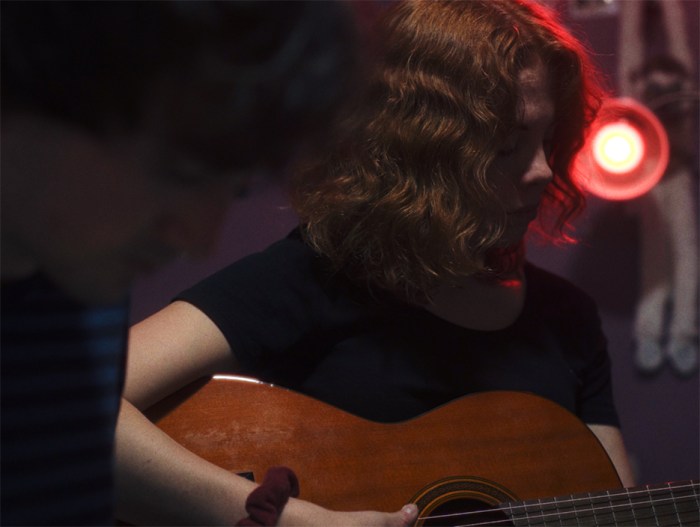
Orly Beringer in Jellyfish.
Jellyfish explores some heavy themes of depression and loneliness, and the film’s lead character is a masochist. How deep was your research into this kind of condition?
I didn’t do a lot of research. I’d had anxiety and depression that started around the time I was 19 or 20. I’ve been on antidepressants, and I’ve gone to therapy. I had a pretty healthy process of learning about mental illness and dealing with it in a healthy way, and that’s where most of the Henry character comes from. He doesn’t really have an understanding of mental health. There’s no point in the film where he really knows what he’s feeling or what’s going on with him. It just bats him over the head. He feels these things, but he doesn’t really understand that he could have some kind of mental illness. That’s what I set out to do with this character. I didn’t want it to be a movie where you explicitly go, “Oh, this guy has clinical depression, and he needs to boost his serotonin.” I didn’t want it to be that. I just wanted it to be a movie where you could feel what it feels to be depressed through this character. Every day could possibly be the same day for this character, and he doesn’t really have an interest in anything. And then he hurts himself on some level. His masochism is a form of self-harm, even though he doesn’t hurt himself technically. The act of asking other people to basically destroy him is how I wanted to convey the emotion and feeling of wanting to hurt yourself, and that feeling of uselessness and inadequacy and that this is how you’re supposed to be treated.
There are always risks involved in shooting any form of physicality on film. How difficult was it to shoot some of those physical scenes?
It was challenging. It was the first time that any of us had done anything like this. I had to do a lot of research for that, because normally in fight scenes, in any movie, the two people are fighting each other and there’s a contest going on. But in this situation, it’s just this guy letting it happen to him. So there’s no self-defence element to it. Through all of my research, I couldn’t really find anything that would teach me how to portray that and how to shoot that. So it was a process of figuring out how we would frame those scenes, how close we would put the camera to the action, and what kind of blocking we would do in order to make it seem realistic. And also how to make it feel impactful. We wanted it to look like he’s being pummelled and that it’s all very, very, very painful. So there was a lot of rearranging scenes. I told Aidan, who plays Henry, to feel like he is this little puppet that’s being thrown around. And I’d give directions like, “Imagine you have a bunch of broken glass shards in your stomach, and every time you move, they shatter a little bit and cut your insides.” So there were a lot of creative workarounds like that. It was all just trial and error in the end.
Your lead, Aidan Rynne, does an exceptional job here considering it’s his first film. Tell us about Aidan’s casting.
I did not expect him to do such an excellent job with this movie. He really, really is excellent. He’s not an actor. I met him when we were studying at ECU. He’s also on the film director route, but I had seen him in a friend’s film. It was a 45-minute feature, and I remember watching him and going, “Wow, this is not the guy I know from class. He’s so good!” And when I asked him to do the film, we began the whole process of rehearsing and seeing how he’d react with our other actors. He really threw himself in there. There’s one scene where he’s at the sink, and he’s touching his bruises on his stomach, then he punches them. That part is scripted. He does punch himself in the script, but when we actually shot it, I was like, “You just throw your fist at your stomach but pull back so you don’t actually hit yourself.” But instead, he actually just started hitting himself, and I was a bit worried at first, but he just did it. I didn’t ask him to. It ended up becoming this thing for the rest of the shoot. Every time we were going into a fight scene, or we were going into a scene where it needed to look like he was in pain, before I called action he would just start punching himself in the stomach to get into the mindset of it. I was like, “Should I be letting him do this?” But at the same time, I knew I should make the most of it.
There are a few times throughout the film where he really goes above and beyond for the film including the night scene where he falls into the Swan River. That’s a big ask for any actor.
[Laughs]. He was not happy. That was probably the most frustrated he was during the whole process. We had visited maybe four or five other jetties at night, and they were full of people. Some of the jetties we visited were on the shoreline, and there were rocks just below the surface. And because we’d visited so many, it was getting quite late. Eventually, when we got to the jetty we used in the film, which is Applecross Jetty, there was no one around, so we knew we had to shoot it there and then. We noticed in the water there were some crabs, and we spotted some jellyfish. Aidan didn’t want to get stung by a jellyfish. I joked that it’d be thematic if he got stung by a jellyfish. [Laughs]. It was around 2 am when we shot the actual part where he falls in. It was very cold. We were cold ourselves standing on the jetty, and he got drenched. When he comes up with the blood on his hand, that obviously had to be a separate take. We had to put the blood on his hand, and it meant he had to come up, wait two minutes for us to apply the blood, climb back into the water, then wait for me to call action and then do that whole bit again. I’m very grateful for everything he did in the movie. I don’t think I could have done this movie with anyone else.
Did Aidan really play the piano for the film?
Every time you see him playing the piano, he’s actually playing the piano. The music element of Jellyfish was very, very important to me because I really love La La Land. It’s one of my favourite movies, and I love the way that [composer] Justin Hurwitz uses the score. It’s a powerful motif throughout the film. I had written the main melody of Jellyfish into a piano piece, which is the piece he plays after he buys the piano from the garage sale. Knowing that Aidan couldn’t play the piano, I had to actually teach him. I always knew I wanted the character to play the piano, and Aidan has a little bit of music knowledge. Aidan can play the guitar, and I think he has a bit of musical intuition, so picking up a piano for him was relatively easy. But I also had to do a lot of work actually teaching him how to play this specific melody because he can’t read notation. I played classical guitar at school and I can read notation. I wrote the theme in notation, but he couldn’t interpret it, so I ended up having to make a video demonstration for Aidan to learn. We went through many, many piano lessons until eventually, he got it down and could play the whole thing. He does a very good job of it. He did it pretty flawlessly for a first-time piano player.

Aidan Rynne in Jellyfish.
Talk us through composing music for your own film. Would you say you have a better understanding of the film’s emotional beats as the film’s creator?
Yes, for sure. I didn’t compose it by myself. I did it with my friend, Christian Colgan. I can say I definitely have a more solid understanding of how emotional I want the music to be because I have a better understanding of the story as the writer and director. And I think that the motif that lent itself to the thematic elements of the story about loneliness and about longing and finding something you love, formed the backbone of the score because you would’ve heard that theme pop up nearly every time there was music. And since I wrote that theme very early on, I could play with it a lot, and Christian also used that theme for most of the stuff he wrote for me, and we ended up being able to make a storyline within the music. Every subsequent time you hear it, there’s a variation on it. And then eventually, by the time you near the end of the film, all the musical elements that have played up to that point come together. In a way, it’s like a resolution to the music because his story is him learning to appreciate playing the piano and getting into music. For the music to grow in that way and for it to reach this high point was important for the story’s development and his own personal growth in the movie.
Amongst the film’s melancholy is this bubbly, shining light in the form of Orly Beringer, who plays Maddy. Was that the brief you gave Orly?
Orly’s character actually morphed and shifted a lot from the beginning to the edit because initially when I showed her the script, her feedback was that she hated the character and she thought Maddy was a bit of a manic pixie dream girl, which I completely agree with. The first iteration of her was that she was just there to introduce music to Henry’s life and be the romantic interest. But aside from that, she didn’t really do that much. And it was during shooting when Orly kind of brought more of her own personality into the character, and I was very happy for her to do that. We all really encouraged it, and her character changed tremendously from how I originally wrote her. She became an amalgamation of that character and herself. The scene where Maddy and Henry are sitting at a playground and she’s saying that she wanted to get a mantis shrimp instead of a fish, that part is just because there was one time after a shoot where Orly just started going on about mantis shrimps. Orly really likes mantis shrimps, and she was telling me all these fun facts about them. And then I realised that Maddy was more interesting when she became this really quirky person who has her own things going on, and she has very niche interests, as you can tell from the really shitty post-punk song she plays in the car. [Laughs]. She’s just this really eclectic little person. And it was more interesting when Orly lent into that instead of being just the romantic interest or the “manic pixie dream girl.”
As if you didn’t have enough to do on this film, you also animated those brilliant animation sequences in the film.
That was very hard to do. I animated that whole sequence myself. I’m guessing you saw Rachel Lim credited as an animator also?
I did.
Rachel’s my girlfriend. She animated the credits for me, and she did some of the titles, but the animation sequence that happens in the middle of the film when Henry gets knocked out, I did all of that. That was a process because I don’t animate. I’ve never animated. I had to learn that from scratch just to do that one sequence in the film. I downloaded Adobe Animate and I had to learn how to animate from the ground up. I had a Wacom tablet that my mum didn’t want. So I used that, and it took a month and a half to animate. I had to pause editing, colour grading, sound editing, and music just to work on this one silly little one-minute animation. At some points, I wondered if it was really worth it to do this one minute of animation for how much time I was spending on it. But I think it turned out really nice. I think what I wanted to communicate was that Henry was this entity that just exists and he has this internal aid of wanting to pursue happiness. That’s his drive, and putting him into animation as a jellyfish, I think, elucidates that idea through the animation.
LifeLine is an incredible Australian service that has saved countless lives. I love that you’ve included LifeLine here as an outreach for Henry. The use of LifeLine resonated with me, as I’m sure it will with many viewers. Was there a reason you wanted to specifically include that service here?
Henry spends the whole movie in doubt or in denial that he is mentally ill and he has so many terrible coping mechanisms to deal with. He’s not really doing the right thing. And that last scene where he calls the suicide line is meant to be this part where I wanted it to bring it back to recontextualise the whole film and have it be a trauma dump in a way. It’s the only time you get an insight into what he’s feeling. LifeLine is important on two levels. One is that’s where the character is finally revealed in a way, and everything he’s done up to that point is kind of sick. He needs help. And then on another level, the whole purpose of the film is a personal expression of my own experience, and I think it exists as a film to be consumed. It’s a premise that gets you in to watch the movie, but then I want it to be more than that. I want it to be something that you feel for and something that you can bring back into your own life. LifeLine is a real service. I wanted it to feel very real, and I wanted it to be like this really down-to-earth sad guy who’s calling for help. I think that will resonate with a lot of people.
Jellyfish will screen at Luna Leederville in Perth in Thursday, 18 July. Details here. Keep an eye on cinemaaustralia.com.au for future screening announcements.
If you enjoyed reading this feature article as much as I loved publishing it, please consider supporting Cinema Australia’s commitment to the Australian screen industry via a donation below.
I strive to shine a light on Australian movies, giving voice to emerging talent and established artists.
This important work is made possible through the support of Cinema Australia readers. Without corporate interests or paywalls, Cinema Australia is committed to remaining free to read, watch and listen to, always.
If you can, please consider making a contribution. It takes less than a minute, and your support will make a significant impact in sustaining Cinema Australia as the much-loved publication that it is.
Thank you.
Matthew Eeles
Founder and Editor.Make a donation here.

ADVERTISEMENT: Click for details.


 Cinema Australia
Pingback: Giles Chan puts pain at the centre of his impactful feature debut Jellyfish - The Curb | Film and Culture