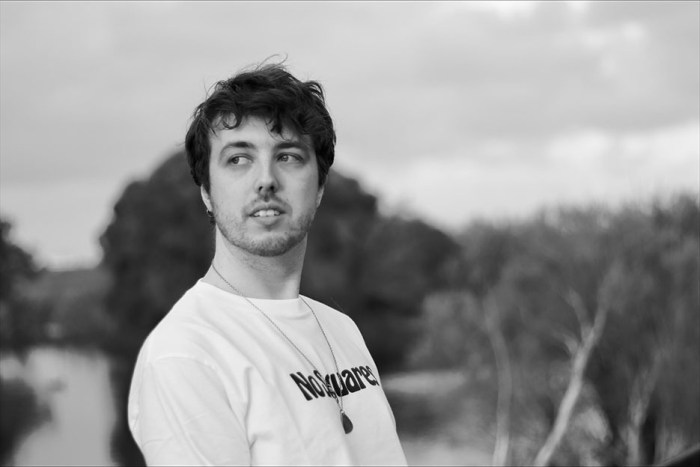
Taylor Broadley.
Taylor Broadley’s debut feature film, Stubbornly Here, is a surreal and touching journey through the eyes of three teenagers in small-town Australia. The film follows Sunny (Cleo Meinck), PJ (Nathan Di Giovanni), and Floyd (Jonathan Maddocks), who band together to escape a mysterious crisis and their vanishing classmates. Their adventure leads them to a quirky motel run by Terry and his partner Sugar, where the trio face their deepest fears and uncertainties.
Broadley’s journey to filmmaking is as interesting as the film itself. With a background in musical theatre, he graduated from Murdoch University with a degree in screen production before diving into the theatre world, writing and directing original musicals. His desire to make movies eventually drew him to the WA Screen Academy, where he refreshed his skills and began working on Stubbornly Here. Fun fact: Stubbornly Here is an evolution of his second musical, Boy Wanted, sharing themes and characters.
The film’s blend of magical realism and coming-of-age drama showcases Broadley’s inspirations from authors like Haruki Murakami and Kazuo Ishiguro. This influence gives Stubbornly Here a nostalgic and dreamlike quality allowing the audience to deeply connect with the characters and their growing pains.
The casting for Stubbornly Here is seriously impressive. Nathan Di Giovanni, Cleo Meinck, and Jonathan Maddocks deliver world class, authentic and heartfelt performances, creating a strong on-screen chemistry. Combined with Stubbornly Here’s striking black-and-white cinematography, they bring a timeless charm to an unforgettable indie gem.
With Stubbornly Here, Taylor Broadley has crafted a heartfelt and introspective film that explores universal themes of identity, fear, and the desire for freedom.
Cinema Australia recently caught up with Broadley to discuss the making of Stubbornly Here ahead of the film’s world premiere at the Revelation Perth International Film Festival on Thursday, 4 July. Details here.
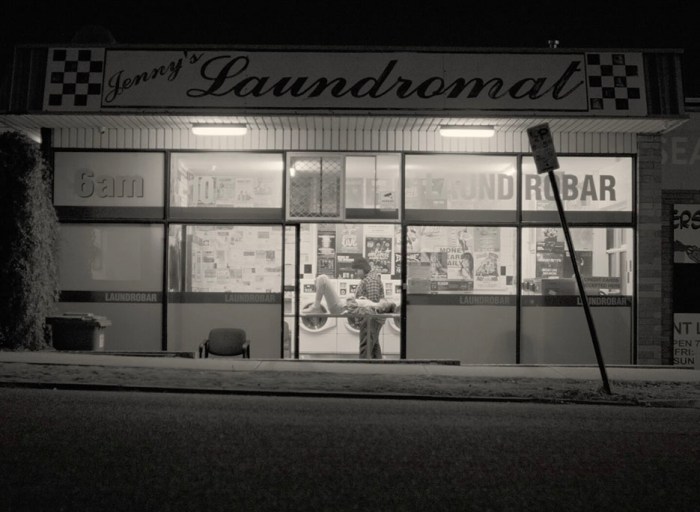
Stubbornly Here.
“It was very much an emotionally driven shoot because we were flying by the seat of our pants. If we felt it was right, we didn’t overthink anything. We just did it.”
Interview by Matthew Eeles
I’m keen to know about your personal journey that has led you to making your first feature film, Stubbornly Here.
I knew I wanted to make movies pretty early on, from when I was 13 or 14. So, straight out of high school, I went and did an undergrad in screen production at Murdoch University. But while I was there, I fell into theatre. I was doing way more acting, working as a theatre technician, and doing a bunch of directing and writing. I ended up in theatre for quite a few years, writing, directing, and composing some original feature-length musicals performed at the State Theatre, which was really, really cool. I cut my teeth in a weird deep end that was a little different from film. But after doing that for a while, I missed making movies. So, I decided to go and do my Master’s at the WA Screen Academy for a year and a half, which refreshed me on how a set works and retaught me a lot of the basics—things I felt I’d lost over the years working in a different medium. Then, I hit a point straight after that course where I wanted to make a feature film straight away.
Considering your musical theatre experience, did you ever consider making your first feature film a musical?
[Laughs]. That’s definitely something I want to do at some point, and I’m toying with things at the moment and how I’d like to do it. My second musical was Boy Wanted, which dealt with very much the same themes as Stubbornly Here. Some of the characters even have the same names, and I adapted Stubbornly Here from that Boy Wanted script. I was looking at taking that script and seeing if I could do a filmed version of it. Boy Wanted was set in bedrooms, so I knew I could figure out a way to do it. In developing it and completely stripping it back and breaking it all down, it evolved into something else and became Stubbornly Here. So, in a way, my first feature film did evolve from a musical.
Before we move on to Stubbornly Here, I want to ask you about Runt, because there’s a lot of hype surrounding Runt at the moment. What was your involvement in that film?
I was only on Runt for two days. I was an art department assistant. A friend of mine was working in the art department while they were shooting in York. When they moved the production to Perth, they needed more runners, so they got in touch with me, and I jumped on for a couple of days. That was cool. I saw the trailer a couple of weeks ago, and it looks great. So that’s a cool thing to be a part of. I was a little separated from the set because I was very much an assistant. I got to see the infrastructure of a film set, though. Something I really took away from my experience was seeing how many cogs are turning to make a set like that work. I was very rarely on set because I was running things to and from set while we were bumping in and setting things up. But seeing how many people were in charge of different departments was wild. I’m sure it’s small compared to something like a Marvel movie, but it seemed gigantic while I was around.
I read something by you recently which I absolutely adore: “Stubbornly Here feels like a home movie of that trip you and your friends took ten years ago if it was dictated by Haruki Murakami.” Were you the friend who always had a camera in their hands, filming everything?
I would love to say I was. I wish I was, but truthfully, I didn’t grow up with a lot of money, so I didn’t have a camera too often. I like to think I had an internal camera, and I am a very nostalgic person. I look back on everything. I’ve got playlists of songs that I was listening to in 2010, which send me back very easily. I’m a very nostalgic person, so I’ll talk to some of my oldest friends about, “Hey, do you remember this thing when we went down here and did this?” And they have no idea what I’m talking about. [Laughs]. I have a really specific memory. I guess I wanted a sense of nostalgia and memory to play into Stubbornly Here.
Why is nostalgia so important to you? And I guess I ask that because people who are nostalgic have often had a positive upbringing.
I don’t know. Sometimes memories can feel a bit more tactile. You’ve got more sense memory to certain moments growing up and things that you don’t realise are important at the time. As I get older, I’m able to look back and picture exactly what I was seeing on that day at a certain time. I don’t think it’s so much that nostalgia as a feeling is important, but memory is, and having those core memories and knowing how to recognise them means you’re more likely to be more present every day. If you’re constantly thinking short term and you’re thinking about how you’re paying rent this week, or what work is going to be like, or who you’re voting for this year, all these monumental responsibilities in the short term feel so important and blinding. It feels like you’re never quite in the good times and the good times have already happened, but that’s not necessarily true. The good times are always happening. There are always memories to be made. There’s always growth to be had, and I think being able to see that and remember that and look back fondly on things that didn’t feel important at the time means you can see a bit more clearly every day.
Are you inspired by Haruki Murakami’s work?
I am. I only got onto his books in the last couple of years, but him and Kazuo Ishiguro, who wrote Never Let Me Go and The Remains of the Day. Reading their work, it feels like the story beats they’re implanting aren’t story beats. They feel like memories. So, when you get to the end of the book and you’re reflecting on things that happened earlier on, it doesn’t feel like you’re remembering plot points or story beats. It really does feel like you are remembering memories, which I really, really like. That’s something that I haven’t really gotten to experience too much in too many movies. It’s something that I found much more in novels. So, I guess in terms of writing Stubbornly Here, that really came into play because those books were what I was reading at the time I was writing this film. It became very much this meld of these two different forms. But those two write a lot of really cool surrealist stuff. It’s very normal, everyday stuff. It’s very still life and true to life and a slice of life, but there’s also elements of surrealism like fish raining from the sky, which I think is just a little bit special. I really like the genre, and I really want to keep making stuff that plays into that a little bit. I find it so interesting.
One genre that we don’t experience too often in Australian cinema is magical realism, which you experiment with in Stubbornly Here. That’s obviously inspired by Murakami and Ishiguro’s work.
Definitely. The magic realism is something I feel comes from very classic cinema that we don’t see very often with modern cinema. Charlie Chaplin would do it all the time, and Buster Keaton would do it a little bit. You’d see it in French New Wave and films from the sixties. That stuff is really cool and unique and a really cute, sweet, and endearing way to tell stories. I’m a big fan of magic realism.
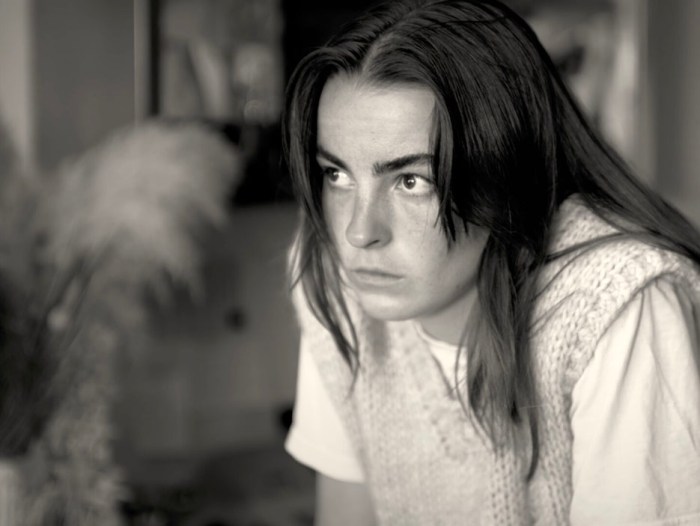
Cleo Meinck in Stubbornly Here.
Stubbornly Here is a coming-of-age drama with themes of mortality. What inspired these particular ideas?
I was diagnosed with type 1 diabetes when I was 20 in 2018. When I was 23, all of a sudden I was doing theatre. I was working gig-to-gig, and I felt like I had plateaued a little bit the year before. Then something happened to me, and I ended up in the hospital. My anxiety was going through the roof. Every night, I was having really, really vivid nightmares that I was going to die that year. I was convinced I was going to die. That whole experience woke me up a little bit, and that’s the year I wrote the first musical. I did The Killdeer musical, then I wrote one the year after that and started doing film. I just had this insane drive at this time, and I felt like I had to do so much because my world could end at any moment. I could die in a car crash tomorrow for all I knew. So, why am I not living for myself and doing what I want to do and making what I want to make? That thought process kicked off everything, and I wrote about those things in and out of different projects over the years. But Stubbornly Here is, to me, the last big combination of all those thoughts. I feel like I’ve finally got it out of my system now.
The anxieties that these characters experience in the film are much clearer to me now that you’ve explained this. You’ve incorporated these anxieties into Stubbornly Here beautifully.
Without spoiling anything, there’s a turning point in the film where this monumental disappearance happens, and all of a sudden these characters go from everything being great to, “Oh shit, what are we doing? Why are we here? What’s happening?” It comes suddenly out of nowhere, just like I felt in 2018. I was struggling to capture that feeling, but I think I’ve made it work.
As well as anxieties and mortality, I’m wondering if there are also political motivations behind this film. I guess I ask that because the older people featured in the film really don’t seem to care about these teenagers going missing, including their own children.
Less so political motivations and more sentiments. I mean, the musical that Stubbornly Here developed out of originally featured a plot about these kids protesting after a school shooting and how they’re not being listened to. That was the catalyst for the original idea. But when I was stripping it back and developing Stubbornly Here, I realised it’s not just about circumstances. I did an interview with Andrew Pearce from The Curb recently, and he asked me why I picked 18 as an age for things to change with these characters. I guess that was a subconscious thing that I didn’t realise I did. But there was this feeling that when you turn 18, there’s all this pressure on you. What’s your career? What’s your job? When are you buying a house? What’s your next path? And there’s all this expectation for young people to be upstanding members of society who contribute to the economy. But politicians and people of power don’t listen to them or value their ideas or their anxieties and worries, be it climate change or foreign policy. But young people are smart and very unfiltered; they’re not caught up in the bureaucracy of what’s right and what’s wrong. They just see something that feels wrong. So the idea that we devalue their opinions is crazy to me, and that very much feels like it happens around the time you are hitting 18 and leaving high school, being told you have to do all these things within this timeframe when in reality you don’t have to do that. You can do whatever you want. You can take all the time you want. There’s no rush. I think it contrasts the pressure that young people get from older generations and how much they’re actually valued.
Can you tell us about casting Nathan Di Giovanni, Cleo Meinck, and Jonathan Maddocks? You were gifted an extraordinary cast here, and I can’t wait to see what these three do next.
They’re incredible. I love them to death. I feel like I owe so much of Stubbornly Here to them. We originally went through the traditional casting process and did self-tapes, chemistry reads, callbacks, and all of that for over a month or two. We had set our cast and started rehearsing, and it was going really, really well. They were all WAAPA students. They had all signed on to make Stubbornly Here, and everything was going really, really well. But then their agents told them they couldn’t be in Perth over this period that we were going to shoot because they had to be over east for pilot season. I wanted them to go, and I wouldn’t have dreamt of making them stay. This was a no-budget feature film. I wouldn’t stop them from auditioning for Netflix. [Laughs]. They were lovely. They helped me recast, and they’ve kept in touch and been very supportive of the film. I love that original cast to death. But this new cast is just as amazing. I pretty much got the call that I would be losing my cast two days before our first shoot day. I had cast Jonathan Maddocks a week before filming. Jon and I had been friends for a number of years. We did theatre together, and I’ve directed him before. I knew Cleo and Nathan through another friend of mine. I’d never met them before, but they came recommended. So I contacted them and got them to send a self-tape, and I was very much just like, “Send in whatever monologue. It’s fine. Just show me something and I’ll see if you fit.” Both of them said, “No, don’t be ridiculous. We want to do the reading. We want to do this properly.” So they learned the reading and sent a self-tape that day, and both of them were perfect immediately. I had a board, and I put all the faces next to each other. I looked at them, and I knew that this new cast looked right. There was very little holding me back. I met Cleo the first day of shooting. She showed up to set to film her first scene, and that was the first time I’d met her.
Unbelievable.
It really was. And they crushed it. One of the images on one of our posters of them walking down the street was on our first day of shooting. There’s a scene where they’re throwing bread into Jon’s mouth. That was their first time meeting. So immediately they clicked and it worked. I knew then that there was no need for me to worry. I knew that everything was going to be great. The three of them clicked immediately.
Did that give you confidence to trust your instincts as a filmmaker?
So much of Stubbornly Here was done off of instinct when I started writing it. I didn’t even know if I was going to be directing it. I didn’t know if I could. It was just me doing an exercise of adapting something I’d worked on before to see if I could make a feature script out of it. So my only plan for that year was just to write the script and have the script be good. Then at a certain point, I realised that this felt right. I knew I needed to make this and just go for it and see what happens. Then the same thing happened with my cast, and it was the same with the crew. I messaged my friend, [cinematographer] Angus Strachan, who I met when I was 11 years old, and we’ve been friends for years. He was living in Victoria, and I messaged him on a whim and asked him if he’d come to Perth to shoot a movie with me. He said yes straight away, no hesitation. So much of it was made on instinct. For so much of this entire process, I was learning to trust myself and my instincts. It was very much an emotionally driven shoot because we were flying by the seat of our pants and asking ourselves, “Is this right? Does this feel right? Does this feel emotionally honest?” And if we felt it was right, we didn’t overthink anything. We just did it.

Cleo Meinck and Jonathan Maddocks in Stubbornly Here.
How much of the performances were scripted compared to improvised?
All of it is scripted. I am a big advocate for letting actors paraphrase and adapt the lines to how they think would best suit the characters. I’m not a stickler for my dialogue being word-for-word all the time, but there are very few fully improvised scenes in the film. There’s a scene in the film where Jon and Cleo’s characters are playing a little song together with a banjolin, and a lot of people think that’s improvised. That is all scripted. The song and everything is all scripted. But I also said to them, “Here’s the template. Here’s the song and everything. I’m just going to roll and I want you to hit these beats, but we can dress it up.” The pirate thing we came up with on the day where Jon puts a tissue over his eye and has tongs in his hand. We just thought that was funny. So we put that in on the day. But no, generally speaking, it is all scripted.
My film brain keeps going back to Clerks. With that film, you know every line of dialogue has come from a Kevin Smith script. Stubbornly Here didn’t feel like that. The dialogue felt much more natural and organic than something like Clerks.
I know exactly what you mean. I love how the dialogue works in It’s Always Sunny in Philadelphia and how they’re constantly talking over each other. It doesn’t feel like movie dialogue. Same with how Noah Baumbach or Richard Linklater write, where it doesn’t really feel like movie dialogue. The way they do that in Sunny is that they know the script so well that they can afford to do that in the delivery of it. They’re not actually making up the lines that they’re saying. Most of the time, it is all scripted, but they know the script so well that they can play with it in that way. And that’s what I wanted in Stubbornly Here.
Talk us through the banjolin scene. It looked like a lot of fun to shoot.
We shot that in two takes. Jon was furious with me that I kept that scene in, but he’s so good in it. He’ll do whatever it takes for a scene, which is why I love him. When I was younger, my friends and I used to hang out with a lot of music students. I went to a music school and played music myself. We all jammed, hung out, and made up little songs. I’ve still got a video on my phone of us at 14, making up a song down by what is now Elizabeth Quay. One of my housemates at the time owned a banjolin, and it’s the weirdest instrument. I thought it was so funny that I just wanted to put it in this film somewhere. Combine that with the pirate part of it and the lyrics, and it all ebbed and flowed and changed. But we only did two takes of that because each take was about seven minutes long. The version I’ve kept in the film is long, but it’s still technically trimmed down. I really liked those moments of just having a camera sit on two actors and just watching them for a little while. I always like that in movies. I think it’s really nice.
You worked with two cinematographers here, Angus Strachan and James Gillespie, who recently shot the excellent Outstanding Young Performers. Why two cinematographers? Was this an issue of availability?
Angus was going to drive over to WA from the eastern states, but because of logistics regarding travel and flight costs, getting over here was a bit of a nightmare. So I kept telling him he didn’t have to do this. He didn’t have to come over. It would be all right. But he wanted to come over. I really wanted him to work on this with me. Angus was always going to be the cinematographer. We had a few shoot dates before he arrived, so I thought I’d cover while he wasn’t there. Then I was talking with James, and slowly over time Angus’ arrival date got extended, so it ended up being a 50/50 split between James and Angus on cinematography duties. They both had the same vision for the film. They worked so well together, and they both very much did equal parts of the cinematography and absolutely nailed it.
You are aware of how rare this is, right?
[Laughs]. Oh, yeah. I’m super aware. I’m super, super aware. I was really worried that people were going to be weird about having two cinematographers. Would it change crediting if I try and get any additional funding later on? Or if someone tries to buy the film, is that going to raise questions? What’s going to happen? And it kind of reached a point where I knew it just felt right. They both did the work. They’re both crazy talented. They both did the job, so they should both get the credit regardless of what happens. And that feels right.
I have no issues with contemporary movies being shot in black and white. I actually love it. And I don’t have any issues with the 4:3 aspect ratio if it’s used with the right intentions. What’s your creative reason for shooting in black and white and in this particular ratio?
There are a few reasons for it. I wanted Stubbornly Here to feel like a story out of time. Yes, they use Zoom and mobile phones, but I didn’t want people to watch it in 20 to 30 years and feel like they were watching a 2024 movie. I wanted it to feel like the movies I was drawn to and loved from decades ago. So there was that classic timelessness reason to it. But also, I wanted to eliminate a lot of the distractions, and I wasn’t sure if our strengths were really going to be in the production. We had no money. We didn’t have a big company behind us. We didn’t have big light trucks. We had little handheld LEDs and a basic gimbal. We had very basic consumer gear. So making it in black and white and using that aspect ratio eliminated those distractions that people might look at and think, “Oh, that’s low budget. That looks cheap. That doesn’t work.” It eliminates that kind of thinking so people focus on the characters and the writing and the story we want to tell. A vertical frame like we’ve used makes you focus on people because people are vertical lines. We see people as vertical objects. We are more drawn to that in a vertical frame as opposed to a landscape. So that also helped as well.
You also managed to create this incredible sense of isolation throughout the film. There’s a particular scene in Mandurah on the estuary where there’s not even a boat in the water, and that place is always bustling. How did you achieve this?
I very much wanted to see no one other than these three main characters. There were so many people around that day in Mandurah. There were boats, there were so many people on tourist tours. People were everywhere in the frame, but I didn’t want to see any of them. I wanted these characters to feel alone because, again, when you’re on a trip, when you’re that young and you’re doing something with your friends, even if you’re in a big populated space, it doesn’t feel like the world exists. It just feels like you’re in your own little bubble with them. I didn’t want to see anything outside of that. And the 4:3 aspect ratio helped with that as well. We shot around everyone in the background. We didn’t have the budget to block off streets. We just had to wait for a time where there weren’t very many people around so we could get clean takes. Or we would frame where we couldn’t see the background too much. It’s also partially why the camera is locked off so much. We don’t travel very often with the camera. There’s a shot where Cleo is waiting for Jon and Nathan’s characters to pick her up in the middle of the night. That took eleven takes because I didn’t want any other cars on the road. It felt weird for it to be 4:00am and seeing other cars roll up behind them. So every take we did, we would get so close and then a car would come down the street. And so we just kept shooting until we got no one, and then eventually we got no one and it felt right. Keeping them alone and isolated always felt like the right thing to do.
How did you get access to the motel? You seemed to have free rein over this place?
We basically did. So much of everything that’s happening with Stubbornly Here makes me pinch myself. In everything that I’ve been taught about how feature films are made, none of this should have happened. This movie should not exist by any rules of logic, and yet it does. I just started contacting motels that looked the part in Perth. Literally the very first motel I contacted approved us filming there. I just had to make sure I advertised them and credited them. It was the Flag Motor Lodge in Perth. They were incredible. They were so nice to us and so good to us. John, the owner, was just so cool. He recognised that it would be something different for the motel. How often does a movie just happen to be made at a motel? He very much gave us free rein, and we were given access to two rooms. He also let us use the pool whenever we wanted because it was really hot. [Laughs]. After shoots, we would just hang out in the pool. It feels stupid that we got completely free rein over going wherever we needed to go. And the staff knew all about us, and they were totally happy to let us do what we needed to, and we stayed out of their way. We didn’t want to encroach on them doing their job. So we hung out for two weeks at this motel, kept to ourselves, and made this thing. We had guests around. We had guests in cars pulling in. We had kids playing in the pool while we were filming on the other end of it. It was a full working motel that we were shooting around.
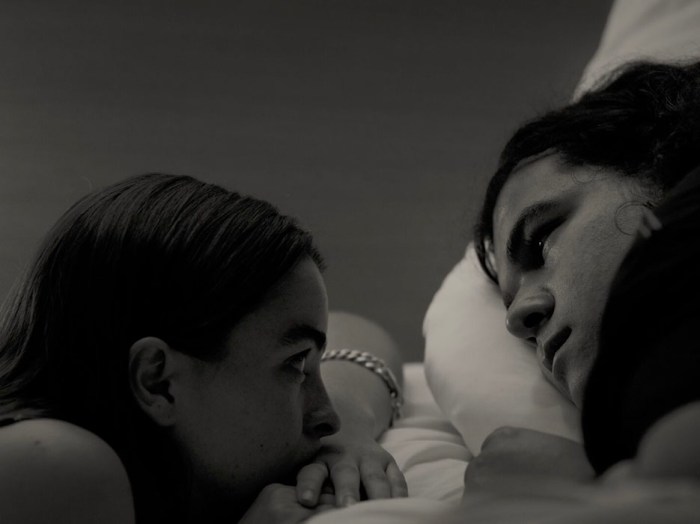
Cleo Meinck and Nathan Di Giovanni in Stubbornly Here.
As well as the deep messages featured within the film’s subtext, there’s also a message here about independent filmmaking in general. This is a film that says to independent filmmakers that there is an audience for films like this. Are you yourself drawn to micro-budget, independently produced films like Stubbornly Here?
One hundred percent. Some of the most unfiltered, honest stuff is what I’m drawn to. I know it has a bigger budget than I had, but I am really looking forward to Hundreds of Beavers at Revelation Film Festival because it doesn’t look like anything else, and they very much look like they just made what they wanted to make. I struggle to imagine a major production company or a government funding body approving a live-action Loony Tunes cartoon in black and white that’s mostly silent with big beaver costumes. [Laughs]. And that, to me, is so exciting and weird. Movies in the French New Wave, that’s what they were doing. They were shooting in real locations where real people were. I love Sean Baker, who made The Florida Project, Red Rocket, and Tangerine. He does really, really good stuff, and he knows how to capture real people really, really well. I’m totally drawn to that. I think there is definitely a market for it. I’ve been extremely lucky with people being excited for Stubbornly Here and being very complimentary. I feel insanely lucky, but there has been a little bit of a pushback from people asking, “Why is it in black and white? Does it have to be in black and white? Does this have to exist in this way?”
Where’s the pushback coming from? Distributors?
I won’t name names, but yes, it’s from a sales and distribution point of view. And look, they’re just doing their jobs. I totally get it. The cast are not names yet, but I swear to God they will be. So it is absolutely a risk to say, “Here’s this coming-of-age, micro-budget, black-and-white movie.” But I do think there is an audience for it, even just on the black-and-white front. On the homepage of Netflix, you’ve got Ripley, for example, which is black and white. So I think there is an audience and a desire for micro-budget, indie filmmaking that feels a little bit more tangible and feels like there are mistakes in it and feels like it’s tactile and someone actually made it. I think the audience is out there. The people who make these movies are trying to express something and get something out there and purge something they’re trying to share, which so often you might not get from movies that have a million layers of bureaucracy to them in order to get made. There is a very unfiltered rawness to these movies, especially now when there is so much content all the time. People just want to feel something and to see themselves on screen and to relate somehow. So I think these kinds of movies definitely do have a lot of value for sure, and there’s a lot of variety in them as well.
You’ve said publicly that there was an industry figurehead who told you to quit halfway through filming. Was this motivation for you to keep going?
Yeah, a little bit. I don’t want to say that this film was driven by spite, but they were wrong. It wasn’t an innate anger response like, “Well, I’ll show you. I’ll prove you’re wrong.” But it was definitely just an immediate response to them saying, “This isn’t a movie. This isn’t the way to go about it. If this doesn’t go well, you won’t get a second chance.” And I was like, “Well, I don’t believe you.” There wasn’t any part of it that really sank into me as true. I just had this feeling that they were wrong. I didn’t believe it. I’m just going to keep doing my thing because it felt right. I had that a little bit with the musicals as well. I had good friends of mine who I’m still really, really close with say to me, “I don’t know if this is ever going to make it to stage. I don’t know if this will happen.” And my response was always, “No, no, it’ll happen.” And not to play on a pun, but I think I’m just that stubborn. [Laughs].
You’ve said that this film has been made with the TikTok generation in mind. You co-wrote the TikTok series The Curse of Baba Yaga with Christopher Colley. Do you see social media platforms like TikTok playing a bigger part in the future of filmmaking around the world?
To an extent. TikTok is very much an amazing tool for demystifying making art and making films, and I think platforms like TikTok and YouTube remove some of the gatekeeping that the industry can have and how learning to make art can feel restrictive at times. Sometimes filmmaking can feel like this exclusive club you only get to be in if you know the right people, but YouTube and TikTok expose how to make movies and what techniques you could use. I’m not sure how much they play a part in terms of a significant platform for narrative stuff, though. I think they are definitely more of a factual or personality-driven platform. I do very much feel like they’re amazing platforms that provide a lot of accessibility and insight into how to make films, but I don’t necessarily think that’s where films or series are likely going to end up going forward. We saw that with YouTube when they launched YouTube Red, which became YouTube Premium. They funded all these creatives to make these narrative series. I think they did a really good job, but the audience wasn’t really there. That’s not really what those platforms felt like they’re for, so they didn’t really land so well. And I think that’s something we might see more of with TikTok, Instagram Reels, or Snapchat. They’re not really the right platform for a narrative series or a feature film, but they’re a really good testing ground for ideas and to share behind-the-scenes stuff. I haven’t done any yet, but we’ve got mountains of footage from making Stubbornly Here that I’m planning to post on TikTok. So I think that they’re going to be extremely useful platforms going forward, even if not necessarily in the way they’re being used right now.
Stubbornly Here will celebrate its world premiere at Revelation Perth International Film Festival on Thursday, 4 July. Details here.

ADVERTISEMENT: Click for details.


 Cinema Australia