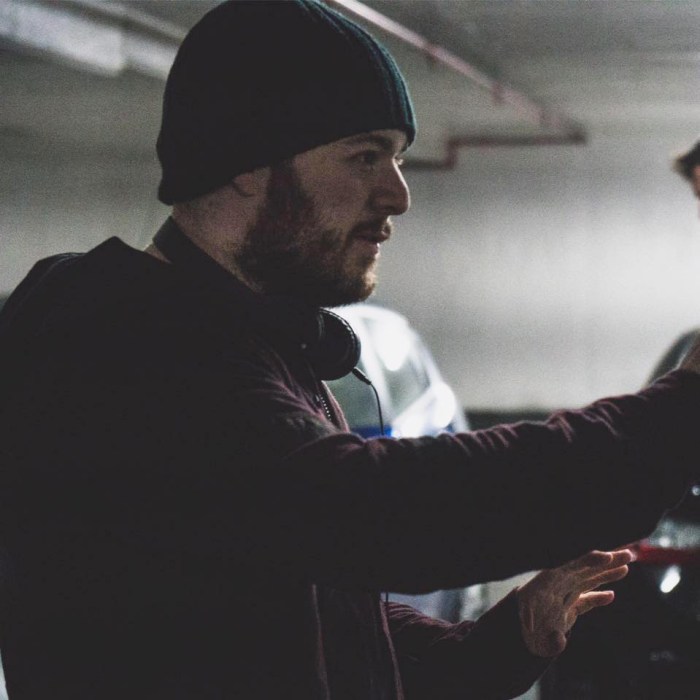
Damien Giglietta.
In the confronting new Australian film Mercy of Others, six friends reunite after a friend’s murder, only to confront their darkest secrets and deepest fears. Trapped in a night of psychological terror, they must face a long-buried deed to survive, revealing that every action carries haunting consequences.
At the helm of this intense thriller is Damien Giglietta, an emerging talent in independent filmmaking whose journey into film began early, fuelled by a passion for storytelling. Despite Giglietta’s family’s trade-driven background, his early love for horror movies, especially slashers, set him on this path. “I grew up in a very sports-driven family,” Giglietta tells Cinema Australia, “but when I hit my early teens, I fell in love with horror movies. I remember writing my own versions of slasher films at fifteen.”
After dropping out of high school, Giglietta pursued his passion through film school at Central TAFE in Perth. Although initially rejected from the directing stream, he immersed himself in various roles, gaining invaluable experience. “You can’t just read a book about directing and think you’re a director,” he says. “You need to fill your toolbox with as many tools as possible.”
Giglietta’s films often explore the complexities of human emotions and relationships. His understanding of these elements is evident in his work, which frequently delves into themes of circumstance, survival, and socio-economic disparities. Mercy of Others is no exception, reflecting on the long-term repercussions of bullying through its chilling narrative.
Passionate about nurturing new talent, Giglietta prioritises working with young and emerging actors. For Mercy of Others, he cast a mix of seasoned and undiscovered talent, believing in the importance of giving opportunities to those eager to prove themselves. “The Australian film industry is very small and can be very cliquey,” he explains. “I wanted to provide projects for talented people who were starved of opportunity.”
Damien Giglietta is certainly a filmmaker to keep an eye on. Cinema Australia recently caught up with the talented filmmaker to find out more about the making of Mercy of Others.

Daniele Clements in Mercy of Others.
“It was one of the greatest experiences ever. It taught me so much about filmmaking.”
Interview by Matthew Eeles
You’ve said that you grew up in a creative environment. Can you elaborate on that for us, and talk us through some of your creative influences growing up?
For me, it was interesting. I grew up in a very sports-driven family, and I played a lot of sports growing up. But when I hit my early teens, I fell in love with horror movies, especially slashers. I remember being about fifteen and writing my own versions of slasher films. At that time, I didn’t really know what I wanted to do with my life. My family is very trade-driven. My old man was a tow truck driver who ran a panel shop. My brother followed in his footsteps. My sister was a hairdresser, so it wasn’t really a creative environment; they weren’t into entertainment or arts. But it was a very encouraging environment. From quite a young age, I started freelancing for television at a community TV station. That was when I got really creative and started watching a lot of low-budget movies. I fell in love with low-budget filmmaking. I fell in love with early Robert Rodriguez, John Carpenter, and Quentin Tarantino—the time in their careers when it was all about stretching the dollar for themselves. I’m a high school dropout, so I had to wait a couple of years before I could actually go to film school. Once I was in film school, I learned very quickly that this was very much my future. There was no backup for me. I wanted to be a filmmaker by any means necessary. I made a lot of short films on a shoestring budget, and then I launched my own production company to make my first feature film, TKG: The Kids of Grove.
Which film school was it, and how was that experience for you?
It was at Central TAFE in Perth. It was a three-year course. I actually got knocked back from the directing stream. They only allow five directors, five producers, and five DOPs for the final year. I applied for directing and ended up getting knocked back and finishing in sixth place. That’s why I named my production company Six Placed Pictures. A lot of my lecturers told me they were surprised I didn’t get in as a director. I was accepted in as a production designer. I had no intentions of being a production designer, but it was a great way to get access to all their equipment and make my own movies while I was there. [Laughs]. But I ended up playing their game. I fully committed to production design, and I worked on a lot of films as a production designer. It was one of the greatest experiences ever. It taught me so much about filmmaking. I learned so much about working in different departments on a film set. I tried to work in as many departments as possible: camera operator, lighting, editing, and then obviously production design. That experience taught me that you can’t just read a book about directing and think you’re a director. You need to learn how to fill your toolbox up with as many tools as possible. And you only get that by experience.
You’re passionate about nurturing up-and-coming talent within the industry. How have you utilised such talent on Mercy of Others?
The Australian film industry is very small. It can be very cliquey, which makes it very hard for people to crack in. With my first two feature films, I made it a priority to include a crew of people that were hungry so that I could build a talented cast and crew to work with going forward. Talented people who were starved of opportunity so I could provide projects for them to work on. With Mercy of Others, we went into this film with very short notice. We were all overly willing. I was working with actors like Jack Martin and Vanessa Madrid who are extraordinarily skilled, but it surprised me the little acting they’d done considering their talent. So I wanted to find a way to expose this talent. To me, utilising undiscovered talent works as a way to expose this talent to audiences who may be tired of seeing the same actors in movies and on TV, and it works as a way to give people experience. With Mercy of Others, actors like Daniele Clements and Traccin Rameka deserve these experiences to get their names out there. People need to see what they’re capable of and what they can do because their work really is just extraordinary.

Traccin Rameka in Mercy of Others.
Mercy of Others explores themes of actions, consequences, and accountability, but it’s also a heightened and extreme example of one of the worst cases of the repercussions of schoolyard bullying. Does this comes from a personal place?
It comes from a mixture of things. I ran a talent academy from 2015 to 2019. We were working with a lot of upcoming actors who were in their early teens. I’d hear a bucket load of stories about bullying. Social media was getting really popular at that time, especially Snapchat, which was really creeping up on everyone. I was hearing some heartbreaking stories of kids who were being absolutely ridiculed and severely bullied. As for my personal situation, I was never involved in anything as severe as what Shaun is involved in in Mercy of Others. But often at school, I’d look around and see people who were copping it for no reasonable reason. I did take some inspiration from my own experiences and inserted them into Mercy of Others. The schoolyard flashback scene was a personal experience of mine. I watched a kid being bullied by a group of people at school, and the kid started throwing punches. I actually admired that kid for having the ability to fight back despite being outnumbered. So I guess you could say that Mercy of Others is a collection of stories and experiences that I’ve had and other people close to me have shared with me. I wanted to shine a light on some of the long-term repercussions of bullying.
There are no two characters the same in Mercy of Others. For the sake of the film’s narrative, each character has their own distinct personality. Considering this, how challenging was the casting process for you?
It was a crazy process. [Laughs]. I had met Jesse Aquiningo, who plays Connor, earlier. He was the easiest character to cast because he just fit that character so perfectly. The Jacinta and Hannah characters were the trickiest for me. They were very particular. We had a narrative of a queen bee for Jacinta, and when we spoke to Daniele Clements about this character, she was immediately pumped to come on board. We worked closely on developing this character’s traits of the queen bee. I found that the Hannah character was going to be very difficult to play. I felt out of everyone in the film, her inactions have led to the consequence that these characters find themselves in. It was just the way she was written. In terms of her casting, Caitlyn Lopes auditioned to play all three lead female characters. She showed some terrific work ethic. I knew this would mean she had what it would take to play someone as complex as the Hannah character. I’ve seen a lot of Vanessa Madrid’s work, so I knew she would do a great job with the Brooke character. We were actually meant to work together on another project before Mercy, but that film didn’t eventuate, unfortunately. As soon as Vanessa read the script, she immediately knew how she was going to play Brooke. The same goes for Jack Martin, who plays Aiden. I found the Ben character hard to cast. Dominic Di Paolo, who plays Ben, isn’t the most physically imposing man, but he has an MMA background. He does a lot of Jiu-Jitsu. Dom’s eyes are menacing, he’s very expressive, and I didn’t mind that he wasn’t that stereotypical, tall, muscle-bound, high school jock. Dom made Ben work so well. Dom also had great chemistry with Caitlin, which worked out well for their character dynamics.
You’ve worked with Jack Martin before. Did that make his casting a little easier than the rest?
That story goes hand in hand with how I met Vanessa. Prior to Mercy of Others, we were supposed to shoot a different film. We were supposed to shoot a film called The Syndicate, which Jack had been attached to for around 12 months at that stage. That film was financed, it was ready to go. At the start of 2022, that finance was shelved due to the Covid lockdowns. We were told we were going to be put on hold for at least a year. That’s when we used that window to make Mercy of Others. We had some of the resources ready to go. We didn’t want to sit on our backsides. We wanted to make something. So that’s how I knew Jack. We met when I moved to Sydney in 2020, and he had auditioned for The Syndicate. We’d been working on that script together for maybe six or eight months. Jack puts in a lot of work. He was very, very big on bringing his own ideas to his characters, and I think he enjoyed playing Aiden.

Jack Martin in Mercy of Others.
Your producer and production designer, Taylor Buoro, is an actor herself. I’m wondering if she also played a part in the casting process considering her acting experience?
Funnily enough, no. [Laughs]. Taylor would have been absolutely useful in that process because she’s got a really good eye for things like that, and she’s always pitching me actors. But we were actually housemates at the time. I’ve known Taylor for a little while. She was always an actor to me. We had a lot of late-night chats about talent and cast and acting and all that sort of stuff. But when Mercy of Others came around, it was never the intent for her to even necessarily be involved in the project. One night I told her about my idea for the final scene of Mercy of Others with the projector screen. She gave me some ideas on how I could shoot that by projecting an image onto a sheet. So that night, we were actually playing with the idea of putting a sheet up. And then, as we were chatting a little bit more, she ended up talking a lot about art. She said she could do all the drawings used in the movie, and that was when I asked her to come on as a production designer. Taylor came onboard right away and threw herself right in the deep end with the production design. Taylor was fixated and focused on that throughout the casting process. I actually want to give Taylor a shit ton of credit for her acting coaching also. She coached Traccin Rameka throughout the film. She’s worked with Traccin previously as an acting coach. She actually pitched Traccin to me for the Shaun character. Taylor ended up being the MVP crew member. She was doing everything from continuity art, and then as the shoot was moving forward, she began taking over producing responsibilities too, which is effectively how she ended up getting the producer credit. It wasn’t a role that she took on at the start. It was a role that was thrust upon her during filming when we were well and truly in the deep end. She absolutely carried this film over the finish line.
You’ve made a point of your ability to manage tight budgets on independent productions. How did you acquired your skills to manage film budgets, and what’s the strongest aspect of your budget management strategies?
We ended up making Mercy of Others for less than $80,000. In terms of managing that, on my first feature film we had between 18 to 23 people on an average day working on set, excluding cast. With Mercy, I didn’t want a big crew. I knew that I could shoot this with six or seven crew members who could do four or five jobs each. So you find talented people with multiple skill sets—people who can do three or four jobs instead of just the one. And that’s sort of what we did because over the years we’ve worked with a lot of crew. I’d love to sit here and say, “I can stretch a dollar. I’m amazing.” Trust me, I’d love you to quote me on that. But at the end of the day, I think if you don’t have a team that trusts you, a team of people who are passionate and hungry just like you, then you can’t stretch that dollar. You’ve got to find a way to achieve as much as you can. I’ll spend every dollar I’ve got, but it’s all about spending it in the right areas. When you’ve been in the film game as long as I have, the trick is to learn which rules to bend, learn which rules you can break, but make sure you follow every single rule that keeps your cast and crew safe and alive.
Mercy of Others will celebrate its world premiere at Dendy Cinemas Newtown in Sydney on July 3, 2024. Details here.
If you enjoyed reading this feature article as much as I loved publishing it, please consider supporting Cinema Australia’s commitment to the Australian screen industry via a donation below.
I strive to shine a light on Australian movies, giving voice to emerging talent and established artists.
This important work is made possible through the support of Cinema Australia readers. Without corporate interests or paywalls, Cinema Australia is committed to remaining free to read, watch and listen to, always.
If you can, please consider making a contribution. It takes less than a minute, and your support will make a significant impact in sustaining Cinema Australia as the much-loved publication that it is.
Thank you.
Matthew Eeles
Founder and Editor.Make a donation here.


 Cinema Australia