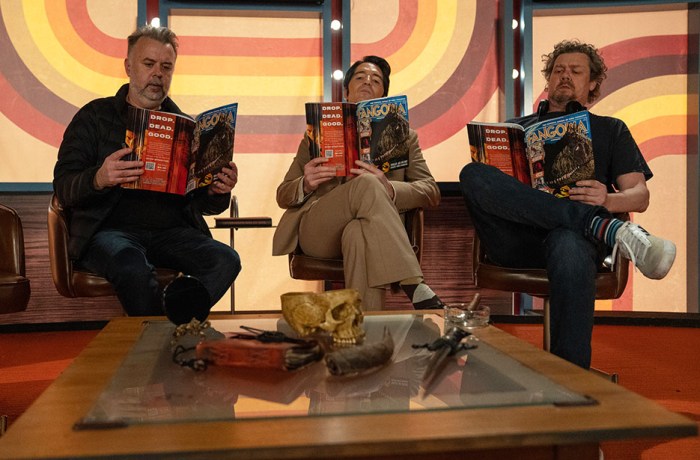
Cameron Cairnes, David Dastmalchian and Colin Cairnes on the set of Late Night with the Devil.


Acclaimed filmmakers Colin and Cameron Cairnes looked to the godfather of Australian variety entertainment, Don Lane, as inspiration for their latest horror film, Late Night with the Devil.
The brothers’ third film, following their laugh-out-loud gorefest 100 Bloody Acres and the criminally under-seen horror Scare Campaign, Late Night with the Devil is a sinister and satirical glance into the often weird and wacky world of late-night television and the extreme lengths some people will go to for fame and fortune.
It’s October 31, 1977. Johnny Carson rival Jack Delroy (David Dastmalchian) is the host of Night Owls, a once hugely popular syndicated talk show. A year on from the tragic death of Jack’s wife, ratings have plummeted, and sponsors are getting nervous. Desperate to turn his fortunes around, Jack pulls out all the stops for his annual Halloween special, booking a psychic, a professional skeptic, a parapsychologist, and a young girl allegedly possessed by the devil… What could possibly go wrong?
Late Night with the Devil stars Dastmalchian in his first lead role following supporting roles in blockbusters like Dune and Oppenheimer, alongside homegrown talent Laura Gordon, Ian Bliss, Fayssal Bazzi, Ingrid Torelli, and Rhys Auteri.
Cinema Australia recently caught up with Colin and Cameron Cairnes to discuss the film.

David Dastmalchian in Late Night with the Devil.
“Don Lane was very influential. We didn’t realise it as we were writing this film that there was so much of Don in the Jack Delroy character.”
Interview by Matthew Eeles
I received a press release recently announcing Late Night With The Devil’s global box office haul of $666,666 in one day. Was this an elaborate marketing ploy, or was it genuine?
Cameron Cairnes [Laughs]. That’s the devil working his magic, Matthew. He ran the numbers, and then he decided that was the figure that we were going to get.
Colin Cairnes The answer is we don’t know. [Laughs]. If we got just 6.66% of that, we’d be wrapped.
I was born in the mid-’80s, so by the time I was a teenager, my era of late night hosts were Letterman, Leno, and Conan. I couldn’t get enough of those guys. Paint a picture for us; what are your memories of late night talk shows and the hosts of the time?
Cameron Cairnes Growing up in the eighties, our guy was Don Lane. Don Lane and his sidekick, Bert Newton. They were our homegrown experiences. We obviously knew of Carson and the likes just through watching American films or American TV. Our own experiences of growing up with and watching Don Lane were very formative in writing the script for Late Night with the Devil.
Colin Cairnes In the early eighties, we would stay up late and watch Don Lane. He was all we had, and it wasn’t until the nineties, I think, probably the era you are talking about, where we’d start to get Letterman and those guys, and they were great, of course, and Letterman is possibly the greatest of all time. But yeah, Don was special, Don was different. Don was endearing. He had this thing for the paranormal and the supernatural, and he clearly believed, or wanted to believe, that there was more than the here and now, that there was something beyond. And he tried his best to convince Australia that that existed. He would have Ed and Lorraine Warren on or psychics like Doris Stokes or the Spoon bending Uri Geller on, and he’d do a whole episode just dedicated to these characters. Australians were a lot more gullible back then too. We were as dumb as dog shit really. [Laughs]. And Don, I think, latched onto that, and he felt like he could be a force for good and to open our eyes to all this stuff. And Don also, God bless him, wore his heart on his sleeve. He was not as polished as Carson who would bat everything back with a quip. Carson was just so polished and slick. But Don, you could just see a little flinch if something upset him, you knew straight away. So that made for really engaging viewing. And there’s the infamous episode where he stormed off his own show when James Randi, the skeptic magician-turned-debunker, proved that Uri Geller’s spoon-bending trick was, in fact, a trick. Don didn’t like hearing that or seeing that. So Don was very influential. I mean, we didn’t realise it as we were writing this film that there was so much of Don in the Jack Delroy character.
It’s interesting that you say that. You’ve spoken about the influence that Don Lane had on Late Night With The Devil, and I’m not asking this question through a critical lens, but was this film always going to be American-set? Or did that element of the storyline come with funding?
Cameron Cairnes Pretty early on, we had certainly entertained the idea of doing a late-night show here in Australia, modeling it more on the Graham Kennedy format more so than Don Lane. Graham Kennedy was the king of television for the sixties and seventies. So he seemed like the likely candidate to base our fictional show on. I think maybe a draft or two in, or even earlier than that, we just decided it would make more sense to set the show in America. I think in a global context, when we think of late-night TV, we think of Americans, we think of Carson and Letterman. And also, I think it’s just a logic thing in that if the Devil’s trying to infiltrate a wide audience, I don’t think it would be using Channel 9’s Bendigo Street studio. [Laughs]. It’s going to be through studios in New York where he’s got forty million people watching him.
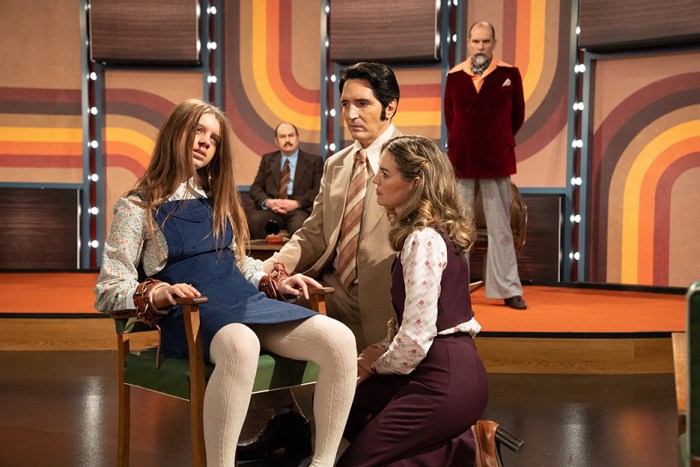
Ingrid Torelli, Rhys Auteri, David Dastmalchian, Laura Gordon and Ian Bliss in Late Night with the Devil.
Late night shows will often have teams of comedy writers on staff with the host often doing very little of the heavy lifting. This isn’t the first time you’ve flexed your comedy chops, but there are some genuinely funny moments here without turning the film into a sideshow. How do you balance the comedy and horror elements of making a film like this?
Colin Cairnes That’s a really great question. We’re making a movie about a late night talk show, so you need the banter, you need the ad-libs, you need the quips. That opening monologue in the film, once we’ve gotten through that prologue, has references to Billy Carter and Reggie Jackson and whatever else is happening in the world. And that stuff kind of had to land, even if you don’t get the references, it’s got to feel true to the time. We are good friends with a guy called Jason Marion, who’s a very funny man, a good comedy writer and performer, and we actually called on him to come up with some gags. I think there’s one or two of them in there. So it was really important that even if you didn’t get it, it felt like it could be funny. Those jokes really landed. And it’s a testament to David Dastmalchian’s performance that he does that and is so convincing, but it’s a talk show, so it’s got to have that lightness of touch. But we never claimed that we were making a comedy. It’s not like we were saying, “Guys, can we make this ten percent funnier?” And even in a good comedy, you should never do that as a director, but it was just like, let’s just play this the way it’s got to be played. It’s a late-night talk show, it’s 1977, this is how it’s got to be done, and then the rest follows being the comedy, being the drama, being the suspense, once you bring in the supernatural element and the scares. So it was just being as true to the period and the format as possible. It was just trusting that process, and the rest followed.
I could talk for days about the incredible cast that you’ve assembled here, but I want to ask about Fayssal Bazzi in particular because I think he’s an actor who doesn’t often get the credit he deserves in Australia. He’s a phenomenal actor, and he gives an exceptional performance here. Tell us about casting Fayssal and working with him here.
Cameron Cairnes We saw his self-tape, and it was an instant decision to cast him. Also, we have some mutual friends, so we’d heard he was a good guy and a sweet guy and great to work with, and God, yeah, he was just so into that role on set. I think there’s a scene where we see a little bit of prosthetic work and some bulging veins. I’m not sure that was prosthetics because the intensity that guy works at is just incredible. And he can just keep going all day. You’ve just got to feed him. He really put it away at lunchtime, didn’t he, Colin? [Laughs].
Colin Cairnes He’s a legend. He would just go take after take. It’s a very physical performance. He does some very physically demanding stuff, but he just kept going. He’s amazing.
Cameron Cairnes We love him, and hopefully, we get to work with him again on something. He’s also the sweetest and most professional actor you could ever work with.
Have you seen We’re Not Here to Fuck Spiders? Fayssal gives a small but seriously unhinged performance in that film, and it’s films like that, and this one, that make me wish we saw more of him in movies.
Colin Cairnes Wow. I’ve not heard of that film. What’s it called?
It’s an awesome found-footage feature film called We’re Not Here To Fuck Spiders. Josh Reed was the director.
Colin Cairnes Thanks for the recommendation. We will definitely be adding that to our watch list.

David Dastmalchian in Late Night with the Devil.
Following the release of Late Night with the Devil, you found yourself in the middle of an AI controversy around the use of AI images in the film. I’m not too fussed about that myself, but I am curious to know about your opinion on the future of AI usage in filmmaking. It’s not without its advantages, I imagine.
Colin Cairnes AI is a tool. When the internet came along, or anything that’s a revolution in technology, there’s always the doomsday sayers who act like the sky’s falling in. And then there are the people who want to embrace it and who recognise that this could be a wonderful tool. And you know what? AI will save lives in medicine, in science. It’s going to be a lifesaver. I know that for a fact. I’ve spoken to the doctors. In the arts, though, it’s a bit trickier than that, so it’s understandable that some people have gotten up in arms, but it’s here and we’ve got to work with it and deal with it and manage it. And we’re not the experts. We were just dabbling. This is going back nearly eighteen months when we experimented with it and decided we’d use a few images. I mean, the jury’s out, but it’s here and it’s already been used in every visual effect that you see. Every movie is employing it in some way. We don’t rotoscope anymore. There are so many examples of how it’s being used to save time and money and make things look a bit better. We definitely don’t want to be replaced as writers and directors. We don’t buy into any of that stuff. The response has been negative, and we get it to a degree, but some of the hyperbole and exaggeration and frankly misinformation that’s come out of it has been a bit upsetting. But look, maybe it’s actually helped as far as marketing goes because people are talking about it. And maybe the box office, which has been fucking excellent in America, we can thank some of these outraged folk who are up in arms over something that’s really quite minor.
Alex Proyas is out there spruiking the absolute shit out of AI in filmmaking at the moment. So you have an ally in Alex.
Colin Cairnes Good on you, Alex. But you know what? I don’t know if we’ll use it again. I think we are going to without even realising it, that’s the thing. So I think we need to be aware of the extent to which it’s already with us, and it’s happened so quickly. Twelve months ago when we finished the film, it was a novelty. And now obviously with the strikes and everything, it’s a different story. But you know what? In twelve months’ time, the pendulum might swing back the other way. Who knows where this is going? We don’t.
The horror genre is built on sequels, and vast worldbuilding through reboots, recuts, prequels, and spin-offs. Which one of your films would you like to see a sequel to, or an expansion of that particular film’s universe?
Cameron Cairnes All of them. [Laughs].
Colin Cairnes All of them, yes.
Cameron Cairnes If somebody pays us enough. [Laughs]. Look, I think there’s maybe more to spin out of the Late Night universe. We’ve been talking about it recently. I think there were ideas percolating when we were writing it and while we were making it. Whether it’s a direct sequel, I dunno, but maybe more of a spiritual sequel and we can sort of still play in that universe, but not have to reference Late Night so overtly. But I don’t know. We’ll see. It’s all up for grabs at the moment.
Colin Cairnes Scare Campaign obviously flew under the radar a bit, but there’s actually a South Korean production company that has picked up the remake rights. We haven’t heard from them for six months or so, but they did renew the option, so that might happen. That’d be cool.
Late Night with the Devil is in cinemas from April 11.
ADVERTISEMENT Watch The Switchblade Sisterhood here.


 Cinema Australia
Pingback: Late Night with the Devil leads Australian Film Critics Association Awards nominations | Cinema Australia