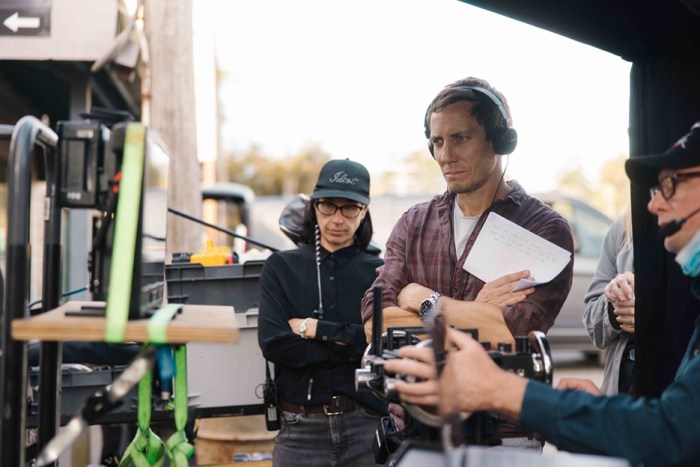
Scott Corfield (centre) on the set of The Nut Farm.


Scott Corfield, a seasoned figure in the Australian film and entertainment industry, has made his directorial debut with the very funny comedy, The Nut Farm.
Graduating from Queensland University of Technology’s film school in 1999, Corfield has worked as both producer and director across various fields including advertising and film. His credits include notable projects like the comedy special The Cadets in America and the acclaimed feature Don’t Tell, which garnered several awards and nominations.
The Nut Farm follows San Francisco based crypto trader Brendan Brandon (Arj Barker) who loses everything when his investments collapse. An opportunity presents itself when his missing uncle (Roy Billing) gifts him the family’s macadamia nut farm in the small Australian town of Cobweb. Faced with an unexpected legal caveat and some evil New Zealander gas frackers, Brendan soon realises that a quick sale of the old farm might not be as easy as he’d hoped.
In this interview, Corfield delves into his creative process including the collaborative efforts to write the The Nut Farm with Barker and Sam Bowring. He shares anecdotes from the film’s production, including the challenges of shooting outdoors, and how regional New South Wales inspired the film’s quirky character base. Corfield also discusses his environmental concerns which make their way into the film’s narrative, and the delicate balance between comedy and social commentary.
The Nut Farm is in cinemas now.

Madeleine West and Arj Barker in The Nut Farm.
“Arj has a great energy on stage, and I think he holds a mirror up to us here in Australia better than anyone else has done because he dedicated so much time to being here.”
Interview by Matthew Eeles
You’ve worked predominantly as a producer and an actor. Why the shift into directing?
Originally, I’d found myself into producing by fault. I went to film school and I studied directing there, and since I left, I did nothing but direct commercials and all sorts of things. I did sound design for rides at Dreamworld. So I have done a lot of directing, but not much long-form. Chris Nyst asked me to produce a little indie film called Crooked Business, which I knew I could do because of my directing experience. Following on from that, I was asked to produce Tori Garrett’s Don’t Tell. They’re my only real producing credits. I’ve probably got a lot more directing credits than producing, but not in feature films. But in terms of the number of years in production, I’ve probably done a lot more directing, and it’s taken this long to be able to get a feature film up. It’s very hard for someone to direct a feature film. I mean, at the very start of this process, I had companies, various distributors attached to the project, but they were only happy for me to produce it. They said, “Comedy’s a big risk. And because you haven’t directed a film before, we won’t back the film unless you have a director that has multiple credits.” So it’s pretty difficult to get your first directing credit, even though I produced a couple of features and had long show reels of a hundred plus commercials and music videos. It is very hard to get someone to let you do it, even though you’ve put it all together, and you write it, and all the rest of it. I’ve been slated to direct one or two films over the years that have fallen over for one reason or another. And so it took this long to get this one off the ground and even then it was done the hard way because I couldn’t get the right distribution funding deals with me attached. So it’s done at a budget level. I would say it’s probably at least a third to a quarter of what you actually would need for a film if you took it to market and budgeted this thing normally. But whatever it takes to get up, it’s how the film game works.
You mentioned Don’t Tell. I remember covering the film at the time and speaking with various cast and crew who told me the film’s heavy subject matter had a great impact on them mentally. What impact did making that film have on you?
A lot. We were in pre-production when my first daughter was born, and so it took on a whole extra level of significance and importance to me just knowing the background of the story. I’ve loved legal dramas, and cinema with a message for a very long time, so it felt like a film that needed to be made. But it’s very heavy subject matter to have weighing on your mind for such a long time. It’s nothing, of course, to what someone that goes through that level of abuse endures over their lifetime. But diving into it in a film sense, you’re researching all sorts of pedophiles and how that grooming process works. And so you’re in that space for a good three years plus. And then on the back of it I had a few other projects in development which I just wanted to have a little fun with and just do a ultra-low-budget little Aussie comedy. And then COVID hit and everything fell over multiple times and The Nut Farm has turned out to be the hardest movie to get up of all time. But moving on from Don’t Tell, I wanted to do something a bit lighter, but I still wanted a bit of a message to it, which is that lighthearted message in there about the environment.
No one should tie themselves to any particular genre, and you’ve been lucky enough to work across multiple genres. Your last two projects have been the series Welfare, and now The Nut Farm. What draws you to comedy?
I’ve been a big fan of comedy since I was a kid. I loved those ’80s comedies when I grew up and I became fascinated with movies in the cinema from the first time I watched Gremlins. And I can still remember the seat I was sitting in at the cinemas watching Gremlins. I loved films like Caddy Shack and all those ’80s comedies. I used to watch them over and over and over again. Beverly Hills Cop was another one. I love a lot of cinema and I guess a lot of my favourite films are probably more like Goodfellas and Breathless and things like that. But as far as watching films go just for pure enjoyment, those comedies are still my favourite. I can watch comedies over and over until I know them off by heart. That’s why I did The Nut Farm. When you do low budget, the entry point is usually a zombie film or a horror movie. But I’m personally not a fan of those. I thought the only other way I can think of as an entry point into feature filmmaking is a silly little comedy. I borrowed the lower production values that you can get away with in genre pictures and horrors and things like that. That’s I guess how I ended up in this space. I knew Artie Laing (producer) from a comedy DVD I did years ago, so I reached out to Artie and said, “I want to do a little comedy. You got anyone on your books that wants to do a film together?” And he said, “Actually, Arj Barker is wanting to do something.” I love Arj. He’s one of my all-time favourite comedians. So I flew to Melbourne, met him and said, “Hey, let’s make a film.” And that’s how it started many years later.

Arj Barker and Gyton Grantley in The Nut Farm.
Explain the writing process. Was it a script you presented to Arj Barker and he added some funny lines, or was it a more collaborative experience?
It was a bit different than that. I went to Arj and his writing partner Sam Bowring and asked them if they want to make a film. Sam’s a standup comic as well, and while they were touring, they were coming up with crazy silly ideas for films. And so this idea of an American crypto trader that comes to Australia, and the macadamia nut farm story was theirs. They came up with the story. And so Arj and Sam, neither of them have a background in films, wrote a first draft and it was largely just lots and lots of jokes with not a lot of character development. I told them, “This is some funny stuff, but one, we can’t afford a tractor chase down the Pacific Highway. [Laughs]. And two, you’ve got to have a bit of narrative towards film.” It’s different than stand up. So then I got involved and over time did lots of drafts and whittled it down. Then there was a point where Arj tapped out and went, “All right, the filmmaking process of trying to find turning points within the narrative is a bit beyond me.” So there were parts where Sam and I dug deep into that, and then we’d send drafts to Arj and he’d throw jokes in.
Was there ever a time when Arj suggested a joke and you’d have to tell him it’s not funny? How do you build up the courage to say that to a standup comedian?
Well, I wouldn’t make that call because it’s all relative really. Comedy’s a funny thing. You can just throw a joke out there and one person laughs, while others don’t. Someone else is offended, especially at the moment. I think comedy is a pretty tough area to navigate right now. Someone’s always offended by something. But no, there was never a time I told Arj a joke wasn’t funny. I would often tell Arj that something wasn’t doable because of our budget. But I didn’t have to censor or edit Arj’s jokes. He’s a master of comedy.
I remember ditching school and watching Arj and Poopy on TV, which was my first introduction to Arj. What was your first introduction to Arj as a comedian?
I really can’t remember. [Laughs]. I got into a real phase where I was loving standup and I was just watching lots of Eddie Murphy which was just so groundbreaking at the time. And Richard Pryor and Steve Martin. And then I guess I just stumbled on Arj as a comedian when he started working here in Australia. I loved his take on Australians. I think he’s very insightful and I love that he’s a clean comic. I mean, you rarely will hear him swear. And I think that’s the purest form of comedy, and I think that’s something that someone like Jerry Seinfeld stands by too. It’s something that Arj does really well. He’s got great energy on stage, and I think he holds a mirror up to us here in Australia better than anyone else has done because he dedicated so much time to being here.
You’ve previously lived in regional New South Wales. How did that community inspire The Nut Farm?
Quite a bit actually because I was living down there all through development and we shot it all around the Byron Shire region and Brunswick Heads. So we shot the whole thing down there. While I was writing, I’d get in the car and I’d just drive around, find farms, or find pubs to see what would be good for a scene. So I’d constantly tour the area and try to find locations and help put them in the script. So it had a very big influence. And Northern New South Wales is in some areas a pretty quirky place. There’s some colourful characters in there who have inspired some of the wackier characters in the film.

Steph Tisdell and Arj Barker in The Nut Farm.
There’s a thinly-veiled anti-fracking message at the centre of this film. Is fracking, and similar environmental issues, something that concerns you?
Very much so. I think I do understand the complexity of that debate of using fossil fuels, but I do also think the fundamentals of that are that we should have started to switch and move across to them a very long time ago. So the transition should have been far more advanced than it is now. So I think that’s a failure in policy. I do acknowledge you can’t do it straight away. And so I think that’s just a bit of a failure in terms of our policy. So I think trying to shine a light on these things and just to keep reminding people that destroying our planet is not really the smartest thing for any living creature to do. It is something I stand by and I remember reading an interview with Michael Moore and he was asked, “Your current films are not as hard hitting as your earlier stuff. Are you getting softer in your old age?” And he said, “No, I’ve just learned that the only way to get the message across is to coat it all in a lot of sugar.” I remember thinking that that was an interesting way to go about it. A lot of people turn off if you start to get too preachy. So that was part of my approach with The Nut Farm. And Northern New South Wales is very much a fracking environment and the community have fought very hard. Byron fought very hard to preserve those beautiful areas and farmlands down there. And they’ve largely succeeded better than a lot of places, especially if you look at the number of thousands and thousands and thousands of fracking wells all around the world. If you get the aerial maps, it’s quite frightening. The world looks like a pin cushion.
A lot of this film is shot outdoors. Was working in the elements ever an issue?
Surprisingly, yes. That’s always a concern. I am very wary of the harshness of the Aussie sun in terms of making your shots. It’s very hard to light. The Australian sun naturally creates deep shadows. So setting as many scenes as possible under the canopy of trees helped with the look of the film. But I mean, I had Jack Wareham, who’s a really great cinematographer working with us, but we didn’t have a contingency plan on the film. So if we had rain, we were in trouble. So we didn’t get one day of rain for the whole film. And on the very last day, which was a Friday, we wrapped and everyone started clapping and then the skies opened up and it just poured on everyone. [Laughs]. It was remarkable. Someone was on my side. We were in the middle of COVID, so everyone had masks, and we had a bit of a covid scare with one of the actors who couldn’t come to one of the important end scenes. I had to rewrite the thing and shoot a different scene the next day. But these things happen. So we got pretty lucky with the elements really.
I have a left field question here for you because I’m such a huge fan of A Country Practice, which regular Cinema Australia readers will know. When I hear the name Esme, I’m immediately reminded of Esme Watson from A Country Practice. Was Annie Byron’s character, Esme, an homage to Esme Watson? She has the right look, and those glasses have Esme Watson all over them.
[Laughs]. Amazing. I think that name might’ve been picked by Sam actually. But I was certainly always quite aware of the Esme name, and I think it was a little bit of a nod to the Esme Watson character. Annie came on and she auditioned, and she’s such a vibrant, big personality, and she said, “My whole career as an actress, I’ve been told to keep toning it down. This is the first time I’m allowed to just be myself.” And I’m like, “Yeah, go for it. Let’s see how it comes out.” So maybe there was some Esme Watson coming out. Annie is a great lady. And that’s a colourful character, that one.
I guess I return to A Country Practice so often because that show was a rite of passage for an entire generation of actors. Every time I’m researching for an interview, an A Country Practice credit comes up every time. Did you know Annie was in A Country Practice?
Really! I did not know that. That’s very funny. I do remember A Country Practice playing in our living room as a kid a whole lot, that’s for sure. [Laughs].
The Nut Farm is in cinemas now.

ADVERTISEMENT Click for details.


 Cinema Australia