
Equal the Contest director, co-producer, cinematographer and editor, Mitch Nivalis.


In the AFL-obsessed heartland of Regional Victoria, emerging filmmaker Mitch Nivalis has donned their footy boots and mouthguard, proudly hip and shouldering their way into the forward line of the battle for gender equity.
Mitch’s newest film, Equal the Contest, explores the unexpected journey of a filmmaker who joins local footy club the Falcons, sparking a campaign that challenges age-old sporting traditions and aligns with the broader movement for gender equality.
Mitch Nivalis’s foray into filmmaking was an organic evolution from a successful photography business they established nearly two decades ago. Initially drawn to photography, the desire for a more comprehensive creative expression led them to explore the world of filmmaking.
Moving to regional Victoria in Ballarat provided the backdrop for Mitch’s creative exploration, where they started making short films about local artists, learning the craft through self-teaching and a connection to ABC Regional.
The transition from photography to filmmaking marked a significant turning point in Mitch’s career. In 2017, they crafted a forty-minute documentary on Al Wunder, delving into the world of improvisation. Equal the Contest, a feature film, emerged as the logical next step in Mitch’s artistic evolution, signaling their commitment to telling stories that matter and resonate on a profound level.
In this interview, Mitch tells Cinema Australia about their journey from a small-town photographer to a multifaceted filmmaker, highlighting their dedication to authentic storytelling and advocacy for inclusivity.

Mitch Nivalis in their studio.
“I really felt like this is why I was born. I was born to make this film.”
Interview by Matthew Eeles
I’d love to know more about your filmmaking background.
I started a photography business nearly twenty years ago. I got six years into just doing photography, and I was feeling like I wanted something more. I came from a bit of a music background, so I was missing the sound element of working creatively. I’d just moved to regional Victoria in Ballarat, and I was meeting lots of artists, so I just started making some little films about these artists, but I didn’t know how to make films, so I just started teaching myself. I had a small connection to ABC regionally and did a small course, and then just started making my own films. It just really took off from there and got kind of enveloped into my business. So pretty quickly, I was doing fifty percent corporate commercial film shoots and fifty percent photography. In 2017, I made a forty-minute documentary on Al Wunder about improvisation. Equal the Contest felt like the logical next step for me. So yeah, it’s been a bit of an evolution over a long period of time.
Would you say that you’ve always had an interest in movies or cinema in general?
I love documentaries. Docos are pretty much the only things I watch. I tend to fall asleep during films; otherwise, I’m not a great film watcher because they just put me to sleep generally. [Laughs]. But yeah, I really do love docos. I love people’s stories. I love humans. They’re so fascinating. It just really lends to my interest to be able to dive into people’s stories, although I was never expecting to share my own story, so that’s a bit of a weird twist that came about.
I’d like to commend you on your editing skills here. I thought they were superb. Is that a space you enjoy working in?
Yes. [Laughs]. Thanks for noticing that. That was not intentional, actually. I got towards the end of filming, and I was so exhausted. It had depleted me mentally making the film and being in it that I knew I couldn’t edit it myself. And so I had saved up a lot of money for me, and I’d done a lot of research, and I’d chosen someone who I thought would be great to edit. This person was local to my area, and so it felt really appropriate. Unfortunately, it turned out that they didn’t do the job they were hired to do. He felt like the treatment that I’d written wasn’t good enough, and he thought he could do a better job of finding the story within. And in completely ignoring what I’d asked him to do, he got lost and conceded. I lost five or six weeks in that process, and it was really heartbreaking. And then a friend said to me, “Look, if you feel like you can edit this yourself, I’ve got a house down in Venus Bay. It’s yours for as long as you need it. Take your computer and go there.” And so I packed up my desktop, drove to Venus Bay, and from six in the morning till eleven at night, I sat for ten days and edited the film. And it’s changed a bit since that first cut. But yeah, the film was there and it was wanting to be made. But yeah, I wish I wasn’t in that byline for the editing, but that’s how it worked out.
Would you say that Equal the Contest is the most significant film of your career so far?
This is by far the most significant thing I’ve done. It’s all of my lived experiences and skills to date really coming together. And at certain points, I really felt like this is why I was born. I was born to make this film. All the experiences I’ve had were purposeful to be able to share this story. It’s been a big journey. I think it’s really changed who I am as a person. It’s changed how I make work. And that was the point, really. I’d enrolled in a masters of photography because again, I was kind of getting a bit bored with my work creatively and I wanted to challenge myself to work in a different way. I wasn’t expecting to make a feature film, but in enrolling in a masters, I was really pushed to work in a way that I wouldn’t have otherwise. All of those sorts of devices, like attaching cameras to my body, that all came about because I’d situated myself in this masters project and challenged myself to do things I hadn’t done before.
You’ve said you’ve never had an interest in AFL, but that the first time you kicked a footy you loved it. What was it that you loved about it? The physicality? The skill involved?
It made me feel like a kid again. I was remembering who I was supposed to be when I was growing up. Actually, every lunchtime in primary school, I used to go onto the oval and kick the footy with the boys, and I grew up in Sydney, so we were playing rugby. And so I loved that. Every day I would kick a football and tackle and be rough, and that really got beaten out of me. As you grow up and as you hit puberty, if you’re not a boy, you start getting told this isn’t for you. You are going to get hurt. You are too weak; you’re too delicate; you’re too fragile, all of those things. And so you end up sitting on the sidelines. And that’s exactly what happened. I sat on the sidelines and watched for a long time, and I really had given up sport. I’d given up a lot of exercise; I’d given up really thinking about my body as a functional, capable thing. And so when I kicked that footy with the Falcons, it was like, “Oh my God, this is who I was supposed to be. This is the potential I had. I’m nine again.” So that felt really exciting.

Mitch interviewing Louise Conwell. Photo by Penny Ryan.
Australia has a huge sporting culture, and I’m sure the issues you explore in this film regarding everyone’s right to play AFL extends to most other sports. Did you look into that? Are any other sports further progressed in this area compared to AFL?
No, it’s all really similar. All sports have similar stories but are at different stages of their journeys. Because I was doing a masters at the time, I was reading a lot of theses and written work, and there was a great paper I read about women’s football in South Africa. Exactly the same story. Exactly. You really are just replacing the different shaped ball with this exact story. I knew that that was the case for soccer in Australia because that had been my experience as well growing up. And you just have to read the newspaper most days, and there’s some sort of story about a battle that a women’s team is fighting for different types of inclusion, or whether it’s pay, or access to fields or umpires. It is all the same. And it blows my mind that this has been okay for such a long time. It really does.
Now you’ve got me wondering if anyone has reached out to you as a spokesperson for these issues. You’re in the spotlight now; has anyone required your expertise on this subject?
Yeah, it’s definitely opened up a lot of opportunities. I’m now sitting on an advisory committee with the Victorian state government for inclusion in sports. I think we’re just at this tipping point where people want to know how can they be doing the right thing. There have been loads of screenings, loads of panel discussions, and different sports turning up. We did a screening in Mildura a couple of months ago, and we had all the sports people from hockey and tennis and soccer and football, and everyone wants to know the same thing. How do we do better? How do we give more access to women and girls and gender-diverse people so that we have greater participation in sports?
I know that you can’t see me right now, but I’m quietly fist-pumping the air when I hear that you’re on that advisory committee. That’s very exciting to hear. I love it.
Thank you.
Does the AFL do enough in this area? They have Pride Round, and Danielle Laidley is likely to become AFLW’s first transgender coach at some stage. But in your opinion, are they doing enough?
There’s always more to be done. I think if anyone was sitting back and just patting themselves on the shoulder and saying, “We’re doing great, what’s next?” That would be disappointing. There’s evidence every single day in every single club that we’re not doing enough. The amounts of sexual assault still happening at clubs, the amounts of women being on the backfield at training and games, and everything needs improving at every level of the sport. While the AFL might be publicly at the elite showing that they’re doing more things, unfortunately, that hasn’t filtered down to community level yet, and there still needs to be a lot more that’s done because if we work at the community level, particularly creating cultures of respect and equality, and particularly within the men’s teams, then what we get is players coming into the elite who aren’t behaving the way our current and past players have. And so just trying to fix things at the elite will not change anything. We’re still going to end up with young boys paid ridiculous amounts just to play community footy on the weekend thinking they’re entitled while the women are still playing on shitty grounds and all of that sort of stuff. There needs to be equity and equality at the community level with young boys and men realising the level of respect that they need to have for their female team. Then nothing changes if that doesn’t change.
Finding Mavis Thompson is quite a significant moment in the film. Can you tell us about learning about Mavis and working with Mavis here?
Mavis was so special. One of our executive producers sent me a story one day about the team Mavis played for. And then I was sitting there doing the maths on dates, and I was like, “Oh, it’s unlikely, but there could actually be someone who’s still alive.” And so doing that research and finding Mavis and then listening to her, it was so interesting. It made me realise how much hasn’t changed actually in all that time. Mavis was still so ashamed. It took me a long time to get her to talk to me about football. She was really happy for me to come around and have cups of tea and catch up, but she didn’t want to talk about footy. And she thought my interest in her football days was a bit silly. I think it really was with the help of her niece, Shelly, that we got to the point where Mavis would talk. And that was so powerful because it really allowed me to create this beautiful line through the film about her own experiences that essentially mirrored our experiences. So seventy odd years on, we’re still having the same conversations where women and gender-diverse people aren’t being taken seriously as footballers, where we’re not given opportunities. All the things Mavis experienced, we were experiencing. So it was a really special connection to have, and then also for Mavis to realise that she was a pioneer and that she did do something important, even though she hadn’t seen it as that for her entire life.
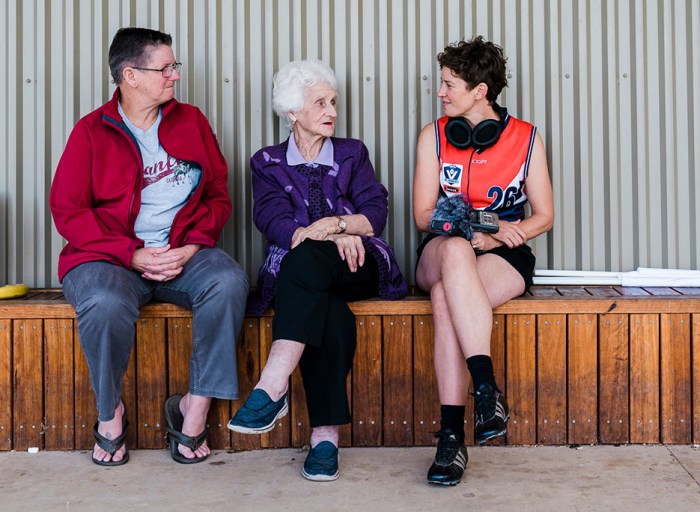
Shelley Thompson, Mavis Thompson and Mitch Nivalis. Photo by Penny Ryan.
Mavis has unfortunately passed away, but there’s a documentary in itself within Mavis’ story, right?
Totally. I would have loved to do more filming with Mavis. And even in that process, I discovered so many things about women and what they had done for football. One of the early matches of women’s football that was played in Ballarat raised money that built the Arch of Victory, and all of these incredible things that happened that people just don’t know about.
Now that you’ve had the opportunity to play AFL games, do you have more of an interest in it now. Will you watch this coming season, or does your interest lie at grass roots only?
I’ve always been a participant over a watcher of sport, but having said that, I definitely am becoming much more interested, partly because I love my team, and they’re always watching footy, so I want to be able to talk to them about what’s going on. But also, I think it’s given me an opportunity to connect more with football. Essendon Football Club has been incredibly supportive of the film, and particularly with Natalie Wood who is in the film. We’ve been able to have lots of great discussions, and there’s been a screening at the club. And so I have found my official football team, and I do check in on Essendon and how everything is going in AFLW when that’s on.
So that’s official. You’re an Essendon supporter?
I am. You can put that in print. [Laughs].
What’s the current status of the Falcons? How’s everyone going at the moment?
It’s incredible. We started pre-season in December last year. We’re keen, so we’ve been training for a little while already. The season will start in April, and we’ve had lots of new players turn up, so I reckon there’s been another fifteen or twenty people turn up that weren’t on the radar last year. We’re pulling in people again that didn’t think they were footballers. We’re pulling in people who have come from other sports; we’re pulling in people who have played footy and are great, and they want this to be their home. So yeah, I’m really excited to see what the team shapes up to be this year and how we go and how we continue to build skills and continue to build community and continue to have fun together.
How are your ribs? Have you recovered? Are you back on the field?
The injury’s completely gone. I’ve fully recovered. I played the whole season last year. We got our full season in 2023, and I got to play a whole season. It was great fun. I actually scored our first-ever official goal.
Wonderful!
It was just really fun. And particularly the league that we did end up joining has a strong commitment to gender equity, and so we’ve all got vision because our games are filmed every week, and we’ve got our little portal that we can all log into and see our stats and watch snippets of the game. Again, that visibility and seeing ourselves being valued, that has been an incredible part of the season and being fit enough and well enough and recovered enough now to experience that, that’s just been such a joy.
Equal The Contest will be available to own or rent from March 6, 2024.


 Cinema Australia