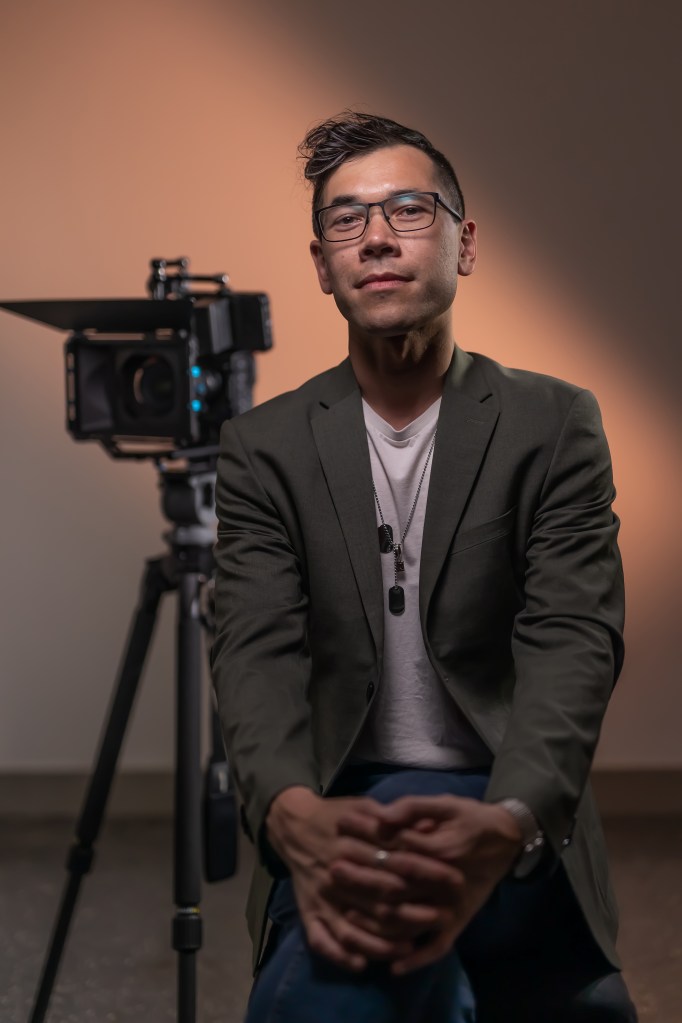
Roger Ungers.


The gay community purports to celebrate diversity, inclusivity and equality, but body image discrimination is rife, and is inextricably linked to body image ideals relating to age, race, masculinity and a very specific physique.
Through interviews with a diverse range of subjects interwoven with expert opinion, Reger Ungers’ insightful documentary Shape examines how the gay clubbing scene, gay targeted advertising, gay networking/hook-up apps such as Grindr and social media can foster an obsession with the “ideal” body and the negative repercussions of this harmful mindset.
The film’s subjects reflect on their personal experiences of body image-based discrimination and dissect their own beliefs, while exploring what needs to happen to create a more inclusive gay community.
Shape uncovers how being in a tribe can help gay males feel part of a community. This sense of inclusion and belonging can be so valuable, especially for young males whose family may have rejected them after they come out. But this social grouping can actually lead to unhealthy stereotypes and unrealistic body image ideals.
As a gay man born and raised in Australia, Melbourne-based independent filmmaker Roger Ungers has grappled with his own body image for many years. In this interview, Roger tells us about those pressures, and why he set out to explore them in Shape, which he describes as being, “provocative, but necessary”.
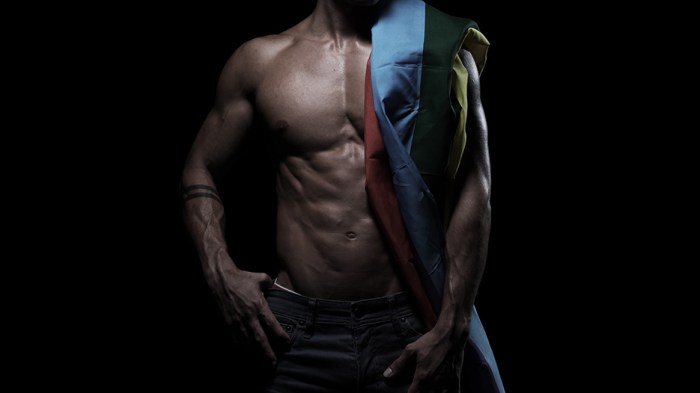
Shape.
Interview by Matthew Eeles
In what way is Shape provocative?
Well, I think personally I wasn’t quite sure because it goes against the values of inclusivity and diversity within the queer community. So that’s quite a significant challenge. Delving into that contradiction, the community celebrates diversity and equality, yet it doesn’t always happen within our own community. So, I hope people pick up what I’m putting down, and that it’s done in a very meaningful way that really humanises people’s experiences. It’s not going against the gay community; it’s highlighting something to create potential social change.
I came across a comment left on the Shape trailer on TikTok. This person was critical of the film, stating that body image issues are problems that exist in the broader community, not just the queer community. They were questioning why you would focus on only the queer community when it’s a universal problem. How do you reply to that particular criticism?
Of course, this stuff happens within the wider community, but the thing about our queer community is that we celebrate diversity and inequality. I think it’s important to highlight that and stay true to our values of diversity and inequality. It doesn’t always happen. So that’s why I think it’s good to focus on it because it’s just a conversation that hasn’t been had yet. We know it happens. So, as a queer community, we need to do better. We have to be better. We have to lead by example, and hopefully, the film will allow people to do that a little bit more.
Is that what set you out to make Shape?
There are several reasons. Firstly, my own personal experiences around body image. As a mixed-race person of Latvian and Cambodian descent born in Australia, I certainly did feel like I was a little bit different, particularly coming into the queer scene. The film talks a lot about themes of being white, masculine, muscular, young. These are identified as idealistic traits, and someone who isn’t completely white ostracises people. Also, my own journey to getting fit. I certainly felt the pressure to go to the gym. It was something that seemed quite important among gay men, and it almost invited you to belong within that community. People receive you better if you follow these kind of white, young, masculine, idealistic traits. So there is the drive to do that to be accepted into a community in which you really, really want to belong. So certainly, it manifested in a way that made me want to look a certain way, and certainly, a lot of my friends are the same. The thing about that idealistic body is most gay men know that it works. So if you’re out in the scene, you are actually received better if you follow these idealistic traits, which is unfortunate. It shouldn’t be that way. So it’s about highlighting it and trying to make us be more accepting because these are the qualities that we go march out on the streets for.
You really could not have selected a more articulate and educated group of participants to feature in Shape. How did you go about selecting this group of people?
Everyone was handpicked. I didn’t throw out a casting call to people within the community. It was people that I actually hand-selected, individuals who had something to say about what I wanted them to talk about. So through development, we realised that ageism was an issue, racial discrimination was an issue, having their idealistic body size, all these things. So I had to find people who were really qualified to talk about it. Obviously, there’s Aaron Jensen, who’s the president of Vic Bears. It was really important to have them in there because they celebrate larger body types. We’ve got Stefan, who’s an older gay guy talking about ageism. So it was about finding people who had these experiences of discrimination but who were articulate, good in front of the camera, and had something significant to say. I think Budi is probably a really good example as well because their work is in intersectionality. Budi also had a very personal story about why they got into that work. Sometimes it’s a bit of a fluke. For example, with Budi, there was an article that they were in, and I just thought they would be the right person to talk about it. So there was a two-stage casting process. First of all, it was a pre-interview where I would talk to them, find out their stories, opinions, and thoughts. The second one was finding out if they were good in front of the camera. We shot these pre-interviews on camera just to make sure they were comfortable. Sometimes as soon as you put a camera in someone’s face, they freeze up. I think it was just a mixture of luck and good research and reaching out to these people to see if they were keen to be in the film.

ADVERTISEMENT Click for Details.
It’s a diverse group in terms of cultural backgrounds. Did your research extend to other countries and whether or not this is a global issue, or whether it’s more localised?
It’s certainly a global issue. What made me want to focus more on the Australian experience was because I wanted to apply for funding through Screen Australia. I know that Screen Australia has a very specific type of documentary or project that they like to fund. There’s a big list of requirements. So an Australian story, LGBTQIA+ story is a lot of boxes to tick. [Laughs]. That made me really want to focus more on the Australian experience, which is an experience that is basically my own life experience and what I’ve experienced within the community. There are certainly a lot of studies out there, some more meaningful than others. I read a lot of articles. So I think that gave me a really good idea that it was a very much universal issue, and I kind of inherently knew that anyway, but it really backed it up. Focusing on the Australian experience is something that was manageable for me with my resources and how much money I had to work with. I didn’t actually get the full production funding from Screen Australia, but they did fund the development. So that was fantastic to get that opportunity. That really made it all happen. Australia is what I know. So Australia is what I’m going to talk about.
I’m curious to know a bit more about Vic Bears and the positive impact they have on the queer community. How did you come across Vic Bears, and what impact has the group had on you?
They definitely have a massive impact on the community. I think a lot of people in the queer community are very aware of the Bear community and that they celebrate different body types. They are a tribe within the community that allows people who look the same as that community to feel accepted and welcome in a world that celebrates a certain body type that we see everywhere. It’s really important to have them because they do say that the community is diverse, that they’re an example, that there is this diversity in body shapes, and that people can find a place. It’s not without its divisions though within the bear community, from going through the process of making this film. Things like racial discrimination or, are you old enough to be a bear? I think the different tribes that we have within the gay community can be quite divisive, I guess, in a way that they do help people find their place. But are you qualified? Does your physical appearance match that person of that tribe? And if you try to go into, or if you identify with a tribe, but you don’t look like the people in that tribe, there’s kind of another layer of exclusion. But it’s important because it does actually help people find their place and feel comfortable as well. So there’s kind of a double-edged sword going on there. But yeah, how do you solve that problem? I don’t know, but I think there’s good and bad in both.
There’s a moment in the film where you ask the participants to read comments from the social media platform Grindr. Following that segment, the mood really changed for the participants because most of these comments were quite inappropriate and hurtful. Can you talk us through shooting that scene, and the different reactions you experienced from the participants?
It was definitely something that I sprung on the participants in the film, but they were very happy to read them out. [Laughs]. I really wanted a reaction that was organic and something that they could genuinely react to in real time. That Grindr segment is very much the turning point because the first half of the film we’re kind of understanding what it’s like to be a gay man within the community. And then, of course, the discrimination and the heavy side tips on from that point. So that’s why I chose to do it because Grindr is a platform that allows people to really say inherently what they’re thinking and to express their personal views about body image. Comments like, “I only want to be with Caucasians” and “Don’t contact me if you’re old.” It’s really exclusionary. It’s good for the documentary because we can see it in real time. It’s written down, it’s not anecdotal, it’s right there, and we’re all exposed to it, and almost in a way, we’re kind of desensitised to it because we see it all the time and we go, “Well, that’s just the way the community is so just deal with it.” But it isn’t something that we should have to deal with because that type of language is just unacceptable. Just getting them to read them out on camera and just to get their reactions and their anecdotes at the end about what they thought about it, I think was very powerful. So that’s why I included it.
Did you do something afterwards to elevate the mood again, or was everyone happy just to continue on and go about it?
Throughout the interview process, I prefix everything. There’s no right or wrong answers. If you don’t want to answer anything, please don’t feel like you have to. I mean, there was no pressure from me as a filmmaker to get a certain reaction or to try and steer it in a certain way. I want it to be very ambiguous and allow people to feel comfortable in the space. It is very important as a filmmaker to develop relationships with the people who are in your film because it’s a collaboration. You’re both working towards a similar goal, and the people who are in the film really had something to say. They understood what I was trying to do and really wanted to be a part of it. So they were very happy to do that. It’s funny because when we were going through the process of filming that Grindr section, there is something kind of humorous about it as well in that it’s hard to believe someone would say such things. The comments are ridiculous. It’s a ridiculous type of language. As awful as it is, it’s just like, “Oh my gosh, how can people be like this?” It’s laughable, but at the same time, quite exclusionary and horrible as well. So there were these dual emotions going on through that whole Grindr scene for all of the participants.
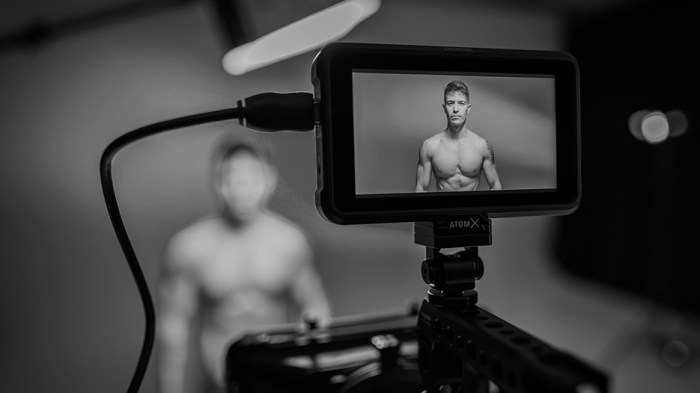
Filming Shape.
In your Director’s Statement, you say that you’ve grappled with your own body image for years. Has making Shape boosted your own confidence knowing that others have been through, or are currently experiencing, the same thing?
That’s a very good question. Going through the development of the film, I was immersed in this somewhat miserable topic. Body image is something that affects everyone. So it was a struggle, I think mentally actually backing up what I kind of already knew, and that a lot of people kind of felt this way. It kind of makes you feel a very different way about your community. I love that I’m part of the queer community. It’s done so much for me in so many ways. But on the same note, knowing that people feel this way, there’s something really quite devastating about that and quite sad. So for me, mentally, it really did make me focus on my own body image a lot more. But I guess if you don’t delve into that, you can’t address it, and you can’t make change. In my early days, I have certainly subscribed to the ideals of the gay community that I’ve seen. The types of posters that we see for gay dance parties, the way that people talk about people who have that idealistic body, how it’s sort of celebrated and put up on a pedestal in underwear commercials that are targeted towards gay men, they always use a specific type of person. That certainly made me feel a certain way about my body image, and I subscribed to it, and I wanted to look like that person. I wanted to be with people who were like that. And as I’ve gotten older, things have changed, but that has happened organically with me. I think I’m definitely on a path to not being too much of a gym junkie or really subscribing to those things. One thing about me though is I’ve always accepted people for who they are. I always thought it was really important to know, who is your character? That’s the thing that’s going to keep me around. So discovering that if someone’s a really nice kind person, it actually doesn’t matter how they look to me. It’s actually ridiculous that the idea of looking at someone first and then going, “Do I want to talk to you because of the way you look, or not?” That’s just ridiculous to me. But it happens. It’s been a real journey for me.
I’m always excited to see a filmmaker take on so many roles themselves throughout the making of a film because it shows how passionate they are about their film. But how overwhelming is it to be a director, producer, cinematographer, writer, and editor on a documentary like this?
It is overwhelming, but it’s incredibly fulfilling at the same time. It is a lot of hard work. And the reason why I took on all of those roles was basically for a lack of resources. My vision for this film was that I would get that funding from the funding bodies, and I’d be able to pay a crew because I would’ve loved to have worked with a really experienced editor or a color grader or sound design. These are all things that I had to do myself for a lack of resources. But I think it’s important actually as a filmmaker to do these things because then you understand in the future how to direct people on those certain things because you understand them a lot better. I’m also a bit of a control freak. [Laughs]. So for me, it really played into my own sensibilities. I’ve loved taking on those roles, and I just love the filmmaking process. There’s nothing else I really feel like I can do in this world.

ADVERTISEMENT Click for details.
What are the plans for this film going forward? I’m not sure how easy it would be, but this film is a valuable educational tool that could be utilised for such purposes.
Firstly, I’m going to try and do the traditional route of film festivals. I think film festivals are a really great way to get your film out there and get recognised. I want to get as many eyes on this film as possible. I think it’s got a lot of potential to work internationally because body image within the queer community, specific to gay men, it’s all the same. We’re all kind of suffering with the same thing. So to get the messaging out there, and ultimately the film is about creating a community where everyone feels welcome. So if people watch it, maybe they’ll change their minds about how they view their bodies and the bodies of other people and get it out there. Hopefully, it will lead to me being able to do other projects that are fully funded and that have resources to create social change through film.
That’s a great segue into my final question. If you could suggest just one step towards creating an all-inclusive queer community, what does it need to be?
I think, to acknowledge the other people that are in your community, because we’re all just trying to get through life. We all just want to find our place. And I think if we extend our friendship groups, if we start interacting with people who don’t look like us, we will be able to understand that these are real people, that they’re humans, and that we’re all part of this community. So I think that’s the most important thing, is just to extend the social groups and not put all your eggs in the body image basket to sort of realise that there’s more to you than your physical appearance, that you may be a really creative person or other things, and kind of say, well, this adds value to me. I don’t need to look a certain way in order for me to be valued as a person specific to the gay community or in the community in general. So I think that’s probably the most important thing for us to do.
Shape will screen at the Mardi Grad Film Festival on Sunday, 25 February 2024. Details here.


 Cinema Australia