
Lily Sullivan in Monolith.


In Monolith, the always impressive Lily Sullivan plays a disgraced journalist who turns to podcasting to try and rebuild her career, but her rush to generate headlines soon uncovers a strange artefact, an alien conspiracy, and the lies at the heart of her own story.
Sullivan’s transition from the Hollywood blockbuster Evil Dead Rise to the intimacy of independent cinema is evident in Monolith, where she plays the sole on-screen character, bearing the weight of writer Lucy Campbell’s impressive narrative under Matt Vesely’s intelligent direction. In this interview, Lily delves into her role, her collaboration with Vesely, and her journey of pushing the boundaries of her acting abilities.
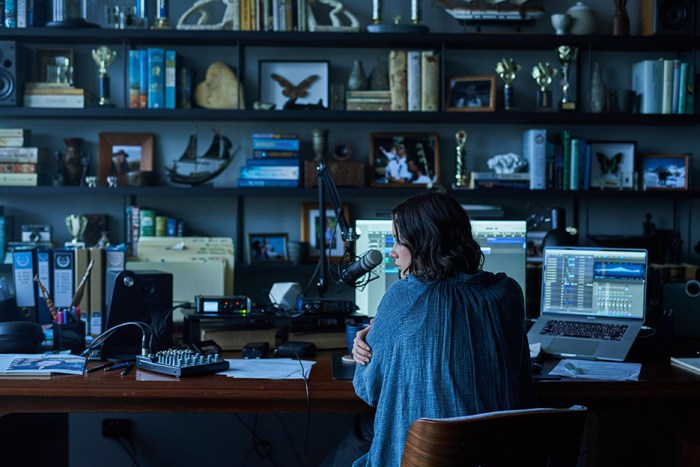
Lily Sullivan in Monolith.
“Without looking into the eyes of another person to distract you during a performance is a challenge. It was very much an isolating experience.”
Interview by Matthew Eeles
Monolith director Matt Vesely told me recently that it was quite a unique experience sharing you between Evil Dead Rise and Monolith at South By SouthWest Texas. How was that experience for you?
It was quite full-on. I was jet-lagged. I got there in the evening, and then just went straight into the madness. But it’s such a buzz, and Austin, Texas just turns it up. It’s like everyone’s just bleeding out into the streets in a way. It really feels like a festival, and the streets are all blocked off. There’s no cars. Being in two genre-heavy films generates a real buzz. When you put blood, sweat, and tears into filmmaking, you’re then rewarded this real joyous moment where you all get to celebrate it and experience it with audiences when you haven’t done that yet.
I know you were part of the Q&A for Evil Dead Rise, but how did the Monolith Q&A compare to that one?
It was great. I’m not going to lie, though, it’s extremely confronting being the only actor in this film, then having to talk about it with an audience. I can’t sit in screenings, and I’ve only ever watched it alone. I feel almost embarrassed and apologetic that audiences just watch me for an hour and a half. [Laughs]. I’m always like a deer in headlights when it comes to the Q&As, but people are really great in regards to finding out how a micro-budget film works and how we managed to shoot it in fifteen days and the challenge of building a story from those restraints and keeping it entertaining. People were receptive, respectful, and appreciative of that. It’s like this movie had a tight box around it, so it felt really nice to be able to pull it off.
Monolith is a phenomenal achievement by everyone involved. You said you’re almost apologetic that people are having to watch you on the screen for an hour and a half, but I can tell you that you pull off a very convincing performance here. There’s certainly nothing to be embarrassed about.
Oh, thanks for saying that. Thank you so much. It was wild, though. It was truly a challenge of a lifetime. I had to approach it like theater to learn it from front to back, covering seventeen pages of dialogue when usually you cover thirty seconds, and then having no physical scene partner and no one’s body language to bounce off and having that to digest and react to it. I ended up ruminating in my own echo chamber. Your imagination and inner visuals take over. It was a super confronting role. I’ve just never appreciated other actors more in my life.
I do want to ask you about this performance, but before I do, I want to ask you this: Having two feature films released in a single year is quite an accomplishment for any actor. How have you managed to balance the demands of two film projects being released so close together, and what have you learned about yourself during this time?
One thing I really learned about falling into the heavy horror genre and the sci-fi thriller world was to really lean into it, and to get comfortable with humiliating yourself. It’s a very freeing thing when you get comfortable with humiliating yourself. One thing I learned as an actor from doing films like Monolith and Evil Dead Rise was that they can be really strenuous and anxiety-inducing in that you have to replicate fear on screen. I found a new way in that I’ll apply to every film now, which is basically entering through carbonating the body with sensation instead of intellectualising the character’s past, their family history, their relationships, and where they’re currently at in their life. Instead, I want to play on how a character feels at that exact moment. How does any anxiety that they’re feeling about that relationship play out by using more bodywork. Acting is more like dancing to find the suspense, and to find that crippling shame like our interviewer in Monolith feels.
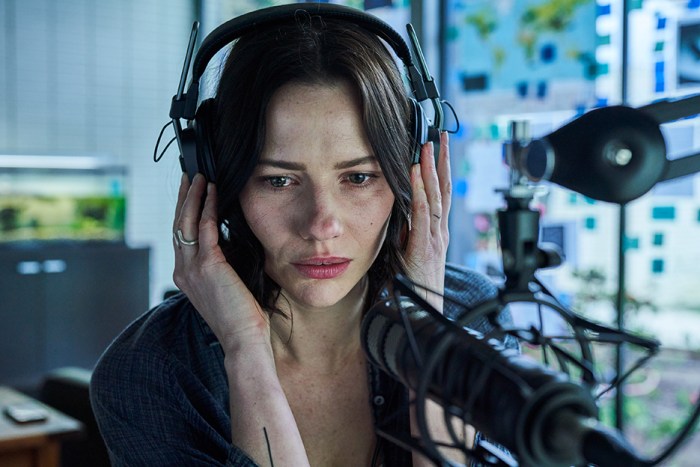
Lily Sullivan in Monolith.
Monolith is a one-hander in every sense of the term. This seems like the type of role that you wouldn’t have to consider for very long once it’s presented to you.
Lucy Campbell constructed such a tight script. I’ve never had less input in a script in my life, to be honest. This script was executed so well. It has themes of intergenerational privilege, the spread of misinformation, clickbait podcast culture, deep shame, and an addiction to existing online and participating and being relevant. How could I turn that down? The sci-fi element just slices right through those themes and flips them on their head. It was a real page-turner. I had no idea where this story was going to go. Monolith terrified me, and that’s why I had to do it. I didn’t audition. It was a really smooth and trusting experience. It was really nice to not have to prove the character to anyone. Instead, they just handed The Interviewer over to me and let me step into it and take on the challenge. Everyone involved in this film is such great creatives. It was a no-brainer.
Did you find it to be a liberating experience or a challenging experience having no other on-screen performers to bounce off?
It was definitely a challenge. There’s a constant nagging voice that tries to trip you up, and that voice becomes amplified for sure. Without looking into the eyes of another person to distract you during a performance is a challenge. It was very much an isolating experience. When you’re alone, the dark voices can come out. Because of the limited budget, we couldn’t use all the different actors on set for all the different characters. Ansuya Nathant, who’s a great actor, was on set to deliver all the lines to me. She was playing a German, then my dad, and everyone else. Ansuya was coming through the headset when I was shooting those scenes. I would be fully immersed in what she was saying to be able to give the best performance possible.
How close was Ansuya to you? Could you see her, or was she in another room?
She was in another room. She was in a closet. [Laughs]. It’s quite unbelievable to think that she was in a closet in another room at the end of the house. It was so ridiculous now that I think about it, but it worked so well.
Did you go over lines together?
We didn’t actually. Because this is dialogue-heavy and driven, I felt like if we rehearse, we’re going to kill it. You have to listen, and listening is hard sometimes. We didn’t want anything to get in the way of me hearing lines for the first time while we were filming. Because it’s only me on camera in the one location, I had to really keep my eyes alive as well as my ears.
I don’t want to give anything away, but there is a moment in the film where you do appear opposite yourself. Talk us through that process.
Oh my God, it was wild. I’d describe filming those dual characters as doing a real do-si-do. At one point, we were shooting my coverage as The Interviewer, and then the camera would swing around, and I would run behind it to place myself down. We did have a body double, so whenever the camera was in reversal, we were both in shot. We’d shoot the double from behind, and I would do a do-si-do and then come in and sit down and play the other version, all within one take. I would run around the camera and then be sitting opposite myself, and the double would sit in the other chair so they could go over her shoulder looking at the new formation. I wanted to play this other version of myself a particular way. I didn’t want to play it robotic. I didn’t want to give it Terminator vibes. I wanted this entity to come across as almost being new flesh and new bones. Their muscles haven’t quite formed properly, so there’s a droopiness to it. There’s a relaxation to it like its muscles are newly forming.
How long did that take to shoot?
We were really tight on time, and everyone was stressed. It was such a dance between Michael Tessari, the cinematographer, and I. I think we had about four cracks at it. Then we had to break for lunch. We decided to go one more time after lunch, and then we got it.
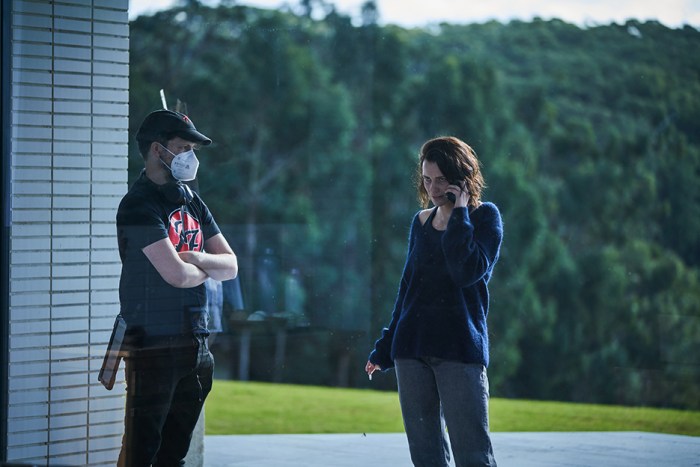
Lily Sullivan on set with director Matt Vesely.
Producer Bettina Hamilton, writer Lucy Campbell, and director Matt Vesely have all described the making of this film as being a highly creative collaboration with all three on set throughout the entire process. How would you describe their dynamic on set?
They have such a shorthand language. They’re very supportive and not ego-driven. Everyone was in a beautiful soft space where creativity could thrive, and I felt the same. There was a moment I called them, and I was crying. I just couldn’t remember any more lines. I was freaking out and over-exhausted. They understood and said, “Don’t worry, we’re going to change the whole schedule tomorrow for you.” Bettina was such a gun like that and so understanding. It’s a really challenging process to make a film in six months with such a small budget. Adelaide is so brilliant for supporting the art scene. It’s just really cool. I’ve learned from making movies with bigger budgets that with more money comes more problems. This was a really nice experience because of Bettina, Lucy, and Matt.
This is Matt’s debut feature film as a director. You’ve been acting in film for over a decade now. Is it still a thrill for you to put so much faith in an independent first-time filmmaker?
Hell yes. Hell yes. It’s wild when you work with so many different people going through so many different stages of their careers. You can’t beat the buzz of working with a first-timer jumping off the cliff and hoping for the best. You can’t get that back. Even though I’ve been in the business for over a decade, I feel like it’s my first time every time. I’m not going to lie. There’s this level of anxiety that fuels you in such a great way. Monolith might be Matt’s debut, but it’s bold and it’s edgy. He’s a brilliant mind and a generous human being.
Your character in Monolith, The Interviewer, is a podcast host. What podcasts are on your playlist at the moment?
I’ve been listening to My Dad Wrote a Porno, which is hilarious. [Laughs]. I listen to Tara Brach all the time. She’s beautiful. Her podcast is a guided meditation interweaved with beautiful chats with all kinds of creatives and different therapists and different writers. It’s really great.
You seem very content with your career at the moment. Are you at the exact place that you want to be right now?
I am. When I look back on all the different storybooks I’ve been a part of, there’s such a great diversity of characters that I’ve collected along the way, and I have all these journals of all these different characters and so many incredible people that I’ve met and different countries and places that I’ve been to, and I just have so much gratitude for it. Right now though, I’m in this place where finally I’m going to start writing. I’m developing a show at the moment, which is really exciting to be a part of the foundational side of it. It’s great to jump onto a job when it’s already fully formed and then you breathe life into it, and then you walk away and then they edit your performance, but I feel like it’s time to start at the root and develop something from the ground up. It’s been really exciting.
Is writing something that has been brewing in you for a while now?
I’ve always known I would find space for it eventually, and then an idea came up, and I’m developing it with my best friend who I’m living with at the moment, up in the hills of Mullumbimby on a hundred acres with cows, sheep, and piglets. It’s hilarious, but it’s like a half-hour black comedy, weird and twisted show.
Lily, it’s been such a pleasure chatting with you. I’ve been following your work since Mental and Galore all those years ago. I look forward to seeing you in so much more going forward.
Can I just say thank you for saying what you said earlier about me not needing to be embarrassed. I needed to hear that. This was such a beautiful interview, so thank you.
Monolith is in cinema now.


 Cinema Australia