
Jack Clark and Jim Weir on the set of Birdeater.
Article originally published August 2023. ARTICLE UPDATE 18.7.24: Birdeater is in cinemas now.
Birdeater is set to have its WA premiere at the prestigious CinefestOZ Film Festival this weekend following incredibly successful screenings at Sydney Film Festival and Melbourne International Film Festival.
Birdeater is a deeply thought-provoking and highly unsettling drama in which a bride-to-be reluctantly attends her fiancé’s buck’s party, triggering a feral response from the groomsmen. Birdeater’s narrative might seem familiar to connoisseurs of European cinema, but its visual style is unlike almost anything ever made in Australia, which is a testament to the unique approach of the writing and directing duo, Jack Clark and Jim Weir which the two discuss in this interview.
Here’s the full synopsis: Recently engaged Irene (Shabana Azeez) has been roped into joining her awkward but loving fiancé Louie’s (Mackenzie Fearnley) buck’s party weekend out in the sticks. Louie’s deadbeat groomsmen, however, have more in mind than just a quiet glass of pinot by the fire, and as night falls the celebration nosedives into a feverish, drug-fuelled train wreck. Inspired by the likes of Wake in Fright, directing duo Jack Clark (Threshold) and Jim Weir present a challenging, darkly comic portrait of young Aussie men that strikes a little too close to home.
Jack Clark is a Sydney-based filmmaker and screenwriter. His early short films such as Threshold drew attention for their use of genre elements from horror and crime in new, subversive contexts. He is the co-founder of Australian independent production company Fax Machine alongside Jim Weir.
Jim Weir was nominated for BBFF’s Young Australian Filmmaker of the Year for his experimental short film Julia, and he won Best Film at Hell Chess Festival for his crime-thriller short Thirty Pieces.
Birdeater will screen at CinefestOZ on Saturday, 2 September. Details here. A general release of the film is expected to be announced soon.
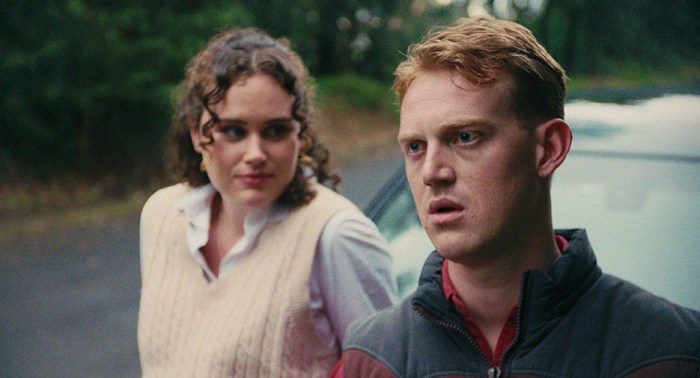
Clementine Anderson as Grace and Jack Bannister as Charlie in Birdeater.
“At this level, it comes down to the practicality of time and energy and the fact that both me and Jack were equally committed to this collective vision of the type of movies we want to make.”
Interview by Matthew Eeles
There are some incredible filmmaking duos making movies in Australia right now, including Indiana Bell and Josiah Allen, who have just made a neat little thriller together called You’ll Never Find Me. Those two have never made a film separately, unlike yourselves.
Jack Clark We made short films separately when we were in film school. We’d never even really considered the idea of making films together until Birdeater, where it became a logical option that, I think, surprised both of us. But then it made sense once we thought about it for a minute. In terms of breaking into the industry, it’s such a difficult industry to get a foothold in. Your first film is always such a risk because there’s an implicit understanding that you really go out on a limb with your first film, and you hope that somebody sees what you’re trying to do, who will come in after and support you. Maybe that’s a fantasy, but that seems to be the implicit idea of anyone’s first film. I think having two of you to lean on each other’s shoulders on any given day is just the ultimate resource for something that has no money and relies entirely on energy and dedication to making something work out of nothing. So having two people who are one hundred percent committed to that idea is the ultimate resource. It helps you to hopefully punch through and make an impression with that first film. So it doesn’t surprise me that there are a lot of independent filmmaking pairs in Australia at the moment.
Jim Weir At this level, it comes down to the practicality of time and energy and the fact that both me and Jack were equally committed to this collective vision of the type of movies we want to make. We had some other practical agreements, like how much casual work we’ll be doing a week, how much time we’re going to be dedicating every day, every single week for years at a time to an independent feature film. That’s essentially what it all came down to: just how much time and how much energy we were both willing to put into a two-hour movie.
What’s the story behind the name Fax Machine?
Jim I wish there were a really great story behind the name. The reality is, we pitched probably three hundred different company names to each other. Most of them were absolutely dreadful. And then Fax Machine came up because it was tonally a little bit non-specific. It felt more like a vehicle for whatever film it is. It’s a mode of delivering communications. We thought it was kind of funny to have a young, hopefully exciting production company naming themselves after an obsolete piece of communications technology. [Laughs].
How did Fax Machine come about?
Jack We did a three-year Bachelor’s at AFTRS. We met in the first year there. We were part of a group of friends, and we were all kind of angling to be directors. But given that it’s a film school, it’s a “one for you, one for them” kind of situation where you’re all taking roles on each other’s films so that they can be a director and follow something through from script to the final stage. We were in a group that was really productive. We were making things outside of the semester. We’d ended up making a dozen films in our three years, which meant that we were right on top of each other during that really intensive learning experience. There was a bonding of taste that maybe happens at that time. I remember reading something recently about the idea that there’s only a few breakthrough movies that you can really fall in love with in your early filmmaking career. If something really shakes you to the core, you end up trying to remake that film for the rest of your career. There were probably a few films that me and Jim happened upon at the same time, or the same lessons that we learned at the same time, that galvanised something in us that made working together logical. We were making short films that were fairly different, but at the same time, they were kind of extensions of each other’s ideas. We could be quite critical of each other’s shorts and quite critical of each other’s scripts in a way that felt like a very honest transaction. By the time we got to the option of making a film together, we knew that that dialogue already existed, and we already had a very good handle on each other’s taste. We founded Fax Machine a year or so ago after graduating from AFTRS because we were making each other’s short films. We thought we should just put these under a name, which became Fax Machine. We made three shorts under Fax Machine. And then from there, we started to develop feature ideas and had this opportunity to reach out to Breathless Films to make Birdeater.

The ute scene in Birdeater.
What are some steps you have to take throughout the pre-production stages to make sure you’re on the same page visually? Birdeater is quite a visual and stylized film.
Jim There is a kind of slow merging that happens. And it is natural because I think me and Jack are really diverse with our film watching. We watch a huge variety of movies with different tones. We obviously don’t want to make only one specific type of movie. I think that while you’re in film school, you’re playing around making movies and slowly your own personal style starts to come about. Like Jack said, there are only a few types of movies that really, really shape you as a filmmaker and leave a lasting impression. I can think back to maybe three or four of those movies for me that were a huge inspiration for Birdeater. The main one was The Celebration, a Danish movie. That film is about a ritual instead of a bucks party. It’s both funny and dramatic at the same time. There’s a really uncomfortable speech that happens at dinner which we essentially lifted for our film, but our film reveals something completely different. The whole movie kind of pivots following what’s revealed in this speech. So yeah, I think there are a few things like that that have calcified our style. But in saying that I think as our career goes on, our movies will look different and our style will change.
The influence of The Celebration really comes through. Wake in Fright is my favorite Australian film of all time. I was thrilled to see a Wake in Fright poster displayed in the background of a scene in the film, and it didn’t take me long to realise that Birdeater is the closest thing we’ve ever had to a modern interpretation of the film. What impact has Wake in Fright had on you both as filmmakers?
Jack It was a very, very fundamental text in film school, and in Australian cinema for both of us. I think you definitely see the impact of Wake In Fright on this film. We didn’t set out to make something like Wake In Fright. That was never in a conversation at the start of thinking about this film. But once we started to involve some of the structural elements of the film, like the bucks party, that influence became unavoidable. We realised the dominance that it had on that sort of male relationship depicted in this film, and we decided to veer straight into it and to see if we could generate something new out of it, because I think it is a really fundamental text. An ongoing conversation that we want to have in our films is this idea of creating quite a safe film for some Australians to watch, because it is still set so far away from metropolitan areas. This film still seems to have that kind of Deliverance quality where there’s this backward version of Australia and then a modern version of Australia, and you never know when the two shall cross. I think bringing those two worlds together and then questioning whether they have a relationship, or whether or not that version of the Australian man has any place in modern Australian society anymore, it’s very interesting to us. We’re interested in bringing that culture closer and closer to home. We think that there’s an uncomfortable truth in it about Australians that relates to humor as well. There’s an indulgent quality to it, especially for masculine cinema. And a lot of men find it funny. There are a lot of things depicted in Wake In Fright which are horrifying, and at the same time people will laugh at it.
Not only does Birdeater reference Wake in Fright thematically, it also references it visually with the flip of the coin shot, and the back-of-the-ute scene. Were these references written into the script?
Jack [Laughs]. The coin, yes. At first it was accidental, and then we kind of realised that of course it was a reference. The ute scene was much more of a deliberate reference. We needed a vehicle. And then we were like, “Well, let’s make it crazy. Let’s make it our version.” Dylan (Ben Hunter) is a private school boy who’s running away from that image and trying to dress as a tradie, or to dress like somebody out of Wake In Fright, even though he has never done a day of labor in his life. [Laughs]. He’s walking around in KingGee boots, but he has never set foot on a work site. We then thought that maybe this character would indulge in a big bright red ute with hunting lights but he’s never been hunting before. It just sort of made sense in the image, but also for the character and it made that set piece a little bit more horrific to watch. Believe it or not, that’s actually Jim’s ute. The Lady Lazarus van is mine.
Jim I felt very silly driving around in that ute.
Is there a bit of Dylan in yourself, Jim?
Jim [Laughs]. I think I’m slowly discovering it, yeah.
Some of the parallel themes between the two films are the alcohol abuse, toxic masculinity, loss of innocence, and isolation, but Birdeater goes way beyond that by exploring trauma and using medication as a coping mechanism. Can you talk us through some of the other themes in this film and why you wanted to explore those?
Jim That’s where we started. We started with just this relationship where this Irene character had severe separation anxiety and couldn’t be away from her partner, and the idea of using this historical trauma which is really common in films that have abusive relationships at the centre. We liked having a trauma where it’s actually the perpetrator’s trauma, but they’re using that to guilt the person who ends up becoming the victim. We like that kind of switch because there’s a great complexity to it.
Jack When it came to depicting Irene, we were in constant communication with Shabana about it. Shabana was brave and fully committed to this idea, not making Irene a character who needed to be likable or good at communicating. We wanted to challenge the audience to see an unlikable victim, someone who doesn’t necessarily work for the audience. She’s not always presenting a pleasing face for the audience. She is prickly and combative in many conversations. Through exhaustive research with Shabana, we discovered this to be a more common situation. These people can be extremely difficult to reach. They can be defensive and combative when talking about their relationships because of the loss of agency they’re experiencing. Working with Shabana, we aimed to create a portrayal of a victim that wasn’t typical, adding complexity. We wanted to be a few steps ahead of the audience, not allowing them to anticipate whom they should sympathise with, avoiding toxic feelings of dictating a certain type of sympathy.
To a lesser degree, was religion included in those themes? Jack Bannister’s character Charlie is essentially resurrected, or brought to life, with the help of Lady Lazarus.
Jim The idea of introducing a young Christian couple into the story was there from an early stage. I grew up in The Hills District of Sydney, essentially Sydney’s Bible Belt, surrounded by Christians. My family is devout. I was interested in showcasing two different sides of Christianity. One, embodied by Charlie, is interested in rules and doctrine, without much depth in their relationship with a higher power. The other, embodied by Grace, has nuanced and thoughtful beliefs. Grace’s beliefs are noble, as seen in the dinner scene, where it’s not about daily relationship quality, but about turning to the loved one during difficult times. We wanted to test this belief at the end of the film. Once people see the film, they’ll realise why her name is Grace. We enjoyed testing a character with noble beliefs to the point where the audience might feel she made a wrong decision. But at the end of the day, she’s simply following through with her beliefs, which sets her apart from most other characters in the movie.
Every one of the actors you’ve assembled for this film is terrific. There’s not one weak link among them. I’m wondering how much rehearsal there was considering how well everyone nails their performance?
Jack Very little. Rehearsal for an indie film is different; it’s usually informal and unpaid. We held more casual rehearsals, hanging out with the actors for dinner or something. We were informally rehearsing for a few months. It was more text-based than traditional rehearsal with everyone in a room. Until the second shooting block, no one had rehearsed with Ben Hunter as Dylan except Mackenzie Fearnley who plays Louie. It was less organised than desired for an ensemble piece. We gave them homework, had them work out extensive backstories for their characters, and provided unique watch-lists and references. On set, they had that history in mind, enabling quick pivots if needed. We relied on their preparation for truthful character adjustments. Some actors were from different states. Shabana was in Adelaide, so we communicated over Zoom. Her performance was research-based, but it was fun. It was exciting to have an unrecognisable cast for our first film. We might want another ensemble for our next film, as an unknown cast can surprise the audience; they’re not anticipating a specific type of performance.
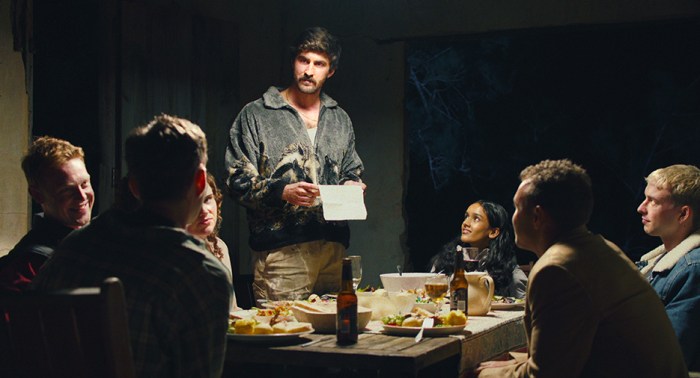
Ben Hunter as Dylan in Birdeater.
Ben Hunter’s captivating speech midway through the film is shot in mostly one take. How long did it take to get that scene in the can?
Jim Believe it or not, that was actually Ben’s very first day of shooting. He hadn’t performed with the ensemble until that night. We had shot a small scene with him and Mackenzie during the day. Then, we had the idea of filming the speech first because it’s “the” Dylan scene. He’s coming in hot, steamrolling the entire ensemble. And we thought it would be interesting to do that first, as the rest of the ensemble had no idea who this new Dylan was. They all knew each other from shooting for a month already with a different version of Dylan who had to leave due to flooding at our past shooting location. So we got this new Dylan in Ben Hunter, and he played a very different version of the character. Being “the” Dylan scene, until we shot it, it loomed over Ben. We didn’t want him to hold back for this scene later. [Laughs]. He had to monologue for seven minutes straight in an uninterrupted take. Ben had to be on his game for this scene, so we did it on night one to get it out of his system. He nailed it. We got three great takes from him, and he was so confident for the rest of the shoot. It was one of the few scenes where the whole cast and crew applauded afterward because he did an amazing job.
Were you all staying together at this location throughout the shoot?
Jack Kind of, yeah. As Jim was saying, there were two shooting blocks. The first one was tested by weather, with flooding in New South Wales. Our set got flooded. It was challenging, but everyone was staying in the same place. It’s a balance to create a working environment, not a holiday. The communal aspect of independent filmmaking made everyone feel like a team. By the second shooting block, we became a machine. We weren’t all staying together, but that team mentality helped us shoot half the film in less than half the time of the first block. The floods turned into a blessing in disguise for us.
Jim During both shooting blocks, me, Jack, and the cinematographer, Roger Stonehouse, and slept in the house featured in the film. It was challenging waking up and feeling like you’re still in the movie. [Laughs]. But it was good for other reasons. One morning, a bird flew into the house, and Roger filmed it with the camera, which we used for the opening title sequence. We got B-roll when everyone left. We’d shoot and shoot, then sleep, wake up, and work when the cast and crew arrived. [Laughs]. It was tough, but I wouldn’t have done it differently.
You’ve had successful screenings at Melbourne International Film Festival and Sydney Film Festival, and now you’re heading west for CinefestOZ. Are you itching to jump into your next film, or will you take a break before that?
Jack This is the holiday, I suppose, going around to festivals. [Laughs]. We are very hungry to get straight back into it and to play with some of the same things we were doing in Birdeater. We feel like there’s so many things that we discovered while making our first film about certain topics, or a certain type of film that it just feels like we’ve only just opened the door in regards to depicting what we want to talk about. We’re just so hungry to dive back in. We’re currently talking about the films that we want to make which we’re referring to like a big brother to Birdeater, or just like a bigger ugly cousin or something. We’re just super hungry to jump straight into the next one.
Birdeater will screen at CinefestOZ on Saturday, 2 September. Details here. A general release of the film is expected to be announced soon.
UPDATE 18.7.24: Birdeater is in cinemas now.

ADVERTISEMENT
ADVERTISEMENT On now!


 Cinema Australia
Pingback: Late Night with the Devil leads Australian Film Critics Association Awards nominations | Cinema Australia