
Godless: The Eastfield Exorcism director Nick Kozakis.


With a passion for the horror genre, Nick Kozakis’ filmmaking journey has been marked by several award-winning films and music videos, including his latest creation, Godless: The Eastfield Exorcism which recently had its world premiere at the prestigious Overlook Film Festival.
Nick’s talent and vision extend beyond the silver screen. He boasts an impressive portfolio of notable music videos, including the chart-topping Dance Monkey for Tones And I, which has amassed over 2 billion views on YouTube. With a keen ability to build tension and suspense, Nick has emerged as one of the most exciting and promising talents in the horror film industry.
In Godless: The Eastfield Exorcism, Nick delves into the haunting story of Lara, a woman torn between the realms of science and faith. Pushed by her husband to seek treatment from a congregation of zealots, Lara’s soul becomes the battleground for a ruthless exorcist’s attempt at salvation, subjecting an innocent woman to the depths of hell.
Nick’s fascination with horror and true crime has been an integral part of his artistic journey.
“The older you get, the more you realise that it’s not just about the monsters and the spirits and all that kind of stuff, it’s actually the real people that are the most terrifying,” Nick tells Cinema Australia. “I think true crime has always had a little bit of a curiosity and an obsession behind it. That’s how I got immersed in it.”
In this interview, Cinema Australia sits down with Nick to delve deeper into his creative process, his passion for horror, and the making of Godless: The Eastfield Exorcism.
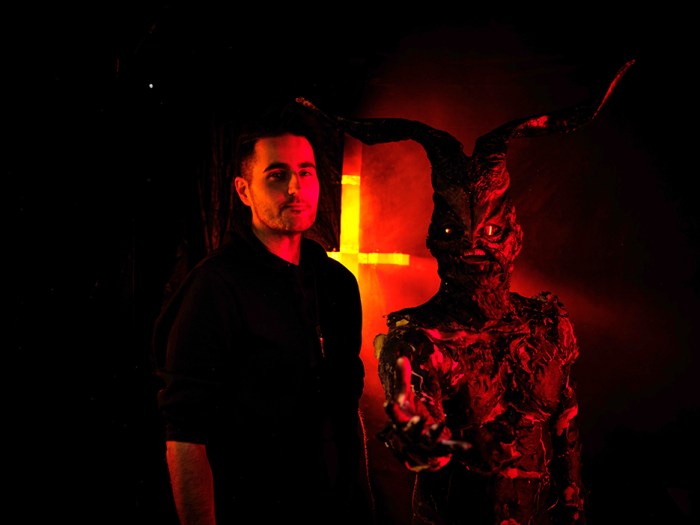
Nick Kozakis with Andy De Ross as Demon.
“Weird stuff would happen. We had rain, thunderstorms, heat waves, cameras falling over on their own. We had locusts that would just come and flood our frame for no reason.”
Interview by Matthew Eeles
Were there any true crime cases that had an impact on you growing up?
Stories from our own backyard are the ones that hit me the most – the whole terror of Mr. Stinky and Mr. Cruel, and all that kind of stuff. I’d always heard those tales, and then, from there, I’d look into their library of books, and they would have their own collections. Then I heard about Jeffrey Dahmer, which is just such a crazy thing. And then there’s the Texas Chainsaw Massacre, which you always hear is based on a true story, but it’s actually based on something completely different. I grew up in a European family background where it’s all happy families, but the outside world can be really scary.
Editor’s note: If you’re a fan of true crime stories, Google Mr. Stinky and Mr. Cruel, but be warned…
Godless: The Eastfield Exorcism is loosely based on the real-life exorcism of Victorian woman, Joan Vollmer. What are some of the parallels between that real-life case and this film?
Well, it’s funny you mentioned that because we started off more on the path of Janet Moses, the New Zealand woman who suffered at the hands of her family and friends. And from there, we found so many stories that inspired us. It really is based on a collection of things. Although we have come across the Joan Vollmer story, the one thing that stands tall in all of these scenarios is that there’s something similar about them all: it’s mostly a woman or a child that’s affected by schizophrenia or whatever their mental health issue might be. And at each point, there is a loved one, whether it be friends, family, or a community that believes they’re doing right by this person, and they will go and find an exorcist or a self-appointed exorcist, and they will utterly torture and harm that person. Even you being based in Perth, a few years ago there was a girl that died by exorcism there. She was six years old. We looked into that one as well. We got a whole bunch of court documents from across the globe to set a tone for this film.
What’s your take on exorcisms? Are you a believer?
I grew up in a Christian setting. It’s funny because this film can potentially be seen as an anti-religious film, and that’s not the case. It’s really an anti-extremist film. I want to believe that there’s something out there. It would be great to be able to tell a story where maybe possessions are real and maybe exorcisms are safe, but that’s not the reality of how these situations play out. I much prefer the pathway of looking at them from a scientific and medical perspective. I don’t think that there is a spiritual connection to a lot of the people that are suffering from these conditions. And when people start taking matters into their own hands, that’s when we get into these dangerous situations, and that’s when people start getting harmed and start losing their lives.

Georgia Eyres in Godless: The Eastfield Exorcism.
That’s interesting to hear about your upbringing because I’ve since found out that both Dan Ewing and Tim Pocock also grew up in religious households, with Tim’s being perhaps a bit more extreme. Did that play into their casting at all?
Well, yes and no. With Dan, it just coincidentally happened that I had worked with him on something prior to this, and he has an uncle who’s a Catholic priest. So he got a little bit of insight from his uncle. I guess what was good about that was when he was speaking to his uncle, he found out that while they do believe in exorcism, the practices that we were presenting aren’t common with how they treat people that have these kinds of conditions. It’s unusual for people to be brutalised and beaten. Georgia I had worked with, and I just think that she’s incredible. She’s very talented. Look at her eyes while you’re watching this movie. One minute she’s human, and when she shuts down, it’s almost like she has no soul. She’s phenomenal. Tim’s casting was serendipitous. We had received a lot of tapes from so many people who had done amazing auditions. Dan reached out to me and said, “Hey, I know this guy. I know who you have to cast.” Tim put down a tape that was so haunting and chilling because it felt like he genuinely believed it. And like you said, Tim’s got a history with it. He was brought up in a school that was run by Opus Dei. He knew these people, and he was growing up to be one of these people. It just so happens that Tim is gay. He was being taught to hate himself and the person that he was. Luckily for him, he was able to get out, and understand who he is as a person. But that trauma has never left him. While we were doing takes and he was channeling it, I went up to him after one particular day and I said, “Hey, is everything okay?” I put my hand on his shoulder and he broke down. To have that authenticity and that life behind it obviously helped the production. It also helped him let go of some demons. Not literal, but metaphorical demons that he was carrying. We’re forever grateful for his performance and for his truth that he was able to bring to this project.
That’s incredible. I wasn’t going to ask you about the performances in the film yet, but I’m going to bring those questions forward. Both Dan and Tim give exceptional performances here, but I’m in absolute awe of Georgia Eyres’ performance too because she really does take this film to another level with her ability to switch from placid to possessed so convincingly. Was there much involvement in getting that performance out of Georgia?
She’s just genuinely possessed. [Laughs]. She’s just incredible. I worked with her on a couple of music videos prior to this. I’ve always wanted to work with her on a feature film. Her professionalism is such that she could switch on and off. And obviously that’s great for music videos, but does that translate over to narrative? And it absolutely does in spades. We did a lot of rehearsals prior to shooting. There was that haunting element that she could bring forward. But the best thing about her is that she’s not method in any way. What was perfect about her was the fact that she would get into this zone, get into this form of narrative brutality with this trauma and abuse. And then as soon as we’d yell cut, she’d start laughing and having fun with the crew, pulling goofy faces. She was just the life of the set. For the cast and crew that are going into a setting in an environment where a woman is being abused, tied to a chair, and to have that lightheartedness, it made everyone feel like we were okay at the end of the day.
Exorcism is almost a sub-genre of its own, and more often than not films like this can fall quite flat. Thankfully that’s not the case with Godless: The Eastfield Exorcism, so I’m wondering if you referenced other exorcism films before going into this one?
The Exorcism of Emily Rose. That was a really interesting film to watch. I love it. I love all exorcism films as much as I love all horror. I’m a fan of horror first, and then I’m a director. [Laughs]. Horror was my first love, and I love the exorcism sub-genre. They’re fun and that’s what we were seeking to make here. But the more I started reading about the real cases of people suffering at the hands of other people that I couldn’t shake, that terrified me more than some of the other stuff that I’ve watched. The Exorcism of Emily Rose was a close point of contact for me because it had the court system and it had the duality of the sides of was she possessed, or wasn’t she possessed? I love The Exorcist, but obviously that was on the side of possession. I tried to keep all the cast away from other exorcism films. I just made them watch more stuff that was on split personality and trauma and all that kind of stuff. So that’s what I got Georgia to reference and to use her performance through that lens.

Tim Pocock in Godless: The Eastfield Exorcism.
You’ve had quite a lot of experience making music videos. Do you approach directing a feature film differently to directing a music video?
A little bit, yes. But also, all the techniques that we use in music videos are great building grounds for what I do on a feature. A lot of the corners that we had to cut, being that we were working with such a tiny budget, we know the cheap tricks of the trade to get it over the line. We do a lot of post-production and VFX on music videos, and we took a lot of those tricks into the making of this film. The narrative side of things is something that I took a little bit of a different approach to because I’ve never really needed to rehearse with actors. We’ll do basic blocking on a music video, and that’s fine, but it was the rehearsals that we dove into with this film that were a big point of difference. But everything else is just coverage in the same way that we were doing a music video.
Some of your music videos are very cinematic. Making feature films seemed like a natural progression for you.
I tend to put a little bit more narrative into music videos than I probably should. Usually, there’s a vibe or a style, and I try to always inject a story into it. So I guess the natural progression was to just do a narrative. [Laughs].
Godless: The Eastfield Exorcism is Alexander Angliss-Wilson’s first screenwriting credit. Tell us about working with Alexander to tell this story. It’s hard to believe this is his first film.
Alex is incredible. He worked as a runner on a web series that I made called Help, which won Best Web Series at Melbourne WebFest. From there, he hit me up. He came to my studio and said, “Hey, I really want to make a film. I would love to write something with you.” He sent me some stuff that he had written, and they were very big in scale, but the sensibility and his intelligence were right there. Then I proposed this concept to him, and he went away, wrote it, and his first draft was absolutely brilliant. He’s just incredibly knowledgeable. The research that he puts into things is amazing. He put himself into a position where he infiltrated some pretty hectic churches to try and get a more authentic feel of what it’s like to be in there. It got to a point where he was interrogated by a church. He’s incredibly talented and incredibly intellectual. He has just recently written and directed his first short film, and I can’t wait to see it. He’s keeping it from me until it’s finished. He’s going to have a really long career doing some really incredible stuff.
Tell us more about Alex infiltrating churches.
Both of us went to different places to have a look at how churches are run and to see what the body language is and what the environment is like. Alex went into a very deep sect which friends of his were a part of it. He went in, and they were pretty much reminiscent of what we’ve captured in the film in the sequence in the church with Ron at the first part where exorcisms are being performed on stage. We’ve seen it on late-night television before, but you think they’re more American-based, but they’re very similar to what we have in our own backyard in Australia. They’re very inquisitive people sometimes, especially if you’re an outsider. They want to know why you’re there. He definitely got away with it. [Laughs]. For Alex, it was interesting to see the think tank mentality, which we tried to convey in this film, which is to have that one hive mind of this is the way of thinking, this is the way it’s done. It’s very hard to get out of that environment. When you’re in that setting, if you’re not a believer or if you’re not on the same wavelength, then you are technically a sinner.

Godless: The Eastfield Exorcism
Have you received any backlash from church communities about this film?
We’ve had some interesting posts here and there. You just can’t help that. It’s so hard to not make someone feel a certain way, and if they feel victimised or portrayed in the wrong way, that’s fair enough. But we really are just talking. We were really just trying to tell a story of what’s happened in so many cases where it’s like, you can have your beliefs and that’s fine, but when you start abusing people with your beliefs, that’s when it’s not okay. So if anyone’s negative or anything like that, we’re happy to die on that cross.
Making something like this can be quite intense. I’ve interviewed other filmmakers who have worked on exorcism films, like Chris Sun, who recently made The Possessed. Quite often there are strange things that happen behind the scenes. Did anything out of the ordinary happen while making this film?
Oddly enough, it did. Weird stuff would happen. We had rain, thunderstorms, heatwaves, cameras falling over on their own. We had locusts that would just come and flood our frame for no reason. And it’s in the film when the congregation is praying outside before they’re about to have their supper, and you see all those bugs flying out. We didn’t plan that. They just happened to come into the frame during that time. That was bizarre. The weirdest thing was Liam Kelly, who was one of two editors on this; he was editing, and our producer Lauren came to check in on him, and he had never had a blood nose before, and he was profusely bleeding during the second exorcism scene as he was cutting it. And then as soon as he stopped cutting it, his blood nose stopped. That was so bizarre. But everyone has their own stories. Georgia moved from location to location. We had beautiful accommodation and everyone was fine. People that stayed there before her were fine. People that stayed after her were fine, but she had these centipedes that were falling from the roof. She had spiders that were crawling around her body. It was just so strange.
Editor’s note: Read our interview with Dan Ewing to find out what happened to him while making Godless: The Eastfield Exorcism.
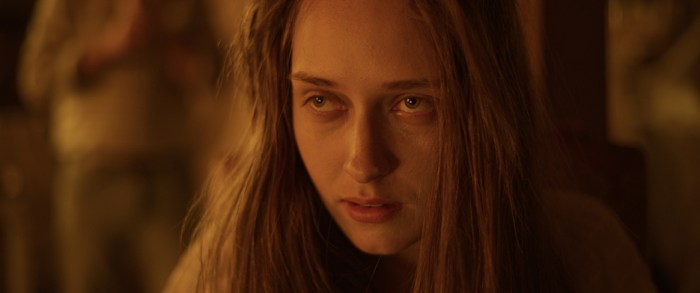
Georgia Eyres in Godless: The Eastfield Exorcism.
How do you maintain calm on set when there’s so much chaos going on once action is called?
Collaboration. I have a really good team surrounding me. We’ve worked together on a bunch of stuff, and even the new people we worked with on Godless, we’re still working with today. We created a sense of family where everyone was important, so everyone felt welcome. There was no hierarchy in place; we really had a family vibe. The ego was in the film and not on set, and we just had a great time making it, even to the point where we had long days, but never anything scheduled outside of what we needed to schedule. So one thing that’s important is to keep the energy up and make sure that everyone is well fed. That’s one of the best things about indie filmmaking; it’s the number one rule. We also kept on time. We only went over twice by thirty minutes, which is nothing. Most days, people would want to stick around, hang back, have a beer, and chat because we became friends.
The spiritual themes are obviously very strong, but there’s also a medical subtext to the film with discussions about medication and vaccinations. Why did you want to include that?
That was Alex, but we were in a time when COVID was hitting. It was an interesting time in the world. We started having these debates where people thought medicine was against us. People were claiming that COVID, vaccinations, and medicines were part of a conspiracy theory. I think, for us, it was important to get that message across because we wanted people to understand that, at the end of the day, it’s important to get medical help if you’re unwell mentally and physically. It’s important to understand and trust that perspective. And if not, then we’re really getting into dangerous territories where we’re assuming that it’s an external power that’s controlling us. We start theorising things that end up becoming quite dangerous. In this instance, we peppered that throughout the film. It might have been a little bit on the nose when we do talk about the vaccination side of things, but we wanted to create a divide of thought process between some characters. We wanted to really emphasise how important medical attention is if you are suffering from something, or if a loved one is suffering from something; it’s better to take the path of speaking to a healthcare professional because we think that that’s so important in this day and age.
Godless: The Eastfield Exorcism will screen at the Melbourne International Film Festival Friday, 11 August (Standby only) and Friday, 18 August. Details here. A general release date will be announced soon.


 Cinema Australia
Pingback: Godless: The Eastfield Exorcism – Film Origins