
Mark Leonard Winter on the set of The Rooster.


Ahead of the film’s world premiere at the prestigious Melbourne International Film Festival, Mark Leonard Winter, best known for performances in film’s such as The Dressmaker, Balibo, Disclosure, Measure For Measure and Escape From Pretoria, tells Cinema Australia during our recent interview that he is filled with gratitude that the film received support from MIFF’s Premier Fund, which boosted his confidence in the project and gave it a home in the world of cinema.
The Rooster follows Dan, a small-town cop performed impressively by Phoenix Raei. When the body of his oldest friend Steve (Rhys Mitchell) is found buried in a shallow grave, Dan seeks answers from a volatile hermit (Hugo Weaving) who was the last person to see his friend alive. As Dan gets closer to the truth, he must confront his own personal demons and he discovers that hope can be found in unlikely places.
The Rooster transcends cinematic boundaries, delving deep into the human experience and illuminating the darkest corners of our minds with a shining light. Mark Leonard Winter’s visionary storytelling proves that he is not just a talented actor, but a genuine filmmaker.
Collaborating with actress and wife Geraldine Hakewill (Disclosure, Ms Fisher’s Modern Murder Mysteries), or Gerry as he calls her affectionately, was a natural and highly-enjoyable experience for Mark as you’ll read more about below. The film was shot at their property, and they shared lunches with the cast and crew, creating a close-knit family atmosphere during production.
Moving from MIFF, an inner-city film festival, to the regional CinefestOZ where it will compete for the $100,000 film prize, is a fascinating prospect for Mark. He is eager to witness how audiences from different backgrounds respond to the film. Having only seen limited audience reactions so far, mostly from cast and crew, Mark is intrigued to learn how people connect with this story. As The Rooster explores themes such as isolation in a regional community, Mark hopes it resonates with all audiences and sparks meaningful conversations.
The Rooster is currently screening at the Melbourne International Film Festival until Sunday, 13 August. Details here. The Rooster will screen at CinefestOZ from Friday, 1 September where it will compete for the CinefestOZ $100,000 film prize. Details here.
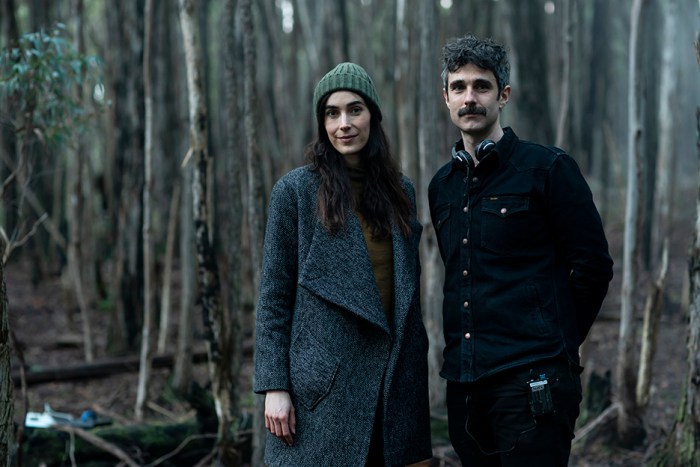
Mark Leonard Winter and Geraldine Hakewill on the set of The Rooster.
“Working deeply with people to create something is such a special thing. I think it’s the best thing to do in the world. It was wonderful. I feel like I’ve been plugged into the film school matrix.”
Interview by Matthew Eeles
Speaking of regional audiences, The Rooster is shot in regional Victoria where you reside. Is this where you grew up also?
I grew up in Melbourne, and then I moved over to Adelaide, and then I came back to Melbourne. About five years ago, Gerry and I moved out to what’s basically a forest, essentially. [Laughs]. So I’m not born and bred there. The house we’re in now is on seven acres, and the house that we were in before that was a backyard with a shoebox on it, so it’s been a bit of a change. [Laughs].
Dan’s suffering is one that is almost endured universally. He’s suffering severe depression with thoughts of suicide, and he’s drinking copious amounts of alcohol to cope. How common is Dan’s story where you live now?
As you say, it’s not just a regional problem. I think it’s a global problem, and I know that it’s certainly a national problem. It’s really common. I know that there are some quite scary statistics about that stuff. I don’t have those statistics off the top of my head, but I think it’s something like one in seven men contemplate or commit suicide. Throughout the writing process of this film, I’d say to people who aren’t connected to the film industry or to the arts in general that I’m making a movie. When I’d explain to them that I’m trying to open up a conversation about men’s mental health, they’d often ask, “Well, do you have experience with it?” I’d tell them what I’ve been through with it, and then from there, people would often open up about their own experiences with their own mental health. Those conversations kept happening over and over. When you’re writing or creating something like this, you’re constantly asking yourself, “Is this of any value? Does this move beyond vanity or personal ambition?” And those conversations made me realise that I was onto something. If this film could be a small catalyst in starting that conversation, then that’s amazing because it’s so hard to talk about. People, particularly men, feel they can’t talk about it. There’s still so much shame around it. But those conversations really did keep me going.
I think you’re doing a great service with this film. You’ll find that you will be approached after these first few public screenings by people who have been encouraged by The Rooster to start their own conversations.
Well, that would be amazing. The real challenge for the project seemed to be, “How can I make a film about these themes and these ideas that anybody in their right mind would want to see?” People may perceive a film about men’s mental health to be a bit of a downer. People don’t particularly want to spend a huge amount of their time around depressed people. It’s a difficult place that they’re in, and it’s a lonely place, so I really tried to explore the humor and the self-obsession, and the strangeness, and the absurdity of what a surreal place you are in when you are in the midst of that. What I found really interesting as the film developed was that it actually becomes about friendship and about being there for someone. Not fixing them or offering them help. Just being there. That really started to resonate with me, and that became the heart of the movie.
You’ve spoken publicly about your own battles with mental illness. How much of yourself is in Dan?
The scenario that Dan finds himself in is not my story. But that sense of losing your way and stepping off the path and not knowing which way to go and losing your sense of self so entirely is very personal. Dan has lost his way with his career and the incident at work, and although there are degrees of difference between Dan’s story and my own, I did attempt to make some meaning of what is essentially such a meaningless time for this character. Depression and thoughts of suicidal are so awful and real when you’re in that place. What I was really trying to open up with the movie was that when you’re in the midst of that, you just have to wait for something to change. These two men in the film, they just have to be there and to keep making it through another day and either wait for life to return to them, or for death to take them. I really endeavored to capture that haze of feeling that you have when you’re in this state that you’re incapable of fixing your brain. As I’m talking to you, I’m looking out at the same trees that we shot this film in. I really enjoyed the journey that those two guys go on to actually get a little bit of peace within themselves in the natural world and their place within it, which is very small. Often on film, our heroes are saving the girl, or robbing a bank, so I wanted to acknowledge that sometimes the most heroic thing that you can do is make it through another day.
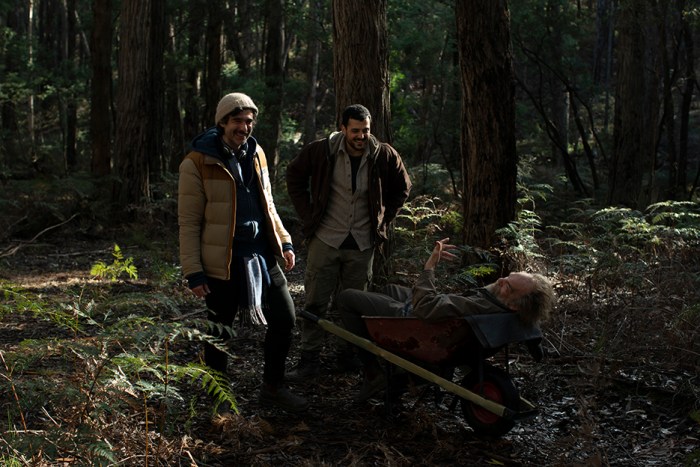
Mark Leonard Winter, Phoenix Raei and Hugo Weaving enjoy a laugh on the set of The Rooster.
The Rooster was backed financially via crowd-funding, private investment, and the MIFF Premiere Fund, but how valuable was the support from the local community in getting this film made?
Our community really opened up their hearts and their houses and their properties and their voices to us. [Laughs]. We had the community choir come and do some work. I’m just really grateful to this community that they just wanted to get behind the film and that they were excited about it. They’ve been amazing, man. We were a very small crew, but if you’re not in the business, a film crew showing up at your house can be confronting. But these people were just great. They were like, “You wanna film on my hill? Go and do it. That’s fine.” I hope too that we captured a little bit of what makes this area special and why these people love this area and why it’s so meaningful to them. The community has been incredible.
You mentioned the community choir, who play the Christian Choir Bushwalking Club in the film. They really do paint an incredible picture of this community’s connection to the land and to each other. It’s very spiritual.
It really is. The Christian Choir Bushwalking Club is a creation of mine, but it’s based on a strange thing that used to happen. I live a few properties away, and every now and then, on hot summer days, I’d hear these threads of music floating on the breeze, and I couldn’t work out what it was. I didn’t know whether it was people singing or whether it was recorded. Those moments just stuck in my brain. I just love the community aspects of that choir in the film. I feel like the film, while having a few comments about the church, also looks at having faith and belief. Not so much in a Christian sense perhaps, but that is a strong thread in the film. So those pieces just seem to fit together a little bit.
Geraldine has said that your original concept for The Rooster may have looked a bit different in terms of character and plot. How much of the story changed from your first draft to this final cut of the film?
It changed quite a lot. Being my first screenplay, I had to do a lot of learning about how to write essentially. The very, very, very first version of the film was looking at a couple who moved to the country, so perhaps a little bit closer to our own experience of things. The script grew and came a really, really long way. The initial seed and some of the themes remained, but the characters changed. It was essentially a two-hander, and budgetary restrictions did shape how the film was created. I wrote for what I had access to, or what would be achievable and what I could get my hands on, basically. I used that as a catalyst for creativity. I’d started creating that sort of hermit character for Hugo, and I slipped him into early drafts of the film. [Laughs]. Hugo was very gracious and encouraging, and he just kept telling me to keep going and to keep writing until I settled on something. He told me that I was onto something, which put a little bit of wind in my sails and kept this whole thing moving.
So you wrote this character with Hugo in mind from the beginning?
I did, man. One hundred percent. I just love the guy so much. I’ve done three films with him as an actor, and I just respect him so much, and I respect how he carries himself in the industry and how much he values Australian film and Australian work. He’s just a beautiful person. He’s a great artist, man. And I think he’s been so brave with his work on this film, and I’ve found his work just so exciting and moving. But separate from that, he legitimised this film. When you’re trying to get together a lower budget film, it actually matters if you can say, “Hugo Weaving is going to be in this film. He’s going to do this role.” Then suddenly people give it a second look and go, “Well, if he’s gonna be there, we’ll come along.” [Laughs]. It’s a tremendous gift that he gave us outside of his extraordinary work.

Mark Leonard Winter, Hugo Weaving and Phoenix Raei on the set of The Rooster.
Hugo’s availability forced you to start production earlier than you expected. Were you prepared enough?
We were ready, man. From my perspective, it’s like getting an acting role where I really want the role, and then I get the role and I’m like, “Fuck, now I have to do the role.” [Laughs]. That’s kind of the scariest moment. [Laughs]. It was a line in the sand moment. Hugo said, “If you’re for real, I’ll be there on this date, can you get things together by then?” And then that became the challenge because obviously I really wanted to shoot in winter, it wouldn’t have worked at any other time. The idea of waiting for another year would have taken the air out of it. Hugo’s availability at that time lit a fuse under things.
How did you feel on set being on the opposite side of the camera? You’re now telling actors what to do. Does having that acting experience make you what’s described in the industry as “an actor’s director”?
Well, I guess so. You need to acknowledge your strengths and weaknesses as a director. And I knew that my camera savvy was going to be much less than my performance savvy. That was a factor in my approach. But look, man, to be honest, that aspect of shooting the actual film was a real joy. It really reminded me why I do this. You can get so caught up in your career and personal ambition, but this actually just really reminded me of what I like about making a movie, be it acting, be it working on stage in theatre. Working deeply with people to create something is such a special thing. I think it’s the best thing to do in the world. It was wonderful. I feel like I’ve been plugged into the film school matrix. [Laughs]. I’ve just done so much learning in such a short period of time. Being on set felt like home. When we got into the edit, and we were putting the movie together, I found that slightly more out of my range of experience. I’ve been on a lot of sets, but I haven’t been in a lot of editing rooms. So my experience level was lower there. With this film, we were trying to capture a feeling and a state of mind, rather than just the narrative beats. I wanted to stay in my natural state of being in a creative, dreamlike situation for as long as possible and explore things that way. The reality of an edit is that at a certain point, the movie is going to become a product, and you are running out of time and you’re running out of money, and you actually have to make some decisions. So that was a different sort of pressure. But I worked with a lovely friend and a great editor, Cameron Ford, which I was really grateful for.
The dynamic between Hugo’s character, Mit, and Phoenix Raei’s Dan is palpable. Did they get to spend much time together before the shoot?
Man, very little actually. It was touch and go with Phoenix as to whether we could get him. He was in Vancouver shooting The Night Agent. They were moving heaven and earth to get him out here. And then, of course, there was a COVID outbreak, so he was supposed to be out here with plenty of time, so we were rehearsing over Zoom. But look, those two guys are just such beautiful souls with humanity, decency, and extraordinary talent. They opened up that friendship in an amazing way. The friendship was in the script, but I don’t think I quite realised how powerful it was until I started seeing these two work together. They’re just awesome guys, man. I feel very lucky because it’s a really tricky lead role in what Phoenix has to do to play a gentle kind of hero who’s sort of unclear about what he wants. That’s a really difficult challenge, particularly up against Hugh “Hurricane” Weaving coming at you at one hundred and fifty kilometers an hour, you know? [Laughs]. I was really grateful for Phoenix that he had such beautiful insight into this character that he was able to hold this film while allowing space for everything to happen around him.
Obviously, the believability of these two characters is a testament to how much these two actors understood their characters. I felt like Hugo’s character was a reflection of the Steve character, played by Rhys Mitchell, had he survived his struggles and continued on.
There is something there, but interestingly I’d never thought about it in terms of the Steve character. I’d actually thought about it in terms of Hugo’s character being Dan 2.0. If Dan continues down that path of holding onto everything that is making him feel terrible about himself and continues to spiral into a state of extreme self-destruction, then he would eventually end up at some degree of Mit’s spectrum. So there is something there, but I just hadn’t really thought about it in terms of Steve. They’re all on that line at various points. The problem with Steve is that his troubles weren’t born by him. There was a physical incident that propelled him to where he is, as opposed to just the weight of decisions and a dangerous mind that both Phoenix and Hugo’s characters have. But there’s definitely something there. And I definitely did think about it in terms of them being a reflection of each other, and that this bizarreness of those two people, however strange they are, are the only two people who they could find comfort in. Not through talking, not through explaining their situations, but because there’s that instinctive recognition of knowing what place they’re both in.

Phoenix Raei and Hugo Weaving in The Rooster.
There are some very funny moments throughout the film, including Hugo screaming at flies that he just wants to enjoy his chicken in peace. Was that expected, or is it just Hugo’s delivery that makes it so funny?
“I just want to enjoy my fucking chicken and peace!” [Laughs]. It was in the script, but it’s just Hugo’s delivery that makes it so funny. He’s amazing at making that stuff work. Hugo’s a lovely, gentle soul. I admire his bravery and his fearlessness to just step into that. I just think he’s so exciting and amazing to watch act. There’s a reason why he’s “Hugo Weaving”. [Laughs].
Can you talk us through the dance scene when Dan and Mit are blind drunk?
We needed to get out of their heads a little bit. We need to break a little bit of ice and reach a new zone of sharing. I guess that’s what Hugo’s character is doing in this scene by shifting Dan towards letting go and to enjoy the chaotic nature of things. I really wanted to capture an energy of “psycho jazz” and just really enjoy them losing their minds. I wanted to introduce an element of chaos, anarchy, and loudness into the film. I wanted to shoot some real extreme closeups of the craziness of them becoming the instruments and just slowly working through their problems, taking them deeper inside of themselves, and then exploding them out. That was the idea behind that scene. And then to explore the aftermath of that where they sit in the quiet of having gotten all of that out of their systems so that they could start to talk about things a little more.
“Psycho jazz”. I love that.
I loved trying to capture this density of the insane feelings that these two men do not know what to do with. This pocket of madness, in the expanse and the silence of the Australian bush. That just felt like a really interesting collision for me.
Geraldine co-produced the film. How was Geraldine to work with?
Man, the film just wouldn’t exist without Gerry. I’m really grateful to her. She kept me going. She read every draft. She’s an incredible person for a number of reasons, but, unlike me, she can get things done, and people really like her. It was really special to make this thing together because we’ve made it as a family and we’ve been through it all together. Being a producer and a director, the two roles can come head to head at times, but she’s been so generous, gracious, and gentle with me in breaking news that we can’t afford this and we can’t do that, and picking her times and picking my moods and all of that stuff. [Laughs]. It’s the kind of thing we’ll probably only ever do once.
Sorry, no. I refuse to hear that that. More please.
[Laughs]. I don’t mean in terms of making films, but making a film together in our house. [Laughs]. You know what I mean? That’s a very, very specific thing. We’re both reasonable. Both of us have spent a bit of time on the other side of the camera, but these were relatively new roles for us. We’ve both done so much learning and we’ve shared that journey together. It’s pretty amazing. Gerry did about seven jobs on the movie that were separate from producing. She was the locations manager, she was finding accommodation. She was talking to a lot of the local community to ask for this or that. She was amazing. We had just found out that Gerry was pregnant, so I’m watching her pull marquees out the back of Utes, and I’m saying, “I’m sure you’re not supposed to do that.” [Laughs]. My mum and dad came to work on the movie with us, and I kept telling my mum that she had to feed Gerry. [Laughs]. It was an amazing thing to share together.

Phoenix Raei and Hugo Weaving in The Rooster.
Have you ever been attacked by a rooster? That scene gave me flashbacks of being attacked by a rooster as a child.
[Laughs]. That scene is a true story, man. [Laughs]. When we moved into this place, the previous owners had twenty-something chickens in one paddock, and they were like, “We’re gonna take all of those chickens, but do you want this rooster and these two chickens who are in that coop?” And we were like, “Yeah, of course.” We walked into say hello to the chickens and the rooster just went fucking nuts, man, and attacked and chased us. He ended up scratching Gerry up. He was just this ultra, ultra-aggressive fella. I’d go down and feed them every morning, and I’d take a shovel to ward him away from chasing me. So that was a daily event. He was pretty agro for a long time until my aunt was house sitting, and she went after him, and he went after her. She actually tapped him on the head a little bit with the shovel, and he really chilled out a bit after that and lived happily into old age. [Laughs].
I’m sitting here laughing very hard at this story, but I know it can be quite serious to be attacked by a rooster.
[Laughs]. He was such a psychopath, man. At first, we called him Pavarotti, and there was Celine after Celine Dion and Whitney after Whitney Houston. But then we changed his name from Pavarotti to Charles after Charles Manson. He was such an insane bird.
The Rooster is currently screening at the Melbourne International Film Festival until Sunday, 13 August. Details here. The Rooster will screen at CinefestOZ from Friday, 1 September where it will compete for the CinefestOZ $100,000 film prize. Details here.


 Cinema Australia