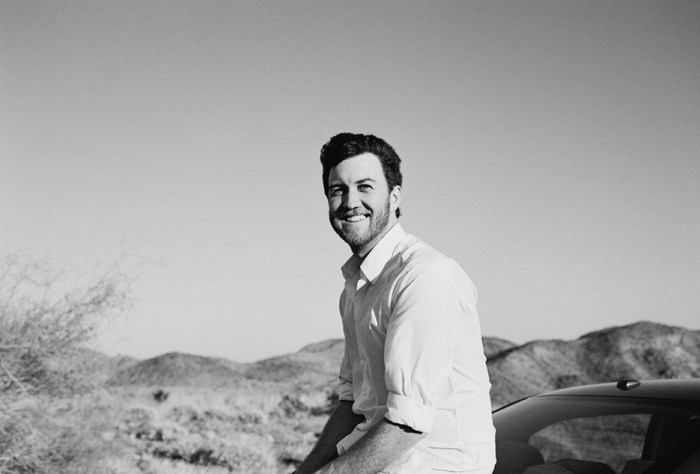
Chad Peter.


Freshly rejected from a marriage proposal, Alex (Tommy O’Brien) boards a flight from Los Angeles to Melbourne, Australia, for what was planned to be a happy vacation for a married-couple-to-be. Instead, he finds himself arriving alone with a fully-booked trip, in a country he’s never once visited. Thus begins Road to Perth, an unscripted road trip film from director Chad Peter, set in the Australian outback.
Alex’s journey begins in Melbourne, venturing out to Adelaide and taking in the exotic landscape one pit stop at a time. By chance meeting, he crosses paths with Ronnie (Hannah Lehmann) – a woman beginning a journey of her own. With little motivation to guide him forward, Alex is drawn in by Ronnie’s plight when he discovers she’s on a trip to scatter her father’s ashes along the Nullarbor Plain – a twelve-hundred kilometre stretch of road, along the southernmost edge of Australia.
Filmed without a script and letting the road take them naturally where they felt the story was meant to go, Road to Perthcaptures the indie spirit of filmmaking in a semi-documentary style rarely seen in a studio production. In the tradition of acclaimed indie films like Before Sunrise or Like Crazy, Road to Perth is an intimate tale of two people that meet each other at a time of need, all while exploring the gorgeous backroads of the Australian south.
Starring Tommy O’Brien (Weird: The Al Yankovic Story) and Hannah Lehmann (Suburban Wildlife), with direction by Chad Peter (the VFX supervisor of Gaslit and Mr. Robot S4), Road to Perth is an experimental road trip film, shot without a script and a crew of one, in a landscape unfamiliar to the filmmakers.
Cinema Australia recently caught up with Chad to discuss the film.

Tommy O’Brien in Road to Perth.
“We’ve got nice sunsets here in America, but some of the ones we saw down there were mind blowing.”
Interview by Matthew Eeles
You live in America. Paint a picture for us. Where do we currently find you?
I am at home in Altadena, California, which is basically North Pasadena. It’s just outside of Hollywood, in LA, about twenty minutes away. It’s beautiful. There’s a nice sunset out here right now, on the opposite side of the planet from you.
I’m in Perth, and it’s currently morning time and absolutely freezing.
I think it hit one hundred degrees Fahrenheit here the other day. We’re finally getting the warmth after a long winter. It was fifty-seven degrees in Death Valley recently, which is the lowest point on earth that’s not underwater. It gets even hotter there, but thankfully I wasn’t there. [Laughs].
I wouldn’t mind some of that heat in Perth at the moment. But we are here to talk about your experiences with your new film, Road to Perth. It’s a universal story. What brought you to Australia to make it?
It actually goes back to my late teens. I had a pen pal in Perth via an old messaging service called ICQ. I think, up until that point, I’d never really considered that other people live that far away from where I grew up in Denver, Colorado. So I kind of planted the seed early on. I guess when it came time to think about where to travel to film, Australia really stood out as an exciting option.
It’s expensive to travel here. Was there ever a time when you thought that traveling all this way to make a movie wouldn’t be possible?
No, actually. But it’s kind of a miracle that the movie came together the way it did because it didn’t have a script. I would say about a month and a half before shooting, we didn’t know we were going to make the movie at all. It was kind of born out of this desire to see if we could pull off this almost documentary-style movie without a script. I had just finished working as a visual effects artist on season one of Mindhunter. The moment I was done with that, I put down my tablet stylist pen and convinced an actor friend of mine to travel with me to Melbourne with the crazy idea that we would drive to Perth and make up an entire film as we went. [Laughs]. It was pretty wild from the outset.
I want to talk to you more about making this film without a script, but does the film’s general narrative come from a personal place for you?
Not particularly. I think the travel aspect of it did. I think experiencing a breakup as the character does, who’s supposed to travel to Melbourne with his girlfriend, and she basically says no to him at the airport, and he ends up going on this trip anyway. That’s not anything that’s happened to me in real life, but we were trying to come up with something that would get him there, essentially on his own, and set up this story of this American who’s traveling through the countryside. In a nutshell, it didn’t happen to either Tom or myself.
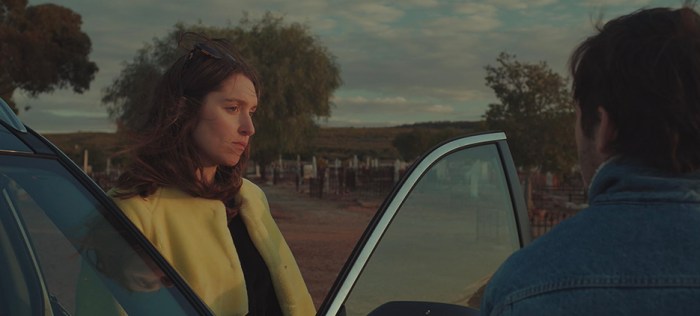
Hannah Lehmann in Road to Perth.
You mentioned the film didn’t have a script. Talk us through making the dialogue up with the two lead actors along the way.
I had made a short film a few years prior without a script. It was much shorter. I talked about the concept with a friend, discussing what we wanted to get out of this road trip. We were going to shoot with just one crew member, as I was the only crew member on the short film and on Road to Perth. I was incorporating visual effects techniques to allow myself to be the only crew member. Instead of having a sound person, we’d set up the camera, shoot a wide shot, and I would run into the frame with the boom mic to capture the actors’ audio. After the take, I’d run out of the frame, and then that’s how we shot the movie. I would have to go in afterward and paint myself out with visual effects. In relation to traveling with actors, we didn’t have much room in this car, so we’d talk about what the story’s going to be, and then we’d shoot that for the day. We’d shoot what scenes we could, and if we saw something on the side of the road, we’d be like, “Oh, that looks cool. Let’s shoot that. Where are we in the story? How do we feel like it needs to progress?” It was really just a very fun experiment, using every technique that we knew to be able to pull it off by ourselves. Every night we’d sit and talk about what we’re going to shoot the next day. It was rare that we didn’t shoot anything in order. Almost everything was in a linear progression, which is unusual for filmmaking. But shooting that way really helped us decide where the story would go at any given moment.
How much freedom did you allow Tommy and Hannah to have with their characters?
A lot. Especially Hannah. Before she came in, Tommy and I had an idea of how the first week would go before Hannah joined us in Adelaide. You can really feel it by watching the movie too. There’s a little bit of a lack of direction. Like we hadn’t quite settled into what the story was going to be just yet. When Hannah joined us, we talked through what she felt her character’s arc should be and where she wants to end up. She very clearly had this idea about scattering the ashes along the road, which Tommy and I hadn’t thought about. That was her input. It was really the only way to work in this situation. It really made them happy to have more involvement than they might have on a traditional film. It wasn’t a totally easy shoot, and sometimes we’d have disagreements, but it was all healthy.
Both Tommy O’Brien and Hannah Lehman are great here. But I want to ask you about Hannah, in particular, whose career is going from strength to strength as an actor, as well as a writer and director in her own right. Can you tell us about casting Hannah and working with her on Road to Perth?
I’m trying to remember how we found Hannah. I want to say it was through casting networks in Australia. She had responded, and we weren’t really auditioning so much as interviewing people. I had a lot of Zoom interviews with actors prior to flying to Australia. Hannah had this really unique quality about her which I picked up on through the interview process. We didn’t have a script, so I couldn’t send her any pages to read. It was more just a sense of knowing that this person was going to bring a unique personality to this story based on who they are. Hannah is an incredible actress. I guess we didn’t really know what to expect because we hadn’t met her in person. We were about to travel in a car halfway across Australia with her. We were all testing the waters in terms of knowing what each other’s strengths are and what each of us would bring to the table. Hannah traveled to America after we had finished Road to Perth, and within seven days she had an agent. [Laughs]. She was bouncing around town taking meetings and pitching ideas as a director and a writer because that’s her primary goal. Tommy and I, meanwhile, we’ve been here in LA for years and years and years, and it took us years to get an agent. [Laughs]. So it’s just so funny that she came here and she got an agent immediately.
She really is a force. It’s interesting to hear you speak about that road trip because a lot of people find it difficult to travel with loved ones, family, and friends on these long road trips, and here you are traveling with someone you hardly know.
[Laughs]. It was probably not the safest, smartest idea I’ve ever had.
Have you seen Wolf Creek?
We had a lot of people ask us that. [Laughs]. Every time we stopped to put some gas in the car, somebody would say, “Haven’t you ever watched a Wolf Creek film?” [Laughs].
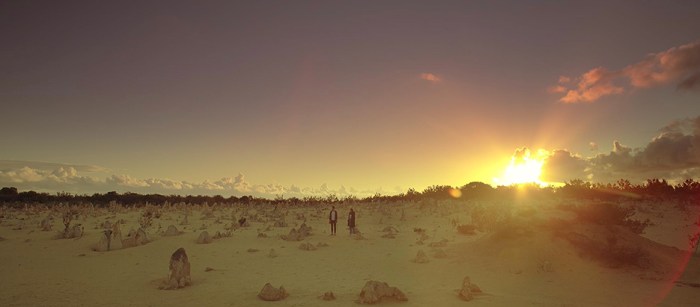
Tommy O’Brien and Hannah Lehmann in Road to Perth.
As well as writing, directing, producing, and editing the film, you also shot the film yourself. It’s quite common to hear American filmmakers talk about the natural lighting in Australia and how it doesn’t really compare to anywhere else in the world. Would you say that was the case for you?
Absolutely. Everywhere we stopped, and everywhere we looked, the sunlight looked amazing. There were a few times throughout the shoot where we would film a particular scene because the light was just gorgeous. One thing I did notice that was very different from American sunsets is just how gorgeous they are in Australia. There’s something about the light quality and how it hits the planet from that specific angle. [Laughs]. It’s a bit more pleasing to the eye when you put it through a lens. We’ve got nice sunsets here in America, but some of the ones we saw down there were mind-blowing.
What was the most memorable location for you?
We hadn’t planned on going down to Esperance originally. We originally planned to drive straight through to Perth, but we felt like we needed to explore a little bit more. We had planned on going up through Margaret River, but we ran out of time. I have to say that my favorite scene in the movie is one of the final scenes at the Pinnacles in the desert north of Perth. It was so hectic at the time. I didn’t really get to enjoy it because it was so chaotic. We were up against time, and we were losing the sun, and we had just lost a microphone. Perth itself was great too.
Road to Perth is available now via VOD. Details here.


 Cinema Australia