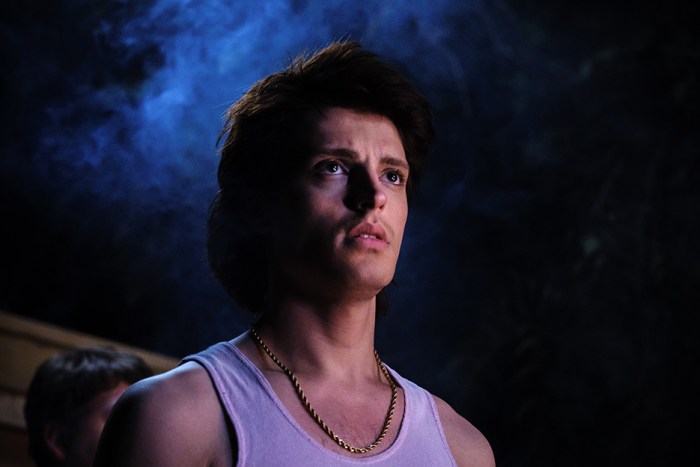
Michael Nikou in Slant.


In this interview, I sit down with Michael Nikou, one of the most exciting new talents on the Australian film scene, who takes on the ambitious role of Derek Verity, a career-driven journalist, in the gripping black comedy thriller, Slant.
Not only does Michael showcase his acting prowess, but he also showcases his versatility as the writer and co-producer of the film. With a notable acting career that includes credits in popular shows like Fisk, Neighbours, and the upcoming reboot of Time Bandits by Taika Waititi, Michael has firmly established himself as a serious talent to keep and eye on.
Set in the eerie and quaint inner suburbia of Melbourne during Christmas 1999, Slant unravels the thrilling tale of Derek Verity, who is assigned to investigate the suspicious disappearance of a local mother-turned-infamous socialite. As his personal and professional lives become entangled due to a dark family secret, Derek’s relentless ambition pushes him to pursue the truth at any cost, leading to a dramatic collision of his worlds.
Slant marks the debut feature for James Vinson, an award-winning writer and director, who assembles a stellar Australian ensemble cast, including the iconic Sigrid Thornton, Kate Lister, Pia Miranda, Neil Pigot, Ra Chapman, Shannon Berry, and Elle Mandalis, each adding depth and intensity to this captivating cinematic experience. With a compelling storyline and a talented cast, Slant is a must-watch film that delves into the complexities of ambition and the consequences of unearthing buried secrets.
Michael Nikou will join fellow Slant cast and crew, including Sigrid Thornton, on a screening tour of metropolitan and regional cinemas around Australia from Wednesday, 26 July. Details here.

Michael Nikou in Slant.
“It may actually shock you how much of the film I have experienced. The campy murder mystery element is the lens through which I told it.”
Interview by Matthew Eeles
You’ve been working as an actor since you were quite young. Were you always interested in other aspects of filmmaking, like writing and producing?
As a young kid, I was definitely one of those precocious children who would make all my aunts and uncles watch me perform at Christmas or on other special occasions. So in that sense, yes. But otherwise, I really did focus on just the acting for quite a while, which I regret because I didn’t start writing until I was twenty-three. The acting was the first love and the main focus.
You say you regret the focus you put into acting. Can you elaborate on that?
If I’d started writing at eighteen, I maybe would’ve made this movie five years earlier. And also, just because I’ve fallen in love with writing and in a way that it’s right on par with how much I love acting. The great thing about writing is that I can do it from anywhere. I wrote Slant in all corners of the globe, and all I needed was my laptop and sometimes a beer. [Laughs]. Writing is such an amazing outlet as an artist because I don’t need to wait by the phone for work. I can create opportunities for myself. I just really need to open up Final Draft.
What were some of the things you worked on as a child and how did they inspire your career path?
My first professional gig was on a Shaun Micallef show called Welcher & Welcher. It was a very small bit-part, and I remember that they shot it at my school, and that’s how I got the gig. They asked kids at the school, “Who likes drama here? We need to cast someone.” I had the most amazing time working on it. I’d done various short films, and in my teens, I was an extra on Neighbours for quite a while, and then I got a bit-part on Neighbours. My resume isn’t flush with heaps of acting credits, but I was always doing something as well as a lot of theatre at school.
What’s it like to be an extra on a show like Neighbours?
I think every young actor should do it at least once. People in the industry try to tell you, “Don’t be an extra because that’s all people will think of you as.” But if you want to get set-savvy and learn a lot from being on a set that’s so fast-paced, then I would recommend it to any young actor.
Slant is so impressive that it’s hard to believe that this is your first feature film as both lead actor and writer. I don’t want to take anything away from James Vinson’s great directing here, but did you ever consider directing the film yourself?
I absolutely, one hundred percent did, but the film would not be anywhere near as good as it is if I had directed it. James and I have been friends since we were twelve years old. He came on board after about 17 million drafts. [Laughs]. He’s actually the reason I fell in love with writing because when I started writing Slant, he bought me an online masterclass as a Christmas gift. From around draft ten of Slant, I asked him if he wanted to come on board as a director. We would go away, brainstorm, and elevate the script. I would always be the one writing, of course, but he’s so much my partner in crime in this, as is our head producer, Monique Fisher. I always call us the Charlie’s Angels of filmmakers because we all complement each other. So yes, I did consider directing, but I was thankfully smart enough to let James, who has made many beautiful, amazing short films, direct it because he did such an amazing job.
You’ve mentioned the large number of drafts a few times. How many drafts were there exactly?
The official draft we shot with was, I believe, draft seventeen; however, there was draft 2.2, Seven Blue, and Four A. [Laughs]. So I don’t think even seventeen is accurate. In terms of development, there are a handful of things that were there in draft one that are still there now. Without getting into spoiler territory, the fates of some of the characters changed along the way. For almost eight drafts, a character that doesn’t make it through to the end of the film originally survived, and a character that does make it through to the end of the film originally died. Every draft was about ensuring that each character’s arc felt like they were the main character of their own story, especially because it’s an ensemble piece. It was really important to James and me that no one was just there to fill space and that they had their own fully realised journey through Slant.

Michael Nikou in Slant.
Am I right to assume that you wrote Derek for yourself to play?
Yeah, one hundred percent. I originally wrote Slant as a short film. The reason that it became a feature film is because of the really intense masterclass that I was telling you about. We were required to bring a character to this masterclass. Like many actors, I wasn’t employed, so I decided to bring this character from my short film. In that masterclass, I explored Derek deeper and I realised that there was much more to the character, and that I could flesh the character out to a feature. It was never an option for me not to play Derek. Also, this is a semi-autobiographical film. So there was never a time where I wasn’t going to play Derek.
Before I ask you about the semi-autobiographical nature of this film, I want to ask you about writing something like Slant with yourself as the lead character. How do you distribute all the other great character moments and not give yourself all the best bits?
Well, the self-indulgent actor in me had moments where I wished I could give myself the best bits. But of course, that’s no fun for the audience, and it’s no fun for the other actors. I love playing with an ensemble. I think everything I write will probably be an ensemble piece. Everyone had their place, so you get really good as you re-draft at knowing where everyone’s moments are to be. Derek’s in almost every scene. But there are technically three scenes that he’s not in. And I think it’s important that he wasn’t in them. So yes, it’s hard, but it’s also really fun to give it to another actor. I really think that this is just the most talented cast and to give them these really exciting things to do was a total thrill ride for me.
So let’s go back to your statement about Slant being semi-biographical. Surely your family wasn’t full of murdering, narcissistic, alcoholic psychopaths. How did your family inspire this story?
[Laughs]. So I’ve never worked as a journalist who’s had to investigate a murder mystery, but it may actually shock you how much of the film I have experienced, and there’s really no other way to say this without being completely honest. I do have my own dysfunctional family, as I know a lot of people do. A lot of the family storylines from both the Verity family and McGowan family have major parallels to my real life, including my relationships with my siblings. One of my sisters was an extra one day on set, and she came up to me and said, “Did you take that scene from an argument our family had?” And she was right; it was from a famous argument in our family. I apologised after not warning her, but it’s all the family stuff. The campy murder mystery element is the lens through which I told it. Having said that, the final act of the film is something I’ve experienced shockingly. I know that’s really dark, but some of the things that happened during that act are not entirely foreign to me.
How have your family responded to parts of your story being made into a feature film that’s about to tour nationally?
It was very important to me that my mum saw it before anyone else. I sat her down at Christmas time, which is also apt given that the film is set at Christmas. We watched it together, and my mother says, “I don’t see our family in that at all.” [Laughs]. I said, “Come on mum, give me a break!” [Laughs]. She has now come around to the fact that a lot of it is accurate. The film does deal with themes of estrangement, and there are some of my own family members who are no longer in my life. How they might feel about it, I don’t know. I hope they see it. I’d love them to see it so that we could talk about it. It was very important to me to obviously protect the guilty. I changed names even though a lot of the characters in the film are named after my family members. I would switch things around like genders.
Does it make it easier to write a story like this by having it set in the 90s? Because limited technology really adds to the mystery of a story like this.
Bingo. You are dead-on there. There are a couple of reasons why I set it in the nineties. I’m a semi-child of the nineties, and it’s such a fun era. Nostalgia is something I’m a slave to. But the other reason is that technology definitely complicates things. I didn’t want people with smartphones, especially when you’re dealing with a missing woman, which is a central focal point of the storyline. Having a smartphone was always going to complicate the plot. It was definitely a benefit to be able to set it during a time when smartphones didn’t exist.
Tell us about working with director James Vinson. I’m curious to know how you stop yourself from interjecting directing choices when this is a world that you’ve created.
Well, the answer is, I didn’t stop myself from interjecting. [Laughs]. Sigrid actually said during one of our first rehearsals, “Best idea wins.” I think that is such a great way of looking at a collaborative experience like this. I want to carry it through to all my work. I know the whole Slant team agreed on that statement. That was our team motto. There’s no time for egos, so if the best idea came from someone else, well, don’t you want to make the best film possible? Because James and I are a partnership, there are ideas in the script that came from him, and then there are directorial choices that came from me, like shot selections or a costume choice, whatever it was. We were a team. Even Sigrid came up with shooting styles and ideas for shots. And thank God we listened to her because I really do think one of the shots she suggested is one of the most important shots in the film. Best idea wins, whoever it comes from, it doesn’t matter. We just wanted to make the best movie possible.
How did you and James meet?
We met in school, and we did school plays together. We’ve been friends for years. I lived in New York for two years for drama school, and he came over and visited me there, and we’ve just always stayed friends. We’ve been through it all together. We’ve partied together, traveled together, experienced breakups together. I’ll be friends with him forever. He’s one of my nearest and dearest.
If you’re both creating films this great, I hope your partnership lasts for a very long time.
Films are hard to make. You want to be around people that you love who want to make it fun. And that goes for the whole team. They have to be talented, but they also had to be people we really wanted to work with.

Ryan A. Murphy, Michael Nikou and Sigrid Thornton in Slant.
How involved were you in the casting of Sigrid, who’s brilliant as your character’s mother, Vivian Verity? Which is such a great name, by the way.
Well, alliteration was very important for me. [Laughs]. Martin McGowan. Vivian Verity. It was hard to not have every character have alliteration in their name. I was very involved in the casting process. James and myself ran the auditions. So only two characters were actually auditioned for; Una and Olyvia. Kaye was written with Elle Mandalis in mind. I’ve known her for seven years now, and I always wanted her for the role. Ryan A. Murphy I just absolutely adore, like I adore everyone in the film. Ryan was cast a week into pre-production, which sort of threw us a bit. It ended up being one of those blessings in disguise. With Sigrid, it was actually Ryan who had a vague connection to her, and he passed on the script, and she read it. She loved it. She met with us. We had a collaborative discussion. And she said at the end of the meeting, “I’m in.” [Laughs].
Sigrid goes quite deep with this performance.
Sigrid is every bit the legend that her name infers. She’s a powerhouse. This entire team that made Slant was below the age of thirty except for Sigrid. She embraced that. She is full of energy, and she never said no to anything. She’s such a creative in that sense. Any exercise, any sort of technique, any offer, and she would do it. She is truly amazing. I think she should win an Oscar for the performance.
There’s a great one-take scene in the film which takes place during a funeral. Can you talk us through that scene and how you all managed to pull it off so convincingly? There are so many people involved in that scene in front of the camera.
It was ambitious. [Laughs]. It was James’s idea. We rehearsed the blocking. Before we shot it, we had one rehearsal at another location where we blocked it and rehearsed it. On the day of the shoot, we rehearsed it several times and then we shot ten takes. The take that you see in the film is take number ten. That wasn’t the only usable take, and here’s a fun fact about that scene. James is very much a performance-based director. He always picks the take that he thinks has the best performances. So in that take, the camera loses focus for just a moment on Kaye’s face. But James was so attached to the take because he thought it was the best performance-wise. We had the footage sent to a special effects company in America who graphic matched the frames on either side of the moment that it lost focus. So Kaye’s face is actually CGI for however many frames.
That’s amazing! The take is perfect, and I’d never have known there were any CGI frames.
I know. And that’s because James just couldn’t let go of that take. In one take, someone fell over. In another take, someone fumbled a line. It was a fun challenge. I’ve never done anything like that before, but I’d do it again for sure.
What an unforgettable experience that must have been for everyone.
Oh, totally. I love a one-take scene. So when James said let’s do a seven and a half-minute one-take, nobody said no. Everybody was very keen to do it.
How easy was it to obtain the rights to use the Round the Twist theme song in Slant?
They actually weren’t that difficult. Our head producer, Monique, is a lawyer, and she is the real brains behind the operations of Slant. It really wasn’t that hard. We got in touch with the writer, and we paid a fee which wasn’t that high actually for Round The Twist, unlike the Kylie Minogue song that’s in the movie. [Laughs]. That cost a bit more.
Does Round the Twist mean something to you, or was it just something that you threw in randomly?
It’s definitely not random. I’m a millennial, and that show was such a big part of my childhood. I love Round The Twist. It’s such a kooky show that really speaks to my sensibilities. The reason why I chose the song is that the scene is such a surrealist moment, right? Like this choreographed dance scene that comes out of nowhere. But it’s symbolically there to represent something because at that point, you feel it’s meant to feel like that character is going round the twist. It felt apt. It just made sense. We could have picked a generic club song or had one of our composers create a song. And when we looked into it, we realised that it wasn’t going to be that expensive to get the Round the Twist theme. Also, the film is set in 1999, so it just made sense.
Michael Nikou will join fellow Slant cast and crew, including Sigrid Thornton, on a screening tour of metropolitan and regional cinemas around Australia from Wednesday, 26 July. Details here.
ADVERTISEMENT Road to Perth is available to watch now.
ADVERTISEMENT Donate to the Old Mate crowdfunding campaign today!

ADVERTISEMENT Program out now!

ADVERTISEMENT


 Cinema Australia