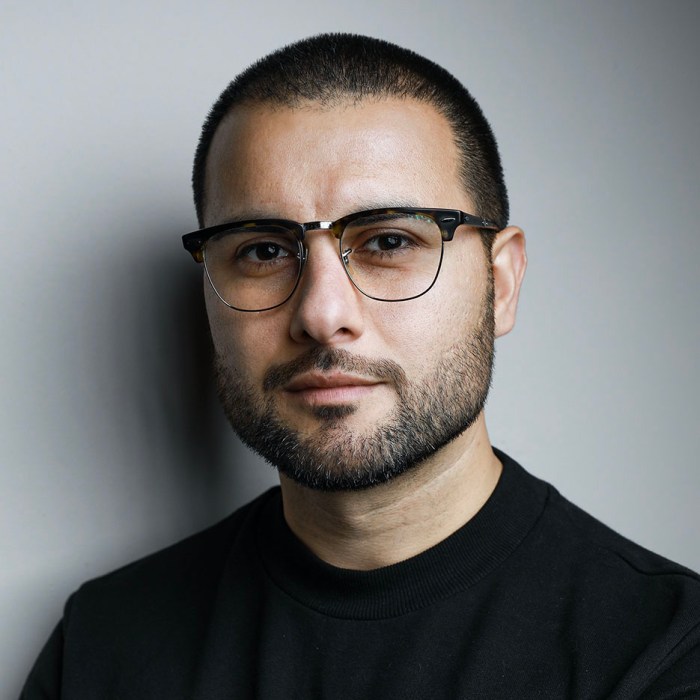
Amin Palangi.


Directed by Amin Palangi, Tennessine is a psychological drama following Arash (Osamah Sami Shayda, Ali’s Wedding), who against his family’s wishes, arrives in Australia to reunite with the love of his life, the elusive Nazanin (Faezeh Alavi). While the couple is about to spend a romantic weekend in a cabin in the woods, the arrival of Nasser, Nazanin’s supervisor, (AACTA-nominated actor Robert Rabiah) interrupts the idyllic reunion Arash had hoped for and raises doubts about his relationship with Nazanin.
Set against a background of migration and the Australian landscape, Tennessine portrays the effects of displacement and explores themes of family duty, belonging and love. Spoken in Persian and English the film tells the story of an entire generation of people separated due to circumstances beyond their control, and the consequences of these events on their identities and relationships.
Amin Palangi is known for his intimate and captivating portrait of people in extreme circumstances. His documentary, Love Marriage in Kabul, won the Audience Award at Sydney Film Festival and Best Direction from Australian Directors Guild. His credits also include several short films such as Break, Close Distance and his AFTRS graduating film Vafadar.
In this interview Amin Palangi discusses the making of Tennessine.
Tennessine will screen at the Sydney Film Festival on Tuesday, 13 June. Details here.
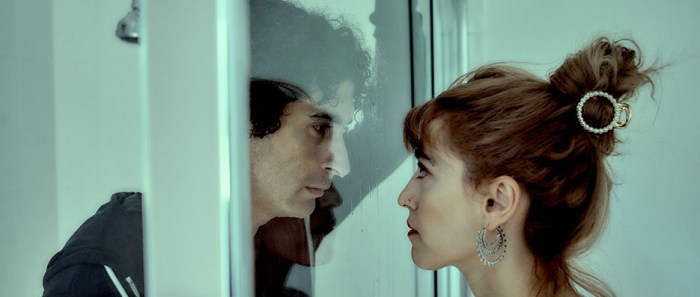
Osamah Sami and Faezeh Alavi in Tennessine.
“I want to make movies that make my heart beat.”
Interview by Matthew Eeles
Tennessine contains themes of displacement which are very similar to what you were exploring in your last short film, Break. Did you always want to expand on these themes with a feature film following Break?
I guess I would say yes and no. It’s a bit of a mixed bag for me. As an artist and filmmaker, I’ve come to realise that creating work isn’t just about expressing myself and sharing my thoughts and emotions with audiences. It’s also about delving into my own inner voice, understanding my personal struggles, and grappling with various dilemmas along the way. I think my personal experience of being a migrant, having been born in Iran and leaving Iran as a youngster, I think that has influenced pretty much all of my artistic activities. I would say that Break was a bit of taster for Tennessine in a way. As I was making Break, I did see the potential to expand the story and introduce other characters to the drama of the film, to the relationship, and what was at stake in the relationship. So, I guess that’s why I say yes and no. Break was made in the same location as Tennessine, which was almost like the proof of concept. But in Break we are looking at the story from the female perspective. With Tennessine, we’re looking at it from the male perspective. And this was a choice because when Osama Sami and I started talking about turning Break into a feature, we weren’t blind to the fact that we are both men and felt it would be more authentic to have it presented that way.
Themes of migration are quite prevalent in most of your work including your previous feature documentary, Love Marriage in Kabul. Do you draw on your own experiences as creative inspiration?
Absolutely. I look at migration as an interruption in one’s life. I think people deal with it differently and process it differently. I feel like in the first few years when someone migrates, it’s all about settling in. It’s all about wanting to join your new community and to be accepted, and wanting to contribute and serve the new society that you’re living in. There will always be a difference in cultures and differences in ways that we see the world. But I feel that if I have an opportunity to voice my opinion artistically, I would be hoping to bridge that gap and actually create that connection and remind us of a common humanity that we all share. As you mentioned, that was the case with my previous film as well, Love Marriage in Kabul. It was about the power of love, and how we all experience that power, and what really gives meaning to our lives. We are all feeling and experiencing our fears and desires, and if we keep our minds open to each other, perhaps we can reach that commonality, or harmony, a lot easier.
Osamah Sami is forging an enviable career as a highly respected creative figure in Australian screen at the moment. What are the origins of your creative partnership with Osamah?
Well, first and foremost, we’re good friends. The first time we met was on the set of a film almost twenty years ago. That film, I think, was Osamah’s first big feature. I was doing my director’s attachment. I was just graduating from AFTRS. Obviously Osama is originally Iraqi, but he was born in Iran and speaks Persian. We had that direct dialogue happening while we were on set. And it was, I guess, in a way, a first experience for both of us. Since then, we’ve been wanting to make a film together. We’ve been doing our own things, but we’ve always been in touch. We co-wrote a different film script which ended up being much bigger than what we anticipated, so we parked it and decided to tackle a story that was more manageable. I really love Osamah’s voice. I love him as an actor, and as a collaborator. Osamah is much more eloquent than me, so I guess I worked with him as a script editor on Tennessine.
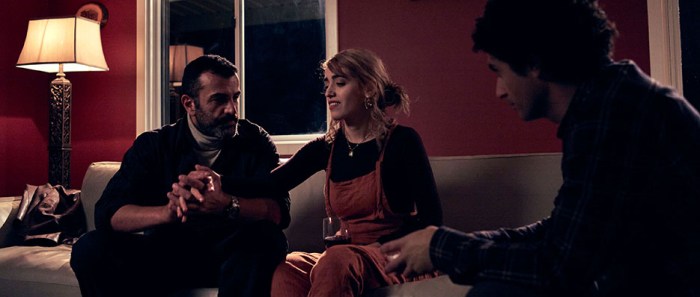
Robert Rabiah, Faezeh Alavi and Osamah Sami in Tennessine.
There’s a great scene in Tennessine where Robert Rabiah’s character Nasser tells Osamah Sami’s Arash, “A man of few words is a man of many thoughts.” That particular line got me thinking beyond Arash as a character and about Osamah as an actor, who portrays a lot of this character through physical expression rather than through heavy dialogue, especially with his eyes. Can you tell us about working with Osamah to accomplish this?
I’m really, really glad that you picked up on this. One aspect that defines my style of direction is the way I envisioned this character. Fortunately, Osamah and I were in agreement regarding this vision. With Osama’s previous work, I could see that he really reaches out of screen, even if there are no lines. His on-screen presence is very strong. With Tennessine, we aimed to draw the audience in, creating a sense of intrigue by pulling back. This decision influenced the writing process, the number of lines, and how we choreographed and blocked the scenes. We dedicated time to crafting this mysterious atmosphere. It’s actually quite similar to a part of Persian culture, or Iranian culture, where not much is said, but it’s just as powerful. We see this in Iranian cinema quite a lot as well.
You said that you wanted to tell Tennassine from a male perspective, but a large portion of this story is still told from the point of view of Faezeh Alavi’s Nazanin. Did Faezeh help with the development of her character to ensure Nazanin’s female perspective was portrayed accurately?
Not during the initial scripting stage. Throughout the writing processes we worked with a couple of other actors and screenwriters who checked the script along the way. A few of our friends helped us with that. I also had other female writers reading the script and helping us with the authenticity of the female voice that we are representing. This was Faezeh’s first feature film in Australia. I was really impressed with her audition and the energy she brought in. During rehearsals, and while we were shooting, she really began contributing to a lot of what we see on screen that was not written in the script. Faezeh brought in her own personality, her own energy. I felt very lucky actually with all of our actors and what they brought to their characters that may not have been written in the script. It was kind of a continuity of energy and a sense of volatileness which ran through all of these characters. As a director, I wasn’t sure I would be able to bring that out of an actor, but in the end, it wasn’t something that I had to worry about because it just came natural to all of these actors.
During one of the most physical scenes in the film, you use AFL as a metaphor for confrontation and strength. Can you talk us through that scene?
Absolutely. Something that we were quite curious about while making this movie is that we had these Middle Eastern characters featuring against this very Australian landscape. And in this particular scene, they’re playing a very Aussie game and they’re speaking through that, but at the same time you’ve got layers of migration stories being told during that scene also. Robert Rabiah’s Nasser has been in Australia for a very long time, so he’s seeking this nostalgic connection to his roots. And then you have Osamah’s newcomer who just literally stepped off a plane a matter of days ago. So this game is being used as a metaphor to showcase this battle between these two sides, and they’re using this battle to articulate their dilemma. The film itself is full of symbolism, full of metaphors. It was a stylistic experiment for me as a director to create this scene as well as this communication style through the poetry of this stunning Australian landscape. Tennessine was shot at the same location as Break. We wanted to ensure that the landscape of this film was a character that isolates the other characters while also surrounding them and protecting them.
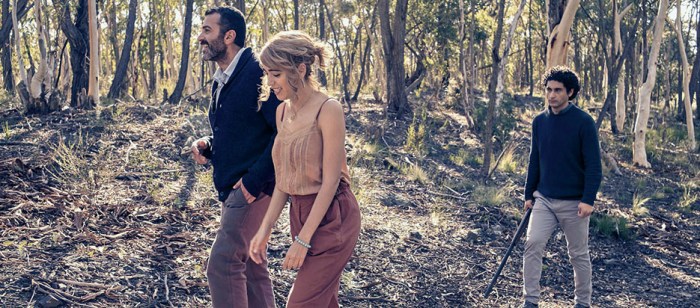
Robert Rabiah, Faezeh Alavi and Osamah Sami in Tennessine.
Speaking of metaphors and symbolism, what’s the card game Arash and Nazanin are playing during the picnic scene?
[Laughs]. That’s actually an Italian game. It’s called Briscola. I don’t want to take credit for that. It was Osama’s idea to include that. It was a way of bringing in another culture to the film on top of the many that were already in it. We’re very fortunate in Australia to have access to so many cultures. Sometimes in Australia you can turn a street and you can feel like you are in completely different country at times. It’s a multicultural experience that has been expanded into our daily routines through fashion, games… everything. That’s why we have this game in this film. It’s not Iranian. It’s not Australian. It’s an Italian game that Nazanin has picked up on her travels which shows that her world has opened up and changed her.
Tennessine is co-produced by yourself, and Ulysses Oliver and Ben Farris who are an absolute force in Australian filmmaking at the moment through their company Breathless Films. What does their producing style bring to a project like this?
I think what Ulysses is doing with Ben is that they’re bringing a breath of fresh air to our industry. I have been fortunate to receive funding from Screen Australia in the past, but every time it honestly feels like a miracle. As a filmmaker, you know that the options for funding are limited, and that the chances to make a feature film are quite limited. Ulysses and Ben, first and foremost, bring a serious can-do attitude and a deep sense of independence. They quite literally place their money where their mouth is and bring an enormous amount of support. They have a strong belief in independent filmmaking and that’s very important.
Love Marriage in Kabul was quite successful. Can you see yourself returning to documentary filmmaking, or would you prefer to continue to make narrative feature films following your experiences on Tennessine.
I’ve never seen myself as a director of one or the other. I’ve never looked at myself as being a documentary filmmaker, or a feature filmmaker. My studies at AFTRS was for scriptwriting fiction. My background is in painting. My parents are painters. I want to make movies that make my heart beat, so I will tell those stories in whatever format fits those stories best. Will it be documentary? Will it be fiction? Will it be through a photograph, or though a painting? I think it’s about finding the right medium to tell the story. Even though I have now made this leap into feature filmmaking, I do see myself making another documentary for sure. If the story hits me right. [Laughs].
Tennessine will screen at the Sydney Film Festival on Tuesday, 13 June. Details here.
UPDATE 7.4.24 Tennessine will screen at Palace Cinemas for one week only from April 8, 2024. Details here.

ADVERTISEMENT


 Cinema Australia