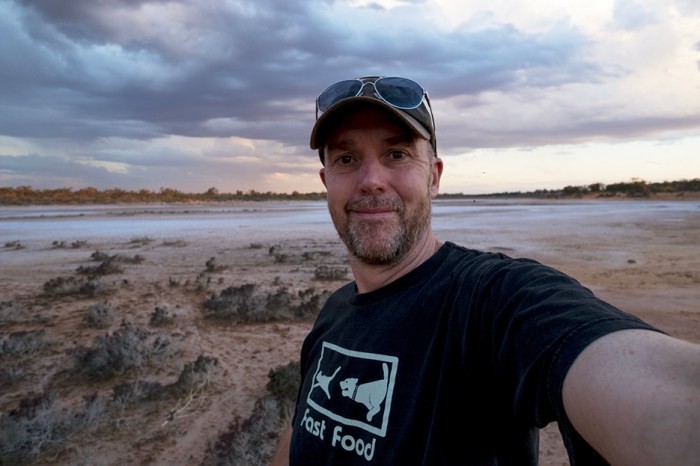
Gravel Road filmmaker, Tristan Pemberton.


The world’s most remote rock band, The Desert Stars, will perform in Perth during a special event screening of Gravel Road – Tristan Pemberton’s new documentary about the band and its frontman, Jay Minning.
The Desert Stars are traditional land owners of Spinifex Country in the Great Victoria Desert, Western Australia, home of the last nomads. From their home in the remotest Tjuntjuntjara, we follow Jay and the band on their first tour as they rock their way across the Western Desert sining songs of hunter-gatherer life, surviving British atomic testing, and a profound connection to culture that spans back 2,000 generations.
With customary Spinifex reciprocity, Jay shares the journey with East Coast friends, The Re-mains, and provides a rare glimpse into his country, his culture and his extraordinary everyday life.
In this interview, filmmaker Tristan Pemberton gives Cinema Australia readers an insight into the making of Gravel Road – a rock-and-roll road movie driven by the power of music and passion.

The Desert Stars on the road.
“We’ve learned something about what it means to be Australian, and a human on this planet, by hearing Jay and The Desert Stars’ story.”
Interview by Matthew Eeles
Where did your filmmaking journey begin?
I really became interested in photography when I was a kid growing up in Papua New Guinea. I’ve still got those first few roles of film that I had developed. And some of them were shot at the end of the Kokoda Track where it arrives near Port Moresby. We always had this interest in walking the hills around Papua New Guinea, because there was lots of leftovers from the Second World War. I took an interest in photography there. My uncle was a photographer, he was in Melbourne, and there was photography in our family. Dad always had a camera. Mum often had a camera. Both my grandparents on both sides of the family were avid photographers.
Photography was always a part of social events, family events, and traveling and holidaying. As an extension of that, it was always something that I enjoyed doing. And it’s something that I connected with. I liked looking at the world through a lens. I really love the creative process of creating images, producing images, telling stories through images. In 2003 I started my own filmmaking business. I made a few short films, but I made lots and lots of films for corporates. I still do those corporate films today, but like every single filmmaker out there, we’ve all got these stories in the back of our mind that we want to tell that keep that fire in our bellies.
As someone who grew up in Papua New Guinea, I really looked at Aboriginal people in Australia much like I look at my Papua New Guinea friends in that they are traditional landowners that have connection with a place that spans generations. When I moved to Australia, I gravitated towards Aboriginal people because they felt more familiar. And that’s what’s gravitated me towards their stories.
What’s one story that has really stood out for you.
My sister worked in the community in the late nineties as a community development officer. She told me the story of the last nomads who were the last nomadic people to have first contact in Australia, which was in 1986. I heard about this story and thought it was amazing. How come all Australian’s don’t know about this family and their story? That started a research journey for me into that story. The first stage of that was to go and meet with Spinifex people, because I don’t have any right to tell someone else’s story. It helped having my sister who had worked out in the community. She was like family to them and had that kinship that you get in any indigenous society across the world when people come into a group, into an indigenous group and demonstrate that they’re there to give and share. You are accepted as family by extension. So I went out to the community and the board agreed that I could come out. I spent a few days out there, met some of the surviving family members of the last nomads, and met with board members and talked about what I wanted to do, and they agreed that I could tell their story. So that started me on a journey with the Spinifex people. And it’s been a long journey of discovery for me. I’m still researching that story, but it’s pretty close to being ready to turn into a film.
After having that initial trip, I thought that the only way I can build a stronger bridge with the community is to make films with the community. So I funded myself to go out, about a year later, with some camera equipment. And once again, I asked permission from the community to come out and run filmmaking workshops. So together with the community we made some films and we made a couple of short films where the story narratives were driven by community. I had a whole lot of people helping with acting, costumes, holding booms, operating cameras, doing all sorts of stuff. And the result of that is when I left the desert, I left behind something. I left behind films that the mob out there were quite proud of that these were their stories, and their films. I remember on the last day before I flew out, I had people coming from everywhere giving me USB sticks so that I could upload copies of the films. [Laughs].
Those films went around the desert and there were people who were in those films who became stars across the Western Desert. What it meant was that I wasn’t just another white fella coming out and trying to take something, but I was actually going out there and giving something and doing something with the community. That’s something that I’ve always been mindful of.
Can you give us an example of a film you made with the community and how that worked?
Well, the first film we made out there was called The Cheater. When I arrived in community I was met by a fella named Trevor who had made quite a few of his own films. He knew I was coming out so he spent the first day with me just sitting, and we just chatted about what we were going to do, because I had no idea. I just had a whole lot of gear, but I didn’t speak a word of Pitjantjatjara.
I said, “I need you to work with me and tell me how we can do this.” The first thing Trevor suggested was inviting everybody along into the boardroom to have a talk about what we’re going to do. We put signs up around the main service places and community and told everyone that there’s tea, biscuits and cake, because if people know that there’s refreshments then they’re happy to come along. And of course it was great. We had about twenty people turn up who were really keen to get involved. From that meeting we walked away with a script. It wasn’t a script that was formatted in the way that you would hand it to a studio, but it was a script that had a very clear outline of who the characters were, the events that happened in each scene, and what the outcomes are. And after all the ideas that were thrown around, people wanted to make a story about card games, because it’s a big thing in community. People love to get together and have card games. I suppose it’s a bit of excitement that happens in the community. And at the card games, they said, there’s always somebody trying to cheat. [Laughs]. So we made this comedy about somebody who gets caught cheating in the game, and they get kicked out and they get really upset and they end up driving their car round and round in circles and doing donuts. Later they come back and they apologise, and then ask if they can join the game.
Again, it’s a very simple idea, but it was a really lovely film. Everybody really liked this story because it was based on the things that happened there.

Jay Minning.
Tell us about your first encounter with Jay. How and where did you meet him?
The first time I met Jay was when I was making a film for Spinifex Health Service. It was a comedy. In the advert, we had one of the elder men in the community going into a store to buy some things. I’d given this fella a fifty dollar note that was just a prop. He was instructed to go into the shop and hand the note to the person behind the counter. As I’m in the store, I’ve got a camera and I’m shooting this old fella. We walk up an aisle and he stops and hands this random person the fifty dollar note and off he walks. I didn’t quite know what was going on. [Laughs]. The camera was rolling. It was Jay Minning who was just coming into the store getting himself some food. Then Jay walks off and I’m going, “Where’s he gone? Everybody disappeared.” I’ve got the camera on my shoulder and I’m running off to chase Jay who’s thinking, “Oh beauty! Fifty bucks.” [Laughs].
Anyway, that was the first time I met Jay. When I was telling that story afterwards, some people told me that they thought it might have been this guy Jay from The Desert Stars. I had heard of The Desert Starts before because I’d used their music in those films that I’d made with the community. So I knew about Jay. The first time I met him officially was when they produced their second album and they were looking to create a music promo for it. Menzies Shire Council provided funding to help with various projects of their’s as part of their cultural remit to support culture and community in their shire. Menzies Shire Council provided me some funding to fly over from the East Coast to shoot a music promo with the band.
Jay was really keen to have me, as he’d seen the other work that I’d produced with the community. He had some really great ideas. So that was the first time I really got to meet Jay and work with him and spend time with him. I discovered a gentle character. He can be a fierce warrior if he has to, like all indigenous people. And that’s anywhere in the world. But he’s a very gentle character with really clear ideas. We talked a lot about what he wanted to happen in the film.
I created a storyboard from those conversations, and over the space of two days we shot the music promo and it was great. It was one of the most fun shoots I’ve ever done. I liked doing music promos and we were all pretty happy with the results. The band was happy, and I was happy. And so there was always this idea that we would do more together in the future. And we didn’t quite know when that was going to be. I did talk to Jay about the last nomads, and he did help me translate one of the interviews I had with Ian Richter who was one of the last family members, and also an incredible, prolific painter. Jay did help me translate the conversations I had with Ian because it was all in Pitjantjatjara. Ian speaks English, but he’s much more expressive and articulate when he speaks in Tjuntjuntjara, as are all Spinifex.
When did the idea to make a documentary come about?
I had heard through Lee Ivan, one of The Desert Star’s tour managers, that The Desert Stars were organising a tour with The Re-mains, an East Coast band which Lee is a member of. The Menzies Shire had provided some funding to The Desert Stars to go on their first tour and they wanted them to be supported by people who could show them the ropes when it comes to touring. Mick Daley, who’s a singer of The Re-mains, had actually spent some time at Tjuntjuntjara with Jay and he wrote an article for The Sydney Morning Herald. Mick has a fascination with Aboriginal culture and would take any opportunity he could to go and spend time with Aboriginal people.
When I heard that this tour was going to get off the ground I spoke with Lee and told him I’d love to get on the bus and join them because I believed that this was a historic moment. The most remote rock band in the world on their first tour, and these guys being traditional land owners of Spinifex Country. I reached out to the community, and Jay, and told them I wanted to bring a camera along. They loved the idea. Once dates were locked in I flew over once again with a modest amount of camera and sound equipment and jumped on the bus. It was as simple as that really. [Laughs].
The result is bloody fantastic. It’s a rock-and-roll road movie driven by the power of music and passion.
Thank you. I love that. That’s really nice to hear.

The fellas cooking marlu.
You’re travelling some incredibly remote areas, which is always a risk, no matter how prepared you are. What was the most challenging part of this shoot for you personally?
The most challenging part of this whole thing was traveling really long distances where not a lot happens. And also not really knowing what’s going to happen. We had an idea of what was going to happen. But as things started to derail, we didn’t really know what was going to happen. We also had no film crew, because there was no budget. So it was just me. I held onto the idea that there was going to be a story in all of this and that it was not going to be a story of failure.
Most of the journey was spent sitting in the bus, just looking at the landscape pass and there’s not really much you can shoot. It was really loud. It was noisy because it’s gravel road and it’s corrugated. I couldn’t really record sound. And I didn’t have a sound recorder anyway. Things would happen when the bus would stop because people needed to go to the toilet, or something like that. Everyone would jump out and something would happen. I would quickly ready the camera, jump out and shoot something interesting. It was pretty much like that the whole time. Even though I kind of knew a gig was going to happen eventually, we didn’t really know what was gonna happen, and what we expected was going to happen never really happened anyway. [Laughs].
I was hanging onto the idea that if I capture whatever I can capture, whatever’s going to happen, there’ll be something in it, and capturing the tour was the first stage of that. And of course capturing the tour was critical, because then we actually got the journey. Especially the footage in Tjuntjuntjara and Warburton was just wonderful. You’ve got this community coming along and supporting the black fella band who they love, and they know they’re telling songs about things that they understand, and in a language they understand. That’s the stuff that was the most enjoyable for me to capture. Also, once those rushes went to our editor, Harriet Clutterbuck, she looked at it and said, “Look, you’ve got something interesting. This is a road movie with rock and roll in it.”
But she also told me that I was missing a real opportunity to tell Jay’s story and to find out more about him. What’s his ordinary everyday life life? We were seeing first-hand what life on tour for Jay looked like, but what’s his ordinary life like at home in Tjuntjuntjara? What’s life like in a remote community? People don’t see these things. Harriet told me that it’d be a real missed opportunity to go and spend time with Jay and not get him to share stories of his life and his experiences. That was where the film, for me, really came alive.
Jay is a great storyteller. I could listen to him talk about his life and his passion for music all day. It’s so infectious. Was the case for you?
Yeah, absolutely. I have to say that getting Jay to tell a story in a way that a white fella might be used to hearing was a challenge. I’m specifically talking about indigenous Australians here, but the way indigenous people tell a story is not around time. We say, “On Monday this happened, and then on Tuesday this happened.” Whereas the way Jay tells a story is of place. When older people tell stories, like Ian Richter for example, it’s about place. It would go something like, “We were in this place and this happened.” Then they will jump in the narrative. “Now we’re at this place and this happened at that place.” It’s quite rare for a story to be told chronological. And it’s timeless. It’s not about time or dates. It’s about how these places interate with each other. It sometimes makes it very hard to edit, and to give the audience the context of what he’s talking about. It was all a very interesting experience for me culturally, and Harriet did an incredible job with the edit. But look, Jay is an incredible storyteller who apparently comes from a very long line of storytellers. He comes from an oral culture.
The kangaroo hunting scene gives Gravel Road a real boost of energy. The boys really come alive during that scene. It reminded me of the kangaroo scene in Wake in Fright. Can you tell us about shooting that particular scene?
It was full on. And you’re right, they do come alive because that’s when those fellas are in their element. That’s what they love. You’re talking about hunters, and this is the case with all indigenous cultures around the world that have very similar roles in that the men are the hunters and women are the nurturers. They also just love eating the meat. They love the whole process. They did come alive, I totally agree. On that day, I knew that they were going to do that. I knew that we were going to go hunt marlu. We didn’t quite know how, and there was no real discussions around it.
Jay was pretty happy to take that car out and try it out in the bush. I just jumped in the vehicle and off we went. There was Jay, and Ashley the drummer, and Ashley’s two brothers. Harriet was also there as well. We had one of the ranger coordinators there, plus we had some of the Spinifex rangers who were in a different vehicle. That’s when they started to get excited. They love the hunt. There’s something exciting about the hunt.
The next thing we knew, we were off-road and driving through the bush. I was bouncing around in the back of the car. I did have my seatbelt on originally, but I couldn’t get the good shots. There were several occasions where I bounced and hit my head on the ceiling while holding a camera trying to shoot. Look, it was amazing. It was one of the most amazing things I’ve ever shot. I really enjoyed that. It was an amazing day. And the more of that stuff those fellas can do in their life is really good. Not only because they are eating bush food, but it’s also about them getting out and getting active. It’s a really healthy activity.
There’s a lot of kangaroo meat being eaten during the trip. Do you enjoy kangaroo’s tail?
I have tried kangaroo many years ago. But I’m a pescatarian.
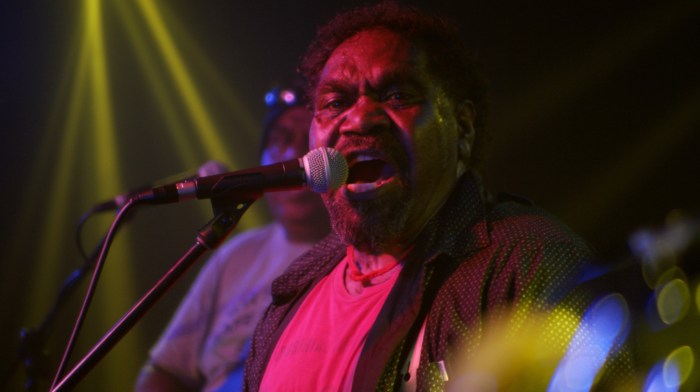
Jay Minning and The Desert Stars performing in Broome.
Eventually, the band does make it to Broome, but the film doesn’t spend too much time focused on that particular gig. Can you tell us about that Broome show, and what it meant for the band?
It was a massive relief for everybody to finally get there. It really meant that all that effort, and all those days of driving was worth it. As you were saying at the beginning, there’s something really passionate about those pillars that drove us. If we didn’t have that passion, and if Jay and those fellas didn’t have that passion just to get to the next gig just to play, we wouldn’t have made it. That’s all they really want to do. They want to play music and they want people to hear their music.
Jay has this very simple philosophy around not having expectations. It’s easy come, easy go. I asked him how he feels about going to Sydney to perform, and he said, “We don’t put expectations on ourselves. If it happens, great, and we really want it to happen, but if it doesn’t happen, that’s okay. We accept it.” It’s very common with Spinifex people to have that outlook on life. Why be obsessed about things you don’t really have control over?
Everybody was relieved to get to Broome because it was such a marathon to get there. The gig was great. It was really well attended. The audience loved the band. There were a whole lot of characters there who were really supportive. A lot of them had never heard an aboriginal rock band. But the film is much more about Jay and sharing his story, rather than the performances. That’s why we kind of capped every one of the live performances, because we wanted it to be more about Jay rather than the songs. But there’s plenty of music in the film. [Laughs].
You said something in your Director’s Statement that really caught my attention. “Now the journey of making this film is over I feel a little lost and empty.” It must feel nice that this whole experience is being revived with event screenings.
Absolutely. It’s nice to revisit things that you’ve put enormous energy into, and to go back and re-experience it. I think it’s also the chaos as well. Having grown up in Papua New Guinea, there’s a certain chaos about trying to do anything in Papua New Guinea. It can be really frustrating at times, but then you walk away from it and you go back to that ordinary everyday life where things are quite predictable. And there isn’t really chaos and there isn’t disruption. Sometimes we need that disruption again, just to remind ourselves of what living is all about. I mean, more importantly than anything, it’s really lovely just to have this film find an audience. It’s really nice to have Jay and The Desert Stars and their story find an audience. I think they have a remarkable story to tell. I think there are lots of people out there who will find it interesting. We’ve learned something about what it means to be Australian and a human on this planet by hearing Jay and The Desert Stars’ story.
Audiences will be treated to an epic celebration of Gravel Road when it screens at Luna Palace Cinemas in Leederville on Tuesday, 9 May. This session will include a Q&A hosted by Cinema Australia’s Matthew Eeles, and a special performance by The Desert Stars. Details here.

ADVERTISEMENT


 Cinema Australia