
Burn Gently director Antony Attridge AKA Sensible Antixx


The Australian hip hop scene is bursting with big talent.
Today, artists like Hilltop Hoods, Bliss n Eso, N’fa Jones, Briggs and Sampa the Great are known internationally for their great music, and their names draw big crowds to live music gigs everywhere.
But it hasn’t always been that way.
It has taken years for the hip hop profession to be taken seriously in Australia, and local rapper-turned-filmmaker, Antony Attridge, AKA Sensible Antixx, wants to spread the music to an even wider audience with Burn Gently, a two part docuseries that sees Aus Hip Hip artists like 360, Thundamentals, L-FRESH The LION, Mantra, Matt Okine, MC Trey, Michelle Grace Hunder, Baker Boy, Def Wish Cast, Mirrah, Genesis Owusu, Drapht and Urthboy detail their genre’s rise from what was once labeled BBQ Rap to a highly-respected and internationally-recognised genre in its own right.
Burn Gently originally began life as a feature film, but the more artists that became involved in the project, the bigger the story became.
“We started interviewing people and the conversations that we were having started to open up more and more,” director Attridge tells Cinema Australia during a recent interview which you can read below.
“Our original idea was to tackle one topic, but that quickly became four topics, which then became eight topics, which then became fifteen topics. And all of sudden we realised that if we’re going to cover thirty-plus years of Australian hip hop, it wasn’t going to be possible to get all of it into one feature film.”
Attridge says the biggest influence for Burn Gently was Wu-Tang Clan: Of Mics And Men which ran over four episodes.
“That was screened as two episodes at the Melbourne International Film Festival, so we wanted to follow their lead. When we watched Wu-Tang Clan: Of Mics And Men we walked away from that screening saying, ‘Hang on. We don’t have to fit this into any particular mould.’ That’s when we reached a point where we decided not to make it a conventional feature film anymore.”
Burn Gently will screen in Melbourne, Sydney, Canberra and Victoria over the coming weeks with all the details below. More national screenings are expected to be announced soon.

Suffa of Hilltop Hoods). Photo by Hideaway Productions.
“Burn Gently is about showing different walks of life, different cultures, and all of those things coming together. We wanted to celebrate the multicultural Australia that we know and love.”
by MATTHEW EELES
Throughout Burn Gently you only briefly introduce yourself. How long have you been rapping for?
Oh, man. How old am I? [Laughs]. I started rapping when I was probably fifteen. I’ve never really done it on a professional scale. I’ve never gone on tour. I never really set out to pursue it as a profession. I really love writing music. I think hip hop is able to offer so many more opportunities for expression than other genres, solely because of the amount that you can say in a rap. You might have four or eight bars in other genres, whereas in hip hop, you can have 32 bars, or 48 bars, so you’re open to how you wanna interpret what you want to put into those verses and those hooks and those choruses. So I’ve been writing for a long time, just never in the capacity of wanting to be a professional artist. That really took a lot of pressure off. I think that I started writing as a form of expression and probably as a form of escapism. Creatively, writing hip hop allowed me to explore who I was and the person I wanted to be, and what I thought about the world. That was when I picked up a pen and started rapping when I was fifteen. But to this day, I still write raps. I’m still constantly writing things in my phone that I come back to later. To me, I don’t need it all to see the light of day either. It’s served its purpose for me just by writing it.
Was hip hop big within your local community as far as live shows go, or were you confined to headphones in your room?
It was one hundred percent headphones in my room. [Laughs]. I even remember my first Walkman [Laughs]. I’m originally from Canberra, and the hip hop community in Canberra is very isolated. Especially back then. It wasn’t big at all. When I was in high school, we’d occasionally get a big US act maybe once a year, or maybe for the Big Day Out you’d get a De La Soul, or a Jurassic Five, or something like that. But hip hop was not a big thing, and certainly not amongst White Australia. I think that there was me and maybe two of my friends within my circle who liked hip hop. I remember my one friend would be on LimeWire on a daily basis illegally downloading torrents and trying to find whatever track he could find from an overseas artist. Also, back then, there wasn’t much Australian hip hop. There weren’t many Australian hip hop artists around. And certainly not in Canberra that we knew about. [Laughs].
The word ‘underground’ felt so much more authentic back then, didn’t it? It was a time when you had to actively hunt for music.
Exactly. And what made hip hop so appetising at the time was that I felt like I was listening to this thing that no one else knew about.
Did you ever aspire to become a filmmaker?
Never. Absolutely not. It never seemed like a possibility to me. I certainly never had the money to own any filmmaking equipment. I certainly never thought of myself ever being in a position where writing songs could turn into writing a film. And in that sense, we never wrote Burn Gently. The people who we interviewed wrote that storyline. I’ve just put the pieces together. Originally, the idea for Burn Gently was a collaboration with N’fa Jones from 1200 Techniques. Originally we kept catching up in bars to have meetings, and every time I met up with him he’d tell me a ridiculous story about his career, because he’s been around twenty plus years. Stories about hanging out with will.i.am from Black Eyed Peas, or about growing up with Heath Ledger, or his first time hanging out with Jay-Z’s crew. Every time I was like, “Your stories are wild! We should make a film about this one day.” I applied for a grant through Creative Victoria and we were successful which none of us could believe. Also, we were so inexperienced that in the grant application we said that we would film interviews with fifteen artists from across the country, edit, produce, release, and screen it all within twelve months. [Laughs].
That’s ambitious for even the most qualified filmmaker.
Right? That was six years ago! [Laughs]. Originally, Burn Gently was going to be called the N’fa Jones Story. We wanted to make an autobiographical piece about his life and to tell those stories. During an interview, Sensible J said, “You’re making a film about yourself? That seems a bit self-absorbed.” [Laughs]. It was then that we realised that the more people we interviewed, the more we wanted to talk about hip hop and its place in Australia. So it quickly went from being the N’fa Jones Story to Burn Gently.
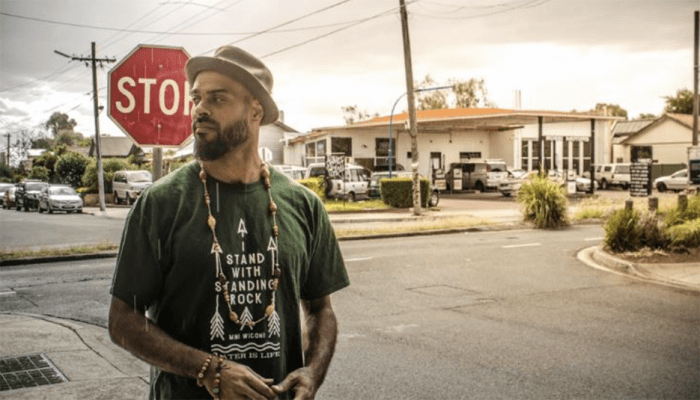
N’fa Jones. Photo by Kevin Rumbelow.
Burn Gently opens with well-known Aus Hip Hop artists describing disrespectful responses they’re often met with when they tell people they’re rappers. I’d love to hear how people react when you tell them you’re a rapper?
I guess I don’t tell people that I’m a rapper, personally. Rapping is certainly one thing that I do, but it’s not the thing I want to be defined by for the same reason that I don’t say I’m a filmmaker, or for the same reason that I don’t say I’m a good cook. They’re all things that I love to do, but I guess I just don’t like to be labeled as the one thing. And I think that a lot of hip hop artists, especially now more than ever, would be on the same page. By including that segment in the film, what I was trying to identify was the fact that hip hop has always had to fight for its place in Australian music. And it very much still does. I feel that this segment is such a clear and succinct example of that. If you were to tell someone that you’re a singer or a songwriter, people will ask, “What band are you in? Who do you play with? Tell us more!” Whereas, if you tell people that you’re a rapper, you get laughed at. Why? Why has it gotten to this point that arguably one of the biggest genres on the planet is still misrepresented so much in the community? And certainly in mainstream media. Why do people feel ashamed of that sort of thing? That’s what we were trying to explore in this film. So for me personally, it’s not that I don’t feel proud of the music that I make or the music that I write, it’s more that I care more about what I think of me than what other people think of me. I don’t really need to know what people think when I tell them I’m a rapper.
It was a shame to hear artists say that Aus Hip Hop was treated like a joke for such a long time. Why do you think it took Australia so long to take this music genre seriously?
It certainly has come a long way. I think first and foremost, you have to recognise that hip hop is a borrowed culture. It’s not Australian. It has never been Australian. Australia is obviously very whitewashed and the stigmas that were attached to hip hop are astronomical because it’s political music. It has always been based around giving a voice to people that don’t feel like they have one. When hip hop started to form its place in Australia in the late nineties and early 2000s, the predominant form of hip hop, especially overseas, was gangster rap from your Snoop Dogs and your Ice Cubes. It was all about fucking this bitch, and shooting that person, and racial slurs. So much of it was just this really misogynistic, fight-music in a way. In Australia especially, if you were listening to hip hop then it was a revolt against something. It was a revolt against society, against community. It was perceived that they were the people that were taking drugs, that were violent, that were misogynistic. It was easy to point the finger at something like hip hop and say, “This is the problem.” When really, hip hop is a reflection of what’s happening in society.
The local film industry suffers heavily from what’s labelled as “cultural cringe”. Do you think there’s a cultural cringe when it comes to Aus Hip Hop?
Yes. Definitely. Growing up, I was listening to a lot of American hip hop, and a little bit of hip hop from the UK. When I started listening to Aus Hip Hop, it sounded like a cheese grater to the ear. There was so much of that Oi! Oi! Oi! fucking blokey grossness that came through to me. It was a reflection of the age demographic of 20-somethings listening to Aus Hip Hop all those years ago. There was a thing called BBQ Rap that was all, “I’m drinking beers with the boys at the BBQ. I can’t wait till the girls come round.” And that’s all it was. There was an element of cringe there for sure.
Is there anything in particular that differentiates Aus Hip Hop from other hip hop around the world?
That’s a really good question. One thing that I really, really enjoy about Aus Hip Hop is that it doesn’t celebrate being an Australian. That’s certainly something that I personally relate to. I don’t like to celebrate being an Australian, because my national identity is not the whitewashed Australia that I was taught to be in school. My schooling ignored the disgusting history that Australia has, especially when it comes to our indigenous people. So I love the fact that Australian hip hop is not like, “I’m Australian, here’s the Southern Cross flag, we’re the best country.” Aus Hip Hop is honest in that we’re starting to see a lot of those narratives about the true history of Australia coming through from lots of different artists, and not just indigenous artists. I think that’s really important. Because of how accessible music-writing tools have become, you’re forced to be creative, and you need to have educated opinions on the world. You’re forced into this creative space where you can’t just be another flash in the pan. You have to be so much more than that. From an Australian perspective, we’re starting to see what was a white, male heavy space now become completely diversified. Something that really stands out with Australian hip hop is that it’s so much more than the national identity. It’s actually about people and their experiences, and how they feel about the world.
I have a great respect for all artists featured in Burn Gently, but I really sat up and listened when Sampa The Great was speaking. She truly understands the cultural importance of her art, and she articulates that importance so well.
When I think of great hip hop artists who are in their own lane I think of André 3000 from Outkast, Missy Elliot, Lauryn Hill. Sampa The Great is in her own lane. There is no one else like her. We felt the same way after doing that interview as you did. There was so much that she said that I was completely unaware of, certainly as a white Australian male. And the most important of which is that we’ve always called this thing an Aus Hip Hop documentary, but in hindsight, I don’t think that that was the correct way to go about it. Sampa the Great is a Zambian artist. She’s always been a Zambian artist. She just lives in Australia. Sampa the Great was able to give us these insights, not just of her experience of growing up in Australia, but also all of the pressures that go along with that at such a young age. Speaking with Sampa reminded me how incredible her music is. It’s world class. She’s on Barack Obama’s playlist. The woman is unstoppable. There’s just no one else in her lane. And she’s just the most humble, gracious, lovely artist. We were so grateful to have her involved.

Sampa the Great.
Speaking of cultural significance, Aus Hip Hop is doing a great service to Australia when it comes to teaching the true history of Australia and our indigenous history. Would you agree with that?
Oh, I couldn’t agree more. I remember there might have been only one or two indigenous artists back in the day going back ten, fifteen, or even twenty years ago. Now there’s a plethora out there. There’s whole labels like Briggs’ Bad Apples. I think something that’s really important to recognise as well, that someone like Briggs who’s not politically trained or necessarily politically minded having significant influence on an institution like Triple J changing the date of the Hottest 100. Obviously that hasn’t changed the history books, but that’s huge. That’s a monumental movement by a hip hop artist. The more I listened to hiphop, certainly in the last ten years, the more I’ve learnt about indigenous culture and Australia’s indigenous history. Speaking to Drmngnow was phenomenal. We interviewed him in Abbotsford in Melbourne and he was telling us about the land and the indigenous history of the place we were meeting on. It was such an eyeopener. When I was in school it was all about the history of the settlers. We didn’t learn anything about the Stolen Generation because apparently you can’t teach that to children. Well, yes you absolutely can.
You’ve mentioned so many great artists who are featured throughout Burn Gently. How did you assemble such an incredible group of artists?
Oh my God. Can I just say, the lineup for Burn Gently is like the soundtrack of my life. Every one of these people have been heroes to me in their own right. To have the opportunity to speak to them has been phenomenal. Those interviews came about because of two things. Firstly, I’ve worked in music for quite some time. I used to work at The Music. They had a weekly printed edition, and I curated an online blog that was hip hop specific. I would speak to whichever hip hop artist that I had managed to get. It was a fortnightly thing, and I would speak to them about social issues. So I was able to build a network of people who work in Australian hip hop. Secondly, something that I’ve learned making this film is that Australia is a really, really big place, but the music scene is very, very small. It’s not what you know, it’s who you know.
Was there anyone you would have liked to feature in Burn Gently but couldn’t get for one reason or another?
So many. We really, really wanted Briggs to be involved. He wasn’t able to because of his calendar and commitments. He’s a crazy busy man. We really would’ve liked to speak to Trials from A.B. Original but it just didn’t work out with our scheduling. I really would’ve liked to speak to Tkay Maidza. I feel like I’m just name dropping at this point, but there are so many people who we just love.
I feel like there’s room for Burn Gently to grow as a series. There’s so much more to this story.
You’re exactly right. That’s something I’d like to do with a streaming platform, even if it was YouTube. But if it was Netflix, Stan or Binge we could do a much bigger ten part series or something like that. That’s the dream.
I enjoy Aus Hip Hop a lot, but it’s not something I actively listen to. I’m a big metal fan. In saying that, I got so much out of Burn Gently because of how educational it is. How would you convince someone who has no interest in hip hop to watch Burn Gently?
I’d really like to get the message across that you don’t have to like rap music to like Burn Gently. You don’t have to like rap music to like hip hop. It’s so subjective and it’s so creative and there’s so much opportunity for expression in the culture of hip hop that it doesn’t need to be defined as this one straight art form. If you’re interested in fashion, if you’re interested in poetry, if you’re interested in any sort of expression then you will enjoy Burn Gently. This film is about speaking to a lot of different people and showing different walks of life, and different age demographics, and different cultures, and all of those things coming together. We wanted to celebrate the multicultural Australia that we know and love.
You can catch Burn Gently at these locations:
MELBOURNE
March 23, Cinema Nova
SYDNEY
March 30 Dendy Cinemas Newtown
March 31 Civic Theatre Newcastle
CANBERRA
April 27 Dendy Cinemas
GEELONG
May 3 Village Cinemas
CASTLEMAINE
May 11 Theatre Royal

ADVERTISEMENT


 Cinema Australia