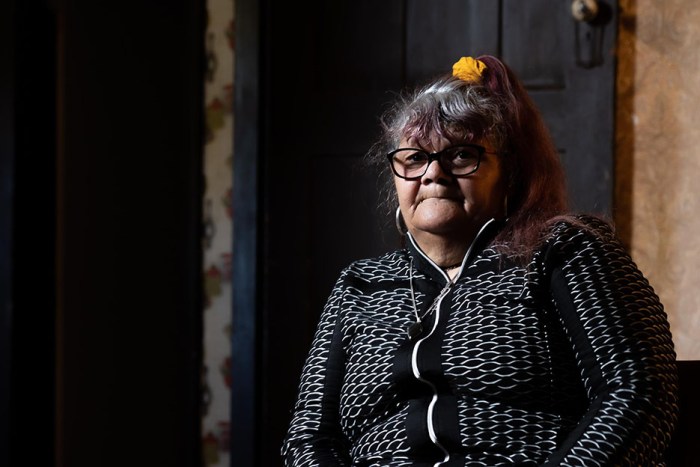
Helen Dwyer in The Grey Line.


by Matthew Eeles
A trailer has been released for The Grey Line ahead of the film’s world premiere at the upcoming WA Made Film Festival.
The powerful new WA-shot documentary tells the story of Helen Dwyer, also known as Ellen Collard.
Taken from her parents during a time when Aboriginal children were removed from their families through Government mandated policy, Helen was raised by a middle-class family in the suburbs of Perth and believed she was their biological daughter until the age of 14.
Despite being raised by a very loving foster family, Helen has never felt like she truly belonged. Not white, not black, she walks a very lonely grey line. This is her story of hurt, a longing to find her true self and to finally be accepted for who she is.
“There is a subsection of the stolen generations who have never been acknowledged. Those of us who were raised by white families and totally disconnected from our Aboriginal family, our culture, our language. We’re not white, not black, we sit on this very lonely grey line,” Helen tells Cinema Australia.
“I have a sense of deep loss, like a black hole, that has hung over me for my entire adult life. I have always just wanted to belong, but never really felt that I have. I want this film to shine a light on what we went through. To be acknowledged. To be seen.”
The Grey Line is directed by Scott Quayle, a relative newcomer to documentary filmmaking of this scale.
Scott has released two short films previously: the 2019 documentary, Coming Home: Isle of Man TT, and the 2021 short documentary SHIL about a public speaker with a stutter.
With a background in corporate marketing, Scott now runs his own production company called Life Films creating one hour documentaries of everyday people for their family and friends.
Having moved to Australia at the age of ten from the Isle of Man, Scott tells Cinema Australia that making The Grey Line has been a confronting experience.
“Going through school in the 90’s, I was never taught the rich history of the Aboriginal culture and the atrocities they suffered,” says Scott.
“Unfortunately I am not alone. A huge number of Australians are unaware of just how many lives have been affected by the acts of our past Governments. Every indigenous person involved in this project has a close connection to what happened during this time, with one or more family members having been part of the Stolen Generations.
“I was nervous to tell this story, but Helen and I had an instant connection and I feel honoured that she chose me to make this film.”
The Grey Line is co-produced by Helen’s daughter Kayah Wills who also features in the film in a confronting scene about the racism experienced by her family in everyday life.
Kayah believes all children need to hear these stories, so they can grow up and share what they have been taught, and to learn what her people have endured just a short time ago, in what most would assume was generations ago.
“It was a journey to get to this point and it was never something I thought would actually happen. To see the final product and the care taken by Scott and the team to get my mum’s story right, I was so proud,” Kayah tells Cinema Australia.
“As a daughter, to feel and see the pain in my Mum’s eyes is hard, however this is the reason this film needs to be seen. This pain runs through so many of our Elders and through their children, it creates intergenerational trauma amongst families, which is hard to break.
“This film will open up the dialogue amongst indigenous and non-indigenous people. It will help to demonstrate why people are still angry, or sad or feel unheard. It will help those with no idea this was something that happened in Australia, or those that have heard about Stolen Generations, but do not know what that actually meant for families to endure. It’s for those who know someone who has been stolen, and for children in my shoes, whose parent(s) have gone through this.”
Co-producing the film alongside Kayah is indigenous theatre star Amy Nyidi Smith, who also plays Helen in flashback scenes throughout the film.
Amy echo’s Kayah’s sentiments that the world needs to hear this important First Nations story.
“It is amazing how many people in Australia, of different ages, have no idea of the assimilation process and how it affected our people, and led to intergenerational trauma,” Amy tells Cinema Australia.
“These stories have been suppressed for so long, and now thanks to filmmakers, theatre makers, play writers, artists, and most of all, our brave people that wish to tell them, we are now on a strong road to telling more of these stories.
“We need to heal. When I speak with my people, and having the space to tell their experience of the assimilation process, I can see the healing already begin. When I was approached by Ian Hale and Scott Quayle, and they described what the documentary would be about, I felt very close to the subject matter. It was very similar to my mother’s story.
“It can be lonely living with these memories and trauma. Sharing her story is a platform to say ‘you are not alone’.”
Ian Hale of HALO Films executive produced the film and tells Cinema Australia he’s incredibly humbled to work with such an amazing and passionate team.
“I’m truly honoured to be entrusted to tell Helen’s important story and to bring it to the widest audience possible,” says Ian.
The Grey Line will have its world premiere at the WA Made Film Festival on Sunday, 19 February. Tickets and details here.

ADVERTISEMENT


 Cinema Australia