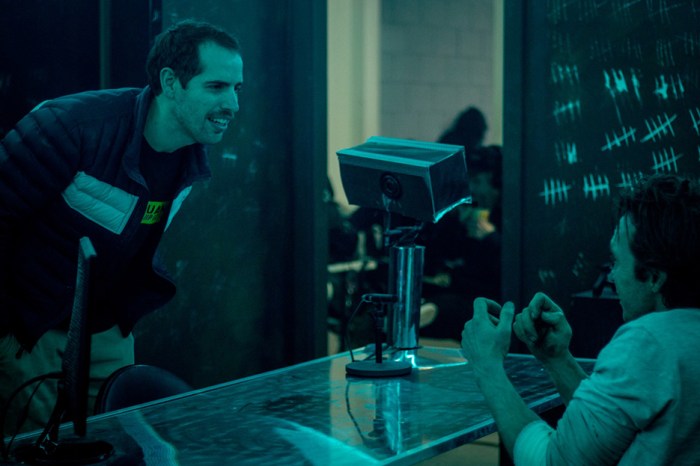
Tristan Barr and Stephen Phillips on the set of Subject.


In 2017, Tristan Barr launched his feature filmmaking career by co-directing, co-writing, co-producing and co-starring in Watch the Sunset.
The fast-paced one-shot action thriller was a hit on the festival circuit around the world and was quickly picked up by Australian streamer Stan where the film is still available to watch.
With Barr’s Watch the Sunset followup, Subject, the talented director and actor has shifted from the world of grimy drug culture to experimental, found-footage horror.
The new creature feature follows Willem, played by Australian stage and screen actor, Stephen Phillips who you’ll know from TV shows like Winners & Losers and Last Man Standing. On his way to prison, Willem gets intercepted by a secretive government agency who task him to monitor a secret experiment in exchange for commuting his sentence.
Cinema Australia recently caught up with Tristan and Stephen to discover more about the making of the film which resulted in some interesting responses, especially when it came to psychological effects of making such an intense horror film can have on cast on crew.
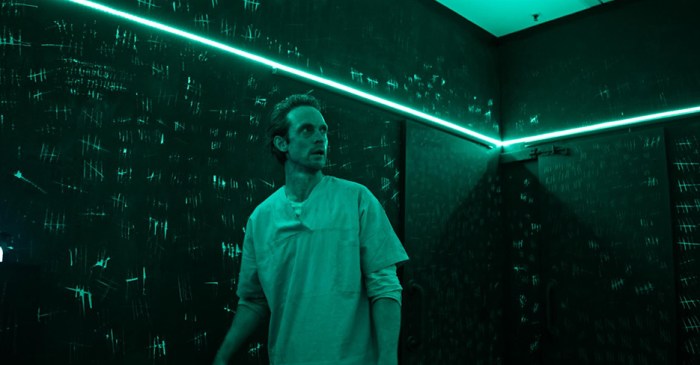
Stephen Phillips as Willem in Subject.
“It was so intense that there were a lot of nightmares happening for cast and crew throughout the process. Genuine nightmares. I was waking up during the middle of the night from the nightmares. And I know Steve had this a lot as well.”
Interview by Matthew Eeles
How did you two meet?
Tristan Barr We’ve known each other for a long time. Steve was my Movement and Improvisation Coach at Victoria College of the Arts. Steve had done the course previously and had come back to teach. When I did the three year acting course, Steve was doing this exploratory improvisation process called Pulse, which teaches you how to create a performance out of nothing. It was similar to what they do at Improv Clubs where they just get up in the space and start improvising. This is like that, but a real, hardcore actor’s version where you create scenes out of nothing with very physical action. So Steve taught me that, and then some years later when this script came along, I just couldn’t think of anyone better to do it than Steve.
Stephen Phillips That’s pretty much it. Tristan was one of a number of really energetic and enthusiastic students. With these courses, you find out who the students are who are willing to drive their own agenda, because it’s about stepping into a space and changing it and filling it with your creative drive. Tristan was very good at it. I remember I really liked having Tristan in the space, and he was wonderful to collaborate with. I wasn’t surprised when I heard through the grapevine that he was off making all of these films like Watch the Sunset. I saw that movie and thought, Yeah, this all makes sense. I was already pretty excited about what he was up to. So when he gave me a call and talked about the Subject script, and the way he wanted to shoot it, I recognised some of the principles of the Pulse course in this improvisational way. We’d both had this history and that could actually be instrumental in the way the film would be performed.
Wow. So you two really did come full circle in the way that you met, and how you’d end up working together.
Tristan Barr And I was just thinking as well, you need a huge amount of trust going into something like Subject because of the extremes of where the improvisation can go to. It’s very easy to cross boundaries physically and emotionally. You often hear of actors going to extreme places with improvisation and transforming into something and someone else entirely. That was very much where we wanted to go with the performances in Subject. And Steve expresses himself and his skills flawlessly in this film. What Subject is now wouldn’t have been possible without Steve bringing all of those physical and emotional elements to it.
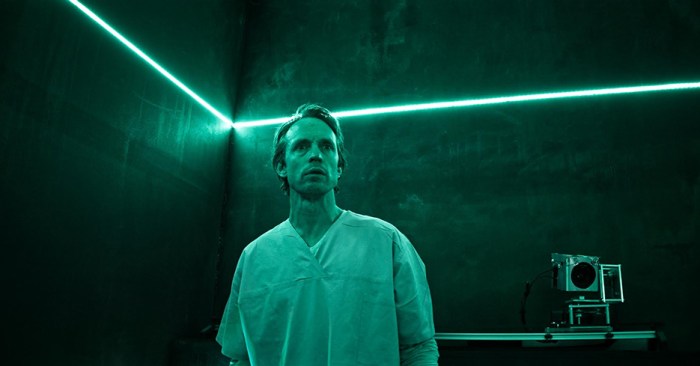
Stephen Phillips as Willem in Subject.
Tristan, the story of how Vincent Befi’s Subject script found you is quite an interesting one. Can you tell us about it?
Tristan Barr Vincent applied to a script writing competition that my company, Continuance Pictures, runs called The Continue Short Film Initiative which basically gives an opportunity for people who have feature film scripts to shoot a short proof-of-concept. We support a certain amount of short films each year, whether it be financially or physically during production. Vincent’s script came up, and it was like one of the top twenty scripts of that year, and we realised very quickly that we could make this film very quickly and affordably. Vincent got on board and began rewriting his original script. So from the time we decided we’d make it, Vincent did rewrites and we got it financed and bought Steve on board. That all unfolded in a three month period, so it was a very quick turnaround. We were able to build a set in that time as well.
How much of the story changed from the original short form version?
Tristan Barr Not much at all. It’s very similar, but it actually required a lot of reworking because of the found-footage element. We decided that it needed to be surveillance-based and told from the point of view of a viewer who’s come across this footage. So it then required a lot of rewrites to basically support that and our desired shooting style as well. The tricky thing with surveillance is that you can’t move the camera to exactly where you want at a specific point in time around the space. And that’s pretty much why we had so many cameras going at once. We had twelve cameras shooting at once.
Stephen, what was your first impression of this script?
Stephen Phillips I immediately knew I wanted to do it. It’s always an indication for me to want to do something if I sit down and I just read a whole script in one go. I know then that there’s something in it. And this script was one of those genuine page turners. I found the story to be really well structured, but it also had a lot of dirty edges where things aren’t immediately decipherable or explainable on the page. It had that lovely balance to it, and it was a joy to work out this puzzle. I found it really fascinating reading. I was immediately hooked.
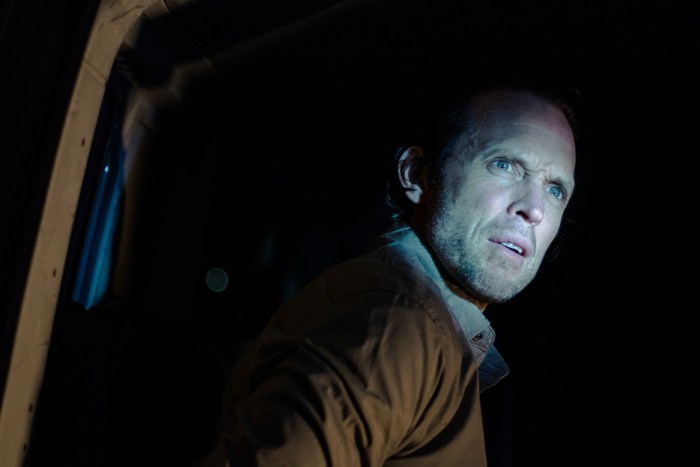
Stephen Phillips as Willem in Subject.
If Subject is anything, it’s an exploration of domestic abuse, drug abuse and addiction. You must have been excited to sink your teeth into something so dramatic.
Stephen Phillips I really was. I think it’s important to investigate that dark side of humanity. I’ve got a natural love for this kind of story as well. I mean, Subject is the kind of movie that I love to watch, and it’s always a rare treat when you get to act in something that you like to watch as an actor. I really enjoy watching stories where people are having to deal with stuff that seems inescapable, and there’s no way out for them. Not in a gratuitous way, but in a moral and humane way. I find that really fascinating as an actor.
Was there much research involved on your behalf before you started filming, or did you just jump straight in?
Stephen Phillips There was a lot of sifting back through personal stories of my own, and some traumas that I’ve experienced. My mum is an incest survivor, she’s passed on now so I feel okay talking about it. But for me, her trauma is something that’s always been present in my life through her and the way that she’s had to deal with that. In a sense, that was something that I immediately drew myself towards and went, Okay, that’s something that is really close to the core of me. It was something that is important to continue to investigate, I suppose, and unravel that stuff for myself as a person and as an artist.
It sounds like it was quite a cathartic experience.
Stephen Phillips I think so. To fly creatively so close to something that has terrorised you as a person in your life can be a damning experience. But it can also be a really liberating one, and this was a liberating one. It was very intense. It was the most intense creative time I’ve ever had in my life. Not just in the subject matter, but also in the process of how it was shot. Everything about it was super intense. But we had a great team around us, and that’s very important.
The trauma you’re exploring within yourself certainly comes through. Congratulations on such a great performance.
Stephen Phillips That means a lot.
The film is set in the US. Had you had much experience with an American accent before this?
Stephen Phillips As well as being an actor, I’m also an audio narrator. I do a lot of voice work and I’ve narrated a few long, unabridged novels in an American accent. I’ve done a few parts on American TV. Auditions, and growing up watching a lot of American TV and film helps too. [Laughs].
Tristan, drug abuse and addiction is becoming a common theme for you as a feature filmmaker. Why are you so interested in exploring these themes?
Tristan Barr It’s something that is very present around me. I’d say it is probably around most actors and filmmakers as well. I just think that it’s something that has occurred in a lot of peoples’ lives. When I come across those scripts, and these ideas, they’re really interesting to me because I can relate to why people do become addicts and why they use drugs to mask pain. We have essentially dealt with a few of those themes in our films, but with Subject, I was more interested in the horror nature of it, whereas with a film like Watch the Sunset, I was very much interested in exploring the raw reality of that sort of addiction. Subject goes into a very weird space when we look at addiction. It covers a whole range of emotional stakes like family as well as curbing one’s own trauma.
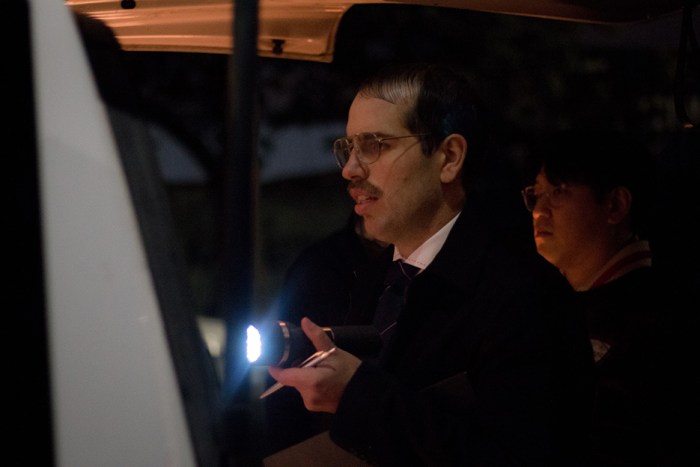
Tristan Barr as Dalesky in Subject.
The monster in Subject is the embodiment of that trauma. Tell us about the design of this monster. Did it go through many variations?
Tristan Barr It did actually. At first we were going to have several actors play the monster as it evolves. But we shot in ten days back-to-back so eventually we decided to have just the one actor, Joey Lai. We knew Joey from VCA. He was a couple of years below me, and he has worked with Steve on other productions. Joey offered such versatility to that character because he’s a giant. He must be seven foot tall. [Laughs]. So instead of casting so many other actors, the idea came to us that we would slowly progress him to the giant form of the monster that you see towards the end of the film. That’s Joey’s full height. Aline Joyce was our special effect and makeup artist, and she did an amazing job. Aline was there prepping him for hours before set every morning at 4:00am in Melbourne in the middle of winter in a cold warehouse. [Laughs]. Aline and Joey’s efforts were really incredible.
We’ve spoken about Joey, and obviously Stephen’s performance anchors this film, but I think it’s important to acknowledge the other performances too. Stephen, I’ll start with you, can you tell us about working with Cecilia, Gaby and Scarlett who play your partner and daughters respectively in the film?
Stephen Phillips They were so wonderful. There’s a lot of pressure to anchor a film with a performance, but it makes things a lot easier to know there is support from other quality actors in the film. Cecilia has a fair bit of experience in the film and TV industry on both sides of the camera. She was just beautiful to work with. She’s an extremely generous co-star. Gaby was so consistent and gives such a solid performance emotionally. And then there’s Scarlett. I was just talking to Tristan a while back about how centred and calm little Scarlet was on this film set. Most kids find it difficult to maintain their focus. She impressed all of us with a number of takes. Scarlett was beautiful to work with. I think Tristan might have something interesting to tell you about working with Scarlett.
Tristan Barr Yeah, so a lot of the actual flashback scenes in the film were shot at Scarlet’s family home. Her parents were incredibly supportive of the whole project. I think having that support, and that familiar environment for Scarlett to work in, was integral while having to deal with stuff of this nature.
Stephen, how does Tristan hold up as a co-star as well as a boss?
Stephen Phillips It’s so lovely to work with someone who you have complete trust in. You mentioned earlier that things had come full circle with us, as in I was Tristan’s teacher and he was my student, and now he’s directing my performance in Subject. I love that. It’s really nice to have those different flows in the energy between artists as they get to different parts of their career. It’s just amazing what Tristan’s achieving now, but I’m not surprised. Also, Tristan is an actor I’ve always really admired. I thought it was really great to have him as a director, and a co-star, because he plays Dalesky in the film. It was amazing to watch him balance those roles in the way that he did. I found that really admirable.
Tristan Barr I really should say that Steve helped me so much in my role as Dalesky. [Laughs]. I would not have been able to do it without Steve’s support. What actually happened was that we had another actor who was originally cast to play Dalesky, but unfortunately they dropped out during the shoot. I basically stepped into that role because we tried quite a lot of other actors, but no one wanted to do it on such short notice. I was so grateful that Steve was there, because we’d just done a twelve hour day and then I had to go home and learn these lines and Steve stayed back with me in the warehouse to help me try to get the lines off the page. [Laughs]. Steve really took a lot of pressure off me with his professionalism. I was very lucky in that sense.
Do you reckon it would have worked out so well if you hadn’t come in to this project already knowing each other?
Tristan Barr I think it would have been a disaster to be honest. [Laughs]. That particular experience of losing one of our actors was one of those times during production were we were contemplating whether or not to stop production. Does this whole thing fall apart? But I just knew that if we got through it, then we will be getting through it together as a team. I just knew having Steve commit to that space for two weeks that we’d have a really good film at the end of it. That’s what I kept telling myself throughout the process.
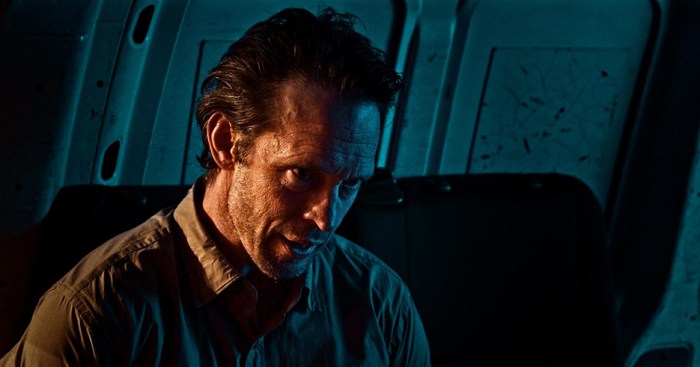
Stephen Phillips as Willem in Subject.
Tristan, this is your sophomore feature film following the superb Watch The Sunset, a one-take marvel. Was this film less of a technical challenge compared to Watch The Sunset, or more so?
Tristan Barr It was a different technical challenge. And in some ways, it was far easier because we could stop and start when we needed to. [Laughs]. But rolling twelve cameras at one time is so hard technically. Just the fact that we had twelve cameras at once feeding back to us seems insane now. If one camera is not working, or is playing up, it could be a complete nightmare. Within our space in the warehouse we had all the cameramen outside of the actual film set just operating these cameras. I found myself getting drawn into the technical side of this shoot because we were working with robots and gimbals and mechanical sliders that were constantly moving during the space. For anyone who has had troubles with any kind of moving camera on a set will understand what kind of nightmare it could be to be operating twelve cameras at one. It gets very tricky. But once we got going, it was just so good. It all got very exciting in the edit room. It felt like we were editing live TV in a way because we had twelve screens at once.
I also found the film to be audibly inventive. How important was sound design in bringing this world to life?
Tristan Barr That it was hugely important. We spent a lot of time trying to figure out what was essentially necessary. We discovered during the whole process that because we weren’t relying on a score the actual sound design was super important and the amount of audio layers that are in the film is just phenomenal. Because there are moving cameras all the time, we’re getting so many layers of sound, then we’re getting the design of the monster, or Steve’s vocals. There was so much going on at any one time. The amount of layers going on are just insane.
After I watched this film, I wondered if I’d prefer to be locked up for life, or given the option to be locked up and experimented on. I think I’d prefer to be locked up and experimented on because at least there are minor freedoms involved. Which would you two prefer?
Stephen Phillips I’d rather be experimented on, Matthew. Who knows what’s inside of you to be discovered. At least you’d know you’re not going to be stuck in one space.
Tristan Barr To be honest, I’d rather be locked up. Having gone through this process, it was so intense that there were a lot of nightmares happening for cast and crew throughout the process. Genuine nightmares. I was waking up during the middle of the night from the nightmares. And I know Steve had this a lot as well. You couldn’t get a good night’s sleep because this space, and what the content was that we were dealing with was just haunting us. I got a bit sick after the filming process. It was probably combined with the fact that it was Melbourne in the middle of winter, but being in that environment for so long, I got this weird thing where my immune system just started attacking itself and I got these little sores all over my body. It was really intense. I know Steve had some experience with nightmares
Stephen Phillips It was quite pervasive. I spent a lot of time in this small space. The space that the guys created was just too good to not use all the time. So I wanted to get that experience of confinement. So I spent a lot of time in there. The dreams that I started to have weren’t specifically about monsters, but it was just about the fractured camera angles. Visually, the dreams were extraordinary, and they were relentless. I used to sleep a lot, but I would wake up exhausted. I lost six kilos across the shoot too, which was another side effect of just how intense and pervasive the stimulus of this process was. It was really relentless. They often say as an actor that the work can enter your subconscious. We shot ten days straight. So by the end of it, it was transformative psychologically and physically. And I couldn’t eat another egg for a very long time. [Laughs].
I was a bit hesitant to ask that question, but I’m glad I did.
Tristan Barr I bet you didn’t expect such a deep response. [Laughs].
Subject will screen at Monster Fest on Saturday, 10 December at 2pm in Sydney, Perth, Brisbane and Adelaide. Details here. Subject will be released via Umbrella Entertainment in 2023.
FILL OUT THE ENTRY FORM BELOW FOR YOUR CHANCE TO WIN A DOUBLE PASS TO THE PERTH SCREENING OF SUBJECT THIS WEEKEND!


 Cinema Australia