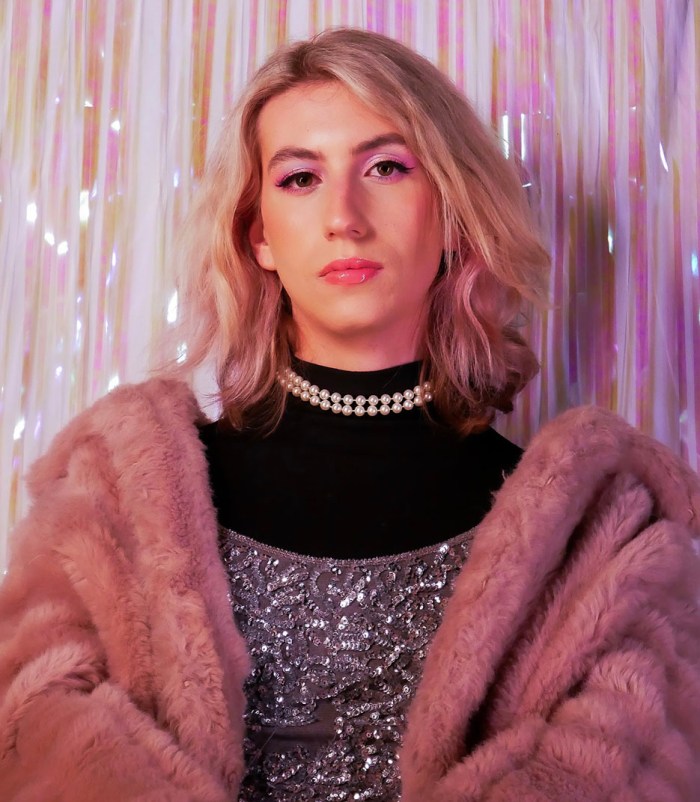
Alice Maio Mackay.


I’m well aware that it’s a cliché to describe a fresh filmmaking talent as “one to keep an eye on”, but in Alice Maio Mackay’s case there’s no better way for me to introduce this extrordinarly talented young filmmaker.
And when I say young, I mean it literally. At just eighteen years old, Alice is preparing to reveal her sophomore feature film, Bad Girl Boogey, to the world when the violent and bloody neon slasher premieres at the upcoming Monster Fest were it will screen alongside other local films from more established filmmakers like Matthew Holmes’ The Cost, and Tristan Barr’s Subject.
On its surface, Bad Girl Boogey will seem familiar to most, following tropes found in your more mainstream horror films like Scream and I Know What You Did Last Summer – there’s a masked killer on the loose hacking up helpless teens as they drink, smoke and party their days away. But it’s obvious that Alice Maio Mackay, an award-winning transgender filmmaker, is working hard behind the scenes to deliver on more mature, political themes surrounding the LGBTQIA+ community.
Bad Girl Boogey is directed, produced, and co-written by Alice Maio Mackay and was made with a predominantly queer, non-binary, and trans cast and crew. The film follows a group of teenagers as they’re hunted by a killer possessed by a parasitic mask cursed with black magic and bigotry.
Alice Maio Mackay is indeed an exciting new voice on the Australian filmmaking scene. And if she delivers more films as good as Bad Girl Boogey is, then the future of Australian genre cinema is indeed in safe hands.
In this interview, Alice Maio Mackay takes us back to her early fascinations with storytelling and how her passion for it developed her into the filmmaker she is today.
You can catch the world premiere of Bad Girl Boogey at Monster Fest from Sunday, 27 November at 2:00pm. Details here.
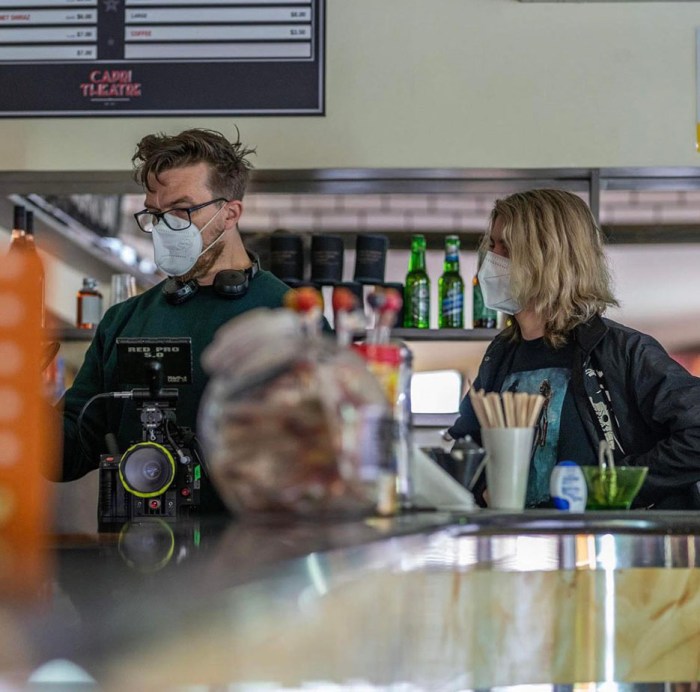
Alice Maio Mackay on the set of Bad Girl Boogey.
“I’ve always been a fan of slasher films, and obviously queer slasher films like Freaky, and Black Christmas, and films like that. I always like to have a political edge when it comes to filmmaking.”
Interview by Matthew Eeles
You started making films when you were twelve, and now six years later you have two impressive feature films in the can, So Vam and Bad Girl Boogey. Where did this passion for filmmaking come from?
I’ve always been interested in telling stories, and I started with short stories. I would enter short stories into various competitions. I just kept writing and writing and eventually I just stumbled upon film. I was always interested in watching movies, but it was never something I thought would be for me. I came across the International Youth Silent Film Festival and I made a stop motion film for that. That film was accepted into the festival, and from there I was able to get onto some local film sets and I gradually worked my way up from there. Once I got onto an actual film set I remember thinking, I wanna make my first proper film.
The stop motion film you mentioned, was that the Lego film, Bestia?
It was. I made a couple of Lego films when I first started. But Bestia was a silent, black and white Lego film. I think it was three minutes long because I had to match the organ soundtrack.
Looking through your filmography, Bestia is the only comedy you’ve made and the everything else is horror. Going back to those short stories you were writing, were they horror themed too?
They were. The horror I was writing was about real people. I’ve never written about fancy demons and stuff like that. I’ve always been interested in incorporating my horror into the human world. I remember in grade three I wrote about vampires and heads being cut off and stuff like that. I guess I’ve always been into horror.
Were eyebrows being raised from those who were reading these stories by someone at such a young age?
I don’t think so. I actually remember giving that particular short story to my teacher as an end of year present because she’d actually been really supportive and allowed me to do other work outside the class. I was really lucky in that regard.
Wonderful. I think it’s so important to have that support at such a young age.
I agree. It really is.
Can you trace back to were your interest in horror came from?
When I was really young I loved watching Munsters, and The Addams Family, and Hardy Boys Meet Dracula. That was one of my favourite things to do. I watched a lot and Buffy and Scooby-Doo. As I got older, maybe grade five, I started watching Scream and getting into slasher films a bit more, and those more mature horror films.
Scream is a great film to start with. What other films do you remember having an impact on you?
Oh, that’s a tough one because there have been so many. Gregg Araki’s work has really stood out for me because he started with no budget as well as being at the forefront of the queer movement in cinema. John Waters of course. And over the last few years Joe Begos’ work with VFW, Bliss, and The Mind’s Eye. Joe made super low budget films for like fifty grand. His work has been really inspirational to me.
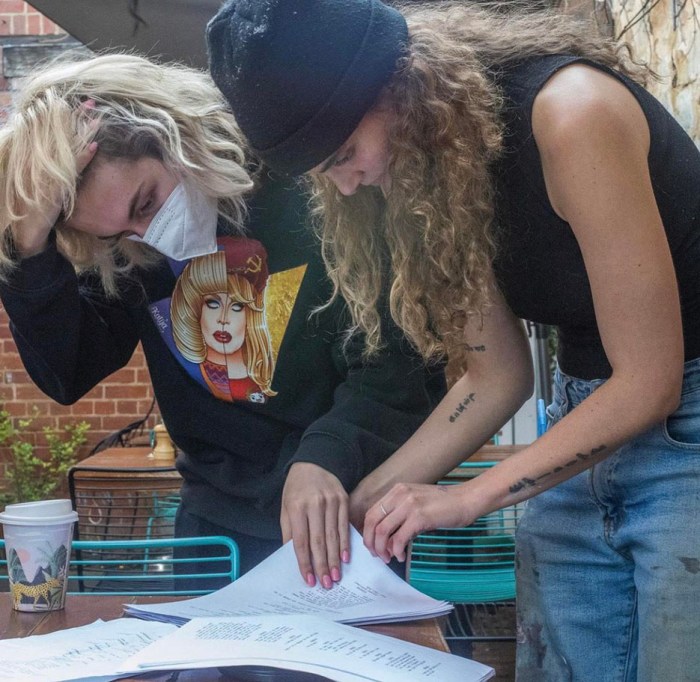
Hard at work on the set of Bad Girl Boogey.
Are you currently studying film?
No, I’m not. I’m making films full time. I work in the arts making movies full time.
Have you previously studied film in any way? Either officially, or by reading a book?
No. [Laughs]. I guess the best study I ever did was being able to get onto other people’s sets. There’s a great company called We Made A Thing Studios based in the SAFC and they’ve done a lot of bigger budget work. When I was in grade eight I was able to get on their sets. Recently I was able to watch the filming of Fury Fingers’ Loved, Guns & Level Ups. I loved being on that set. So I’ve just been able to observe and actually be on big sets and small sets and that’s been the best way of learning for me.
You can’t get a better film school than being on an actual film set.
You’re so right. I started a TAFE course, but I just didn’t find anything they were teaching relevant or helpful compared to actually being on sets and being surrounded and immersed in that whole experience.
What’s the one thing you learnt from being on those sets that you take with you onto your own sets today?
Problem solving. Thinking quick and overcoming a problem quickly on the day. Just getting it done. There are a lot of ways that problems can be overcome in post-production. It was really interesting to watch and listen to how things are being filmed and how they were going to go about a particular scene during post-production.
Bad Girl Boogey is your second feature film collaboration with screenwriter Benjamin Pahl Robinson. And this film also features actors and crew who you have worked with in the past. How important is collaboration at this point of your career?
It’s one of the most important things a filmmaker can have. Without that collaborative support, I just wouldn’t have a film. Especially Ben. He’s been writing and collaborating on stuff with me ever since I was making really shitty short films. [Laughs]. We’ve grown together as a writing duo. I’ve even grown with my cast and crew from the very start. I shot Bad Girl Boogey with cinematographer Aaron Schuppan who’s amazing. He does all my films now. Collaboration is really important, especially when we’re shooting with time restrictions as well as no money. It’s really good because we all know each other so well and we work great together. We know each other’s strengths and we all have that same vision now which really helps us get to that end goal.
Tell us about working with Benjamin. What’s your process there?
Ban actually lives in Argentina. So I’ve never met him in person. [Laughs]. He’s Australian, but he moved there a few years ago. I was on a film set recently and the DOP recommended that I get in touch with him. Ben and I have similar vibes. But yeah, we’ve actually never met. Our process is that I generally come up with an idea or character, and I write a few pages in narrative form and send that over to Ben. We just go back-and-forth turning that narrative into a script, and then just fleshing it out and working on it for a few months.
In what ways do you two compliment each other?
Ben is really good at taking some of my ideas that aren’t the most comprehensive, and fine tuning them to make sure they work. He’s very good at fine tuning a script and helping to flesh out a story. My scripts are very much word vomit, and he does an incredible job at cleaning it all up. [Laughs].
How much have you grown as a filmmaker since your first feature film, So Vam?
I think I’m still the same in terms of what I wanna see in a film, but I think I just executed my ideas better on this one compared to So Vam. Now that I have even more experience with my team, we’ve been able to execute our vision more clearly. I’m a much better filmmaker with this team around me. When I made So Vam I was 16. These films are stylistically different, but they’re the same kind of vibe. I think I really grew a lot in between those films, and I was much more prepared going into Bad Girl Boogey because I had experience under my belt. We knew where we had to change certain approaches going into this one.

There’s a killer on the loose in Bad Girl Boogey.
As far as horror films go, there’s nothing new about a masked killer slaughtering teenagers. But this killer is quite unique in that it’s a stone cold bigot. What’s the origin of this story?
I can’t quite put a finger on it. As I mentioned, I’ve always been a fan of slasher films, and obviously queer slasher films like Freaky, and Black Christmas, and films like that. I always like to have a political edge when it comes to filmmaking, so obviously this killer feeds on bigots and abusers and bullies and people like that. With this film, I didn’t want to focus on just two protagonists. I wanted to focus on a range of characters and their queer struggles. And I wanted my killer to have something a bit different about them in that they’re the anti-queer struggle. I don’t want to give too much away, but the mask plays into that a lot.
I got the impression that there’s a deeper meaning here for you, in that certain sections of society are still homophobic and transphobic? Is your film a reflection of that frustration?
Definitely. A lot of my films feature personal experiences of mine, or my community’s experiences to some degree. With So Vam, we dealt with more literal physical bullying, whereas with Bad Girl Boogey, it’s more about the adults and their lack of care towards these teenagers. They’re not looking out for the queer kids’ best intentions. I think it’s a bit different for a slasher film, but these themes are still important, and it’s important to shine a spotlight on them.
Where did the story of actor Elmar Busch come from? Was it inspired by anything? It comes out of nowhere in this film, but it works so well.
Thank you. That was Ben’s idea. We had the whole bigotry idea for our killer, and we needed to tie that back to an actual origin story. It just made perfect sense to have a killer blaming his doings on a community rather than himself, but then actually being outed as part of that community and having to go through that whole bigotry themselves. I just think it fit into the film so well.
It’s not based on a real person is it?
No, no. In no way.
It’s very clever.
Thank you.
The film has strong supernatural themes, and some of the characters are involved in rituals. Is this something that interests you outside of filmmaking?
I like to stay as far away as possible from the supernatural cult stuff in real life. [Laughs].
Tell us about the design of the killer’s mask?
Our production designer, Iris Mcerlean, worked with another person to make that mask. Because of the Elmar Busch story, and the old theatre and performance background, we wanted the mask to reference those old theatre and opera masks. They give it a real spooky feel.
There’s a bit of V for Vendetta in the mask.
Right? Yeah. That film certainly wasn’t an influence here, and it just kind of happened unintentionally that there are some stylistic similarities.

Lisa Fanto in Bad Girl Boogey.
Lisa Fanto is very good as the lead character here. I can see her going on to do big things. Can you tell us about casting Lisa and developing this character alongside her?
I worked with Lisa on Love, Guns & Level Ups. She was the lead actress in that, and I’ve known her ever since. I also worked behind the scenes on a Fringe show she did. Ever since that I have wanted to work with her. We shot a short film together too. When this film came about I knew she’d be perfect for the role because she was so good in Love, Guns & Level Ups. She has a tenacity mixed with vulnerability which is perfect for this role. Lisa was so amazing to work with. She’s actually in my third feature too, T Blockers, which we shot in July. Lisa is such an incredible actress.
So this is the first time you’ve worked with Lisa, as opposed to Iris Mcerlean who you’ve worked with previously. How did your working relationship with Iris come about?
I met them when I was sound recording for a short film called Illustrating Sam Newton a few years ago, which got into the Queer Screen Film Festival. I also helped out on the editing department of that film and their scene actually got cut, but I saw them in it and then I asked them to audition for So Vam, and I loved working with them. They did their own costumes for their role of Harley in that film, because at that time they were also studying costume and production design. They took on the co-lead role here and also did all the production and costume work. They’re pretty phenomenal. Doing duel roles is a lot of pressure and effort obviously. Having to do a scene and then also having to work on the production and getting all the actors into costumes. They did a hell of a job.
You were lucky enough to cast Bill Moseley as a radio announcer in the film. Bill is no stranger to Australian movies having made Boar and Charlie’s Farm with the great Chris Sun. How did Bill’s involvement come about?
I didn’t think it would happen at all. [Laughs]. I’m the biggest Bill Moseley fan, and Rob Zombie who’s a huge inspiration for me. We had this part in the script, so I emailed Bill’s agent who’s just the loveliest human being. Bill was like, “Yeah, I’d love to help out. We’re gonna record it.” I was truly blown away. Even to this day when I hear Bill’s voice in my film, I’m like, “Wow, I worked with Bill Moseley. That’s just so surreal.” He recorded it all remotely with the script and directing notes at his end.
Music plays a huge part in this film. It’s rare for such low-budget indie films to boast such a rocking soundtrack from bands like Teenage Joans. How did their involvement in the film come about?
They’re friends of friends. I reached out to them and they were super lovely. I was able to cut us a really nice deal so we didn’t have to blow our budget on music. Music plays a very heavy part in all of my films. I’d love to have a music budget, but I’ve been really grateful that artists have allowed me to use their music without exorbitant prices. We also got Classless Act for the film who opened for Mötley Crüe. We originally wanted a particular song they perform with the lead singer of Mötley Crüe, but because of the Mötley Crüe connections, it was a lot harder. [Laughs].
Speaking of music, there’s a montage scene halfway through the film that feels like a music video? It’s directed like a music video and it plays like one. Am I reading too much into that?
You’re definitely correct. I actually haven’t really gotten into music videos that much personally, but I think I really wanted to explore the trauma that all the characters are going through in a different style to the rest of the film. Obviously at that time in the film there’s been a lot of things happening to these characters. I wanted to explore it in a way that wasn’t just them crying in such a linear way, but to use that music by Alter Boy, an amazing queer band, that explores a period of time that’s emotionally heavy, but without being too linear.
The film festival circuit is so important to independent filmmakers in Australia. Quite often it will be the only opportunity for audiences to see a filmmaker’s work on the big screen. What does it mean to you to get into Monster Fest?
Monster Fest is one of the most supportive festivals in the country. Monster Fest supported my very first proper short film, and ever since I’ve been grateful to have two other short films in the festival. It’s such a wild experience because they have all kinds of films from all of these big genre names. I’m really grateful to be surrounded by other filmmakers that I look up to and whose work I love. I’m very grateful to screen alongside their work and to be able to reach an audience in Australia and interstate at such a great festival. I’m very, very grateful for it.
You can catch the world premiere of Bad Girl Boogey at Monster Fest from Sunday, 27 November at 2:00pm. Details here.
ADVERTISEMENT


 Cinema Australia