
The cast of Shadow.


Australia’s internationally acclaimed Back to Back Theatre, a professional theatre company with an ensemble of actors with disabilities at its core, revealed their new film Shadow to the world when it screened at SXSW earlier this year where the film was awarded the SXSW Visions Audience Award.
Shadow is directed by Bruce Gladwin, co-produced by Alice Fleming and Meret Hassanen, and co-conceived and authored by Back to Back Theatre’s core performing artists Michael Chan, Mark Deans, Sarah Mainwaring, Scott Price, Simon Laherty and Sonia Teuben, together with Gladwin.
The film stars Back to Back’s professional ensemble, with Scott Price, Simon Laherty and Sarah Mainwaring in lead roles, playing a trio of disability activists who hold a public meeting, desperate to save the world. As the meeting unravels, they discover the greatest threat to their future is already in the room.
Shadow is a darkly humorous 56-minute film based on Back to Back Theatre’s award- winning The Shadow Whose Prey The Hunter Becomes, which was developed, in
part, at the 2019 Sundance Theatre Lab at MASS MoCA, and was described by The New York Times as “an extraordinary play”. Provocative and challenging, it has created
opportunities for people with disabilities both in front of the camera and behind the scenes.
In this interview, Scott Price and Bruce Gladwin discuss the film.
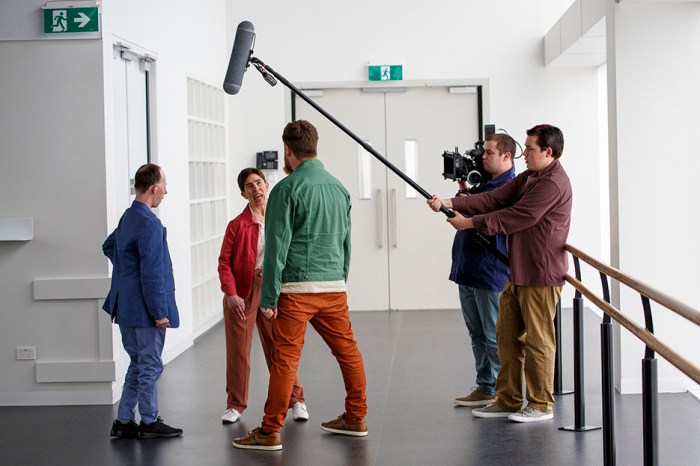
Cast and crew on the set of Shadow.
“I’d love to see more production companies open to the idea of employing crew members who are people with disabilities.”
Interview by Matthew Eeles
How did you both become involved in Back to Back Theatre?
Scott Price I become involved in 2007. First as part time and now full time. It puts a smile on my face. I always wanted to be involved in technology, but that didn’t happen. So I thought, Stuff it. I’m going into theatre. I haven’t looked back. There’s a perception that people with disabilities aren’t good in employment, but that’s wrong. I’ve been loving this job ever since. I can’t be serious enough about how fortunate I am. I’m working with such a great bunch of people like Bruce.
Bruce Gladwin My first experience with the company was as an audience member. The first show I saw was transformational for me. I was a young theatre graduate and I felt like I was watching the birth of a new art movement when I saw the company’s work. This was in the 1980s. There was a shift in government policy in the deinstitutionalisation of people with disabilities, specifically people with intellectual disabilities. There was a shift to find employment and activity engagement for them in society. In some ways, the beginning of Back to Back Theatre was really influential in that shift in government policy. I felt like, as an audience member, I sat down and watched a group of people on stage that I’d never seen empowered in society before. They were really holding the stage aesthetically. They were different to anything I’d seen in terms of major theatre companies or independent theatre companies creating new work. And from that point on, I just felt very committed to the idea of working with the company. And initially I worked as a freelance actor and then a freelance director. When the opportunity to work as the artistic director came up, I just jumped at the chance.
Scott Price Bruce, it started off as something different too didn’t it in Geelong.
Bruce Gladwin Yeah. So Scott’s just referring to how it started off as a series of workshops, and then there were activities attached to a disability service provider. And then when the company started evolving, it formed its own independence. Now it operates as a fully functioning group that employs artists with disabilities, and not a patronising one that’s operating on a reduced wage structure. Scott and his colleagues who work with the company, who identify either as neurodiverse, or as people with disabilities, are professionals paid above award wage for their work.
Scott Price Thank God for that. It’s full time. People power to people.
The theatre is based in Geelong. Does the Geelong community embrace the company?
Scott Price Yes. We perform shows, and people in Geelong enjoy them.
Bruce Gladwin We do a lot of work in terms of workshops and working with the community that doesn’t necessarily have a very high profile. That’s an ongoing commitment from us to the people of Geelong. Every Wednesday we work with fifteen young people with disabilities and working with them in a community context. There’s a lot of open access workshops. Each year we run a program called CAMP, which is an acronym to Come and Make Performance. All of our new works will be played in Geelong through the Geelong Arts Center as well.
Scott Price It’s fun for me. It makes my position in the company fun.
Bruce Gladwin As a small company that makes contemporary theatre, and now increasingly screen projects too, our audience is quite wide, so a lot of our work comes from touring and performing in festivals around Australia.
Scott Price And it’s in repertoire.
Bruce Gladwin Yeah, our work is in repertoire so that we have a number of works that we can offer at any given time.
Shadow is based on an original stage play developed by Back to Back Theatre called The Shadow Whose Prey the Hunter Becomes. When was the decision made to develop it into a film?
Bruce Gladwin We were developing a series called Oddlands at the time, which we made a pilot of for the ABC. That was initially supported through HIVE. The ABC were on board and we had really great support from Film Victoria and Screen Australia. We had a gap in the funding to get the six part series up. But as a part of that initiative, we wanted to run a program of internships throughout that series. We were supported to do that through a grant from the NDIS which was a substantial amount of money to be able to bring crew members in who are people with disabilities to be able to have a working role on the production behind the scenes across the whole series. When the series fell through, we still had this grant to run the internship project. We really wanted to run the internship project, so we thought we need to find another project to attach it to. We’d made a short film of the initial stage show which was a short five minute film.
We thought it had great potential. We also wanted the project to be something that didn’t require a huge budget and we knew that we could shoot this relatively cheaply and predominantly in one location. So for the sake of not having to hand a grant back, and also knowing that the actual project had a huge amount of merit to make filmmaking really accessible. We’ve had a lot of success with putting artists with disabilities on screen, but we really wanted to explore the potential of putting people behind the screen as well. We did a general call out through our networks and we had about forty people apply it. A real range of people applied. Some already had experience working in the industry, but not in their most preferred role.
A lot of times people were just really kind of dealing with things with incredibly fresh eyes which was great because we were keen to see then how that affects the aesthetics. If someone is a camera operator and they are shooting from a wheelchair, then their perspective may not have been seen before. It really led us in really unexpected directions. it also set a tone and pace to the whole shoot. We allowed extra time because of the learning that was required. And also just for multiple people to have a voice within it, a democratisation of a film set where people have the opportunity to talk and discuss more. There’s an efficiency and an economy that’s required at times, but as much as possible we really wanted to have that space for learning and for discussing what we’re doing.
Is there much difference between the original stage play and this film version?
Scott Price I guess there is, yes. There’s an amazing difference with the audience and how they interact with it.
Bruce Gladwin The stage show is a story about a Town Hall meeting which incorporates the audience into the Town Hall meeting. We endow them as the audience at the meeting. Whereas in the film, we had to actually have a large group of actors play that audience. There’s a big difference between holding an audience’s attention on screen compared to holding an audiences attention on stage.
Scott Price There is. There really, really is.
Bruce Gladwin We adapted the script to be able to build a sense of anticipation moving from one scene to another for the audience. I think the work for the actors is very different. Once you shoot a scene, they don’t have to retain those lines again. There was a real sense of relief moving through the script while we were filming. For theatre it’s like, Well we didn’t quite nail it tonight on that scene, but we’ll get it tomorrow night.
Scott Price That’s true, yes. That’s true.
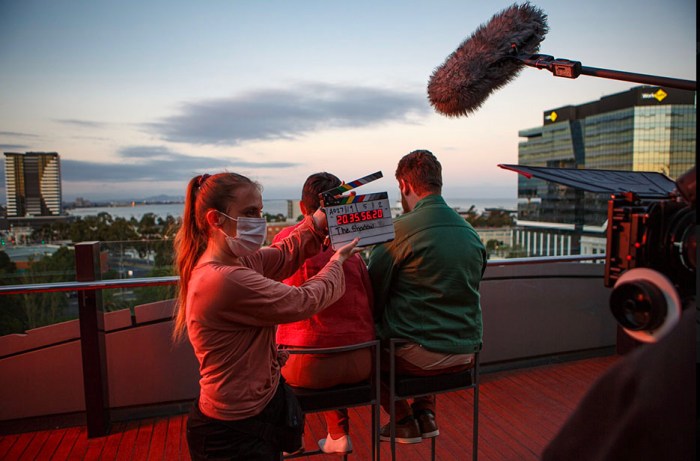
Cast and crew on the set of Shadow.
Scott, I believe one of your acting fortes is improvisation. How much of your role here is improvised and how much of it was scripted?
Scott Price Improvisation is one of my fortes. I’m a filmmaker. I’m a social media editor. I’m multitalented.
Bruce Gladwin Matt, Can you please note that Scott is multitalented? [Laughs].
Scott Price [Laughs]. We didn’t improvise much. It was mostly what’s on script.
Bruce Gladwin I’ll just say that, Scott, just to remind you, there were some moments in the material that was improvised, like you turning to the camera and telling the camera to cut while we were shooting the stuff on the balcony.
Scott Price Yes, that was improvised.
Bruce Gladwin A lot of that stuff was improvised. But it’s worth mentioning to Matt that all of the original script for the stage show and the film was written through improvisation.
Scott Price It was drafted as full improvisation.
Bruce Gladwin The actors are the co-authors of the piece. I think that the aesthetic of what we end up with by having those multiple voices in there gives the film a real authenticity and naturalism. In those improvisations we’re also capturing mispronunciations. There’s an acknowledgement of country at the beginning of the film that was a genuine attempt from one of the actors to improvise how we were going to start this meeting? Someone went to do an acknowledgement of country and messed it up. That was a genuine mistake. There’s a meaning behind that, about the difficulty of language and embracing a language. What it’s saying for us as predominantly white Australians dealing with a cultural shift, is that we need to make those mistakes, and those mispronunciations as pathways of creativity and understanding. We really tried to embrace that. I think if it was just one person sitting down writing this script, we wouldn’t have that level of detail and sophistication that’s embedded in the script.
Scott, would you like to do more screen acting now that you’ve made Shadow?
Scott Price I guess so. I will say yes. I like music. I like film. Yes.
Is there any particular actor who you’d like to work with? I’m actually not sure. Hugh Jackman.
Bruce, how would you describe Scott as an actor?
Scott Price Oh boy. [Laughs].
Bruce Gladwin Scott and I have a very good working relationship. I really appreciate those relationships that are so fluid. Scott and I are very different as people, so it’s not like we went through the same training method and we’ve arrived at the same point. We actually came to it making art or theater or film from very kind of different perspectives and background. He’s really brilliant. He’s really intuitive. He’s got a great sense of communications and culture. Scott has so much personality. Scott says that he is on a learning curve, and this company allows you to grow as an artist and encourages that. Scott’s just incredibly generous and resilient. You have to do long hours on a film set and Scott is just there for the team the whole time and was really supporting of others and supportive of me. Scott’s continually taking artistic risks as he goes.
And Scott, is there anything that you’d like to say about working with Bruce as a director?
Scott Price Bruce likes to joke around and so do I. Bruce is very unique and unorthodox.
It’s worth mentioning the other main actors in the film too. Mark is the longest standing member of Back to Back Theatre. What have you both learnt from Mark over the years?
Scott Price He’s a lot funnier than I am. He deserves a crown at times. He’s so good.
Bruce Gladwin Mark has an incredible relationship with the audience. I think that translates to screen as well. Mark can engage an audience with a glance out of the corner of his eye. That one glance says, “Come with me. You’re included in this.” Mark is a person with down syndrome and he is constantly working against this idea of cognitive understanding. He’s a master at what he does, and I’ve never really worked with a performer that has such a dynamic relationship with the audience as Mark does.
Scott Price Experience counts.
Australia has made some great films over the years featuring people with disabilities both in front of and behind the camera. But what would you both like to see more of? How can the local screen industry better the inclusion of people with disabilities?
Scott Price More funding for people with disabilities. Tell more true stories about people with disabilities.
Bruce Gladwin Well, I guess having this experience with internships, I’d love to see more production companies open to the idea of employing crew members who are people with disabilities. Often at Back to Back, we’ll get a call from a production company or a casting agent that is looking to fill a role with a person with a specific disability. And I think that’s to be commended because that is a recent shift that’s happened and it’s now being embraced by the industry. But I would say too, that I’d like to see more creative thinking around casting someone with a disability in a role that is not necessarily specified as a person with a disability.
Scott Price It would make the production more interesting. I agree actually.


 Cinema Australia